United Kingdom · The Entente
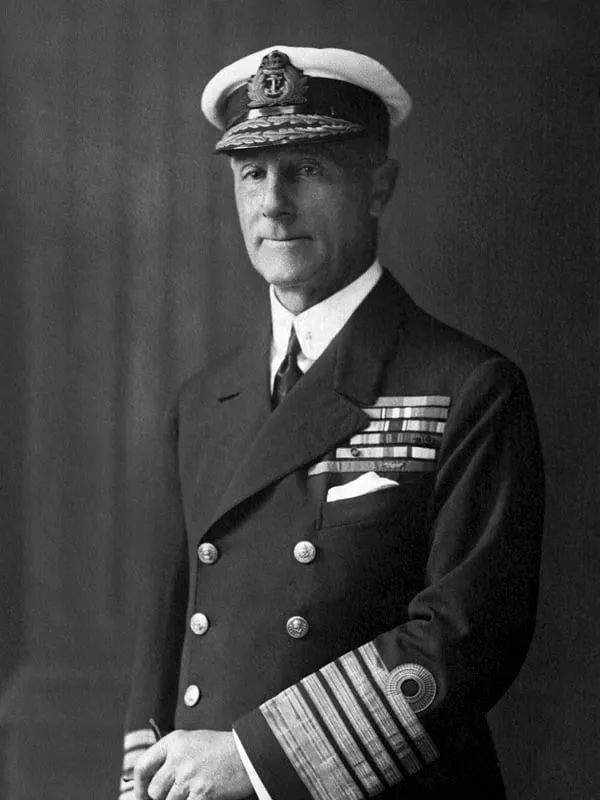
John Jellicoe
Commander of the Grand Fleet (1914–1916), First Sea Lord (1916–1917), Admiral of the Fleet
- Born:
- 5 December 1859, Southampton (England)
- Died:
- 20 November 1935, London
- Author:
- Łukasz Skowroń
- Photo:
- Bain News Service; restored by Adam Cuerden, domena publiczna, Wikimedia Commons

For more than two years John Rushworth Jellicoe commanded the Grand Fleet, the largest war fleet in the world, on which it depended whether Britain would keep command of the sea, the blockade of Germany and the supply of food from overseas. He was the only British commander to lead the whole battle fleet in an engagement with the German High Seas Fleet. At Jutland in 1916 he did not win the victory the country expected, but he prevented a defeat and kept a superiority that the Germans never challenged again. Then, as First Sea Lord, the professional head of the Royal Navy, he fought unrestricted submarine warfare at its most dangerous. For a long time he did not believe in convoys, and at the end of 1917 the Prime Minister, who considered him a pessimist, had him removed. The dispute over his caution continues to this day.
Before the war
He was born on 5 December 1859 in Southampton, the son of a captain of mail ships of the Royal Mail Steam Packet Company. In 1872, aged twelve, he joined the training ship Britannia, and throughout his life he was among the best of his year. He specialised in naval gunnery, which the Royal Navy then saw as the road to the highest posts. As a young lieutenant he commanded a company of the naval brigade in the Egyptian war of 1882, and in 1893 he survived the sinking of the battleship Victoria, rammed by another ship during manoeuvres of the Mediterranean squadron. In 1900, as a captain and chief of staff to Admiral Edward Seymour, he took part in the failed expedition to relieve the legations besieged in Peking during the Boxer Rebellion. He was severely wounded in the lung, and the doctors gave him little chance.
His career gathered pace thanks to Admiral John Fisher, who saw him as one of the ablest officers in the navy. As Director of Naval Ordnance in 1905–1907 Jellicoe took part in building the battleship Dreadnought and the first battlecruisers, and as Third Sea Lord and Controller of the Navy in 1908–1910 he was responsible for the dreadnought building programme during the arms race with Germany. He then commanded the Atlantic Fleet and a battleship squadron of the Home Fleet, and in December 1912 he became Second Sea Lord. He was short, calm, hard-working and courteous, liked by the sailors and trusted by his superiors. Through his marriage to Florence Cayzer, a shipowner’s daughter, he also entered the world of merchant shipping. Even before the war Fisher wrote that Jellicoe was to be the admiral who would lead the fleet in the great battle to come.
1914: the Grand Fleet
At the end of July 1914 Jellicoe was designated as second-in-command to Admiral George Callaghan, commander of the Home Fleet. When he travelled north to the fleet, however, he carried a sealed order that he was to open on a signal from London. The First Lord of the Admiralty, Winston Churchill, and Fisher had decided that the older and ailing Callaghan was not fit to command in wartime. Jellicoe telegraphed London several times, asking that this should not be done at the last moment and in such a way, but he had to give in. On 4 August 1914, the day Britain entered the war, he took command of the fleet, renamed the Grand Fleet, with promotion to admiral. The battleship Iron Duke became his flagship.
The fleet lay at Scapa Flow in the Orkneys, a base far from the German ports but in 1914 completely unprotected against submarines. The autumn brought a series of alarms. After a false alarm in October Jellicoe decided that keeping the battleships in an open base would be tempting fate, and moved the fleet to the west coast of Scotland and to Ireland. On 27 October the modern battleship Audacious sank on a mine laid by a German auxiliary cruiser. At Jellicoe’s request the Admiralty kept this secret, because every dreadnought lost reduced the margin over the Germans. The fleet returned to Scapa Flow at the beginning of November, although anti-submarine barriers were still being built there for many months.
In October 1914 Jellicoe set out for the Admiralty the principles that guided him for the rest of the war. He wrote that the Germans might try to draw the Grand Fleet on to minefields and submarine ambushes, and that he therefore did not intend to pursue a retreating enemy into his own waters. He also announced that he would turn his battleships away from a massed torpedo attack. The Admiralty approved these principles. For Jellicoe what mattered most was that the fleet should exist: as long as the Grand Fleet ruled the North Sea, the blockade worked, and troops and food sailed safely to Britain and France. Churchill later put it in a famous phrase: Jellicoe was the only man on either side who could lose the war in an afternoon.
After the German raids on the English coast, Vice-Admiral David Beatty’s battlecruisers were moved at the end of 1914 to Rosyth, closer to the enemy’s likely targets. It was they who fought at the Dogger Bank in January 1915, while Jellicoe with the battleships arrived too late, and for the rest of the year he made sweeps into the North Sea without meeting the Germans. He took a critical view of the Dardanelles operation, which took ships and men away from the Grand Fleet. When Fisher and Churchill left the Admiralty in May 1915, Jellicoe wrote to Fisher that the navy owed him its deliverance from Churchill, and expressed the hope that no politician would ever again usurp the tasks of professional officers. Constant readiness to put to sea, illness and concern for every detail of the fleet wore him out badly.
Jutland
From January 1916 the High Seas Fleet was commanded by Admiral Reinhard Scheer, who wanted to lure parts of the Grand Fleet out to sea and destroy them with superior forces. After the raid on Lowestoft and Yarmouth in April Jellicoe was preparing his own plan to lure the Germans out, but Scheer got in first. On the evening of 30 May, forewarned by the cryptanalysts of Room 40, Jellicoe took the fleet out of Scapa Flow before the Germans had even left port. At noon on 31 May, however, he received erroneous information from the Admiralty that the German flagship was still in harbour, and he did not hurry.
At the Battle of Jutland Jellicoe steamed south for several hours without knowing exactly where the enemy was. At about 6.15 p.m., within a few minutes and on the basis of scanty reports, he had to decide in which direction to deploy 24 dreadnoughts from cruising formation into line of battle. He deployed them on the port wing, and as a result the British line emerged from the mist across the course of the German fleet. Most historians regard this decision as exemplary. Scheer twice found himself in a trap and twice escaped from it by turning the whole fleet about. The second time, at about 7.20 p.m., he threw his torpedo boats at the British, and Jellicoe, in accordance with his principles, turned his battleships away from them. No torpedo hit, but the fleets lost contact and did not regain it before dark.
Jellicoe did not want to fight at night, for which his fleet was not prepared. He placed his ships so as to resume the battle at dawn with the Germans between himself and the open sea. Scheer, however, broke through during the night across the British destroyers behind the Grand Fleet. Most reports of the night actions never reached Jellicoe, and the Admiralty did not pass on to him all the intercepted signals which showed that the Germans were heading for the Horns Reef. On the morning of 1 June the sea was empty. The British lost more ships and men than the Germans, and the country, which had expected a new Trafalgar, was disappointed. Yet by the evening of 2 June Jellicoe reported that his fleet was ready to put to sea and that the strategic situation had not changed.
A few days after the battle he received on his flagship the Secretary of State for War, Horatio Kitchener, who was sailing to Russia. It was Jellicoe who set the route of the cruiser Hampshire along the western shores of the Orkneys, where the ship struck a German mine. He was later criticised for this choice.
After Jutland Jellicoe became even more cautious. He believed that the Germans had better shells, better armour and better night signalling, and he demanded changes to the rules for handling the fleet. On 19 August 1916, when Scheer put to sea again, German submarines torpedoed two British light cruisers. Jellicoe then agreed with the Admiralty that the Grand Fleet would not venture into the southern part of the North Sea, where it was threatened by mines and submarines, except in exceptional circumstances.
First Sea Lord
In the autumn of 1916 German submarines were sinking more and more ships, and Jellicoe sent alarming memoranda to London. At the end of November the First Lord of the Admiralty, Arthur Balfour, offered him the post of First Sea Lord in succession to Admiral Henry Jackson. Jellicoe accepted, and on 28 November he handed the Grand Fleet over to Beatty. According to the British chronology of the war he formally took office on 4 December, although other sources give the end of November. He brought men from the fleet with him to London and created an anti-submarine division at the Admiralty, headed by Rear-Admiral Alexander Duff. A few days later Asquith’s government fell, and in David Lloyd George’s cabinet the Admiralty went to Edward Carson, who trusted the professional admirals and defended them against the politicians.
On 1 February 1917 Germany announced unrestricted submarine warfare. Shipping losses rose sharply, and in April, according to Admiralty figures, they approached 900,000 tons. When the American admiral William Sims arrived in London, Jellicoe showed him the secret figures and is said to have told him that Britain could not go on with the war if such losses continued. For the first months the Admiralty relied on arming merchant ships, patrols and minesweeping. Jellicoe, like most admirals, believed that a large group of ships would be an easy target and that the masters of merchant ships would be unable to keep station. The urging of Maurice Hankey, officers of the younger generation and Lloyd George himself, together with the promise of American destroyers, finally led Duff at the end of April to come out in favour of a trial. Jellicoe agreed to it, and in May and June the Admiralty set up a convoy committee and approved the whole system. From the summer losses began to fall.
Who deserved the credit for introducing convoys was argued over for decades. In his memoirs Lloyd George presented the Admiralty as an obstacle he had to overcome himself. Jellicoe’s biographers stress that the decisions were taken in the Admiralty and that what was lacking above all were escort vessels. Many historians take an intermediate view: Jellicoe was not an enemy of convoys, but he agreed to them late and cautiously, at a time when losses were already catastrophic.
Dismissal
In 1917 Lloyd George grew increasingly irritated by the admiral’s pessimism. In June Jellicoe argued to the politicians that if the Belgian coast could not be taken from the Germans, a shortage of shipping might make it impossible to continue the war in 1918. This argument strengthened the position of Field Marshal Douglas Haig, who was preparing the offensive in Flanders. In the summer, however, the Prime Minister did not dare to dismiss the commander of Jutland. In place of Carson he brought into the Admiralty Eric Geddes, a railway organiser, who reorganised the naval staff and gave Jellicoe a deputy, Admiral Rosslyn Wemyss. The cooperation did not go well. In the autumn Jellicoe came under fierce attack in the press, and on 17 October and 12 December German warships destroyed convoys bound for Norway.
On Christmas Eve 1917 Geddes sent Jellicoe a letter demanding his resignation. The admiral replied that he would do what was best for the navy. The other Sea Lords were indignant and considered resigning collectively, but Jellicoe dissuaded them. His place was taken by Wemyss. By way of consolation he was given a peerage, and in March 1918 the title of Viscount Jellicoe of Scapa. The way he had been treated long aroused anger in the navy. In a debate in the House of Commons in March 1918 it emerged that Geddes had presented the decision to him as the government’s rather than his own, although the War Cabinet had not been consulted on it. In the summer of 1918 Lloyd George still proposed him as Allied naval commander-in-chief in the Mediterranean, but the idea collapsed in the face of Italian opposition.
After the war
In April 1919 Jellicoe became Admiral of the Fleet and set off on a tour of India and the Dominions to advise them on naval defence. In the same year he published his memoirs of the Grand Fleet, and a year later a book on the crisis of the submarine war. In 1920–1924 he was Governor-General of New Zealand, and in 1925 he was created an earl. After his return he led ex-servicemen’s organisations and for several years was president of the British Legion. He also had to watch as Beatty, First Sea Lord from 1919, influenced the official accounts of the Battle of Jutland so that they showed his battlecruisers in a better light and the commander-in-chief’s caution in a worse one. In 1928 he invited his former opponent, Scheer, to England, but the German admiral died before the journey. Jellicoe died of pneumonia in London on 20 November 1935. He was buried in the crypt of St Paul’s Cathedral, near Nelson’s tomb. The ailing Beatty, against his doctors’ advice, was one of his pall-bearers.
Assessment
For a hundred years the verdict on Jellicoe has depended on what one expected of the Grand Fleet. His critics, from Beatty’s supporters to some British historians, accuse him of excessive caution, of centralised command that deprived subordinates of initiative and, at Jutland above all, of the turn away from the torpedo attack and the refusal to fight at night. They believe he wasted the only chance to smash the High Seas Fleet, and that his style of command, based on detailed instructions, reflected the weaknesses of the whole Royal Navy of the time.
Jellicoe’s defenders, among them the American historian Arthur Marder, reply that his task was not victory at any price but the maintenance of command of the sea, and that he accomplished it. The deployment of the fleet at Jutland is considered masterly, and the missed opportunities are largely attributable to unreliable signalling, poor shells and the mistakes of the Admiralty and the battlecruiser commanders. Opinions on his work at the Admiralty are more divided. He is often charged with excessive pessimism, being overloaded with detail and being converted to convoys too late. Other historians point out that it was during his tenure that a modern anti-submarine staff was created, and that the convoy system, introduced in 1917, decided the battle for the sea lanes. Almost everyone agrees that he was an honest man, devoted to the navy and respected by his subordinates, and that the manner of his dismissal did his superiors no credit.
Sources
Spotted a mistake?Report an error
Commanded in battles
(02)Mentioned in battles
(02)Often appears with
People who appear in the same events.