1917: Flanders
Third Battle of Ypres
- Dates:
- 31 July – 10 November 1917
- Front:
- Western Front
- Location:
- The Ypres (Ieper) salient in West Flanders, from the Ypres–Comines canal in the south to Bikschote and Houthulst Forest in the north, including the Gheluvelt plateau and the Passchendaele ridge (Belgium)On the battle map →
- Sides:
- United Kingdom, Australia, Canada, New Zealand and other dominionsDouglas Haig, Hubert Gough, Herbert Plumer, Arthur CurrieFranceFrançois Anthoine
- Result:
- Inconclusive. The British took the Gheluvelt plateau and the Passchendaele ridge, but did not break the front or reach the Belgian coast. Both sides suffered enormous losses.
- Author:
- Łukasz Skowroń
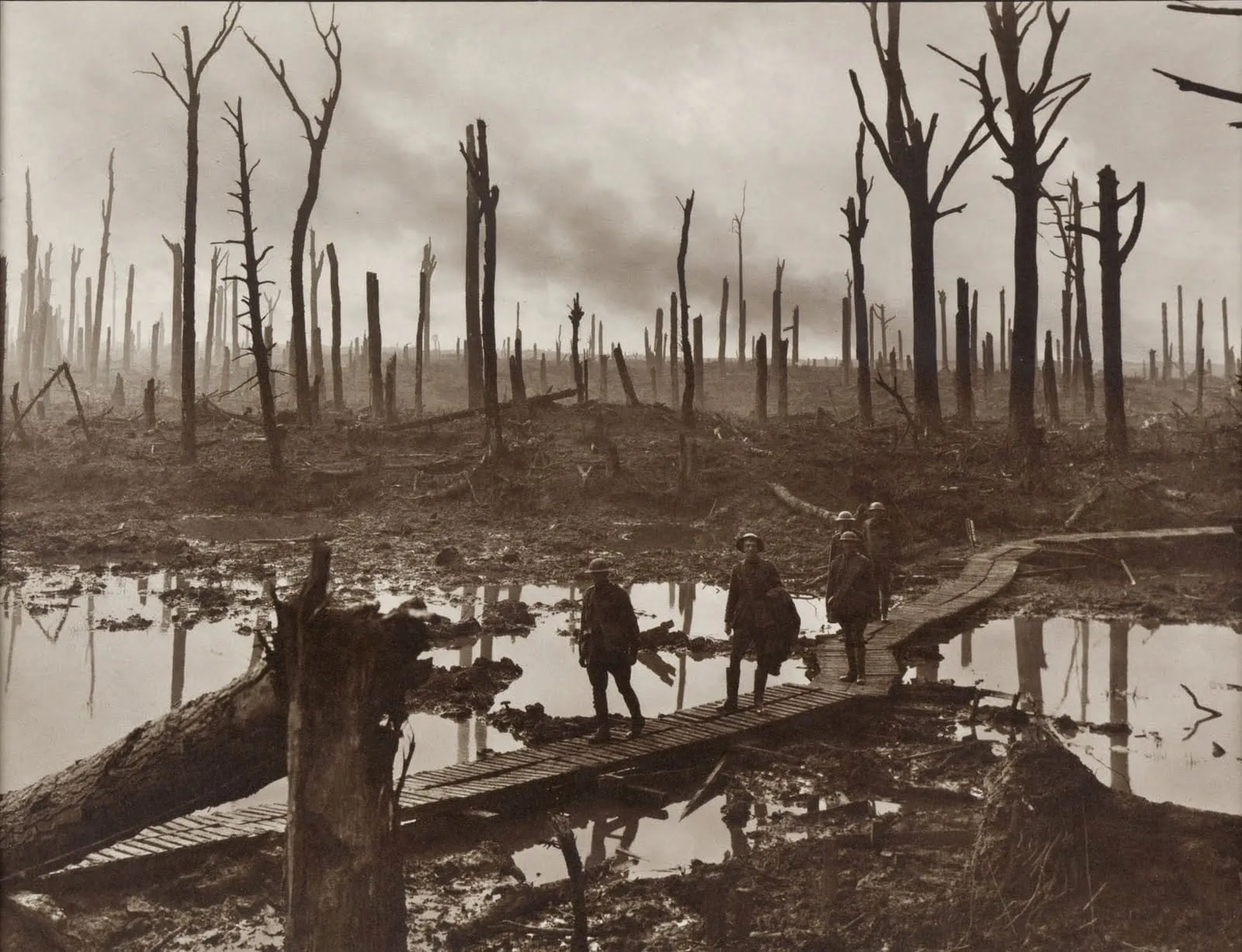
The Third Battle of Ypres, commonly known as the Battle of Passchendaele, was the main British offensive of 1917. From 31 July to 10 November the armies of the British Expeditionary Force, supported in the north by the French First Army, attacked out of the salient around Ypres towards the low ridges east and north-east of the town. Field Marshal Douglas Haig hoped to break through the German defences, reach the railway junction at Roeselare and the Belgian coast with its submarine bases. On the first day the Pilckem Ridge was taken, but rain began to fall that very afternoon, and an exceptionally wet August turned the shell-ploughed fields into a swamp. After the September successes of the limited attacks of General Herbert Plumer, Haig pressed on through the autumn rains until, on 6 November, the Canadians took the ruins of the village of Passchendaele. The front moved forward a few kilometres, and each side lost a quarter of a million men or more. In Britain, Canada, Australia and New Zealand the name Passchendaele became a byword for senseless slaughter in the mud.
Name and dates
After the war the British Battles Nomenclature Committee named this fighting “the Battles of Ypres 1917” and set its limits at 31 July – 10 November 1917. It distinguished eight battles within it: Pilckem Ridge (31 July – 2 August), Langemarck (16–18 August), the Menin Road Ridge (20–25 September), Polygon Wood (26 September – 3 October), Broodseinde (4 October), Poelcappelle (9 October), and the First (12 October) and Second (26 October – 10 November) Battles of Passchendaele. The committee treated the June Battle of Messines separately, although it was the prelude to the same offensive. The August Battle of Langemarck should not be confused with the fighting for the same village in October 1914.
The Germans call this fighting the Battle of Flanders (Flandernschlacht) or the Third Battle of Flanders and divide it into five periods, from 31 July to the beginning of December. English-language literature, and Polish literature after it, adopted the name of the village of Passchendaele (today Passendale), even though the village itself was fought over only in the last weeks. Some authors end the battle on 6 November, the day the village was taken. We follow the committee’s dates: on 10 November the Canadians made the last large attack north of Passchendaele.
Background
Haig had wanted to strike in Flanders since the beginning of 1916. The Ypres salient, held since the First and Second Battles of Ypres, was the most exposed and most heavily shelled sector of the British front: the Germans looked down on it from a semicircle of low ridges, from Wytschaete through the Gheluvelt plateau to the Passchendaele ridge. These heights rose only a few dozen metres above the plain, but they gave full observation over the town and its rear. The plan was that once they were taken the army would advance on Roeselare and Torhout and cut the railway from Bruges to Kortrijk, which supplied the German front from Ypres to the sea; the British Fourth Army would then attack along the coast at Nieuport, supported by a landing from the sea (Operation Hush). In 1916 the plan was put off because of the Battle of the Somme, and in the spring of 1917 priority went to the Nivelle offensive.
After its failure and the mutinies in the French army, the burden of the fighting in the west passed to the British. The Admiralty, alarmed by shipping losses after Germany declared unrestricted submarine warfare, strongly supported an attack on the Belgian ports: in June Admiral John Jellicoe warned that unless the Germans were driven out of Zeebrugge and Ostend, Britain might not hold out until 1918. Haig added the argument that the German army was exhausted and close to collapse, and that pinning it down in Flanders would give the French time. The Prime Minister, David Lloyd George, was sceptical. He preferred to wait for the Americans or to support the Italians, and he thought of an offensive from Ypres as a repeat of the Somme. The newly created War Policy Committee questioned Haig from mid-June, and the cabinet finally agreed only on 20 July, with the proviso that the battle must not turn into long, costly and indecisive fighting. Haig received formal approval on 25 July, six days before the attack.
The first step was the capture of the Messines Ridge by Plumer’s Second Army on 7 June. Haig entrusted the main attack, however, not to Plumer, who had known the Ypres salient for two years, but to the younger and more impetuous General Hubert Gough and his Fifth Army, which on 10 June took over the front north of Messines. The preparations took almost two months, since thousands of guns had to be brought up from Artois, and roads and light railways built on the open plain under the eyes of German observers. On the left flank stood the French First Army of General François Anthoine, which at the beginning of July relieved the Belgians on the canal at Boezinge. The date of the attack was postponed twice, at the request of Anthoine and Gough, from 25 to 28 and then to 31 July.
Meanwhile, in the summer of 1917, the Allies’ situation in the east was deteriorating. The Russian Kerensky offensive of early July, the last effort of the Russian army, turned after less than three weeks into a disorderly retreat. Haig saw in this an additional reason to fight before the Germans could move divisions from the east to the west.
Forces and the German defence
The Allies. For the first day Gough’s Fifth Army had four corps with nine divisions in the first wave, supported by more than 2,000 guns, while Plumer’s Second Army covered its right flank. The French I Corps attacked with two divisions on the northern flank. In all the Allies were supported by more than 3,000 guns and mortars, about 140 Mark IV tanks and more than 800 aircraft. The artillery preparation, begun in mid-July, was the most powerful in the British army’s history up to that time: according to popular accounts more than 4 million shells were fired. Over the whole battle about 50 British and dominion divisions passed through the Ypres salient, including all the Australian divisions, the New Zealand division and the Canadian divisions, as well as 6 French divisions.
The Germans. The front from Lille to the sea was held by the Fourth Army of General Friedrich Sixt von Armin, part of the army group of the Crown Prince of Bavaria, Rupprecht. After Messines its chief of staff became Colonel Fritz von Loßberg, a master of defence in depth, who rejected the idea of withdrawing to the Passchendaele ridge. Behind a thin front line ran successive positions: the Albrecht Line, the Wilhelm Line and three Flanders Lines. Between them stood hundreds of concrete shelters and machine-gun nests, which the British called pillboxes, because in the waterlogged ground deep dugouts could not be dug. Behind the front waited counter-attack divisions (Eingreifdivisionen), which were to strike the enemy once he had exhausted himself in the defensive zone. In the course of the battle the Germans passed about 80 divisions through Flanders, and according to German medical statistics as many as 95.
Course of the fighting
31 July – 2 August: the Battle of Pilckem Ridge. On 31 July at 3.50 a.m. the British and French attacked on a front from the Lys to Steenstraat. In the north they took the Pilckem Ridge and reached the Steenbeek stream, and the French took Bikschote (PL). In the centre some units advanced more than three kilometres, but in the afternoon, when the rain began, the German counter-attack divisions pushed them back. On the key Gheluvelt plateau, astride the road from Ypres to Menin, II Corps was held up after a few hundred metres. The rain then fell for four days without a break.
August: rain and mud. August 1917 was exceptionally wet, and the shelling had destroyed the Flemish drainage ditches. The stream valleys turned into swamps and the shell craters into ponds, and men, horses and mules drowned when they stepped off the duckboards. On 10 August II Corps took the Westhoek ridge, but not Glencorse Wood. On 16–18 August, in the Battle of Langemarck, the British took the ruins of Langemarck and the French advanced in the north, but on the Gheluvelt plateau the same thing happened again: the attacks bogged down and German counter-attacks took back the gains. Further costly attacks on 22–27 August changed little. At the same time, on 15 August, the Canadians took Hill 70 near Lens, tying down German reserves. On 25 August Haig moved the army boundary and handed the main task to Plumer.
September – early October: “bite and hold”. Plumer ordered a three-week pause. He decided to take the plateau in short steps, about every six days, to a depth of no more than a mile and a half, with an enormous concentration of artillery and immediate consolidation of the captured ground before the German counter-attacks arrived. The weather improved and the ground dried out. On 20 September, in the Battle of the Menin Road Ridge, nine divisions, including two Australian ones, took almost all their objectives within a few hours, and the German counter-attacks broke against the new line. On 26 September, in the Battle of Polygon Wood, the Australians took Polygon Wood, and on 4 October, in the Battle of Broodseinde, three Australian divisions and the New Zealand Division took the Broodseinde ridge, running straight into German divisions preparing to attack. The Germans lost more than 5,000 prisoners that day. Rupprecht began to consider withdrawing from the whole salient.
October: through the rain to Passchendaele. After Broodseinde the rains returned. Haig, convinced that the Germans were close to collapse, ordered the advance on the Passchendaele ridge to continue, although the artillery could no longer get through the mud. On 9 October at Poelcappelle and on 12 October in the First Battle of Passchendaele, exhausted British, Australian and New Zealand divisions went forward through the morass without covering fire and were repulsed almost everywhere. On 12 October the New Zealand Division lost more than 2,700 men in a few hours, including about 850 killed, which is regarded as the blackest day in New Zealand’s military history.
26 October – 10 November: the Second Battle of Passchendaele. Haig entrusted the last attacks to the Canadian Corps of General Arthur Currie, who had taken command of it only in June. Currie protested, predicting 16,000 casualties, but carried out the order, demanding time for careful preparation. The Canadians attacked in four stages, on 26 and 30 October and on 6 and 10 November, each time advancing a few hundred metres. On 6 November the 2nd Canadian Division took the ruins of Passchendaele, and on 10 November the 1st and 2nd Divisions took the rest of the high ground north of the village. In these days the French and Belgians also cleared the Merkem peninsula on the northern flank. Meanwhile, on 24 October, the Germans and Austrians routed the Italians at Caporetto, and London had to send British divisions to Italy, and Plumer with them. The offensive in Flanders came to a halt less than a kilometre short of Westrozebeke. Ten days later the British attacked with tanks at Cambrai.
Losses
The losses in the Third Battle of Ypres have been disputed since the 1920s. The British official history (James Edmonds, 1948) gave 244,897 killed, wounded and missing on the British side, while Robin Prior and Trevor Wilson put them at about 275,000. According to Charles Bean the Australians lost 38,093 men, and according to their official history the Canadians lost 15,654 at Passchendaele itself, almost exactly as many as Currie had predicted. According to Cyril Falls the French lost about 8,500 men. A much higher figure of about 450,000, given in 1958 by Leon Wolff, covered the losses of the whole second half of the year, including the Battle of Cambrai, and has been discredited.
German losses are even more disputed. German medical statistics give about 217,000 killed, wounded and missing for the Fourth Army from 21 July to the end of the year. Edmonds held that the lightly wounded had to be added to this and estimated German losses at as many as 400,000, which most historians reject. Others put them at 200,000–260,000. The British took 24,065 prisoners. It is most often accepted that both sides lost roughly the same, about a quarter of a million men each.
Significance
The offensive achieved none of its great aims. The British did not break the front or reach Roeselare or the coast, and the submarine bases remained in German hands. The landing at Nieuport was cancelled. The salient won around Passchendaele was a narrow, waterlogged bulge, shelled from three sides, and in April 1918, during the German offensive on the Lys, the British gave it up of their own accord within a few days in order to shorten the front. Lloyd George later wrote in his memoirs that Passchendaele was one of the greatest disasters of the war, and he never forgave Haig for continuing the attacks in October. The dispute over whether the rains could have been foreseen, whether choosing Gough was a mistake and whether the battle should have been stopped after Broodseinde continues in the historiography to this day.
Some historians point to the other side of the balance sheet. The battle pinned the German army down in Flanders in the months when the French army was recovering from the mutinies, and cost the Germans losses they could no longer replace. One post-war publication of the German General Staff went so far as to say that the Battle of Flanders in 1917 had brought Germany face to face with certain ruin. Plumer’s method of limited attacks showed that the British army had learnt how to take strongly fortified positions, and after Broodseinde the Germans had no good answer to it.
In the collective memory of the countries of the Empire, however, Passchendaele remained above all a symbol of mud and futile sacrifice. In one of his poems Siegfried Sassoon gave a fallen soldier the words “I died in hell — (They called it Passchendaele)”. At Tyne Cot Cemetery near Passchendaele, the largest Commonwealth war cemetery in the world, lie nearly 12,000 soldiers, and the wall at its rear bears the names of nearly 35,000 British and New Zealand soldiers who went missing in the Ypres salient from 16 August 1917. The missing of the earlier years are commemorated by the Menin Gate at Ypres, beneath which the Last Post has been sounded every evening since 1928. The Canadians erected a memorial on Crest Farm, taken on 30 October, from where they set out for the village on 6 November.
Spotted a mistake?Report an error
Battles and phases
(08)- 31 July – 2 August 1917Battle of Pilckem RidgeOn 31 July – 2 August 1917 the Allies took Pilckem Ridge near Ypres, but the British stalled on the Gheluvelt plateau, and on 31 July rain began to fall.
- 16–18 August 1917Battle of Langemarck (1917)On 16–18 August 1917 the British took Langemarck and the French the Drie Grachten bridgehead, but on the Gheluvelt plateau and at Frezenberg the attack failed.
- 20–25 September 1917Battle of the Menin Road RidgeOn 20–25 September 1917 Plumer's armies took the western part of the Gheluvelt plateau at Ypres, and artillery fire broke the German counter-attack divisions.
- 26 September – 3 October 1917Battle of Polygon WoodOn 26 September – 3 October 1917 Plumer's Australians took Polygon Wood and the Butte near Ypres, and British artillery broke the German counter-attacks.
- 4 October 1917Battle of BroodseindeOn 4 October 1917 Plumer's Anzacs and British took the Broodseinde ridge near Ypres, smashing German divisions formed up to attack in no man's land.
- 9 October 1917Battle of PoelcappelleOn 9 October 1917 Plumer's exhausted divisions attacked the Passchendaele ridge in the mud and were repulsed. In the north the Allies reached Houthulst Forest.
- 12 October 1917First Battle of PasschendaeleOn 12 October 1917 New Zealanders and Australians advanced in the rain on Passchendaele. Uncut wire at Bellevue stopped them with huge losses.
- 26 October – 10 November 1917Second Battle of PasschendaeleFrom 26 October to 10 November 1917 Currie's Canadian Corps took the ruins of Passchendaele in four attacks. It cost close to 16,000 men.