1917: Flanders
Second Battle of Passchendaele
- Dates:
- 26 October – 10 November 1917
- Front:
- Western Front
- Location:
- The Passchendaele ridge east of Ypres (Ieper), from the Ypres–Roeselare railway in the south to the Bellevue spur, Goudberg and Hill 52 in the north, with the village of Passchendaele (today Passendale), West Flanders (Belgium)On the battle map →
- Sides:
- Canada and United KingdomDouglas Haig, Herbert Plumer, Hubert Gough, Arthur CurrieGerman EmpireRupprecht, Crown Prince of Bavaria, Friedrich Sixt von Armin
- Result:
- Canadian tactical victory. The Canadian Corps took the village of Passchendaele and the highest part of the ridge, but the offensive halted short of Westrozebeke, and the salient won was narrow, waterlogged and under fire from three sides.
- Author:
- Natalia
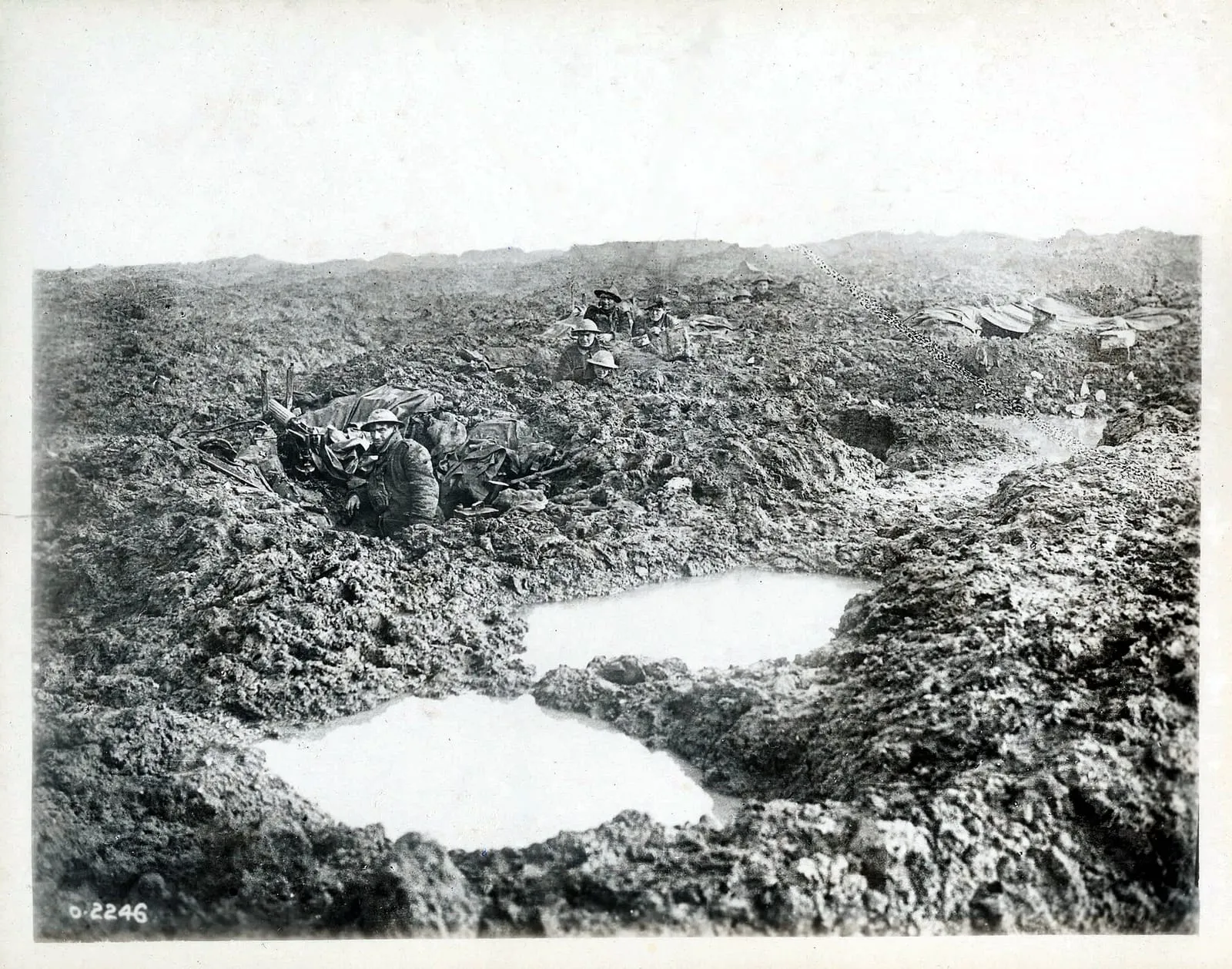
The Second Battle of Passchendaele was the final act of the Third Battle of Ypres. After the bloody failures at Poelcappelle on 9 October and in the First Battle of Passchendaele on 12 October, Field Marshal Douglas Haig nevertheless resolved to take the village on the ridge so that his army could spend the winter on higher, drier ground. He entrusted the task to the four divisions of the Canadian Corps of General Arthur Currie. Currie did not want this battle and predicted that it would cost 16,000 killed and wounded. He did, however, insist on time for preparation: plank roads, artillery moved forward and thorough reconnaissance. The Canadians attacked four times, on 26 and 30 October and on 6 and 10 November, each time advancing only a few hundred metres, through swamps and past concrete shelters. On 6 November they entered the ruins of Passchendaele, and on 10 November they occupied the rest of the high ground north of the village. According to the Canadian official history the corps lost 15,654 men in Flanders, almost exactly as many as Currie had predicted.
Name and dates
The British Battles Nomenclature Committee distinguished within “the Battles of Ypres 1917” two Battles of Passchendaele: the first on 12 October and the second from 26 October to 10 November. The second was fought almost entirely by the Canadian Corps, with subsidiary attacks by the British Fifth Army in the north, the Australian I ANZAC Corps and the British X Corps in the south, and the French and Belgians on the far left flank. The Canadian official history (G.W.L. Nicholson, Canadian Expeditionary Force 1914–1919), on which this page mainly relies, adopts the same dates. The Canadians counted their attacks as four stages, and in the reckoning of the Second Army, which since 20 September had been conducting a series of limited attacks, they were the sixth to ninth phases. Times are given in British time.
After the war the English-speaking countries extended the name Passchendaele to the whole Third Battle of Ypres, and the Polish Wikipedia also uses it in that sense. Today the village is called Passendale in Dutch and belongs to the municipality of Zonnebeke.
Background
At the beginning of October it seemed that the limited attacks of General Herbert Plumer would bring the British the Passchendaele ridge. After the victory at Broodseinde on 4 October the village on the crest lay only a mile and a half from the leading troops of the Second Army. On the night of 4–5 October, however, it began to rain. In the low stream valleys west of the ridge three months of shelling had destroyed the drainage ditches, and the shell craters soaked up water like a sponge. On 9 and 12 October British, Australian and New Zealand divisions, without adequate cover from the artillery, which had stuck in the mud, were repulsed almost everywhere. On 13 October a conference at Cassel decided to postpone further attacks until roads had been built to bring the guns forward.
Haig, however, had no intention of breaking off the offensive. He wanted to take the ridge for winter positions, to pin the Germans down ahead of the French attack at La Malmaison and to draw their reserves away from the Russians and Italians. As early as 2 October he ordered the First Army to withdraw into reserve two Canadian divisions which had been fighting near Lens since August; on 5 October he decided to use the whole corps, and on 9 October he issued the order transferring it to Plumer’s Second Army. Currie preferred not to fight under General Hubert Gough, of whom he had bad memories from the Battle of the Somme, and Haig took this into account. Currie himself, as the Canadian War Museum writes, protested against the attack, fearing that it could not be won without terrible losses, but he had to carry out the order. On 13 October the Second Army instructed him to submit a plan for the capture of Passchendaele.
Preparations
On 18 October the Canadians took over from II ANZAC Corps the front in the valley of the Stroombeek, almost on the same spot where in April 1915 they had withstood the German gas attack. The veterans did not recognise the area: almost nothing was left of the villages of St. Jean, Wieltje and Fortuin. “The battlefield looks bad,” Currie wrote on 17 October. “No salvaging has been done and very few of the dead buried.” Only two roads led to the village: the main one from Zonnebeke along the ridge and a second through Gravenstafel and the Bellevue spur to Mosselmarkt. Between them lay the valley of the Ravebeek, turned into a swamp several hundred metres wide in places. Almost half of the ground in front of Passchendaele was under water or covered in deep mud.
The artillery taken over from the Australians was in a deplorable state. Of 250 heavy guns, the corps artillery commander, General Edward Morrison, found 227, of which 89 were unserviceable, and of 306 field guns fewer than half were firing, scattered wherever they had stuck. Haig stipulated that the attack would not start until Currie considered the preparations complete. From 17 October Canadian engineers and pioneer battalions, together with British engineers and tunnelling companies, built gun positions, roads of oak and beech planks and the tracks of a light railway. By mid-November more than three kilometres of double plank road and nearly four kilometres of heavy track had been laid. This cost more than 1,500 killed and wounded, because the Germans on the ridge shelled the works incessantly, including with shells filled with mustard gas and with diphenylchlorarsine, which penetrated the masks and forced men to take them off.
Currie wanted to attack on 24 and then on 29 October. Haig pressed for haste, and after a conference between Plumer and Currie the first attack was set for 26 October, with the following ones provisionally for 30 October and 6 November. Haig wanted to take the village in three limited attacks at intervals of three days or more. The Canadian artillery was finally given about 420 guns and howitzers, including British and New Zealand batteries. For four days before the attack it shelled the whole German line morning and afternoon to mislead the defenders about the hour of the attack.
German defence
The ridge was defended by Group “Ypern” of the German Fourth Army of General Friedrich Sixt von Armin, part of the army group of Crown Prince Rupprecht of Bavaria. At first the 11th Bavarian Infantry Division faced the Canadians, followed in turn by the 238th, 39th, 11th and 4th Divisions and the 44th Reserve Division. After the defeat at Broodseinde, where the densely held front lines had been shattered by British artillery, the Fourth Army introduced a “forefield” by an order of 7 October: the first line of craters was to be held only by scattered outposts with light machine guns, while the main line of resistance ran 500–1,000 metres further back. The forefield was defended by machine-gun nests in craters and by concrete shelters, which the British called pillboxes. Their walls, a metre and a half thick, could be broken only by a direct hit from a heavy howitzer shell. Behind each front-line division stood a counter-attack division.
Course: 26–28 October
The Ravebeek swamp split the corps front in two. On the right bank Major-General David Watson’s 4th Division was to take, with a single battalion, a stretch of the ridge by the main road and the copse of Decline Copse by the railway. On the left Major-General Louis Lipsett’s 3rd Division attacked with two brigades towards the Bellevue spur, where the New Zealanders had bled on 12 October. The attack started on 26 October at 5.40 a.m., in a mist that turned into a day-long rain. On the ridge the 46th Battalion took all its objectives. On the Bellevue spur the 9th Brigade took the pillboxes within an hour, but under German fire fell back to its start line. Only Lieutenant Robert Shankland, with a handful of men from various companies, held on at the edge of the spur. In the afternoon the 52nd Battalion, advancing from his position, took the Bellevue and Laamkeek pillboxes, which had held up II ANZAC Corps since 12 October. On the left flank the 4th Canadian Mounted Rifles took Wolf Copse, but had to fall back a few hundred metres so as not to lose touch with the British 63rd (Royal Naval) Division. Decline Copse, a joint objective of the Canadians and the 1st Australian Division, was given up to the Germans through misunderstandings between the neighbours. The 44th Battalion retook it on the night of 27–28 October.
The subsidiary attacks on the flanks failed. The British X Corps, which attacked Gheluvelt (PL) and Polderhoek Château in the south, returned to its start positions, and the Fifth Army divisions in the north got stuck in the mud. On the far left flank the French of the First Army and the Belgians cleared the flooded Merkem peninsula by 28 October. From 26 to 28 October the Canadians lost 2,481 men, including 585 killed on the first day, and took 370 prisoners. For that first day three soldiers of the 3rd Division, Shankland, Captain Christopher O’Kelly and Private Thomas Holmes, received the Victoria Cross.
Course: 30 October
The second attack, on 30 October at 5.50 a.m., on a cold, windy day, was to win a base for the assault on the village: the Crest Farm knoll just in front of Passchendaele, the hamlet of Meetcheele on the Bellevue spur and the Goudberg area. On the right bank of the Ravebeek the 12th Brigade of the 4th Division took all its objectives. The 72nd Battalion took Crest Farm and sent patrols into Passchendaele itself, which found the Germans withdrawing. On the left bank the 3rd Division advanced through the swamps under machine-gun and sniper fire. Princess Patricia’s Canadian Light Infantry lost almost all its junior officers within an hour, but took the crossroads at Meetcheele. Lieutenant Hugh McKenzie was killed drawing fire on himself, and Sergeant George Mullin single-handedly took a pillbox that was holding up the attack. On the left flank Major George Pearkes of the 5th Canadian Mounted Rifles took and held Vapour and Source Farms, although the neighbouring British divisions barely moved, and sent his reports by carrier pigeon. All three, as well as Private Cecil Kinross of the 49th Battalion, received the Victoria Cross. After the Second World War Pearkes was Canadian Minister of National Defence in the government of John Diefenbaker. The corps advanced close to a kilometre on a front of more than 2.5 kilometres, but the single day cost it 2,321 men, including 884 killed, almost as many as the three previous days.
Course: the capture of Passchendaele, 6 November
Currie insisted on a week’s pause. During that time the exhausted 3rd and 4th Divisions were relieved by Major-General Archibald Macdonell’s 1st Division and Major-General Henry Burstall’s 2nd Division, and the Second Army took over from the Fifth Army the sector north of the Canadians, so that the battle would be directed by a single command. The neighbouring corps to the south, as far as Zandvoorde, were to feign attacks. On 6 November at 6 a.m., in good weather, a barrage opened that was so heavy that the German artillery replied only after several minutes and its shells fell mainly behind the attackers. Prisoners said afterwards that the Canadians had followed close behind the barrage and that they often had not had time to man their machine guns. The 6th Brigade of the 2nd Division attacked straight at the village, and the 28th Battalion struggled up from the Ravebeek valley waist-deep in water and mud. Less than three hours after the start of the attack the ruins of Passchendaele, the objective of the offensive since 31 July, were in Canadian hands. The first to enter them was the 27th Battalion from Winnipeg. In the north the 1st Brigade occupied Mosselmarkt and Goudberg by 8 a.m. Private James Robertson of the 27th Battalion and Corporal Colin Barron of the 3rd Battalion received the Victoria Cross, Robertson posthumously. The day cost 2,238 men, including 734 killed. In his dispatch Haig compared this attack to the capture of Vimy Ridge.
Course: 10 November
The last attack was to take the high ground north of the village, the crossroads on the roads to Westrozebeke and Hill 52, the highest point of the northern part of the ridge. On 10 November shortly after 6 a.m., in pouring rain, the 2nd Brigade of the 1st Division, with a battalion of the 4th Brigade, took the first objective by 7.30 a.m., and the 10th Battalion from the brigade reserve carried the line to the final objective. The 8th Battalion captured four German field guns in the process. To the left of the Canadians, however, the British 1st Division was driven back by a German counter-attack, and the narrow Canadian wedge came under the fire of the artillery of five German corps. The Canadians held the ground they had won, losing 1,094 men that day, including 420 killed. This was the end of the Third Battle of Ypres. The line came to a halt about 800 metres short of Westrozebeke.
Losses
According to the Canadian official history the Canadian Corps lost 15,654 men during its stay in Flanders. This figure also includes losses during the preparations, from road-building to the shelling of the rear areas. The British official history gives 29,454 killed, wounded and missing for the whole Second Army from 26 October to 10 November, and 14,219 for the Fifth Army from 26 October to 9 November. The German official history counted the Fourth Army’s losses in ten-day periods and gives about 20,500 men from 21 to 31 October and about 9,500 from 1 to 10 November, on the whole Flanders front. The Canadians received nine Victoria Crosses for the fighting at Passchendaele.
Significance
The capture of Passchendaele confirmed the reputation of the Canadian Corps as one of the best formations of the British Army, and of Currie as a commander who, through careful preparation and masses of artillery, paid for victory with shells rather than with the lives of his soldiers. At Passchendaele, however, the price was very high. Haig did not even get the whole ridge for winter positions. After the Italian defeat at Caporetto five British divisions were sent or due to be sent to Italy, and preparations for the tank attack at Cambrai absorbed the remaining forces. On 15 November Haig decided to halt the offensive in Flanders. From 14 November the Canadian divisions returned to their old sector near Lens and Vimy, and the salient they had won, waterlogged and under fire from three sides, was abandoned by the British without a fight in April 1918.
In Canada news of the losses at Passchendaele arrived during the campaign before the election of 17 December, which decided on conscription and the future of the Union Government of Prime Minister Robert Borden. The Canadian war historian G.W.L. Nicholson judged that the Battle of the Somme had begun the destruction of the German army and that Passchendaele had carried it a long step further. In Canadian memory, however, Passchendaele remained, alongside Vimy, the best-known battle of the war and a symbol of mud and futile sacrifice. On the site of the former Crest Farm there stands today a Canadian memorial, a granite block with the inscription: “The Canadian Corps in Oct.–Nov. 1917 advanced across this valley – then a treacherous morass – captured and held Passchendaele Ridge.”
Spotted a mistake?Report an error