1917: The Western Front
Battle of La Malmaison
- Dates:
- 23 October – 1 November 1917
- Front:
- Western Front
- Location:
- The western part of the Chemin des Dames ridge between Vauxaillon and La Royère farm, with the Laffaux mill, Fort La Malmaison and the Ailette valley, about 15 km north-east of Soissons, Aisne department (France)On the battle map →
- Sides:
- FrancePhilippe Pétain, Louis Franchet d'Espèrey, Paul MaistreGerman EmpireCrown Prince Wilhelm, Max von Boehn
- Result:
- French victory. The French took Fort La Malmaison and reached the Ailette, capturing over 11,000 prisoners and about 200 guns, and on the night of 1–2 November the Germans abandoned the whole Chemin des Dames ridge as far as Craonne.
- Author:
- Natalia
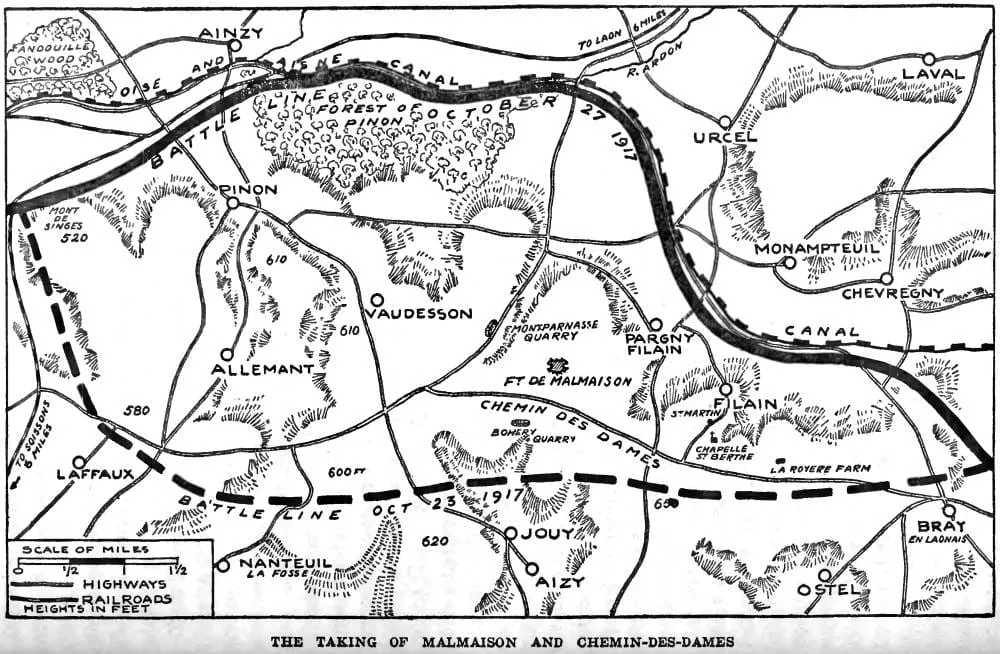
The Battle of La Malmaison was the last and most successful French attack of 1917. Six months after the failure of the Nivelle Offensive, General Paul Maistre’s French 6th Army struck at the western end of the Chemin des Dames ridge, where the Second Battle of the Aisne had stalled in the spring. After a six-day bombardment from about 1,800 guns, heavier than anything the French had yet laid on anywhere, six divisions went in to the assault with more than sixty tanks at 5.15 a.m. on 23 October 1917, while it was still dark. Before 6.30 a.m. the Zouaves had taken the ruins of Fort La Malmaison, and in the afternoon the French stood at the foot of the northern slopes of the ridge, above the valley of the Ailette. Within a few days they took more than 11,000 prisoners and about 200 guns. On the night of 1–2 November the Germans, under flanking fire from the new French positions, abandoned the whole ridge as far as Craonne. The battle was a model example of the method of General Philippe Pétain: an attack with a limited objective, in which the artillery was to do as much of the infantry’s work as possible.
Name and dates
The battle took its name from Fort La Malmaison and from the nearby farm of the same name on the ridge, by the road from Soissons to Laon. The French speak of the battle or the “affair” of La Malmaison (bataille, affaire de la Malmaison), and in unit histories also of the battle of the Ailette. Dates vary. The British chronology of the war on which our timeline is based dates the battle from 23 October to 1 November 1917, that is, up to the night on which the Germans began their retreat from the Chemin des Dames. We adopt these dates. The French Wikipedia and French memorial sites limit the battle to 23–25 October, when the French took their main objectives and reached the Ailette; other authors write of 23–26 October, and the English Wikipedia of 23–27 October, when Froidmont farm fell, one of the last German observation points over the Aisne valley. Some French authors treat La Malmaison as the final act of the fighting for the Chemin des Dames that had begun on 16 April. Times in the text follow French accounts.
Background
The Nivelle Offensive had not brought the promised breakthrough, and in May and June a wave of mutinies swept through the French Army. Pétain, commander-in-chief from 15 May, ordered in Directive No. 1 of 19 May that deep attacks on distant objectives be abandoned. Instead the army was to make attacks with limited objectives, carefully prepared, using the full mass of the artillery, sparing men and aimed at points where the French had the advantage. They were also meant to restore the soldiers’ confidence in themselves and in their commanders. The first large attack of this kind was the Second Offensive Battle of Verdun in August. La Malmaison was to be the second. The French were also helping the British, who had been fighting the Third Battle of Ypres since 31 July and expected France to tie down part of the German forces.
The choice fell on the western end of the Chemin des Dames. After the spring fighting the front line there ran from Vauxaillon on the Ailette through the Laffaux mill and the southern edges of the plateau with Fort La Malmaison to La Royère farm on the ridge. The Germans held a projecting salient, the so-called Laffaux corner, from which they could see the French rear in the Aisne valley, and their batteries near Vaudesson and Chavignon shelled the French positions on the ridge. The ground favoured the defenders. The limestone plateau was cut by ravines and hollowed out by great underground quarries, which the locals call “creutes”. In the Bohéry, Fruty and Montparnasse quarries, the last with galleries almost a kilometre long, whole battalions could shelter. The fort itself, built after the war of 1870 as part of General Séré de Rivières’s system of fortifications, had been sold for demolition before the war, but from 1914 the Germans had rebuilt its underground works and surrounded them with concrete machine-gun nests. The French reckoned, however, that in the event of defeat the Germans would find it hard to withdraw, because a few kilometres behind their line flowed the marshy Ailette with the parallel Oise–Aisne canal. A successful attack could therefore bring a great haul.
Preparations
The attack was prepared by the 6th Army, which Maistre had taken over on 1 May 1917, part of General Louis Franchet d’Espèrey’s Northern Army Group. Three corps were assigned to the attack on a front about 10–12 km wide, each with two divisions in the first line and two in reserve, which were to occupy and mop up the captured ground. On the left wing General Marjoulet’s XIV Corps (28th and 27th Divisions) was to cut off the Laffaux corner in a pincer from two sides and take the village of Allemant. In the centre General Degoutte’s XXI Corps (13th and 43rd Divisions, reinforced with battalions of chasseurs alpins) was to take La Malmaison farm and descend towards Vaudesson and Chavignon. On the right wing General de Maud’huy’s XI Corps had the 38th Division, made up of Zouaves, Algerian and Tunisian tirailleurs and the Moroccan Colonial Infantry Regiment, which was to take the fort, and the 66th Division of chasseurs alpins. The flanks were covered by the 129th Division in the north-west and the 67th Division in the east.
The weight of artillery was unprecedented. According to French figures the 6th Army had 768 75 mm guns and 44 95 mm guns, 862 heavy guns from 105 to 380 mm and 105 of the heaviest guns, about 1,800 barrels in all, plus 66 batteries of trench mortars. On the XXI Corps front there was one gun for roughly every 5 metres of front. Pétain allotted the army batteries of the heaviest guns, which fired armour-piercing shells capable of breaking through the roofs of the quarries. The watchword of this stage of the war became the formula “the artillery conquers, the infantry occupies”. More than sixty Schneider and Saint-Chamond tanks were also assigned to the attack. Sources give different numbers, from 63 to 68 machines. After the April experience, when many tanks had burned near Berry-au-Bac, their design had been improved to make them less likely to catch fire, they had been given carrier pigeons and wireless sets, and their routes had been reconnoitred on aerial photographs.
The Germans knew what was coming. The sector was defended by General Max von Boehn’s 7th Army of Crown Prince Wilhelm’s army group. According to French data, on the day of the attack it had five divisions in the first line, three counter-attack divisions (Eingreifdivisionen) close behind them and about three in reserve, and its artillery had grown to 180 batteries, 63 of them heavy. Even so it was about three times weaker than the French artillery. Boehn decided to defend the first line instead of treating it as a forward zone and basing the main defence behind the canal. According to the German official history, the commanders on the spot trusted the fortifications, and the Laffaux corner was to be kept as a jumping-off point for an attack in 1918. Erich Ludendorff later reproached himself for not having ordered the evacuation of the threatened positions against the optimistic opinion of the army command.
Course
The bombardment (17–22 October)
At the beginning of October the French artillery simulated preparations for an attack, and from 11 October it was registering on its targets. The main bombardment began on 17 October. It was to last four days, but from 18 October fog and bad weather hampered aerial observation, so it was extended to 22 October and the attack was postponed from 22 to 23 October. According to the French Wikipedia, about 2.8 million shells fell on the German positions during those six days, and according to other figures about 3 million in the whole battle. The heaviest guns, directed by observers in aircraft, hit the same spot with shell after shell until they broke through the roofs of the quarries and the fort’s underground works. A thick cloud of gas covered the Ailette valley and the slopes above it. The Germans could not take off their masks to eat and drink, ammunition could not be brought up nor the wounded evacuated, and some of the guns could no longer be withdrawn. German counter-battery fire quickly weakened. Between the 13th Division and the 2nd Guards Division the bombardment blew a gap about 800 metres wide in the German defences.
The French set the start of the attack for 5.45 a.m., at dawn. On 22 October, however, they intercepted a German wireless message which showed that the enemy knew the hour of the attack and was preparing its own bombardment for 5.30 a.m. The army chief of staff called General Maistre back from a tour of the corps, and the attack was brought forward to 5.15 a.m., even though this meant attacking in the dark.
23 October
At 5.15 a.m. the infantry moved off behind a dense creeping barrage. On the left wing the 28th Division quickly took Moisy farm and the Laffaux mill at the tip of the salient, and the 27th Division and its neighbours from XXI Corps broke through the southern face of the Laffaux corner and surrounded the Fruty quarry. At about six o’clock the 31st Chasseur Battalion took La Malmaison farm. On the right wing a battalion of the 4th Zouave Regiment of the 38th Division crossed the shattered first lines, reached the fort’s ditch under machine-gun fire and broke into its ruins. Grenadiers and flamethrower teams cleared the underground galleries. According to a British account of 1918 the battalion’s flag was raised over the fort at 6.05 a.m.; French accounts say more generally that the fort fell before 6.30 a.m. The Bohéry quarry was surrounded by men of the Moroccan Regiment and African tirailleurs. Soon it began to rain. Things went differently on the extreme flanks: the 129th Division in the north-west was thrown back to its starting positions, and the 66th Division, attacking where no man’s land was too narrow for the heaviest guns, ran into intact wire and fought hand to hand with the Prussian Guard near Panthéon farm.
After the first objectives had been taken there was a three-hour pause. According to the statements of prisoners, the Germans concluded that the attack was over and moved to counter-attack, but at 9.15 a.m. their units were caught by a second barrage opened by batteries that had been hidden until then. The French went down from the plateau. The last defenders of Allemant surrendered at about eleven o’clock, and the garrison of the Montparnasse quarry at 10.30 a.m. Vaudesson was taken by the 21st Infantry Regiment with the help of tanks, and the 109th Regiment captured 18 guns in the Belle-Croix wood. At about two in the afternoon the chasseurs took the western part of Chavignon, and an hour later the 38th Division the eastern part. By evening the French had reached their objectives almost everywhere and sent patrols towards the Ailette. Only the 66th and 67th Divisions were held up in front of machine-gun nests. In the evening Pétain announced that more than 7,500 prisoners and large quantities of equipment, including several dozen guns, had been taken.
The tanks, although they performed better than in April, were not reliable. According to English-language studies many of them got stuck in the mud while still behind the French line, a dozen or so were immobilised by shell holes in no man’s land and in the German trenches, and roughly a third reached their objectives. Those that got through, however, destroyed machine-gun nests, as near the Saint-Guillain wood, where they had held up the attack of the 140th Regiment.
24–27 October
The German command lost track of the situation: artillery fire and the cloud of gas over the valley cut it off from the units on the southern bank. As early as noon on 23 October the 7th Army decided to pull its artillery back from the Pinon wood and to treat the ground south of the canal merely as an outpost zone. The announced counter-attacks did not take place. On 24 October the Germans abandoned the Moisy plateau and the Mont des Singes hill, which the 129th Division occupied. On 25 October the French, in a supplementary attack, took the village of Pinon with its tower and château, entered the Pinon and Rosay woods, and in the afternoon their outposts stood on the Ailette. The 66th Division, having broken stubborn resistance, took Pargny-Filain. That day, according to the German official history, a French communiqué broadcast from the Eiffel Tower mistakenly reported that the French had crossed the canal near Anizy. In the German Supreme Army Command there was a moment’s fear that an outflanking move threatened the Hindenburg Line. The 7th Army’s chief of staff reported to Ludendorff that the army no longer had anything with which to repel another attack.
On 26 October the French took Filain and La Royère and reached the reservoir feeding the canal near Pargny, and on 27 October they captured Froidmont farm. The whole southern bank of the Ailette from the Pinon wood to the reservoir was in their hands. On 28 and 30 October they repulsed German counter-attacks near Froidmont and Cerny.
The retreat from the Chemin des Dames (1–2 November)
Boehn concluded that the Chemin des Dames could not be held, because the French artillery on the La Malmaison plateau could now fire in enfilade along the Ailette valley and the German positions on the northern slopes of the ridge further east. He proposed a retreat according to a previously prepared plan, called the “Bunzelwitz movement”. The army group command, remembering how much the defence of the ridge had cost in the spring, hesitated at first but soon agreed. On the night of 1–2 November the German units withdrew to the northern bank of the Ailette, leaving only a screen of riflemen and machine guns on the ridge, and without blowing up the dugouts so as not to alert the enemy. On the morning of 2 November the French artillery shelled empty trenches. Behind a creeping barrage the French climbed onto the ridge and took Cerny, Courtecon and Ailles, and by the morning of 3 November they stood on the Ailette on a front about 20 km wide, as far as Craonne. The Germans withdrew in good order.
Losses
According to the American historian Robert Doughty, from 23 to 26 October the French lost 2,241 killed, 8,162 wounded and 1,460 missing. French studies from the war period gave about 14,000 men, including the lightly wounded. The 66th Division suffered most: the 24th Chasseur Alpin Battalion alone lost about 450 men. According to a French website devoted to the Chemin des Dames, from 15 October to 30 November the 6th Army lost a total of 4,329 killed, 20,225 wounded and 1,953 missing.
According to Doughty the French took 11,157 prisoners and 180 guns, and according to other French figures more than 11,500 prisoners, 200 guns, 222 trench mortars and 720 machine guns. German losses were estimated very high on the French side: about 8,000 killed (some 3,300 bodies were buried after the battle) and about 30,000 wounded. These figures, however, come from calculations, not from German documents. The German official history gives about 18,000 casualties, including about 10,000 missing, that is, mostly prisoners. Whatever the discrepancies, the French lost clearly fewer men than the enemy, which happened rarely in offensives on the Western Front.
Significance
La Malmaison achieved everything that had been intended. The French took the plateau with the fort, reached the Ailette, deprived the Germans of their view over the Aisne valley and forced them to give up the whole Chemin des Dames, the ridge for which they had lost tens of thousands of soldiers in April and May. At the cost of between ten and twenty thousand men they won what the Nivelle Offensive had failed to win. The experience of Verdun and La Malmaison was used in the instruction on offensive action by large units issued on 31 October 1917. Ludendorff admitted in his memoirs that the losses had been very painful and that some divisions had been shattered.
The moral effect was no less important. The soldiers saw columns of prisoners and captured guns, and the press wrote about them widely. For an army that had mutinied a few months earlier, this was proof that it could win again, and with small losses. The success, however, was soon overshadowed by the Italian defeat at Caporetto, where the Austro-German offensive began the next day. Some journalists compared the modest territorial gains with the Germans’ advances in Italy and criticised Pétain’s limited objectives, and a month later, when the British at Cambrai broke through the front with a surprise tank attack without a long bombardment, they reproached him for his costly artillery preparations. Pétain and his supporters replied that the forces to cross the Ailette marshes and press the attack further over shell-torn, roadless ground would have been lacking, and that a pursuit could have ended as the defence of the Laffaux corner had ended for the Germans.
The Chemin des Dames ridge remained in French hands for only seven months. On 27 May 1918, in the Third Battle of the Aisne, the Germans retook it in a single day. The battle honour “La Malmaison 1917” was inscribed on the colours of the regiments distinguished in the battle.
Spotted a mistake?Report an error