Key event
Nivelle offensive begins
- Category:
- Military operations
- Front:
- Western Front
- Date:
- 16 April 1917
- Author:
- Natalia
- Battle:
- Second Battle of the Aisne
- Tags:
- France, Germany, Robert Nivelle, tanks
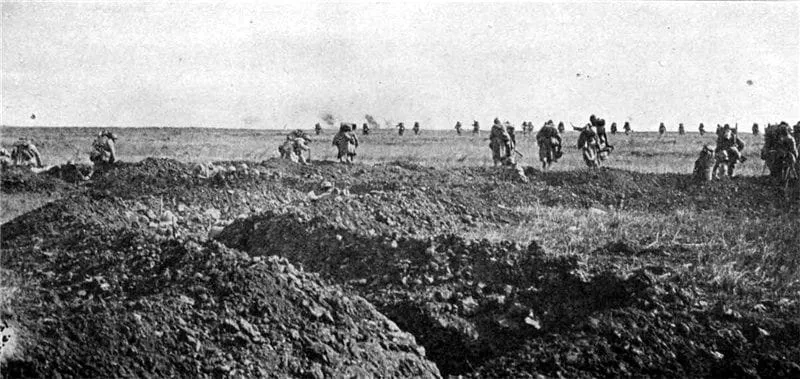
At six in the morning on 16 April 1917, a cold and misty Monday, the French infantry went over the top on a front of about 40 kilometres, from Laffaux near Soissons to Courcy near Reims. The main blow of the Nivelle offensive, which France had been awaiting all winter, had begun. Two armies of General Alfred Micheler’s Reserve Army Group, General Charles Mangin’s Sixth and General Olivier Mazel’s Fifth, were to pass with one violent blow through the whole system of German fortifications on the Chemin des Dames ridge and on the plain along the Aisne. The commander-in-chief, General Robert Nivelle, promised a breakthrough within 24, or at most 48, hours. In his order to the troops he wrote: “The hour has come! Confidence! Courage! Long live France!”
A plan for one day
The attack was to be faster than ever before. Behind a creeping barrage that moved forward 100 metres every three minutes, the infantry was to pass the first and second German positions within a few hours and reach the artillery positions. The Sixth Army was to cross the Ailette valley beyond the ridge that same day, and in the following days the cavalry was to break out onto the plain around Laon. The soldiers carried grenades and supplies of food and water, some units even for several days, because no one expected them to get stuck below the ridge. Behind the lines the Tenth Army waited to go into the breach.
The commanders who were to carry out this plan were not sure of it. Ten days earlier, at a conference at Compiègne, Micheler had said in the presence of the president and ministers that he could not vouch for a breakthrough, and the commander of the neighbouring army group, General Philippe Pétain, would have preferred an attack with limited objectives. The minister of war, Paul Painlevé, a member of Ribot’s government since March, made no secret of his scepticism. The Germans had known about the offensive for weeks, and on 4 April at Sapigneul they had captured the attack plan of a battalion of the Fifth Army. The French preparatory bombardment had also been going on for several days, in rain and snow. Cloudy weather hampered observation, and much of the German wire and many machine-gun nests survived. The attack was postponed several times. Since 9 April the British had been fighting at Arras, their attack intended to draw in German reserves.
On the slopes of the Chemin des Dames
Already in the first hour it was clear that something had gone wrong. The German artillery fired weakly, but machine guns hidden in concrete shelters, on the reverse slopes and in the mouths of underground quarries poured fire on the French as they climbed uphill over soft, shell-torn ground. The barrage soon moved far ahead of the infantry. From underground caves connected to the front line by tunnels, the Germans emerged in the rear of the attackers. A sentence by the deputy Jean Ybarnégaray was later often quoted: “The battle began at six o’clock; by seven it was lost.”
The worst was in the centre, on the narrow neck of the plateau near Hurtebise farm, where the Sixth Army’s II Colonial Corps attacked. In its first line went battalions of Senegalese tirailleurs, recruited in French West Africa, who had spent the winter in camps on the Côte d’Azur. The frozen soldiers, fired on from the front and the flanks and attacked from behind by Germans coming out of a cave the Germans called the Dragon’s Cave, fell back after a short fight. According to the British official history, II Colonial Corps advanced a few hundred metres at most and after an hour the attack was over. The neighbouring XX Corps did better: after a second attack its 153rd Division reached the Chemin des Dames road itself. On the western flank, at Laffaux, the French penetrated the German defences by barely a few hundred metres.
Tanks at Berry-au-Bac
East of the ridge, on the flat plain north of the Aisne, the Fifth Army’s attack at first went well. Here French tanks went into action for the first time. There were about 130 of them, all of the Schneider CA1 type: heavy, slow, with not very thick armour and fuel tanks placed on the sides. The father of the French armoured arm, General Jean-Baptiste Estienne, considered their use premature, but Nivelle insisted. Commandant Louis Bossut’s group, about 80 vehicles, was to support XXXII Corps between the Aisne and the Miette stream and lead the infantry through the third German position. Bossut, a cavalryman who had written to his brother that the tank was “a horse on which one charges”, led the attack in person.
The tanks, however, came up too late. The infantry, thinned out and tired, could not keep up with them, and the German artillery picked off the vehicles one after another. At about 9.30 a.m. Bossut sent a message by carrier pigeon that he had been held up by shell craters in front of the second German position. Some tanks still broke through to the area of Juvincourt and Guignicourt, but Bossut himself was killed near Berry-au-Bac, and the remnants of the group withdrew in the afternoon. The British official history notes that for several hours the tanks dominated the battlefield far ahead of the infantry and helped repulse a strong German counter-attack. The second group, Commandant Chaubès’s 48 tanks, fared worse. It set out from the Bois de Beau Marais in full view of German observers on the heights of Craonne. According to Falls, 23 vehicles were destroyed before they even reached the French lines, and in the evening only about ten returned to the wood. According to French tallies, of all the tanks that went into action 57 were destroyed and several dozen got bogged down or broke down. The crews lost about 180 men.
The Fifth Army’s infantry between the Aisne and the Miette, the 42nd and 69th Divisions, reached the second German position and advanced about 4 kilometres. On the army’s right flank the Russian 1st Brigade took the village of Courcy, but further on, by the Aisne–Marne canal, the attack came to a halt. South of the Aisne the attack mostly broke down, and the Germans, who had nothing to fear from the French here, were able to fire into the flanks of the neighbouring divisions and tanks.
Evening
In the afternoon it began to snow. The first French communiqué, issued at 2 p.m., spoke only of an “extremely violent artillery battle” between Soissons and Reims. By evening the French held in most places only the first line of German trenches, and even where they had got furthest they had not reached the objectives set for 9.30 a.m. They took more than 10,000 Germans prisoner, but captured few guns, because the Germans had withdrawn their forward batteries in good time. Losses were very heavy, and according to Falls hardly any division was capable of another serious effort. The overwhelmed medical services could not keep up with evacuating the wounded, who waited in crowds behind the front line.
Nivelle did not give up. Believing that the Germans would defend themselves at all costs against the Sixth Army, he ordered the Fifth Army to press on the next day to the north-east, where it had got furthest. An attack by the Fourth Army on the hills east of Reims was also planned for 17 April. In the following days the French gained a good deal more ground, but the promised breakthrough did not come. The first day of the offensive went down in history as one of the blackest days of the French army, and the name Chemin des Dames became in France a symbol of senseless slaughter.
Remember the articles you have read? Only in this browser; nothing is sent anywhere.How it works
Read ·
A voice from the front
“The day of the attack; it is very distressing, and all day long I live a double life. The guns did not stop all night; today there is silence, and that is even more striking when one thinks of everything that is happening. The wounded arrive in masses; those who can walk come in groups, I see them passing the windows of my hut.”
Translated · Original (fr)
Le jour de l’attaque ; c’est fort angoissant, et toute la journée, je vis en partie double. Le canon n’a pas arrêté de la nuit, aujourd’hui, c’est le silence et c’est encore plus impressionnant, en pensant à tout ce qui se passe. Les blessés arrivent en masse, ceux qui peuvent marcher viennent par groupe, je les vois passer des fenêtres de ma baraque.
Spotted a mistake?Report an error
Meanwhile
(04)Elsewhere in the same days.
- 17 April 1917 · Middle EastSecond Battle of Gaza beginsOn 17 April 1917 British infantry crossed the Wadi Ghazze and, at little cost, took the Sheikh Abbas and Mansura ridges, from which they were to storm Gaza.
- 17 April 1917 · War at seaSinking of the Lanfranc and DonegalOn 17 April 1917 German submarines sank two ships carrying wounded from Le Havre in the Channel. The Lanfranc also carried 167 wounded German prisoners.
- 13 April 1917 · War at seaJapanese destroyers in the MediterraneanOn 13 April 1917 Rear Admiral Satō's Japanese 2nd Special Squadron, the cruiser Akashi and eight destroyers, reached Malta to escort transports.
- 13 April 1917 · DiplomacyBolivia breaks off relations with GermanyOn 13 April 1917 Bolivia gave the German minister his passports and broke off relations, citing submarine warfare and the torpedoing of the Tubantia.
Related events
(04)The same battle, people or subject.
- 4 May 1917 · Western FrontFrench retake CraonneOn 4 May 1917 the French 36th Division took the ruins of Craonne and broke onto the Californie plateau, one of the last successes of the Nivelle offensive.
- 20 April 1917 · Western FrontCollapse of the Nivelle offensiveAround 20 April 1917 the French gave up hope of a breakthrough on the Aisne. They had 20,000 prisoners and huge losses; the Chemin des Dames fighting went on.
- 29 April 1917 · Western FrontPétain becomes chief of the general staffOn 29 April 1917, after the Aisne offensive failed, France made Pétain chief of the general staff and its military adviser. Nivelle got a supervisor.
- 4 May 1917 · Western FrontThird Battle of the Scarpe endsOn 4 May 1917 the British pulled the last troops out of the failed Scarpe attack. In Paris Haig and the French agreed the time for a breakthrough had passed.