France · The Entente
Paul Painlevé
Minister of War (March–November 1917) and Prime Minister of France (September–November 1917)
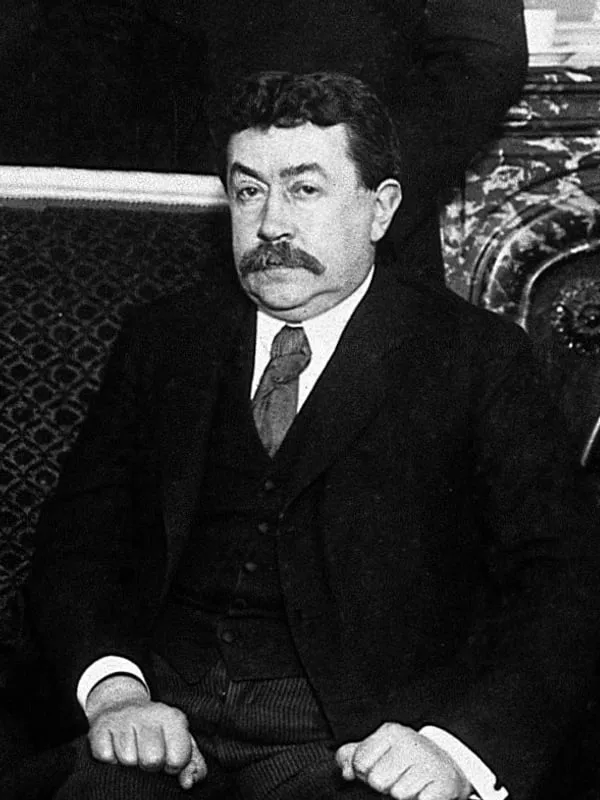
- Born:
- 5 December 1863, Paris
- Died:
- 29 October 1933, Paris
- Author:
- Natalia
- Photo:
- Gallery, CC BY 4.0, Wikimedia Commons

Paul Painlevé was one of the most eminent mathematicians of his time and also the politician who, in the hardest year of the war, was responsible for the French army. He became Minister of War in March 1917, on the eve of General Nivelle’s offensive, in which he did not believe. When the attack failed and mutinies broke out in the army, he handed command to General Pétain and made General Foch chief of the general staff. From September to November 1917 he was prime minister. His short government closed the period of the “sacred union” with the socialists, and at Rapallo, after the Italian defeat at Caporetto, Painlevé co-founded the Allied Supreme War Council. Brought down by the Chamber amid espionage scandals, he gave way to Clemenceau. To this day he is judged in sharply different ways: as the minister who saved the army from further slaughter, or as a politician too weak for wartime.
Before the war
Paul Painlevé was born on 5 December 1863 in Paris, into a family of printing craftsmen: his father was a lithographic draughtsman. He studied at the Lycée Louis-le-Grand, and in 1883 entered the École normale supérieure. He also studied in Göttingen under Felix Klein and took his doctorate in 1887. He lectured in Lille and, from 1892, in Paris, at the Sorbonne, the École polytechnique and the Collège de France. His work on differential equations made him famous: the so-called Painlevé transcendents still bear his name. In 1900, at the age of 36, he became a member of the French Academy of Sciences.
Painlevé was also passionate about aviation. In 1908 he was one of the first passengers whom Wilbur Wright took up into the air in France, and in the following years he lectured on the mechanics of flight. He was drawn into politics by the Dreyfus affair. In 1910 he was elected to the Chamber of Deputies for the Latin Quarter of Paris as an independent socialist, and later was active in the small Republican-Socialist Party. In parliament he dealt with the navy and aviation, chaired the naval committee and pressed for the first money for aircraft for the army. In 1914 he had the reputation of a scholar who understood military technology, but he had no experience in government yet.
Minister of public instruction and inventions
When the war broke out, Painlevé turned to applying science to national defence. At the end of October 1915 Aristide Briand gave him, in his government, the Ministry of Public Instruction, to which the affairs of inventions for national defence were attached. Painlevé set up within it a Directorate of Inventions, which brought together scientists and engineers working for the army, and arranged an exchange of scientific information with the British. Among the fruits of this cooperation was the research of the physicist Paul Langevin into detecting submarines by means of ultrasound. Painlevé was also among the politicians who argued as early as 1914 and 1915 that bombing the Krupp works could paralyse German war production.
In December 1916, when Briand reshaped his government and gave command of the army to General Robert Nivelle, Painlevé refused to join the new cabinet. According to historians, he did not want to sit beside the new Minister of War, General Hubert Lyautey, whom the left suspected of dictatorial ambitions, and in any case he would have preferred General Philippe Pétain at the head of the army.
Minister of war and the Nivelle offensive
After Briand’s fall, on 20 March 1917 Painlevé took over the Ministry of War in Alexandre Ribot’s government. From the first days he was the sharpest critic in the cabinet of Nivelle’s plan, which promised to break through the front in 24, at most 48 hours. He talked to the army group commanders behind the commander-in-chief’s back and heard from them that they did not believe in a breakthrough. He argued that after the revolution in Russia there would be no Russian offensive, and that the United States would soon enter the war, so it was better to wait. On 6 April, at a conference in Compiègne, he repeated these arguments, but when Nivelle offered his resignation, neither he, nor President Raymond Poincaré, nor Prime Minister Alexandre Ribot dared to accept it on the eve of the offensive.
When the attack of 16 April brought no breakthrough, Painlevé had the arguments in his hands. The British official history (Falls) writes that on 26 April he spoke to Field Marshal Douglas Haig as if the French had been beaten, and even encouraged him to suggest a change of commander. On 29 April he made Pétain chief of the general staff and adviser to the government, and at Pétain’s request the attack on Fort Brimont near Reims was postponed; it never took place. On 15 May the council of ministers dismissed Nivelle. Pétain became commander-in-chief of the armies in France, and General Ferdinand Foch chief of the general staff in Paris. The same day Painlevé left it to General Maurice Sarrail to decide on breaking off the offensive on the Vardar, which was not to be pursued at the cost of losses out of proportion to its aim.
These decisions were taken just as mutinies were spreading through the army. Painlevé backed Pétain, who combined severe courts martial for the ringleaders with leave, better food and the abandonment of costly attacks. Of several hundred death sentences, a few dozen were carried out and the rest commuted. At the same time the minister had to deal with the mutinous Russian brigades, which had been withdrawn from the front: they were isolated in the camp of La Courtine in the Massif Central, where the mutiny (PL) was put down by force in September. In June 1917 Painlevé, together with Ribot, countersigned the decree establishing the Polish Army in France, and on a railway platform in Paris he welcomed General John Pershing. He also favoured a hard line towards Greece: at the London conference he proposed deposing the king, which happened in June after the Jonnart ultimatum.
Prime minister
In September 1917 Ribot’s government fell after the affair of the newspaper Le Bonnet Rouge and the resignation of the Minister of the Interior, Louis Malvy. On 12 September Painlevé formed his own cabinet and kept the Ministry of War. He made it a condition that Ribot would be foreign minister, and this decided the refusal of the socialists of the French Section of the Workers’ International. For the first time since August 1914 there was not a single socialist in the government, and the Ministry of Armaments passed from Albert Thomas to the industrialist Louis Loucheur. In his declaration of 18 September Painlevé spoke of the “disannexation” of Alsace and Lorraine from Germany rather than their annexation, which was meant to reassure the left. The Chamber gave him its confidence almost unanimously, with the socialists abstaining.
The most important business of his government was played out in relations with the allies. On 25 September at Boulogne he agreed with Prime Minister David Lloyd George that the British would take over part of the front from the exhausted French army. According to his later book Comment j’ai nommé Foch et Pétain (“How I appointed Foch and Pétain”), the two prime ministers were already then discussing in private a joint body to direct the war. After the breakthrough on the Italian front at Caporetto Painlevé went to Italy. At Rapallo, at the conference of 5–7 November, together with Lloyd George he made the dismissal of General Cadorna a condition for sending French and British divisions, and formally tabled the proposal to create a Supreme War Council based at Versailles. Foch was to be the French military representative on the council. The British official history speaks of a proposal by Painlevé agreed beforehand with the British, although Lloyd George later claimed the idea as his own.
At home the government was losing ground. The autumn brought further scandals: the arrest of Paul Bolo, accused of buying influence in the press with German money, the charges against Malvy and ever louder rumours about the former prime minister Joseph Caillaux. Painlevé could not convince the Chamber that the government was pursuing traitors energetically enough. In October Ribot left the government and diplomacy was taken over by Louis Barthou. On 13 November, a few days after returning from Italy, the prime minister demanded the postponement of interpellations on the scandals and lost the vote by 186 to 277. The right voted against him and, for the first time, so did the socialists. The cabinet fell after only two months, and on 16 November a government was formed by his fiercest critic, Georges Clemenceau.
After the war
Until the end of the war Painlevé remained on the sidelines. In 1918 he presided over the Academy of Sciences. After the war he became one of the leaders of the left against the right-wing National Bloc and a co-founder of the Cartel des Gauches, which won the 1924 election. He was President of the Chamber of Deputies, in 1924 he lost the presidential election to Gaston Doumergue, and in 1925 he was again prime minister for a few months, during a financial crisis and the Rif War. From 1925 to 1929 he was Minister of War in successive governments. He then prepared the law on one-year military service and the first work on the fortifications on the eastern frontier that went down in history as the Maginot Line. Later he was Minister of Air. He died in Paris on 29 October 1933 and was buried in the Panthéon.
Assessment
Painlevé took care of his own legend. In a book of 1923 he presented himself as the politician who had spotted Nivelle’s mistakes in time and given France its two commanders of victory: Pétain, who healed the army after the mutinies, and Foch, whom he had put forward as chief of staff and as representative at Versailles. Some historians accept this view: Painlevé was the only one in the government with the courage to doubt the offensive plan openly, and his decisions of May 1917 allowed the army to survive the crisis. The British historian Elizabeth Greenhalgh draws attention to his role in building cooperation with the British, from Boulogne to Rapallo.
Critics point to the other side of the coin. Military commanders, Haig and Nivelle among them, accused him of undermining the commander-in-chief’s authority by talking to his subordinates behind his back, and of weakening an already uncertain offensive with doubts that never turned into a firm decision. The French historian Denis Rolland, Nivelle’s biographer, believes that Painlevé and Pétain’s supporters needed a scapegoat and contributed to the harsh verdict on the general. As prime minister Painlevé could control neither the Chamber nor the wave of accusations of defeatism. Historians such as David Dutton see his short governments as the end of the “sacred union”: the departure of the socialists opened the way for Clemenceau, who promised no longer compromise but war until victory.
Sources
Spotted a mistake?Report an error
Mentioned in battles
(04)Often appears with
People who appear in the same events.
On the timeline
(24)1915
1916
1917
March
April
May
- 04
- French retake CraonneOn 4 May 1917 the French 36th Division took the ruins of Craonne and broke onto the Californie plateau, one of the last successes of the Nivelle offensive.
- Third Battle of the Scarpe endsOn 4 May 1917 the British pulled the last troops out of the failed Scarpe attack. In Paris Haig and the French agreed the time for a breakthrough had passed.