Key event
Pétain becomes commander-in-chief
- Category:
- Military
- Front:
- Western Front
- Date:
- 15 May 1917
- Author:
- Łukasz Skowroń
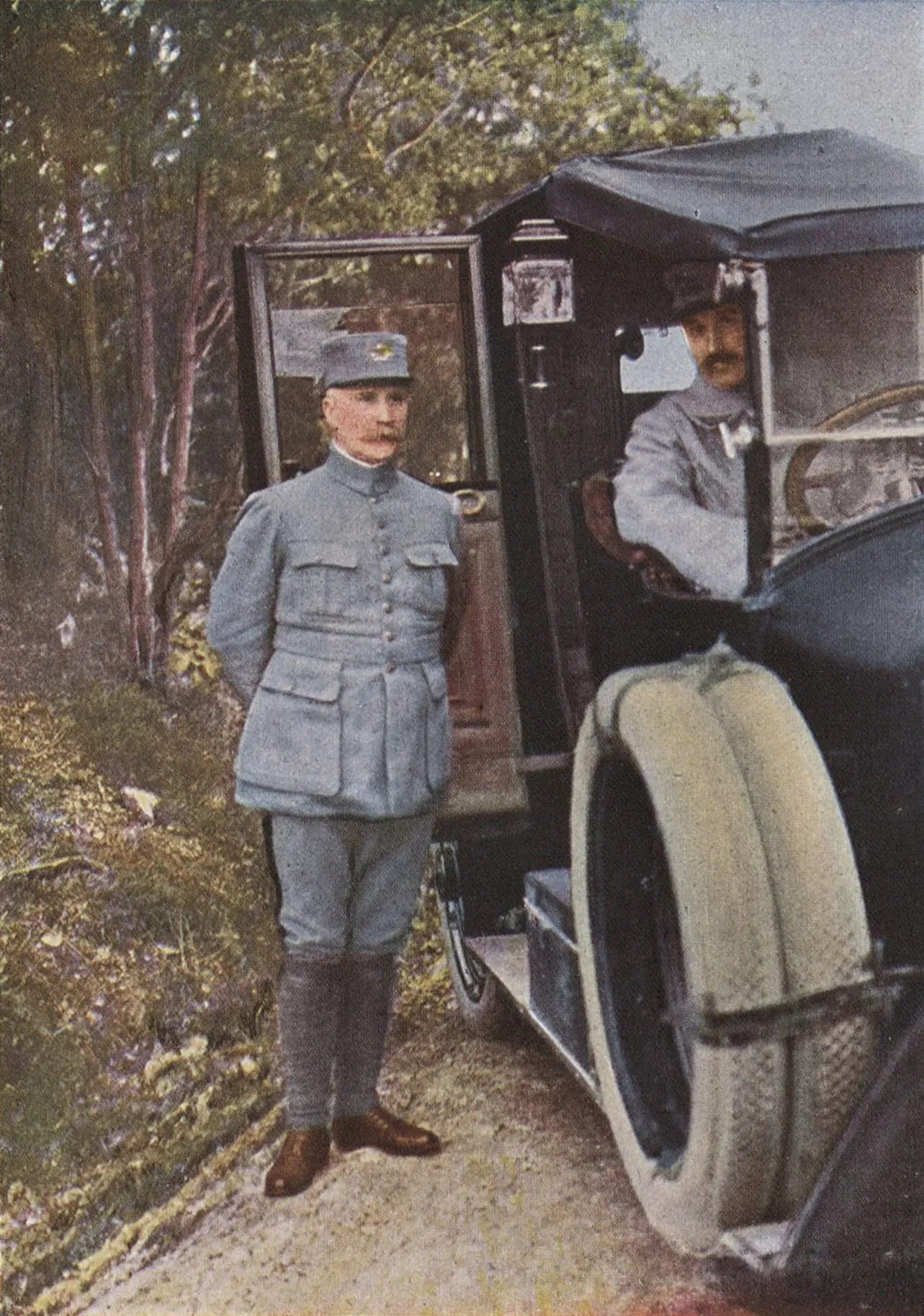
On 15 May 1917 the French Council of Ministers removed General Robert Nivelle from the post of commander-in-chief of the armies of the North and North-East, that is, of all French forces in France. By a decree of that day his place was taken by General Philippe Pétain, for the past two weeks chief of the general staff and military adviser to the government. As chief of the general staff he was replaced by General Ferdinand Foch. A month after the start of the offensive that was to decide the war at a single blow, the French army came under the command of a general known for sparing his soldiers’ lives. The change came at the last moment, for mutinies had already begun in the army.
Nivelle refuses to go
Nivelle’s fate had been sealed from the moment his offensive on the Aisne failed to bring a breakthrough. The government, however, delayed his removal. The prime minister, Alexandre Ribot, did not want to change the commander-in-chief for the second time in five months, and removing Nivelle would have meant publicly admitting defeat and might have angered the British, who were fighting at Arras precisely in order to support the French offensive. According to the American historian Robert Doughty, as early as 24 April an emissary of the war ministry forewarned Pétain that if Nivelle were removed he would be the successor. When three days later Nivelle, sensing the threat, offered Pétain the post of his chief of staff, Pétain refused without revealing what he knew. Pétain’s appointment as chief of the general staff on 29 April was a compromise: Nivelle stayed, but under supervision.
At the beginning of May Nivelle carried out his last major attacks, in which the French took Craonne and the Californie plateau, and the Sixth Army broke into the Hindenburg Line at Laffaux. This did not restore his position. On 8–9 May the offensive was halted. Mangin, Nivelle’s closest collaborator, had already lost command of the Sixth Army, and in the following weeks dismissals reached other generals. On 11 May the government demanded that Nivelle resign of his own accord. He refused. According to Doughty he told a liaison officer: “They want my skin… But neither my dignity, nor my conscience, nor my sense of what I owe the country allows me to play their game.” On the morning of 15 May President Raymond Poincaré and the minister of war, Paul Painlevé, met him once more, but achieved nothing. The same day the Council of Ministers took its decision.
Nivelle was formally moved to the post of an army group commander. There was no vacant post, so he was sent on leave. On 29 June, at the request of Pétain, who declared that no army group would fall vacant for a long time, the appointment was revoked. At the end of 1917 Nivelle took command of the French forces in North Africa, far from the front. His offensive was later examined by a special commission.
Pétain and Foch
Pétain was 61. Before the war he had been a colonel close to retirement, known for his criticism of the then fashionable doctrine of the offensive at all costs and for the saying that “firepower kills”. In 1916 he won fame as the defender of Verdun. Among the soldiers he had the reputation of a commander who did not send them to their deaths needlessly. The politicians regarded him as a cautious pessimist, and that was why in December 1916 they chose Nivelle. Now that caution became a virtue. According to Doughty, Pétain, while still chief of the general staff, with the consent of the minister of war had the attack on Fort Brimont near Reims called off, and at the Franco-British conference in Paris on 4–5 May he reassured the British that France did not intend to wait passively for the Americans. It was agreed there that the Allies would no longer seek to break through the front, but would wear down the enemy’s forces with attacks with limited objectives, while sparing their own. The British were to take over the main burden of the summer operations.
Foch, five years older than Pétain, was returning to favour. In December 1916, together with Joffre, he had paid for the bloody Battle of the Somme and lost command of the Northern Army Group. Afterwards, according to the British official history (Falls), without a permanent command he studied at Senlis plans in case of a German march through Switzerland, for two months commanded two armies in eastern France, and in April went on a mission to Italy to discuss with General Luigi Cadorna possible French help in the event of a great Austro-German offensive. As chief of the general staff in Paris he was to be the government’s adviser, on the model of the British Chief of the Imperial General Staff. Pétain commanded the troops at the front, while Foch dealt with the affairs of the war as a whole, including cooperation with the Allies.
Pétain’s programme
Pétain took over the army at the worst possible moment. As he himself wrote, the weapon the nation had entrusted to him was bending in his hand, and the army’s confidence in its commanders, in the government and in itself had been undermined. For the time being he did not intend to carry out great attacks. According to a saying attributed to him, he was waiting “for the tanks and the Americans”: for the Renault FT light tanks, which were only just going into production, and for the army of the United States, which in April had entered the war. Four days after his appointment, on 19 May, he issued his first directive. In it he stated that breaking through the front and exploiting the breach strategically were “for the time being” impossible. Instead he announced attacks with limited objectives, prepared by the artillery, sparing the infantry and inflicting the greatest possible losses on the enemy.
The second part of the programme concerned the soldiers. Falls, who drew on the French official history, regarded the lack of leave as the main cause of discontent. Pétain wanted to give every soldier seven days’ leave, later ten, every four months, and to increase the number of men on leave to a quarter of the strength, and in units withdrawn from the fighting even to a half. He promised better food, more comfortable and safer billets for units at rest, buffets at stations for men on leave, and restrictions on the sale of wine behind the front. He visited divisions, talked to officers and men, and demanded the same of his commanders.
What came next
The hardest part, however, still lay ahead of him. The mutinies, which had begun at the start of May, spread widely only after his appointment. According to the French official history, most of the 119 cases of collective indiscipline fell in the period from 25 May to 10 June. Pétain combined reform with severity: from June the courts martial worked under a summary procedure, several hundred death sentences were passed, of which a few dozen were carried out. In the summer the army began to calm down. Pétain decided on the first larger attacks, always with limited objectives, only in August at Verdun and in October at Malmaison. The burden of the fighting on the Western Front in 1917 passed to the British.
Remember the articles you have read? Only in this browser; nothing is sent anywhere.How it works
Read ·
Spotted a mistake?Report an error
Meanwhile
(04)Elsewhere in the same days.
- 14 May 1917 · War at seaDestruction of airship L 22At dawn on 14 May 1917 a British flying boat from Great Yarmouth shot down the naval airship L 22 near Terschelling. All 21 airmen were killed.
- 17 May 1917 · War at seaConvoy committeeOn 17 May 1917 the Admiralty set up a committee to draw up a plan for ocean convoys. The first trial convoy from Gibraltar was then under way.
- 17 May 1917 · DiplomacyHonduras breaks off relations with GermanyOn 17 May 1917 Honduran President Francisco Bertrand broke off relations with Germany by decree and declared a state of siege. He offered the US co-operation.
- 12 May 1917 · Italian FrontStart of the tenth battle of the IsonzoAt dawn on 12 May 1917 the Italian artillery opened fire from Tolmin to the Adriatic. The Tenth Battle of the Isonzo, Cadorna's largest offensive, had begun.
Related events
(04)The same battle, people or subject.
- 12 December 1916 · Western FrontNivelle becomes commander-in-chiefOn 12 December 1916 Briand reshaped his government and set up a five-man war committee. Nivelle replaced Joffre in command of the French armies in France.
- 29 April 1917 · Western FrontPétain becomes chief of the general staffOn 29 April 1917, after the Aisne offensive failed, France made Pétain chief of the general staff and its military adviser. Nivelle got a supervisor.
- 13 June 1917 · Western FrontPershing in FranceOn 13 June 1917 Gen. John Pershing and his staff landed at Boulogne. That evening crowds greeted him in Paris, and in the next days Poincaré, Joffre and Pétain.
- 26 December 1916 · MilitaryJoffre becomes Marshal of FranceOn 26 December 1916 Joffre gave up the last of his authority over the army and was made Marshal of France, the first since 1870. It was a consolation prize.