France · The Entente
Hubert Lyautey
Resident-General of France in Morocco (1912–1925), Minister of War of France (December 1916 – March 1917), Marshal of France
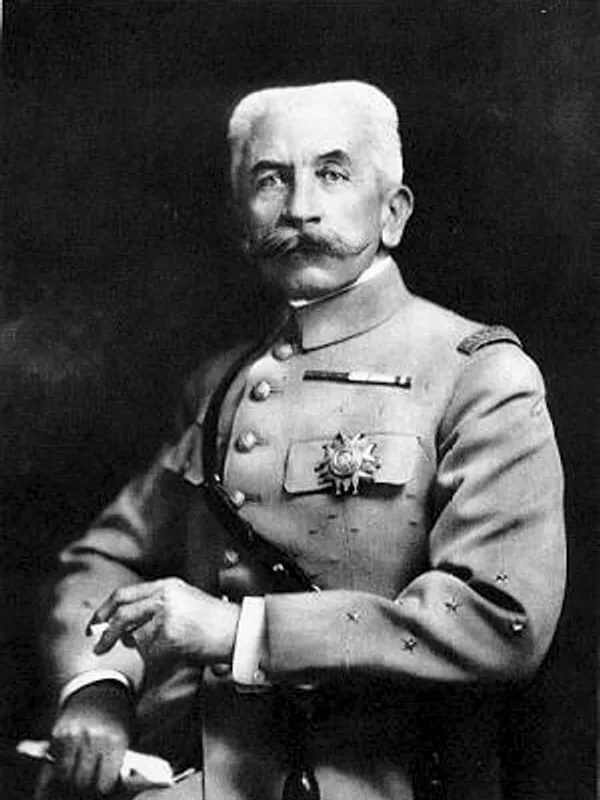
- Born:
- 17 November 1854, Nancy (France)
- Died:
- 27 July 1934, Thorey (France)
- Author:
- Łukasz Skowroń
- Photo:
- Leo Wehrli, domena publiczna, Wikimedia Commons

Louis Hubert Gonzalve Lyautey, known simply as Hubert Lyautey, was the most famous French colonial soldier of his generation. He spent the world war above all in Morocco, which he had governed as Resident-General since 1912. When in 1914 Paris demanded that he give up most of his troops and withdraw to the coast, he refused and held the country, while at the same time sending dozens of battalions to France. In December 1916 Aristide Briand brought him to Paris as Minister of War. His three months in office proved a string of humiliations for him: he had no say in the choice of General Nivelle, in whose plan he did not believe, and the left in parliament saw in him a general with the ambitions of a dictator. On 14 March 1917, shouted down in the Chamber of Deputies, he resigned and brought down the whole government with him. He returned to Morocco and governed it for another eight years.
Before the war
Lyautey was born on 17 November 1854 in Nancy, in Lorraine, into a family with military traditions. His great-grandfather had been a commissary in Napoleon’s army and his grandfather a general. As a child he fell from a balcony, and because of a spinal injury he walked for years in a corset and on crutches. Brought up in a Catholic and monarchist spirit, he disliked the parliamentary republic all his life, although he served it. In 1873 he entered the military school at Saint-Cyr and became a cavalry officer. He made his name in 1891 with an article on “the social role of the officer”, in which he argued that in an army based on universal conscription the officer should be an educator of his soldiers and not merely their commander.
He made his real career in the colonies. In 1894 he went to Tonkin, where he met General Joseph Gallieni, and then followed him to Madagascar. From Gallieni he adopted the “oil stain” method: the gradual occupation of a country combined with the building of roads, markets, schools and dispensaries and with winning over the local elites. From 1903 he commanded on the border between Algeria and Morocco, where he more than once crossed the frontier against the wishes of Paris. In 1907 he occupied Oujda. On 28 April 1912, after the signing of the Treaty of Fez, he became the first Resident-General of France in Morocco. He relieved Fez, besieged by insurgents, moved the capital to Rabat and brought about the replacement of the sultan by his younger brother Yusef. The column of Colonel Charles Mangin routed the forces of the pretender al-Hiba and took Marrakesh. Lyautey governed in the sultan’s name, showing him ostentatious respect, and preserved the Moroccan administration. In October 1912 he was elected to the Académie française.
Morocco during the war
At the end of July 1914, when news of the threat of war arrived from Paris, Lyautey is said to have told his officers: “They are mad! A war between Europeans is a civil war.” The Minister of War, Adolphe Messimy, ordered him to send all his crack units to France and if necessary to withdraw from the interior to the ports and the large cities. Lyautey judged that a retreat would mean an uprising throughout Morocco and decided to hold all the posts, manning them with thinner forces. At the same time he immediately sent several dozen battalions to France, among them a brigade of Moroccan rifles, which in September fought on the Ourcq. Their place was taken by territorial reservists from France, Senegalese units and mobilised settlers.
It was a high-stakes gamble. In November 1914 a French column which had attacked a camp of the Zaian tribe at El Herri near Khénifra without orders was routed, and about 600 soldiers were killed, among them 33 officers. Lyautey feared that German and Turkish propaganda, especially after the Ottoman sultan’s proclamation of jihad, would rouse the tribes to holy war. The Germans supported the pretender al-Hiba in the south and tribal leaders in the mountains with money and arms, and at the end of 1916 a submarine landed German emissaries on the coast. Nevertheless no uprising broke out in Morocco, and the fighting was confined to the Middle Atlas, the Taza area and the south. Lyautey deliberately showed that France was not worried about its rule: he did not stop the building of roads and ports, he organised fairs and exhibitions, and Morocco sent grain and wool to France. In December 1914 Britain recognised the French protectorate in exchange for France’s recognition of the British protectorate over Egypt. In his view Verdun and Morocco were fronts of the same war.
Minister of War
In December 1916 Prime Minister Aristide Briand reconstructed his government and offered Lyautey the Ministry of War by telegram. The general hesitated, because the situation in Morocco was tense, but he agreed, and General Henri Gouraud took over as his deputy in Rabat. He arrived in Paris on 22 December and at once found himself faced with accomplished facts. Command of the army in France had already been entrusted to General Robert Nivelle, whom Lyautey would not have chosen, armaments production had been split off into a separate ministry under Albert Thomas, and decisions were to be taken by a five-member war committee. Lyautey himself saw to the departure of Joseph Joffre: according to the British liaison officer Edward Spears, he threatened not to join the government if the marshal became the government’s adviser, because he regarded that role as his own. Joffre received the marshal’s baton and left. Lyautey found new tasks for Ferdinand Foch, who had been sidelined after the Somme, and Noël de Castelnau was sent on a mission to Russia.
Lyautey spent a great deal of time at the front and at headquarters, but in Paris he felt out of place. He was hard of hearing, spoke at length and liked to lecture the people he talked to. At the Rome conference at the beginning of January 1917, while still on the train, he lectured the British delegation on the campaign in Palestine, and the Chief of the Imperial General Staff, William Robertson, wrote of him as a man who had spent his whole life in the colonies, talked only about them, did not yet understand this war and would probably not last long in his post. Lyautey also did not believe in Nivelle’s plan, which was to break through the front in 24, at most 48 hours. He reportedly called it a plan worthy of “The Grand Duchess of Gerolstein”, an operetta mocking the army. He considered dismissing the commander-in-chief and would have preferred Foch in his place, but Briand objected. Lyautey gave up, aware that the left suspected him in any case of intending to seize power.
At the Calais conference on 26 and 27 February he witnessed the attempt to subordinate the British army to Nivelle. Haig explained to him why he wanted to take Vimy Ridge, and Lyautey accepted his reasons and signed the agreement together with the prime ministers. Relations between the two commanders had to be repaired at the London conference, where Lyautey stayed from 11 March until the morning of 14 March. He then advised Nivelle to have his letters to British headquarters drafted by officers who chose their words carefully.
Resignation
On the afternoon of 14 March 1917 Lyautey appeared before the Chamber of Deputies, which was discussing military aviation in a closed session. He was convinced that the content of such debates quickly reached the Germans, and he read out a statement that even in a secret session giving such explanations exposed national defence to risk. The left took this as an insult to parliament and raised an uproar. The President of the Chamber, Paul Deschanel, was unable to quieten it, and the minister stepped down from the rostrum and left the chamber. In the evening he submitted his irrevocable resignation. According to his biographer André Maurois, he later told one of his associates that he had never understood that race, meaning the parliamentarians. Briand found no successor, and on 17 March the government resigned.
Public opinion was largely indignant with the deputies, but Lyautey’s career in Paris was over. The new Prime Minister, Alexandre Ribot, asked him to return to his post in Morocco. In the second half of May, after talks in Paris with politicians and generals, Lyautey left for Rabat. On his way through Madrid King Alfonso XIII gave him to understand that he supported the idea of a separate peace with Austria, but Lyautey did not want to get involved.
After the war
Until the end of the war and afterwards Lyautey pursued in Morocco a policy of “pacification” and of building a modern protectorate state: the port of Casablanca, railways, new European quarters beside the old medinas, which he had protected, schools for the Moroccan elites. On 19 February 1921 he became a Marshal of France. In 1925, when the Rif War against Abd el-Krim spread in Morocco, the government sent Marshal Philippe Pétain to Morocco with full military authority. Lyautey regarded this as an insult and resigned in September. He returned to France without official honours. He was Commissioner-General of the Colonial Exhibition in Paris in 1931, and in his last years he sympathised with the right-wing leagues. He died on 27 July 1934 at his château at Thorey in Lorraine. He was buried in a mausoleum in Rabat, and in 1961, after Morocco had gained independence, his remains were moved to Les Invalides in Paris.
Assessment
Lyautey was regarded as a model colonial administrator, and his methods, combining armed force with winning over local elites and with investment, influenced later theories of counter-insurgency. Historians assessing his war stress that holding Morocco with minimal forces, while at the same time sending dozens of battalions to France, was his greatest achievement. At the same time they recall that “pacification” meant years of bloody campaigns against tribes that did not want to recognise French rule, and that his respect for tradition went hand in hand with a conviction that Europeans had the right to rule.
His role in Paris comes off much worse. The British, like Robertson, regarded him as a man who did not understand the war in Europe, and French historians point out that a minister without influence over the high command and without support in the Chamber could not have stopped Nivelle. Lyautey himself blamed himself for not having dismissed the commander-in-chief while he still could. His biographers, from Maurois to Arnaud Teyssier, see in him a man who wanted to be the saviour of his country but who in the Great War played only a secondary role.
Sources
Spotted a mistake?Report an error
Often appears with
People who appear in the same events.