France · The Entente
Georges Clemenceau
Prime Minister and Minister of War of France (1917–1920), President of the Paris Peace Conference
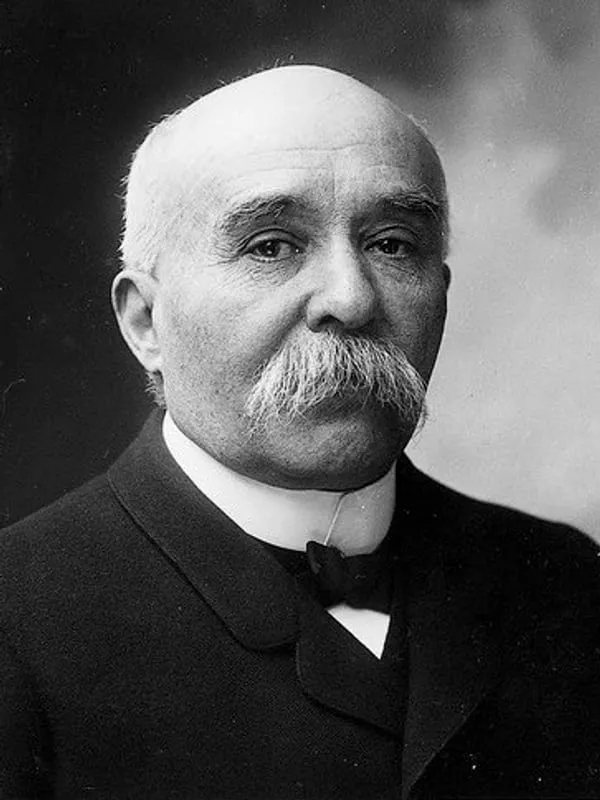
- Born:
- 28 September 1841, Mouilleron-en-Pareds (France)
- Died:
- 24 November 1929, Paris
- Author:
- Łukasz Skowroń
- Photo:
- Paul Nadar, domena publiczna, Wikimedia Commons

Georges Clemenceau took over the government of France in November 1917, at the worst moment of the war. The army had barely recovered from the mutinies, Russia was dropping out of the war, the Italians were retreating after Caporetto, and the country was living on spy scandals and rumours of a compromise peace. For three years the 76-year-old radical, a doctor by training and a journalist by inclination, had been the fiercest critic of successive cabinets. As prime minister and minister of war he promised “war, nothing but war”: he dealt with politicians suspected of defeatism, restored confidence in the government and, in the spring of 1918, during the great German offensives, supported giving General Foch command over the Allied armies. The French called him the “Father of Victory” (“Père la Victoire”). As president of the peace conference in Paris he was one of the makers of the Treaty of Versailles, which some considered too harsh and others, including he himself at the end of his life, too weak.
Before the war
Georges Benjamin Clemenceau was born on 28 September 1841 in Mouilleron-en-Pareds in the Vendée, into a family of doctors. His father, a republican and atheist arrested several times under the Second Empire, instilled in him a hatred of the monarchy and the Church. Clemenceau studied medicine in Paris, and from 1865 to 1869 he lived in the United States, where he wrote reports for the French press and taught at a girls’ school in Connecticut. There he married an American, Mary Plummer. From then on he spoke fluent English, which during the war made his talks with the British and Americans easier.
After France’s defeat in 1870 he was mayor of the Montmartre district. During the Paris Commune he tried without success to mediate between the Communards and the government. From 1876 he was a deputy and leader of the Radicals. He brought down one cabinet after another, which earned him the nickname “the wrecker of ministries”, and for his sharp tongue and ruthlessness in polemics, and in duels too, he was called “the Tiger”. Implicated in the Panama scandal, he lost his seat in 1893 and for nine years was only a journalist. During the Dreyfus affair he was among the most ardent defenders of the accused: it was in his newspaper L’Aurore that the letter of Émile Zola appeared in 1898, to which Clemenceau gave the title “J’accuse…!”.
In 1902 he became senator for the Var department. In 1906 he took over the Ministry of the Interior, and from October of that year until July 1909 he was prime minister. His government strengthened the entente with Britain, but it is remembered above all for its firm hand against strikes, which alienated the socialists and Jean Jaurès. He called himself “the first cop of France”. In 1913 he founded the newspaper L’Homme libre, in which he warned against Germany and supported the three-year military service law. He tried without success to prevent the election of Raymond Poincaré as president, and from then on the two were enemies.
Critic of the wartime governments
In August 1914 Clemenceau called his countrymen to arms: “Dying is nothing. We must win.” He refused, however, to join René Viviani’s government of national unity because, as his biographers explained, he would accept no role other than the premiership. He preferred to control the government from outside. As early as September his newspaper was suspended for an article on the appalling conditions in which the wounded were transported. Clemenceau then changed its title to L’Homme enchaîné (“The Man in Chains”) and went on writing. As a member, and later chairman, of the Senate army committee he travelled to the front, demanded parliamentary control over the government and the high command, and bombarded ministers with charges of shortages in the army’s supplies, medical services and artillery.
Day after day his newspaper reminded readers that the Germans were still at Noyon, about a hundred kilometres from Paris. In 1916, in secret sessions of the Senate, Clemenceau attacked the government of Aristide Briand, whom he loathed, and refused it his confidence. His most dangerous opponent, however, was the interior minister Louis Malvy, whom he accused of indulging pacifists and revolutionaries. On 22 July 1917, after the affair of the newspaper Le Bonnet Rouge, in a speech of several hours in the Senate he openly accused him of betraying the interests of France. Malvy resigned at the end of August, and in September Alexandre Ribot’s government fell. Clemenceau attacked the next cabinet, that of Paul Painlevé, just as mercilessly, and a wave of new scandals and the Italian defeat at Caporetto brought it down on 13 November 1917.
Prime minister
Poincaré disliked Clemenceau, but according to the French historian Michel Winock he had in practice a choice between him and the former prime minister Joseph Caillaux, who was regarded as a supporter of a compromise peace. He chose the man who promised victory. On 16 November Clemenceau formed a government and kept the Ministry of War for himself. The ministers were mainly his friends and politicians without a strong position: Stéphen Pichon at foreign affairs, Louis Loucheur at armaments. His closest collaborators were Georges Mandel, head of his civil cabinet, and General Henri Mordacq, head of his military cabinet, who helped him win the trust of the generals. In his programme of 20 November the prime minister announced: “No more treason, no more half-treason. War, nothing but war!” The Chamber backed him by 418 votes to 65. The socialists voted against.
Clemenceau began by settling accounts. The Malvy case was referred to the Senate sitting as a High Court, in December the Chamber lifted Caillaux’s immunity, and in January 1918 the former prime minister was sent to prison. Paul Bolo, accused of buying influence in the press with German money, was sentenced to death and shot. Critics spoke of dictatorship, but the prime minister relaxed the censorship of political opinion, saying that the right to insult members of the government must remain inviolable, and time and again he put confidence votes to the Chamber. At the first meeting of the war committee, on 6 December, he declared that General Maurice Sarrail could not remain in Salonika, and recalled him. He reportedly spent a third of his time at the front, in the trenches, in an ordinary hat instead of a helmet, which won him the soldiers’ affection. On 8 March 1918 he spoke in the Chamber the words that became his motto: “Home policy? I wage war. Foreign policy? I wage war. All the time I wage war.”
Within the coalition Clemenceau played first fiddle from the start. On 1 December 1917 he chaired the first meeting of the Supreme War Council at Versailles, and his main aim was to hold out on the Western Front in 1918 until the Americans arrived. He received Wilson’s Fourteen Points with relief, because they included the return of Alsace and Lorraine, but he is credited with the barbed remark that the good Lord was content with ten commandments, while Wilson needed fourteen.
1918: Doullens and unity of command
On 21 March 1918 the Germans struck on the Somme and shattered the British Fifth Army. Clemenceau briefly considered moving the government to the Loire, but Poincaré advised him against it. He was alarmed by the pessimism of General Philippe Pétain, who told him that the Germans would beat the English in the open field and then beat the French. On 26 March at Doullens Clemenceau wrote out in his own hand the draft of an agreement, which he signed together with the British minister Lord Alfred Milner: General Ferdinand Foch was to coordinate the operations of the Allied armies on the Western Front. When Foch complained that he had been given responsibility without power, the prime minister called the Beauvais conference, which on 3 April entrusted him with strategic direction, and on 14 April the governments gave him the title of commander-in-chief of the Allied armies in France.
In April Clemenceau became embroiled in a resounding dispute with Vienna. When the Austro-Hungarian foreign minister Ottokar Czernin declared that it was Clemenceau who had sought negotiations, the prime minister replied in a single sentence: “Count Czernin lied.” When Vienna would not give way, he published a 1917 letter from Emperor Charles I in which the monarch supported France’s “just claims” to Alsace and Lorraine. The Sixtus affair cost Czernin his post and humiliated the emperor in the eyes of the Germans. The American secretary of state Robert Lansing believed, however, and many historians agree with him, that in this way Clemenceau pushed Austria into Germany’s arms and buried the hope of a separate peace.
The hardest moments came at the end of May, when the Germans broke through on the Aisne and reached the Marne. Paris was again under fire, and in the Chamber there were calls for the generals’ heads. On 4 June Clemenceau defended Foch and Pétain and won a vote of confidence by 377 votes to 110. According to General Mordacq, the prime minister told him in those days that the Germans might take Paris, but he would fight on the Loire, on the Garonne, in the Pyrenees and finally at sea. At the meeting of the Supreme War Council at Versailles on 3 June he signed with the prime ministers of Britain and Italy a declaration that a united and independent Poland with access to the sea was a condition of a lasting peace.
Victory
After the July counter-offensive on the Marne the initiative passed to the Allies. At Clemenceau’s request Foch was made a Marshal of France in August. Relations with the Americans were not easy: on 21 October the prime minister, irritated by the slow progress of the Meuse–Argonne offensive, demanded in a letter to Foch a change of the commander of the American army, John Pershing. Foch refused. In September the government recognised the Polish Army in France as autonomous and allied, under the political authority of Roman Dmowski’s Polish National Committee. When Germany asked President Wilson for an armistice, Clemenceau, against Poincaré and the right, who wanted to march on Berlin, decided that the slaughter must not be prolonged if the armistice terms made it impossible for Germany to resume fighting. When Poincaré objected in a letter to a premature armistice, the prime minister threatened to resign.
On 11 November 1918, after the signing of the Armistice of Compiègne, Clemenceau read out its terms in the Chamber of Deputies and paid tribute to the fallen. That evening he is said to have told General Mordacq that they had won the war and now had to win the peace, and that might be harder. In December, together with Poincaré, he was welcomed by Strasbourg. At the same time, as a determined opponent of the Bolsheviks, he sent troops to Odessa. The expedition ended in the spring of 1919 with a withdrawal and mutinies in the French fleet in the Black Sea.
After the war
On 21 November 1918 the Académie française elected him a member, although he never took his seat. In January 1919 he became president of the Paris Peace Conference. On 19 February the anarchist Émile Cottin shot him in the street. One of the bullets lodged in his body and remained there for the rest of his life, but Clemenceau was back at work within a few days. In the Council of Four he clashed with Wilson and Lloyd George over France’s borders and security. He gave up the separation of the left bank of the Rhine, which Foch and Poincaré demanded, in exchange for a fifteen-year occupation of the Rhineland and the promise of American and British guarantees, which the United States Senate later failed to ratify. He supported a strong Poland as a counterweight to Germany. The Treaty of Versailles was signed on 28 June 1919.
In January 1920 Clemenceau lost to Paul Deschanel in the vote of republican parliamentarians that preceded the presidential election, and resigned. He withdrew from politics, travelled, in 1922 spoke in the United States in defence of French policy, and wrote books on Demosthenes and on his friend Claude Monet. He died in Paris on 24 November 1929 and was buried in a simple grave beside his father at Mouchamps in the Vendée. His memoirs, Grandeur and Misery of Victory, a reply to Foch’s criticism, appeared posthumously.
Assessment
For the French, Clemenceau remains a symbol of the will to win. According to Winston Churchill’s biographers, his speeches of 1918 inspired the British prime minister in 1940, and Kaiser Wilhelm II is said to have admitted after the war that if Germany had had its own Clemenceau, it would not have lost the war. Historians stress that his government restored the sense that the country was being governed, and that through all the crises of 1918 Clemenceau never lost faith in victory and knew how to subordinate the generals to himself without taking away their freedom of action. His greatest military service was to stake everything on Foch.
Critics point to the darker side of his rule: political trials in which the line between treason and dissent was sometimes blurred, and ruthlessness towards opponents. For a long time he was also blamed for blocking a possible compromise peace, although German documents show that in 1917 Germany had no intention of giving up Alsace and Lorraine. As a peacemaker he was judged from two sides: John Maynard Keynes portrayed him as an old man who wanted to destroy Germany, while Foch and the French right portrayed him as a politician who had given up the Rhine for the promises of allies. Present-day historians such as Michel Winock and Jean-Baptiste Duroselle see him rather as a realist who understood that France alone could not maintain its advantage over Germany and needed an alliance with Britain and the United States.
Sources
Spotted a mistake?Report an error
Mentioned in battles
(06)Often appears with
People who appear in the same events.
On the timeline
(52)The 40 most important of 52 events. All tagged “Georges Clemenceau” (11) →