1918: The German Spring Offensive
First Battle of Bapaume
- Dates:
- 24–25 March 1918
- Front:
- Western Front
- Location:
- The front from the Somme near Péronne through Combles, Bapaume and Sapignies to Ervillers, with a retreat to the Albert–Ancre line, Somme and Pas-de-Calais departments (France)On the battle map →
- Sides:
- United Kingdom and South AfricaDouglas Haig, Julian Byng, Hubert Gough, Walter Congreve
- Result:
- German victory. The Germans took Bapaume and pushed the right wing of the British Third Army back behind the Ancre, but did not destroy it or split the British armies. Their exhausted infantry, without its artillery, which was stuck in the wasteland, advanced ever more slowly.
- Author:
- Łukasz Skowroń
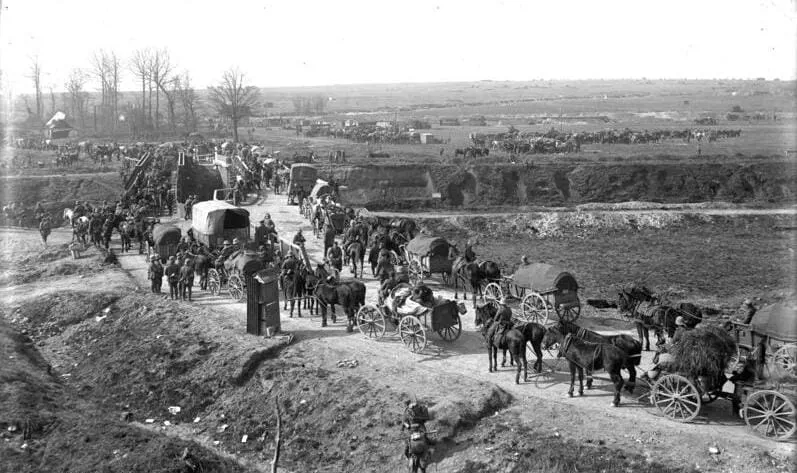
The First Battle of Bapaume was the second stage of the German Operation Michael, the largest offensive of the war. After three days of the Battle of St Quentin the British Fifth Army had fallen back behind the Somme, and the Third Army of General Julian Byng, which had held on to the Flesquières salient for too long, had lost touch with it. On 24 March 1918, Palm Sunday, divisions of the German Second Army broke into the resulting gap. For two days British divisions retreated across the wasteland they themselves had won in 1916, through Combles, Flers, High Wood and Pozières. The Germans took Bapaume, the objective of the whole Battle of the Somme, and reached the river Ancre. On the night of 24 March the British commander Douglas Haig also learned that the French might draw away from him to cover Paris. Two days later the crisis led to the Doullens conference.
Name and dates
The name “First Battle of Bapaume” and the dates 24–25 March 1918 were fixed after the war by the British Battles Nomenclature Committee. The battle belongs to the group of the “First Battles of the Somme 1918”, alongside the Battle of St Quentin (21–23 March), the Battle of Rosières (26–27 March) and the battles of the Avre and the Ancre in early April. It covers the fighting of the Third Army and the neighbouring VII Corps of the Fifth Army north of the Somme. The committee assigned the fighting south of the river on the same days to the separate “Actions at the Somme Crossings”, and the French fighting near Noyon to a separate battle. The ordinal number distinguishes it from the Second Battle of Bapaume at the turn of August and September 1918.
The date on which the town itself fell is uncertain. German communiqués and some accounts, among them a British chronology of the war, state that Bapaume and Péronne fell on 24 March. The British official history, based on German regimental histories, writes that the British left Bapaume late in the evening of 24 March without a fight, and that the Germans entered the empty town only at about noon on 25 March. The Fifth Army had already given up Péronne in the afternoon of 23 March, when its units crossed to the west bank of the Somme. We give times according to the British official history.
Background
On 21 March three German armies, the Seventeenth Army of General Otto von Below, the Second Army of General Georg von der Marwitz and the Eighteenth Army of General Oskar von Hutier, attacked the British Third and Fifth Armies between Arras and the Oise. On the first day they broke through the forward zone along almost the whole front. Hutier got furthest: he shattered the right wing of General Hubert Gough’s Fifth Army and crossed the Crozat Canal. On 23 March the Fifth Army gave up the line of the Somme south of Péronne and abandoned the town itself. North of it, V Corps of the Third Army, which was defending the Flesquières salient, a remnant of the gains of the Battle of Cambrai, withdrew too late and too slowly. Orders from GHQ obliged it to keep touch with the Fifth Army, but on the morning of 24 March a gap more than 2 kilometres wide yawned between the army boundary near Sailly-Saillisel and its right wing.
On 23 March Erich Ludendorff changed his plan. He judged that a large part of the British army was beaten and ordered the three armies to advance in three directions at once: the Seventeenth Army north-west, towards Arras and Saint-Pol, the Second Army west, towards Amiens, and the Eighteenth Army south-west, against the approaching French. The boundary between the Seventeenth and Second Armies ran along the junction of the British V and IV Corps. In front of the German infantry, however, lay the worst possible ground: the shell-cratered Somme battlefield of 1916, and beyond it the belt the Germans had themselves laid waste when withdrawing to the Hindenburg Line in the spring of 1917. Of the villages there, only the names on the map remained.
Course
24 March, morning. The night was frosty, and in the morning thick fog again filled the river valleys. The British official history writes that after three days of fighting and night marches the soldiers of both sides were tired almost to the limit of endurance. The divisions of the Fifth Army were by now fighting in small groups made up of men from different units. Between 8 and 8.30 a.m. the Germans attacked the 21st and 9th Divisions of General Walter Congreve’s VII Corps, on the left wing of the Fifth Army, and drove them back towards Combles and Maricourt. By 10 a.m. the gap between the Fifth and Third Armies had grown to more than 6 kilometres, and the Germans were advancing through it towards Sailly-Saillisel, Combles and Lesbœufs. At the same time General Edward Fanshawe’s V Corps was withdrawing the 63rd and 2nd Divisions from the remains of the salient, across open hills, under fire from a range of a few hundred metres. The withdrawal succeeded almost without loss, and the 2nd Division beat off an attack from Vélu Wood with machine-gun fire.
Marrières Wood. North of Péronne, at Marrières Wood near Bouchavesnes, stood the South African Brigade of General Frederick Dawson, the same brigade that had won fame in Delville Wood in 1916. On the evening of 23 March it had been ordered to hold its position “at all costs”. From the morning the Germans closed in on it in the fog, and later under cover of smoke from burning grass. At about 11 a.m. the brigade was left alone, as the neighbouring units had withdrawn. After 2 p.m. ammunition began to run short, and at about 4.30 p.m. three fresh German battalions attacked from the east and north-east. Fewer than a hundred last defenders were taken prisoner, and Dawson was captured weapon in hand. German regimental histories write of the brigade’s “heroic and desperate defence”, and the prisoners found that the road behind their position was choked for kilometres with German guns and transport, which had been waiting for more than seven hours. Near Maricourt the advance was stopped in the afternoon by the fresh 35th Division, which had arrived by rail during the night, and General Legard’s cavalry closed part of the gap near Montauban.
24 March, afternoon. At 11.50 a.m. Byng ordered V Corps to retake Sailly-Saillisel, but gave it no reinforcements. By about 2.30 p.m. the Germans were already in Lesbœufs and Ginchy, behind the corps’ right wing. At 3.45 p.m. Byng ordered the right wing of the Third Army to fall back to the line Bazentin–Martinpuich–Le Sars–Grévillers–Sapignies. The British official history judges that had this order been given a day or two earlier, it would have saved much trouble at the junction of the armies. Now the retreat was hurried and chaotic. Telephone communications broke down, orders often failed to arrive, and brigades decided for themselves where to go. Mixed British and German units streamed west across the devastated ground, where water was scarce, and strong German patrols sometimes moved parallel to the retreating brigades. The 47th Division, which had fought here in 1916 and knew the ground, passed Flers to Bazentin-le-Petit. The commander of one of its brigades was wounded and taken prisoner near Flers, and the commander of the 99th Brigade of the 2nd Division was killed by a shell at Gueudecourt.
Bapaume. Byng pointed out to GHQ that the retreat meant the loss of Bapaume, the road junction through which ran the Péronne–Bapaume–Arras road linking the two wings of the army. In the afternoon the Germans broke into the rear position, the so-called Green Line, near Beugny, and at about 5 p.m. they entered Frémicourt. They were closing in on the town, which their artillery shelled until 10 p.m. The 57th Brigade of the 19th Division held on east of Bapaume until almost 8 p.m., and the last battalions of the 56th and 58th Brigades left the outskirts between 9.30 and 10.30 p.m. The Germans did not interfere. To the left of General George Harper’s IV Corps, General Aylmer Haldane’s VI Corps beat off attacks near Mory and Ervillers all day. According to the official history the Germans suffered heavy losses there, and the 3rd Division did not give up an inch of ground near Neuville-Vitasse.
Night of 24/25 March. In the evening Haig visited Byng’s headquarters and ordered him to keep his left wing in touch with the First Army near Arras at all costs, and if necessary to fall back with his right wing to the old British trenches. He hoped that by bringing troops down from the north he could assemble a reserve for a counter-attack if the Germans advanced on Amiens. At 11 p.m. General Philippe Pétain came to see him at Dury. According to the British account, written down immediately, Pétain expected a German blow in Champagne at any moment and had ordered General Fayolle, if the Germans kept advancing, to fall back south-west to cover Paris. Haig understood that this meant the French separating from the British right wing, and demanded that the Chief of the Imperial General Staff Henry Wilson and Lord Milner come to France. Some historians, notably Elizabeth Greenhalgh, believe that Haig embellished this version later when rewriting his diary, and that Pétain had no intention of abandoning the British. That night the British units south of the Somme came under Fayolle’s orders, and VII Corps on the north bank was placed under the Third Army. The river became the boundary between the armies.
25 March. The fog lifted earlier, at about 7.30 a.m. VII Corps, with the 35th Division in the front line, held out all day near Maricourt and Montauban against at least five German divisions. In the evening Lieutenant-Colonel William Anderson of the 12th Battalion, Highland Light Infantry, led a counter-attack in which the cooks, clerks and signallers of the brigade staff went in alongside his men, and threw the Germans back almost a kilometre. He was killed and posthumously awarded the Victoria Cross. V Corps fared worse. Its divisions were scattered, and the 2nd and 63rd Divisions, weakened by gas casualties, were according to the official history perhaps the most exhausted of all. At about noon they fell back from High Wood and Martinpuich to the line Contalmaison–Pozières–Courcelette. After 2 p.m. the Germans, believing the British were fleeing, began to advance in dense waves without artillery support. Witnesses believed that they then suffered the heaviest losses of the whole March fighting. Even so, numbers told. The 63rd Division fell back to the Thiepval ridge and in the evening formed a bridgehead at the Ancre crossings, and the 2nd Division crossed the river near Beaucourt and took up position on the heights near Beaumont-Hamel. At about 6 p.m. reports came in that Pozières was in German hands.
According to the official history, IV Corps faced as many as fifteen German divisions. The 19th Division held Grévillers until 11 a.m., then fell back through Loupart Wood, and after 1 p.m. the Germans took Bihucourt. A counter-attack by three companies of the 42nd Division and seven tanks, of which two returned, held them up for more than an hour. Ervillers was held by the 1/10th Battalion of the Manchester Regiment, which beat off eight attacks. General John Salmond, commander of the Royal Flying Corps in France, gathered more than a hundred aircraft from various squadrons and threw them into low flying over the battlefield with the order: “Very low flying essential. All risks to be taken.” The pilots dropped bombs and fired on German columns west of Bapaume, went back for ammunition and flew out again. The Germans wrote of airmen circling over them like a swarm of angry hornets.
Retreat behind the Ancre. In the afternoon GHQ ordered the Third Army, if pressure continued, to fall back to the line of the Ancre and the old British front of July 1916. At about 6 p.m. Byng issued orders for a general retreat to the line Bray–Albert–Hamel–Puisieux–Bucquoy. The retreat took place at night, in a storm of hail and sleet, by the light of burning dumps, along roads choked with transport. The British official history writes that the Germans meanwhile ate captured British supplies and had a good sleep. On the morning of 26 March the Third Army stood on the new line, but a gap about 7 kilometres wide yawned between its V and IV Corps. The New Zealand Division was to plug it, and Australian divisions were gathering behind it.
Losses
The losses of these two days cannot be separated from the overall losses of Operation Michael. Many British battalions dwindled to a few hundred, or even a few dozen, men, although some of the missing were not lost but had become separated from their units and joined the nearest ones. On the morning of 25 March the 19th Division numbered 2,200 men, and its 58th Brigade 270. Of the South African Brigade, which had been fighting since 21 March, only remnants were left, from which a single battalion was formed. On 24 March the Royal Flying Corps claimed 41 German aircraft shot down, but itself lost 11 machines missing, 46 wrecked and 8 burnt or abandoned on airfields. On the German side the heaviest losses were suffered by the divisions attacking in open ground in front of V Corps in the afternoon of 25 March, and by those that attacked VI Corps near Ervillers.
Significance
The Germans achieved a great deal. By the morning of 26 March the right wing of the Third Army was more than 30 kilometres behind its positions of 21 March, and the British line stood on the Ancre, where in July 1916 it had set out for the Battle of the Somme. They did not, however, manage to destroy the Third Army or drive it back northwards. VI and XVII Corps near Arras hardly gave ground, and the divisions retreating in the south, though tired and scattered, kept their cohesion. Ludendorff realised that the Seventeenth Army would not break the resistance at Arras by pursuit alone. On 25 March he decided that the front on both sides of the Scarpe was to be broken by the “Mars” offensive, set for 28 March, while the Second Army was to push on towards Amiens. His infantry was ever more tired, and the artillery could not keep up across the wasteland. One German author wrote of 25 March that had there been even one fresh division, the Germans would have reached the Ancre that same day.
The battle had its greatest consequences, however, for relations between the Allies. Haig’s conversation with Pétain on the night of 24–25 March showed that the common front might fall apart, because each commander thought first of his own army. On 25 March Wilson and Milner arrived in France, and at Compiègne Georges Clemenceau, Pétain and General Ferdinand Foch conferred. The next day, at the Doullens conference, Foch was given the task of coordinating the actions of the Allied armies in front of Amiens.
Spotted a mistake?Report an error