1916: The Battle of the Somme
Battle of Delville Wood
- Dates:
- 15 July – 3 September 1916
- Front:
- Western Front
- Location:
- Delville Wood (Bois d'Elville) on the eastern edge of the village of Longueval, between Longueval and Ginchy, about 11 km east of Albert, Somme department in Picardy (France)On the battle map →
- Sides:
- United Kingdom and Union of South AfricaHenry Rawlinson, Walter Congreve, William Furse, Henry LukinGerman EmpireFritz von Below, Max von Gallwitz, Friedrich Sixt von Armin
- Result:
- British victory. After seven weeks of fighting the wood and the village of Longueval remained in their hands, opening the way for the September attacks on the Somme. Both sides suffered heavy losses.
- Author:
- Natalia
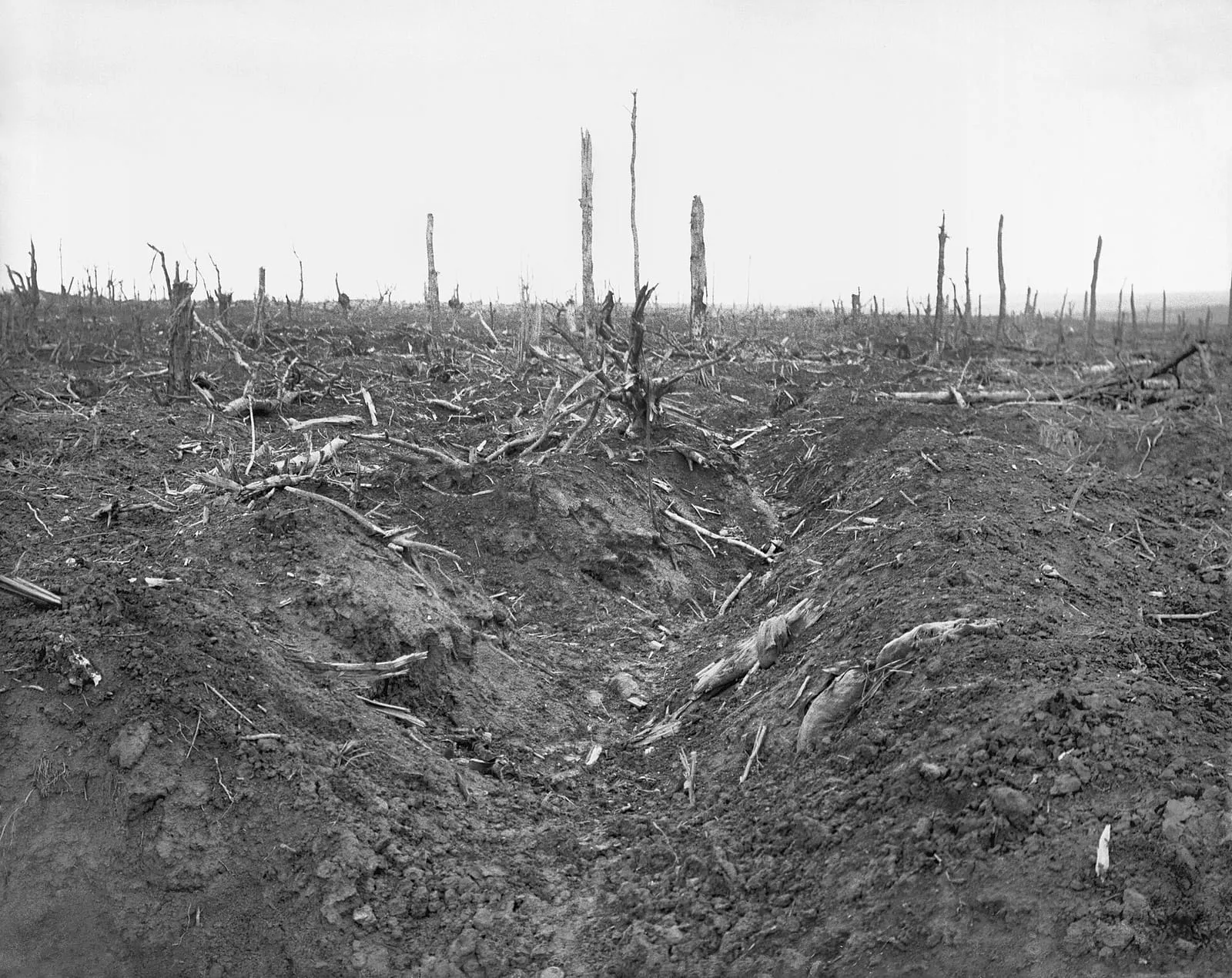
The Battle of Delville Wood was one of the bloodiest and longest engagements of the Battle of the Somme. It was fought for a copse of less than 65 hectares on the eastern edge of the village of Longueval, which after the British attack of 14 July 1916 had become the tip of a narrow salient in the German lines. On 15 July the wood was taken by the 1st South African Infantry Brigade of Brigadier-General Henry Lukin. For six days and five nights it held out there under fire from three sides against one German division after another, and came out decimated. Further British divisions then fought for the wood and the neighbouring village. The Germans were finally driven out of the wood only at the end of August, and their last counter-attack was repulsed at the beginning of September. British soldiers called the place Devil’s Wood, and for South Africa it became the symbol of its part in the First World War.
Name and dates
The French name of the wood is Bois d’Elville, which the British wrote as Delville Wood. After the war the British Battles Nomenclature Committee designated the “Battle of Delville Wood” as one of the battles that made up the Somme offensive and gave it the dates 15 July to 3 September 1916. These dates are used by the British official history and most studies, and following them by this site. The start is marked by the South Africans’ entry into the wood, the end by the attack on Ginchy on 3 September, after which the fighting for the wood passed into the next phase of the offensive.
Sources differ on when the wood was finally taken. The South African official history, based on John Buchan’s book, states that it was cleared on 25 August by the British 14th (Light) Division. The British official history says that the last German foothold in the wood, Edge Trench, was taken on 27 August. On 31 August, however, the Germans counter-attacked and recovered part of the eastern edge of the wood, and the fighting for it went on into the first days of September.
The names of the rides through the wood that appear in accounts of the fighting were given by the British. Princes Street ran east to west through the middle of the wood; to the north of it branched the Strand, Regent Street and Bond Street, to the south Buchanan Street, Campbell Street and King Street, and between Princes Street and the southern edge of the wood ran Rotten Row. Buchan remarked that it was a “curious mixture” of London and Glasgow names.
Background
The Longueval salient
On 1 July 1916 the British and French opened the Somme offensive. North of the Albert–Bapaume road the British attack collapsed with enormous losses, but on the right wing, next to the French, XIII and XV Corps took Montauban and Mametz. In the following days the British fought for Bernafay, Trônes and Mametz woods and for Contalmaison, and on 14 July the Fourth Army of General Henry Rawlinson attacked at dawn against the German second position from Bazentin-le-Petit to Longueval. The attack, which opened the Battle of Bazentin Ridge, was one of the greatest British successes of that summer.
On the right wing of the attack, XIII Corps of General Walter Congreve was to take Longueval. The commander of the British Expeditionary Force, General Douglas Haig, wanted to make the village the pillar of the new line, from which the front could be extended south-east towards the French. The village could not be held, however, without Delville Wood. The wood adjoined it on the east and overlooked its northern part, where the road climbed towards Flers. It was also the starting point for an attack on Ginchy and Guillemont. The village and the wood formed a projecting salient which the German artillery could shell from the north, east and south-east. Buchan wrote that it was a “vicious circle”: Longueval could not be taken and held without the wood, nor the wood without Longueval.
The wood itself was a thicket of beech and hornbeam with hazel undergrowth. The Germans had dug trenches through it along and across the rides, and sited their main machine-gun positions 50–200 metres from its edge. In July it was defended by the German IV Corps of General Friedrich Sixt von Armin, part of the Second Army of General Fritz von Below. After the offensive began, the chief of the German General Staff, Erich von Falkenhayn, ordered that not a foot of ground was to be given up and that lost positions were to be retaken at once by counter-attack, “even to the last man”. Below forbade voluntary withdrawals. At Delville Wood this doctrine meant dozens of costly counter-attacks.
The South African Brigade
The Defence Act of the Union of South Africa of 1914 did not allow troops to be sent outside South Africa. When, after the conquest of German South West Africa, Prime Minister Louis Botha and Minister of Defence Jan Smuts decided to send soldiers to Europe, they formed a separate overseas force made up of volunteers, which formally had the status of imperial troops. In August and September 1915 the 1st South African Infantry Brigade was recruited from white volunteers at Potchefstroom. Many of its soldiers had fought earlier in South West Africa, and Boers formed a large group, some of whom had fought against the British in the Second Boer War a dozen or so years before.
The brigade’s battalions were meant to represent the whole country. The 1st Battalion was the regiment of the Cape Colony, the 2nd of Natal and the Orange Free State, the 3rd of the Transvaal and Rhodesia, and the 4th Battalion, the South African Scottish, drew on the Scottish military traditions in the country. The brigade’s commander, the 56-year-old Henry Lukin, had served in South Africa since the Zulu War of 1879, in which he was severely wounded at Ulundi. At the beginning of 1916 the brigade fought in Egypt against the Senussi order, among other places at Agagia. In April it sailed for Marseille, was trained in trench warfare near Armentières and joined the 9th (Scottish) Division of Major-General William Furse, one of the volunteer divisions of Kitchener’s New Armies.
On 1 July the division was in XIII Corps reserve. In the following days the South Africans held the line in Bernafay and Trônes woods, and one company of the 4th Battalion took part in the fighting for Trônes Wood. By 13 July the brigade had lost 537 men, mainly to shellfire, including 7 officers killed. On 11 July the commander of the 4th Battalion, Lieutenant-Colonel F. A. Jones, was killed.
Course of the battle
14–15 July: taking the wood
At dawn on 14 July the Scottish 26th Brigade broke into Longueval. By noon it had taken the western and south-western part of the village, but the Germans resisted fiercely in its northern end, and the 27th Brigade, which was then to take the wood, itself became bogged down in the fighting in the village. The 1st South African Infantry Battalion of Lieutenant-Colonel F. S. Dawson was sent in to help, and in the afternoon it too was held up by machine-gun fire. At 1 p.m. Furse told Lukin that his brigade was to take over the task of capturing the wood. The attack was postponed several times, until it was settled that it would go in on the morning of 15 July. The order was that the wood had to be taken at all costs, even if the Scots did not capture the northern part of the village.
The attack of the 2nd and 3rd Battalions, supported by two companies of the 4th Battalion, was led by Lieutenant-Colonel William Tanner. The South Africans entered the wood at its south-western corner, from a trench along Buchanan Street that a company of the 5th Battalion, Cameron Highlanders had occupied during the night. The attack began at about six. By about seven the whole part of the wood south of Princes Street was in their hands, and three companies of the 2nd Battalion moved on to the northern edge. Resistance was weak, and the greatest obstacle proved to be the tangled undergrowth and fallen trees. Patrols of the 3rd Battalion took between 138 and nearly 190 prisoners in the east, depending on the source. In the afternoon Tanner reported that he held the whole wood except the north-western corner by the village and the orchards to the north.
Lukin intended to hold the wood with a few machine-gun posts, but German counter-attacks forced him to man the whole perimeter. According to the British official history, two battalions of the 24th Reserve Division counter-attacked before noon, losing 528 men between them, and in the early afternoon a battalion of the 8th Division, which lost all its officers. At about 3 p.m. the 6th Bavarian Reserve Infantry Regiment of the 10th Bavarian Division attacked from the east. All these attacks were beaten off, but one company of the 2nd Battalion ceased to exist. The men tried to dig in, but in ground matted with roots they managed to dig only shallow scrapes. During the night, according to Buchan, up to 400 shells a minute fell on the wood. In the evening twelve depleted companies were holding a perimeter several kilometres long, and the Germans in the north-western corner had a covered entry into its interior.
16–17 July: failed attacks
Early on 16 July Lukin received orders to close the northern entrance to Longueval to the Germans at all costs: his brigade was to complete the capture of the northern edge of the wood and push west to meet the 27th Brigade, which was attacking through the village. The attack at 10 a.m., preceded only by trench-mortar fire, failed completely. The Scots were stopped in the village by a fortified stone redoubt, and the South Africans by machine-gun fire from the orchard between the Flers road and North Street. During this fighting Private William Faulds of the 1st Battalion carried the badly wounded Lieutenant Craig, who was lying halfway between the trenches, back under fire in broad daylight. For this he received the brigade’s first Victoria Cross. Buchan links the deed with the fighting on 16 July; the official citation dates it to 18 July.
For the rest of the day the men in the wood, in heat and dust, endured shelling to which they could not reply. It was impossible to bring up food and water or to carry out the wounded. Dawson reported to Lukin that his men were exhausted, and Lukin passed this on to Furse, but Congreve’s order stood: the wood was to be held at all costs. There were no fresh troops. Before dawn on 17 July, after a night bombardment of the north-western corner, the 27th Brigade and the South Africans renewed the attack and were again repulsed. In the evening Tanner was wounded, and command in the wood passed to Lieutenant-Colonel E. F. Thackeray, commander of the 3rd Battalion. On the left wing the 3rd Division began relieving the 9th Division and was to attack Longueval from the west during the night.
18 July: the crisis
On the morning of 18 July the 76th Brigade of the 3rd Division broke into the orchard in the northern part of Longueval, and a company of the 1st Battalion made contact with it. Then the Germans opened a bombardment that Buchan called unparalleled. The shells searched every corner of the wood, falling most thickly on its perimeter and along the Strand, and in the rain the craters filled with water. According to the British official history, the German 8th Division and part of the 5th Division, in all elements of nine battalions and about 6,000 men, attacked the wood from the north and north-east, while the 107th Reserve Infantry Regiment attacked from the east along the Ginchy road. The 3rd Battalion broke up this last attack with rifle fire. In the north, however, the 2nd Battalion was overwhelmed, and the Germans forced their way into the wood through a gap on the South Africans’ left wing. The fighting broke down into clashes between small groups among the fallen trees.
At about 2.30 p.m. the situation became desperate. Dawson led 150 men of the 1st Battalion, who had only just come out of four days’ fighting, to the rescue, and the crews of Lieutenant Phillips’s trench-mortar battery were sent up from Montauban. Thackeray now held only the south-western corner of the wood, bounded by Buchanan Street and the western stretch of Princes Street. The trenches were full of wounded, because all the stretcher-bearers had been killed or wounded. That day the Scottish soldiers of the 26th Brigade saved the village from being lost by a counter-attack in Longueval. At 6.05 p.m. Lukin learned that the brigade would be relieved by the 26th Brigade during the night, but in these conditions the relief went very slowly.
19–20 July: the last handful
During the night of 18/19 July Thackeray’s handful beat off three German attacks. On the morning of 19 July soldiers of the 153rd Regiment and two companies of the 52nd Infantry Regiment entered the wood from the north and attacked from the rear B Company of the 3rd Battalion, which had run out of machine-gun ammunition. Its commander, Captain Medlicott, surrendered after eight o’clock. According to the British official history, 6 officers and 185 men of the Transvaal battalion were taken prisoner. The Scots from Longueval tried to break into the wood, but fire from the north-western corner drove them back. Throughout that day and the next the remnants of the brigade endured shelling and close-range sniper fire, without water or food.
On 20 July the 76th Brigade again came to the rescue. In the afternoon men of the Suffolk Regiment and the 6th Battalion, Royal Berkshire Regiment broke through to the South Africans, and at about six in the evening they took over what remained of their positions. Thackeray came out of the wood with two wounded officers and about 140 men from all the battalions of the brigade. For the fighting on 20 July the Victoria Cross was awarded to Corporal Joseph Davies and Private Albert Hill of the Royal Welch Fusiliers, and to Major William Congreve, a staff officer of the 76th Brigade and son of the commander of XIII Corps, who was killed in this fighting. On 21 July the survivors assembled in Happy Valley, behind the front. When the remnants of his brigade paraded before Lukin, the general, as Buchan wrote, took the parade bareheaded and with tears in his eyes.
July and August: the fight for the wood and the village
After the South Africans left, further British divisions fought for the wood and Longueval. On 19 July the Germans divided the Somme front: the troops north of the river became part of Below’s re-formed First Army, and the whole army group on the Somme was commanded by General Max von Gallwitz, who was also commander of the Second Army. On 23 July an attack by the 3rd and 5th Divisions on the northern part of the village and the wood was repulsed, although according to German accounts the defence of Longueval and the wood came close to collapse that day.
On 27 July the British guns of two corps, 369 guns and howitzers, pounded the wood and the village for an hour. When the bombardment ended, the 99th Brigade of the 2nd Division crossed a wilderness of craters and shattered trees and reached the northern edge of the wood at about nine, while the 15th Brigade of the 5th Division took its western part. Among the prisoners were 163 men of the German 8th Grenadier Regiment. A German counter-attack at 9.30, however, retook the eastern part of the wood, and the artillery pounded along Princes Street, inflicting heavier losses on the British than the attack itself. Sergeant Albert Gill of the King’s Royal Rifle Corps received the Victoria Cross for that day. On 30 July the 5th Division again attacked the positions north of the village, without much success.
At the beginning of August the front fell quiet for a while. The 17th Division twice, on 4 and 7 August, attacked the trenches north of the village and the wood without success. On 12 August it was relieved by the 14th (Light) Division, which on 18 August, as part of a larger attack by three corps, took some of the trenches east of the wood, but torrential rain spoiled the whole operation. On 24 August, behind a barrage moving forward in lifts of 25 yards, battalions of the 14th Division went through almost the whole wood and took over 200 prisoners and a dozen or so machine guns. The soldiers lit flares, and the airmen of contact patrols passed their positions on to headquarters. On 27 August one of the battalions of the 43rd Brigade took the rest of Edge Trench and captured about 60 prisoners from the 118th Infantry Regiment. According to the British official history, this was the last German foothold in the wood.
The last fighting: 31 August – 3 September
The Germans did not accept the loss of the wood. At the end of August a wave of fresh divisions arrived on the Somme, and on 31 August the 4th Bavarian and 56th Divisions made a pincer attack on the eastern and northern edges of the wood. Detachments of the 3rd Jäger Battalion, one of the first German assault formations (Stoßtruppen), took part in the attack with flamethrowers and grenade launchers. In the east the first two attacks failed because the mud put the flamethrowers out of action, but the third, after a heavier bombardment, pushed the British back into the wood. In the north the attack collapsed under fire, and the Jäger, who had taken about 300 prisoners, had to abandon the strip of ground they had won. Counter-attacks by the 24th Division in the following days achieved little.
On 3 September the 7th Division attacked Ginchy. The German positions on the eastern edge of the wood dominated the ground it had to cross, so the 24th Division was to take them five minutes earlier. The attack, carried out under conflicting orders, failed. Only the 55th Division, which relieved the 24th Division during the night of 5/6 September, dug in unhindered beyond the north-eastern edge of the wood on the following nights. Delville Wood and Longueval remained in British hands and two weeks later became the base for the attack in which tanks were used for the first time in history.
Losses
Figures for the losses of the South African Brigade vary depending on the source and the period taken. According to Buchan, at midnight on 14 July, when Lukin received the order to attack, the brigade numbered 121 officers and 3,032 other ranks, and about 750 men assembled in Happy Valley after the battle. The South African official history gives the losses of the individual battalions in the fighting for the wood and the village: 558 in the 1st, 482 in the 2nd, 771 in the 3rd and 509 in the 4th Battalion. Counting from 1 July, the brigade lost 2,815 men, including 502 killed, 1,785 wounded and 578 missing. The British official history puts the brigade’s losses in the fighting from 14 to 20 July at 2,536 men, and notes that later, higher figures sometimes added losses at Bernafay and in the fighting in Longueval to those in the wood. All the officers of the 2nd and 3rd Battalions who went into the wood were killed, wounded or taken prisoner.
According to its history, the whole 9th Division lost 314 officers and 7,303 other ranks in three weeks of fighting, roughly half its strength. The further British divisions that fought for the wood and the village suffered similar losses: the 3rd Division over 6,000 men in the second half of July, the 5th Division about 5,600, the 14th (Light) Division over 3,600 in August. Some of these losses, however, were incurred on other sectors of the front.
German losses are only partly known, because many Prussian records were burnt during the Second World War. According to the British official history, the 7th and 8th Divisions of IV Corps, holding the front from Delville Wood to Bazentin-le-Petit, lost 9,494 men from 15 to 27 July. The 26th Infantry Regiment, which was at full strength on 13 July, numbered 260 men on 20 July. The German 5th Division lost about 5,000 men at the wood, more than at Verdun in May.
Significance
The Battle of Delville Wood was a typical example of the attritional fighting that replaced the great attacks on the Somme after 14 July. Both sides threw single brigades and battalions into battle on narrow sectors, and rain and mud hampered both attack and defence. The historians Robin Prior and Trevor Wilson accused the British commanders of squandering men in small, badly co-ordinated attacks. Others, such as J. P. Harris, stressed that the Germans paid an even higher price, because by sticking to the principle of retaking every scrap of ground they exposed their infantry to the fire of the superior British artillery. The fighting also taught both sides that a wood should not be defended inside, where roots make digging impossible and shells bursting in the treetops shower the soldiers with wooden splinters, but on its edge or in front of it. In the end the British held the wood and Longueval, and from this base the attack on Flers was launched in September.
For South Africa Delville Wood became a place of national remembrance. After the war it was bought by the writer and politician Percy FitzPatrick and given to the country. On the edge of the wood stands a memorial designed by the architect Herbert Baker, with a sculpture by Alfred Turner showing two men with a horse, who, like the Dioscuri, symbolise the country’s two white communities, British and Afrikaner. Its inscriptions are in English and Afrikaans. The memorial was unveiled on 10 October 1926 by Louis Botha’s widow in the presence of Prime Minister Barry Hertzog, Field Marshal Haig and Tanner. It commemorates all South African soldiers who fell in the First World War, on all fronts. Lukin, who took command of the 9th Division in 1916, was vice-chairman of the memorial committee after the war. In 1986 a museum of the South African armed forces was opened next to it. In the wood, replanted after the war, traces of the trenches have survived, and by tradition the only tree that survived the shelling is a hornbeam still growing today.
Opposite the memorial, on the other side of the Longueval–Ginchy road, lies a Commonwealth War Graves Commission cemetery, one of the largest on the Somme battlefield, with over 5,500 graves, two-thirds of them of unknown soldiers. In 2023 the memorial and the cemetery were inscribed on the UNESCO World Heritage List among the funerary and memorial sites of the First World War on the Western Front.
Spotted a mistake?Report an error