Union of South Africa · The Entente
Louis Botha
Prime Minister of the Union of South Africa (1910–1919), commander-in-chief in the South West Africa campaign (1915)
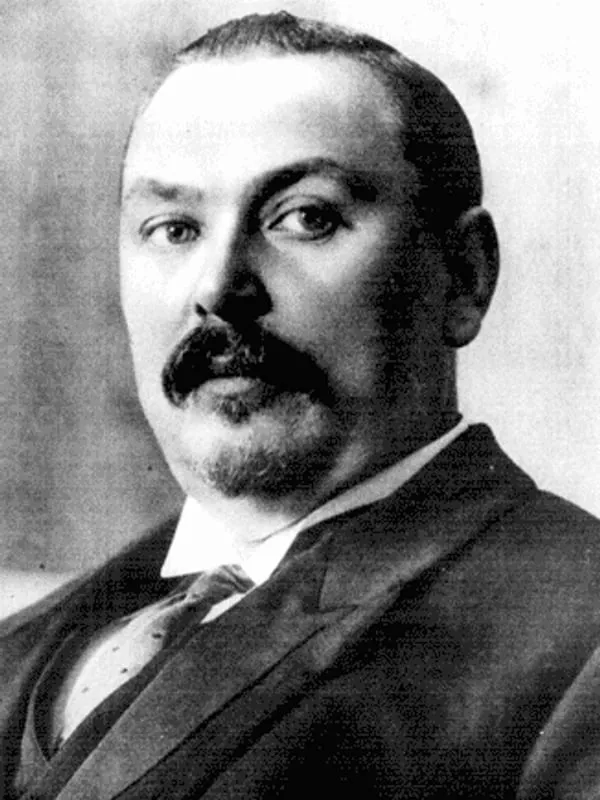
- Born:
- 27 September 1862, Greytown (Natal)
- Died:
- 27 August 1919, Pretoria
- Author:
- Łukasz Skowroń
- Photo:
- autor nieznany, domena publiczna, Wikimedia Commons

Louis Botha was one of the most remarkable figures of the Great War. A dozen or so years earlier, as commandant-general of the Transvaal, he had fought against the British in the Boer War, and in 1914, as prime minister of a British dominion, he sided with the Empire without hesitation. He paid for it with a revolt by part of his own people. He put down the Boer rebellion personally, and then himself led the forces of the Union of South Africa across the Namib Desert and in July 1915 accepted the surrender of German South West Africa. Later he sent soldiers to East Africa and to France, and in 1919 he signed the Treaty of Versailles on behalf of his country. He died two months later.
Before the war
He was born on 27 September 1862 near Greytown in the British Colony of Natal, into a family of Boer farmers who soon moved to the Orange Free State. He had almost no formal education. As a young man he took part in an expedition of Boer volunteers who in 1884 helped the Zulu ruler Dinuzulu in a civil war and received land in return. He settled at Vryheid, married Annie Emmett, and in 1897 took a seat in the parliament of the Transvaal.
Fame came to him with the Second Boer War. He led the Boers in the victorious battles of Colenso in December 1899 and Spion Kop in January 1900, and in March 1900, not yet 38, he became commandant-general of the Transvaal. After the fall of Pretoria he waged a guerrilla war. According to a legend repeated by Winston Churchill himself, it was Botha who took the young war correspondent prisoner in November 1899; more recent research contradicts this. In 1902 he negotiated the terms of surrender with Lord Kitchener and Alfred Milner and signed the Peace of Vereeniging.
From then on he staked everything on reconciliation with the British. Together with Jan Smuts, eight years his junior, who became his closest collaborator, he won self-government for the Transvaal and in 1907 became its prime minister. After the creation of the Union of South Africa in 1910 he took office as its first prime minister. His programme of reconciliation among whites, Boers and British, soon split his camp, however. In 1912 he removed from the government General Barry Hertzog, who in 1914 founded the nationalist National Party. In 1913 Botha’s government also passed the Natives Land Act, which forbade black inhabitants to buy land outside designated reserves.
1914: war and rebellion
When the war broke out, Botha immediately assured London of the Union’s loyalty and agreed to let the British garrison sail for Europe. At the beginning of August the British government asked him to seize the ports and wireless stations in German South West Africa. Some ministers feared that a war with Germany, which had sympathised with the Boers in 1899, would tear the country apart. Botha convinced them, however, that if the Union refused, the task would be carried out by troops from Australia or India, and the news that the Germans had crossed the border helped to win over public opinion. In September parliament backed the government by a large majority. That same month Union troops landed at Lüderitzbucht, and on 26 September they suffered a painful defeat at Sandfontein, just across the colony’s border.
In mid-September the commandant-general of the Union Defence Force, Christiaan Beyers, resigned, and General Koos de la Rey, who was travelling with him, was killed by a policeman’s bullet. In October Lieutenant-Colonel Manie Maritz went over to the Germans and the Boer revolt broke out, joined by Beyers, Jan Kemp and Christiaan de Wet. Botha refused to accept the help of British troops. He believed it was a quarrel among Afrikaners that Afrikaners had to settle themselves. He personally led the government forces, also made up mostly of Boers, and on 12 November routed De Wet’s main force at Mushroom Valley. The government promised an amnesty to rank-and-file rebels, De Wet was captured on 1 December, and Beyers drowned in the Vaal River. By the end of the year the rebellion had collapsed, and the last rebels laid down their arms at the beginning of February 1915.
Botha tried to soften the consequences of the fratricidal struggle. The leaders were sentenced to prison terms, but after about two years all were released. The only death sentence was carried out on 20 December 1914 on Captain Jopie Fourie, who had gone over to the rebels without resigning his commission in the Union army. The nationalists made him a martyr and Botha a traitor to his own people.
1915: South West Africa
After suppressing the rebellion Botha returned to the invasion plan, taking command personally despite his ministers’ fears for his safety. Four forces attacked the colony. Botha led the main one, the Northern Force, which from December had been assembling at Walvis Bay and at Swakopmund, taken in January. He arrived there in February and on 23 February set off inland. The march across the Namib Desert was above all a struggle for water and for the rebuilding of the wrecked railway. On 20 March his troops routed the Germans at Riet and Pforte, and captured documents showed that the enemy had stripped the south of the colony.
In April Botha advanced on Karibib, which he took on 5 May, and on 12 May he rode into Windhuk, which was surrendered without a fight. At the end of May he met Governor Theodor Seitz, who proposed a truce until the end of the war in Europe. Botha agreed to discuss only surrender. In the second half of June he advanced northwards on a broad front, with mounted troops outflanking the Germans on both sides. On 1 July his forces took Otavifontein, and on 9 July, at the “Kilo 500” marker stone near Khorab, Seitz and Lieutenant-Colonel Victor Franke signed the surrender. The terms were lenient: officers kept their arms and reservists returned to their farms. The campaign lasted less than six months and cost the Union relatively light losses.
Prime minister of a dominion at war
Botha returned home a victor, but the election of 20 October 1915 showed how deeply divided the Afrikaners were. His South African Party won 54 of the 130 seats and lost its overall majority, while Hertzog’s nationalists collected the votes of many former supporters of the rebellion. From then on the government relied on the support of the English-speaking Unionists. Even so, Botha allowed volunteers to be recruited for other fronts. An infantry brigade raised in the summer of 1915 fought in Egypt, and in July 1916 suffered heavy losses in Delville Wood on the Somme. Thousands of soldiers sailed to East Africa, and in February 1916 Smuts took over the supreme command there in the fight against Paul von Lettow-Vorbeck. Botha himself visited that front in 1916.
The government also agreed to send a contingent of black labourers to France. In February 1917 the troopship Mendi, which was carrying them, sank after a collision off the Isle of Wight, and more than six hundred men died. When David Lloyd George convened the Imperial War Cabinet in 1917, Botha did not go to London. He feared that a long absence might cause fresh unrest at home, and sent Smuts, who stayed in Britain for a long time.
1919: Paris
After the armistice Botha went to the Paris Peace Conference. He wanted South West Africa annexed to the Union, but when the talks on the colonies stalled he accepted a mandate, which in practice gave the Union control of the territory. This was regarded as one of his most important contributions to the proceedings. In the spring of 1919 he chaired a commission that was to bring about an armistice between Poland and the Ukrainians in Eastern Galicia. The demarcation line (PL) it proposed left Lviv on the Polish side and the oil basin near Borysław on the Ukrainian side. The Ukrainians accepted it; the Polish delegation rejected it. Botha considered many of the terms of the peace with Germany too harsh and said so openly, but on 28 June 1919, together with Smuts, he signed the Treaty of Versailles on behalf of the Union. For him it was proof that South Africa had become a state on a par with others.
Death
By then Botha was already seriously ill and exhausted. Soon after returning home he fell ill with influenza, and on 27 August 1919 he died of a heart attack in Pretoria, shortly before his 57th birthday. He was succeeded by Smuts.
Assessment
For the British and for English-speaking South Africans, Botha was a model statesman: a former enemy who kept the word he had given at Vereeniging and stood by the Empire at its most difficult moment. Soldiers appreciated the 1915 campaign, conducted swiftly, with great use of mounted troops and with small losses, although the enemy was many times weaker. The Encyclopaedia Britannica wrote in 1922 of his readiness to yield in small matters and his firmness in great ones.
Among Afrikaners opinion was far more divided. The nationalists never forgave him the war at the side of the British, the suppression of the rebellion and the execution of Fourie, and the split of 1914–1915 contributed to the later victories of the National Party. Modern historians also point out that the reconciliation he sought concerned whites only. His government’s policy, headed by the Land Act of 1913, entrenched the segregation of the black majority, and for the inhabitants of South West Africa the war ended merely in a change of colonial master.
Sources
Spotted a mistake?Report an error
Mentioned in battles
(02)Often appears with
People who appear in the same events.