1916: The Battle of the Somme
Battle of Pozières Ridge
- Dates:
- 23 July – 3 September 1916
- Front:
- Western Front
- Location:
- The ridge along the Albert–Bapaume road, from the village of Pozières and the windmill hill (Hill 160) east towards Courcelette and north towards Mouquet Farm and Thiepval, Somme department (France)On the battle map →
- Sides:
- United Kingdom and AustraliaDouglas Haig, Hubert Gough, William Birdwood, Harold Walker, James Gordon Legge, Herbert CoxGerman EmpireFritz von Below, Friedrich Sixt von Armin, Max von Boehn
- Result:
- A British victory bought at enormous cost. The Australians took Pozières and the crest of the ridge with the windmill, but did not capture Mouquet Farm. I ANZAC Corps lost about 23,000 men.
- Author:
- Łukasz Skowroń
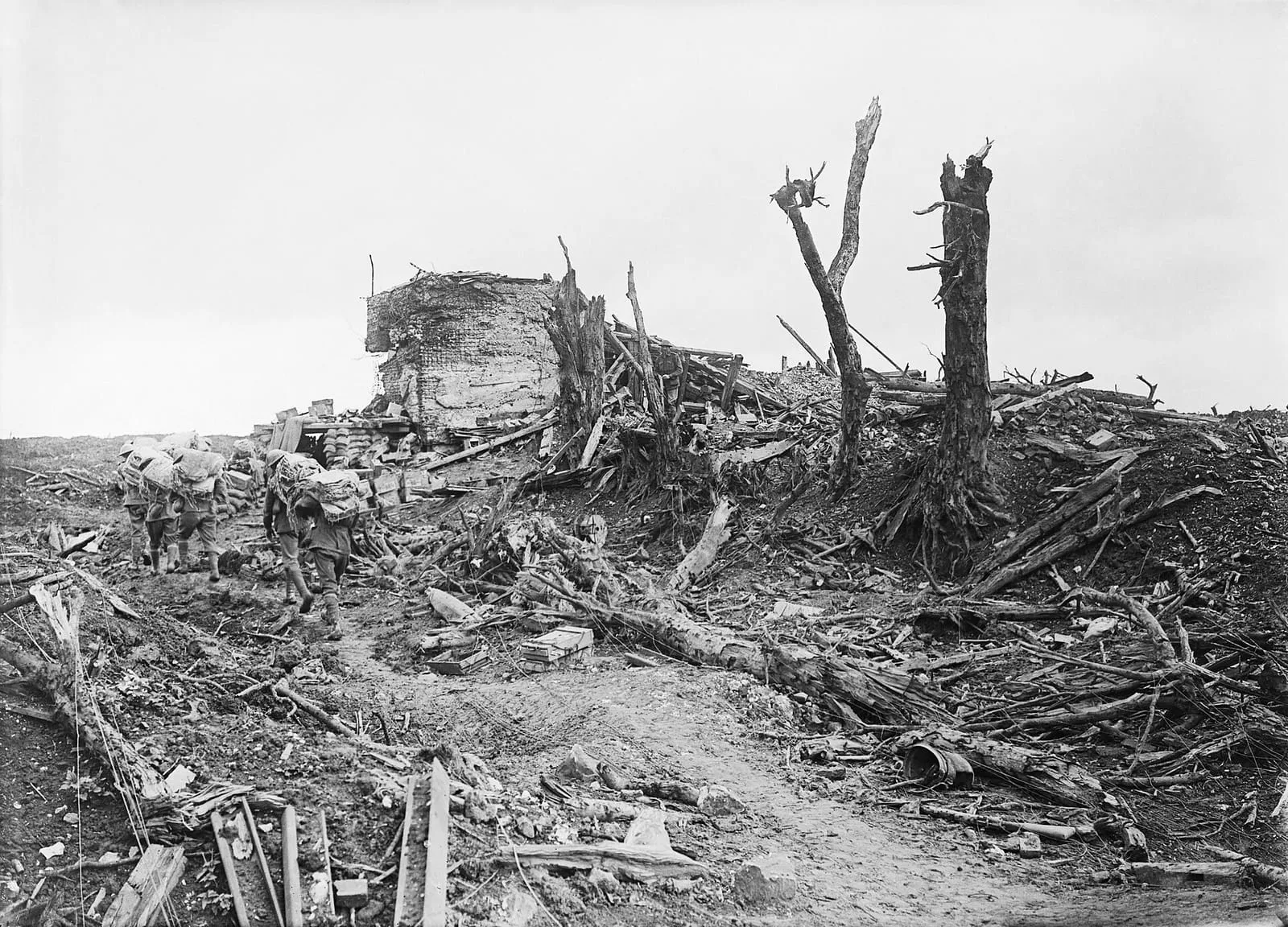
The Battle of Pozières Ridge was the Australians’ heaviest ordeal of the entire First World War. It was fought as part of the Battle of the Somme, in the centre of the British sector of the front, around the village of Pozières on the road from Albert to Bapaume. On the night of 22–23 July 1916 the 1st Australian Division took the village, which the British had attacked in vain for three weeks. On 4 August the 2nd Australian Division won the crest of the ridge with the ruins of a windmill, one of the highest points of the battlefield. After that the three divisions of I ANZAC Corps took turns pushing north in a narrow wedge towards Mouquet Farm, to take the German stronghold of Thiepval from the rear. They did not capture the farm. When the Canadians relieved the Australians at the beginning of September, the latter had lost about 23,000 killed, wounded and missing in under seven weeks. The Australian official historian Charles Bean later wrote that the Pozières ridge is “more densely sown with Australian sacrifice than any other place on earth”.
Name and dates
The name “Battle of Pozières Ridge” and the dates 23 July – 3 September 1916 were fixed after the war by the British Battles Nomenclature Committee. Formally the battle covers not only the fighting of the Australians but also the attacks of British divisions of the Reserve Army and of the left wing of the Fourth Army on the neighbouring sectors. In Australian memory, and on this page, it is above all the fighting of I ANZAC Corps for the village, the windmill hill and Mouquet Farm. The start date is the day of the night assault on Pozières. The end date is the day of the last Australian attack on Mouquet Farm. That afternoon the Canadian Corps took over command of the sector, and the last Australian units left the line over the following days. Some studies, particularly French and German ones, do not treat this as a separate battle and describe the fighting as part of the Battle of the Somme.
The main source for this page is the third volume of the Australian official history (Bean, The A.I.F. in France 1916, 1929). We give times after him, in British time. In German sources they are shifted by an hour.
Background
On 1 July 1916, on the first day of the battle, the British army suffered a bloody defeat north of the Albert–Bapaume road, but south of it, next to the French, it advanced. On 14 July General Henry Rawlinson’s Fourth Army took the German second position from Longueval to Bazentin-le-Petit. On the left wing of that sector, however, where the second position crossed the road to Bapaume, the Germans held on to Pozières. The village lay on an exposed, open plateau. Along its southern edge ran a trench the British called Pozières Trench; on the west it was covered by “K” Trench, running north towards Mouquet Farm and Thiepval; and a few hundred metres behind it, on the crest of the ridge, ran the two trenches of the second position, which the British named the O.G. Lines (from Old German). Behind them stood the remains of a windmill. The Germans called the spot Hill 160. Whoever held this ridge could see the British rear on one side and the German rear on the other, as far as Courcelette and beyond.
Several attempts by the Fourth Army’s III Corps to take the village in mid-July failed. On 18 July Douglas Haig handed Pozières over to the Reserve Army of General Hubert Gough, which held the front north of the Bapaume road. Gough was given General William Birdwood’s I ANZAC Corps. The Australians had come from Egypt to France in the spring of 1916, a few months after the evacuation from Gallipoli, and first held a quiet sector near Armentières. In mid-July three of the corps’ divisions, the 1st, 2nd and 4th, were moved to the Somme. The fifth, the 5th Australian Division, stayed in the north and on the night of 19–20 July bled itself white at the Battle of Fromelles. Many soldiers of the divisions fighting at Pozières were Gallipoli veterans, but a large proportion were newly arrived recruits who had never experienced artillery fire on the scale of the Western Front.
On the other side stood the German 1st Army of General Fritz von Below, formed on 19 July from the northern wing of the 2nd Army. In the second half of July Pozières was defended by units of the 7th Division and of the Silesian 117th Division, freshly brought down from Ypres, under the group of General Friedrich Sixt von Armin. At the end of July General Max von Boehn’s IX Reserve Corps entered the sector, and in the second half of August the Guards Reserve Corps was defending at Mouquet Farm.
Capture of the village (23–27 July)
Gough was impatient. He wanted Major-General Harold Walker’s 1st Division to attack on the very night after its arrival at the front, and intended to direct it himself, bypassing Birdwood’s staff. Walker pressed hard for time to prepare, and Birdwood and his chief of staff, General Brudenell White, obtained two postponements. In the end two brigades, the 1st from New South Wales and the 3rd from Queensland, South Australia, Western Australia and Tasmania, went in at 12.30 a.m. on 23 July, close behind the barrage, in three stages at half-hour intervals. Pozières Trench fell almost without a fight, and by 2 a.m. the Australians had dug in among the rubble along the main street. Only on the right wing, in the trenches of the O.G. Lines, did the attack stall. Private John Leak and Second Lieutenant Arthur Blackburn were awarded the Victoria Cross there. In the morning the Australians beat off a counter-attack by a battalion of the 157th Regiment, and on the night of 23–24 July they occupied the northern part of the village without a fight. The great attack of the Fourth Army from Pozières to Guillemont, carried out the same night, broke down everywhere else. Pozières was the only gain of the day.
It soon became clear that taking the village had been easier than holding it. For the Germans Pozières became a position that had to be recovered at any cost. From 24 July their artillery pounded the captured village and its approaches from several directions at once. Bean writes that the bombardment of 26 July, lasting with breaks from seven in the morning to eleven at night, was probably the heaviest to which Australian soldiers had yet been subjected. The village vanished. After a few days, where the houses and orchards had been there was a field of craters, from which only a concrete blockhouse protruded, which the Australians called Gibraltar. On 25 July the 1st Division, with the help of the British 48th Division, took the rest of “K” Trench as far as beyond the village cemetery. The attack on the O.G. Lines to the east failed again. On the night of 26–27 July the division was relieved by the 2nd Australian Division. In those few days the 1st Division had lost 5,285 men.
The windmill hill (28 July – 7 August)
Major-General James Gordon Legge’s 2nd Division was given the task of taking the O.G. Lines on the crest of the ridge. Gough pressed for haste. The attack went in at 12.15 a.m. on 29 July. Bean considers that there had been no time for careful preparation: the infantry had to assemble in the open and cross 350–450 metres without artillery cover, and the Germans, who were expecting an attack every day, spotted them before the assault. In several places they were also stopped by uncut wire. The attempt failed almost everywhere, and the division lost over 2,000 men, on top of the roughly 1,500 that the two previous days under shellfire had cost it. Haig was furious. Bean quotes the words he spoke to Birdwood and White at their headquarters in Contay: “You’re not fighting Bashi-Bazouks now. This is a serious, scientific war, and you are up against the most scientific and most military nation in Europe.”
Legge asked that his division be allowed to try again. This time jumping-off and communication trenches were dug for several nights under constant fire, and the attack was fixed for 9.15 p.m. on 4 August, just before dusk, when the crest of the ridge and the windmill mound were still visible against the sky. After three minutes of bombardment the battalions of the 5th, 6th and 7th Brigades moved forward and within a short time took both trenches of the O.G. Lines along almost their whole length. On the morning of 5 August the Australians saw from the ridge for the first time the treetops and roofs of Courcelette and the green hills behind the German lines. According to Bean, the commander of the 6th Brigade, General John Gellibrand, said that night that if three more Australian divisions and a few British ones had been behind them, they could have gone through to the other side.
The commander of the German 1st Army issued an order whose text the British later found on prisoners: Hill 160 had to be recovered at any cost, because in British hands it would give them an important advantage, and any officer or soldier who did not defend the ground gained to the death was to face a court martial. For three days the German artillery smothered the ridge with shells. On the morning of 7 August, just as the 2nd Division was being relieved by the 4th Australian Division, the Germans launched their last great counter-attack on the windmill hill and broke through to the crest, taking some of the defenders prisoner. Lieutenant Albert Jacka of the 14th Battalion, who at Gallipoli had won the first Victoria Cross of this war awarded to an Australian, burst out with a few men from the dugout in which the Germans had cut him off and fell on them from behind. Badly wounded, he freed the prisoners and helped to repel the counter-attack. Bean judged it the most dramatic and effective act of individual bravery in the history of the Australian army. Jacka received the Military Cross for it. The crest of the ridge remained in Australian hands. According to Bean, the 2nd Division paid for it with about 6,800 killed, wounded and missing.
Towards Mouquet Farm (8 August – 3 September)
Gough now decided to strike north along the ridge towards Mouquet Farm, to take from the rear Thiepval, for which the British had fought in vain since 1 July. The task was to be carried out by successive Australian divisions advancing in night attacks on a narrow front. Such a wedge was exposed on three sides to German artillery fire, and every step forward lengthened the salient. From 8 August Major-General Herbert Cox’s 4th Division, in six successive night attacks, came within assaulting distance of the farm, losing 4,649 men. In the second half of August the decimated 1st and 2nd Divisions returned to the front, only partly brought up to strength, because reinforcements from Australia were beginning to run out. Their attacks on the farm and the neighbouring trenches brought small gains. The farm was in ruins, but beneath it lay deep cellars and dugouts from which the defenders emerged after every bombardment.
The last Australian attack was carried out on 3 September by the 4th Division, on the day of a wider British attack, including at Thiepval and Guillemont. Its 13th Brigade took a stretch of Fabeck Graben trench east of the farm, but the attacks on the farm itself failed. That afternoon Birdwood handed over command of the sector to General Julian Byng’s Canadian Corps, and Canadian companies sent in to help held the captured foothold together with the remnants of the Australians. Over the following days the Canadians relieved the last Australian battalions. Mouquet Farm fell only on 26 September, when the British 11th Division passed through it in a wider attack by the Reserve Army in which Thiepval was also taken. The last Germans, hidden in the farm’s cellars, surrendered only in the evening.
Losses
According to Bean, I ANZAC Corps lost about 23,000 killed, wounded and missing in this battle: the 1st Division about 7,700, the 2nd Division about 8,100 and the 4th Division about 7,100. Other tallies give about 24,000, including nearly 7,000 killed and died of wounds. Together with the 5,500 losses of the 5th Division at Fromelles, the Australian forces in France lost over 28,000 men in under seven weeks, an average of more than 7,000 per division. Fewer than 200 Australians were taken prisoner. Bean calculates that in six weeks the Australian divisions made nineteen successive attacks in the same sector, rarely on a front wider than a mile and a half. The Germans, following the principle that every lost trench had to be retaken, counter-attacked again and again and also suffered heavy losses. The 4th Guards Division alone lost about 3,200 men at Mouquet Farm in three weeks. Full figures for German losses in this battle have not been established. For the fighting at Pozières and Mouquet Farm the Australians received five Victoria Crosses.
Significance
Pozières was one of the few clear British gains on the Somme in the summer of 1916. Taking the ridge gave the British a view into the German rear as far as Courcelette and threatened Thiepval from behind. From these positions the Canadians set out for Courcelette on 15 September. Bean, however, judged the conduct of the battle severely. Throwing brigade after brigade in a series of battering-ram blows against one of the strongest points of the German defence might, in his view, be called “methodical”, but it was certainly not economical. He blamed the tactic on Haig, who had laid down the principle of constant pressure through small attacks, and on Gough, who in the details of its execution constantly demanded haste.
The losses at Pozières also had political consequences in Australia. There were not enough volunteers to replace the bled-white divisions, and Prime Minister Billy Hughes decided to put the introduction of conscription for service overseas to a vote. The referendum in October 1916 ended with conscription being rejected and deeply divided Australian society. Bean also notes that the strain of those weeks changed the Australian soldiers’ attitude to the war.
Pozières today holds a place in Australian memory beside Gallipoli. Next to the ruins of the Gibraltar blockhouse stands the memorial of the 1st Australian Division, and on the site of the windmill, on the other side of the village, an Australian memorial commemorating the fighting on the ridge. Thousands of soldiers killed in this battle lie in the surrounding war cemeteries.
Spotted a mistake?Report an error