Australia · The Entente
Billy Hughes
Attorney-General (1914–1921), Prime Minister of Australia (1915–1923)
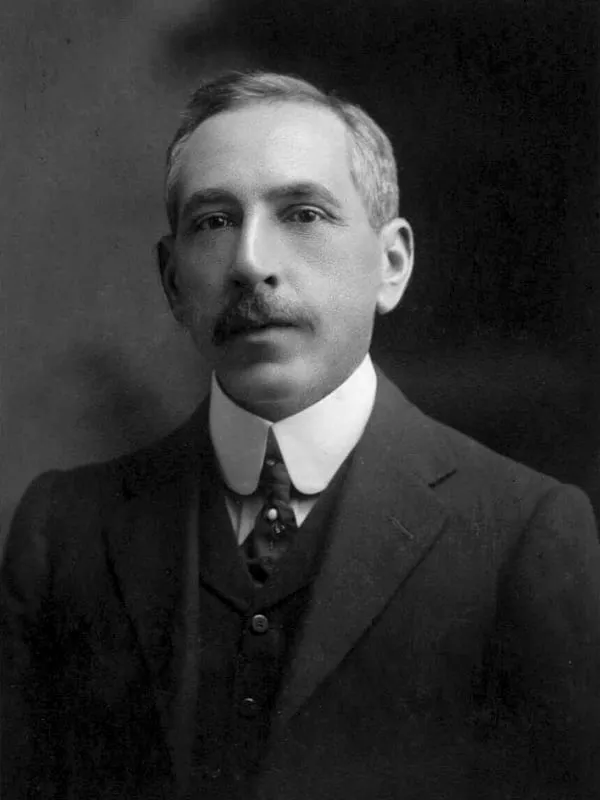
- Born:
- 25 September 1862, London (Pimlico)
- Died:
- 28 October 1952, Sydney (Lindfield)
- Author:
- Natalia
- Photo:
- National Library of Australia, domena publiczna, Wikimedia Commons

William Morris Hughes, known as Billy, was Prime Minister of Australia for most of the Great War and one of the most colourful figures in the politics of the Empire. Slight, almost deaf, hot-tempered and sharp-tongued, he made his way from wharf labourer and trade union organiser to a statesman who quarrelled with the President of the United States at the peace conference table. During the war he twice tried to introduce conscription for service overseas and twice lost in a popular vote, and in the process he split the Australian Labor Party, of which he had been one of the founders. The soldiers called him “the Little Digger”, while the labour movement still regards him as a traitor.
Before the war
He was born on 25 September 1862 in the London district of Pimlico, into a Welsh family. His father was a carpenter at the Palace of Westminster. After his mother’s death the boy grew up with relatives in Llandudno in Wales, and he remained proud of his Welsh origins all his life. In London he went to school and then helped at a school as a pupil-teacher. In 1884 he emigrated to Queensland, where, as he himself told it, he took on many jobs, from fruit-picking to cattle droving. Biographers treat these stories with caution. On arrival he also gave a false year of birth, which came to light only after his death.
In Sydney he ran a small shop, and in the late 1890s he took up organising the wharf labourers. He became secretary of their union and one of the most effective trade union leaders in Australia. In 1894 he entered the New South Wales parliament, and in 1901 the first federal parliament. In the evenings he studied law and became a barrister. In the governments of Andrew Fisher he was Attorney-General, that is, minister of justice, and the only lawyer in the cabinet. From 1907 he was deputy leader of the Labor Party. He was an ardent supporter of the White Australia policy, which closed the country to immigration from Asia.
Attorney-General and Prime Minister
In September 1914, after Labor’s victory in the election, Hughes again became Attorney-General. He drafted the War Precautions Act, which gave the government wide powers, including censorship and internment. He also set about breaking pre-war contracts that had put Australian metal ores, especially zinc, in the hands of German firms, and organised their sale within the Empire. On 27 October 1915, when the tired and ailing Fisher stepped down, Hughes became Prime Minister.
At the beginning of 1916 he sailed to Britain. In a series of fiery speeches he called for imperial unity and for ruthless economic war against Germany, even after peace had been made. The speeches were published as a book, which became a bestseller. In June, in Paris, he represented Australia at the Allied economic conference, where he put forward the most far-reaching proposals. In London he also bought fifteen or so ships, which became a state shipping line to secure the export of Australian wool and wheat. He visited the soldiers in France. He did not get on with Asquith. Lloyd George later wrote that the two were entirely different types of men and that their conversations gave pleasure to neither.
Conscription and the split
In the summer of 1916 the Australian divisions lost tens of thousands of men on the Somme, especially in the fighting for Pozières Ridge, and volunteers were not enough to replace them. The commanders of the Australian Imperial Force convinced Hughes that five divisions could not be maintained without conscription for service overseas. The Labor Party was divided and the Senate offered no guarantee that a bill would pass, so at the end of August the Prime Minister announced a popular vote. The campaign divided the country: conscription was opposed by most trade unions, by many Catholics of Irish descent, angered by the suppression of the Easter Rising, and by a large part of the party. In September the New South Wales Labor executive expelled Hughes from the party. On 28 October 1916 conscription was defeated by a narrow margin: 1,160,033 people voted against and 1,087,557 in favour.
On 14 November, as the parliamentary caucus met to strip him of the leadership, Hughes walked out of the room with twenty-odd supporters. He said later that he had not left the party; the party had left him. He went on governing as leader of the minority National Labor Party, and in February 1917 formed a war government with Joseph Cook’s Liberals and a new Nationalist Party. In May 1917 the Nationalists won the election in both houses, and Hughes won the seat of Bendigo. Because of the election campaign he did not go to the first sessions of the Imperial War Cabinet that spring. Earlier, in February 1917, he had agreed that Britain should promise Japan support for its claims to the German islands north of the equator.
He had promised not to return to the question of conscription unless the fortunes of war turned against the Allies. In November 1917 he decided that this condition had been met and announced a second vote. The campaign was even more bitter. With a squad of soldiers Hughes seized in Brisbane the transcripts of anti-conscription speeches from the Queensland parliament, and after an incident at Warwick, where he was hit by an egg, he created a federal police force. On 20 December conscription was defeated more clearly than a year earlier. Hughes, who had said he would not govern without conscription, resigned in January 1918, but the Governor-General found no one else and again entrusted him with forming a government. Until the end of the war Australia did not introduce conscription for service overseas, and its soldiers fought solely as volunteers.
1918: London and the front
In the spring of 1918 Hughes sailed via the United States to London and in June took his seat in the Imperial War Cabinet. There he looked after Australian interests in the Pacific and demanded that captured German New Guinea be kept after the war. On 2 July, on his way to a session of the Supreme War Council, he visited soldiers preparing for the Battle of Hamel. The commander of the Australian Corps, General John Monash, made a strong impression on him, although Monash’s appointment had been criticised at home and by some war correspondents. Hughes ultimately backed Monash. In the autumn, as volunteers grew ever fewer and the divisions dwindled, the Prime Minister pressed the British to withdraw the whole corps to rest after the fighting for the Beaurevoir Line, which happened at the beginning of October. He also insisted that Australia be consulted on the armistice terms, and protested sharply when the Allies accepted President Woodrow Wilson’s Fourteen Points without consulting the Dominions.
The peace conference
In Paris Hughes, together with the Canadian Prime Minister Robert Borden, won separate seats at the conference for the Dominions and the right to sign the treaty. He demanded the annexation of New Guinea and clashed sharply with Wilson, who wanted to place the former German colonies under the supervision of the League of Nations. According to Lloyd George’s account, when the President asked whether Australia was prepared to defy the appeal of the whole civilised world, Hughes replied that that was about it. The compromise was the class C mandates, which in practice allowed a territory to be administered as part of one’s own country. Hughes sat on the reparations commission and demanded enormous sums from Germany. His most lasting mark, however, was his opposition to the Japanese proposal to write the principle of racial equality into the Covenant of the League of Nations, which Hughes feared as a threat to the White Australia policy. The proposal failed, and the Japanese took it with resentment. On 28 June 1919 Hughes signed the Treaty of Versailles, the first international treaty signed by Australia.
After the war
At home he was received as a victor, and in December 1919 the Nationalists won the election. His position soon weakened: his conservative allies did not trust the former socialist, and the new Country Party refused to govern with him. In February 1923 he had to make way for Stanley Bruce. He remained in parliament for almost thirty more years, changing his party colours several times, and in the 1930s and at the beginning of the Second World War he was again a minister. He died on 28 October 1952 at his home in Lindfield in Sydney, a member with more than fifty years’ service in the federal parliament.
Assessment
Hughes remains one of the most controversial figures in Australian history. To his supporters he was an energetic war leader who won the country recognition in the Empire and on the international stage, and who in Paris single-handedly secured what mattered most for Australia. The Australian historian Ernest Scott wrote that Hughes, although he did not obtain everything, achieved things vital to the country’s existence. Joan Beaumont observes that in later historiography he even became a folk hero thanks to his firmness at the peace conference.
Critics point out that the conscription campaigns, waged with censorship, pressure on opponents and attacks on the loyalty of Catholics, tore Australian society apart and divided the labour movement for decades. The Americans saw him as a demagogue, and Wilson reportedly called him a “pestiferous varmint”. His opposition to the racial equality clause is seen today as an expression of the racism of the era, which poisoned relations with Japan. Most historians agree that he was an exceptionally able politician, but also an exceptionally difficult one to work with, who divided more often than he united.
Sources
Spotted a mistake?Report an error
Mentioned in battles
(03)Often appears with
People who appear in the same events.