United States · The Entente
Woodrow Wilson
President of the United States (1913–1921)
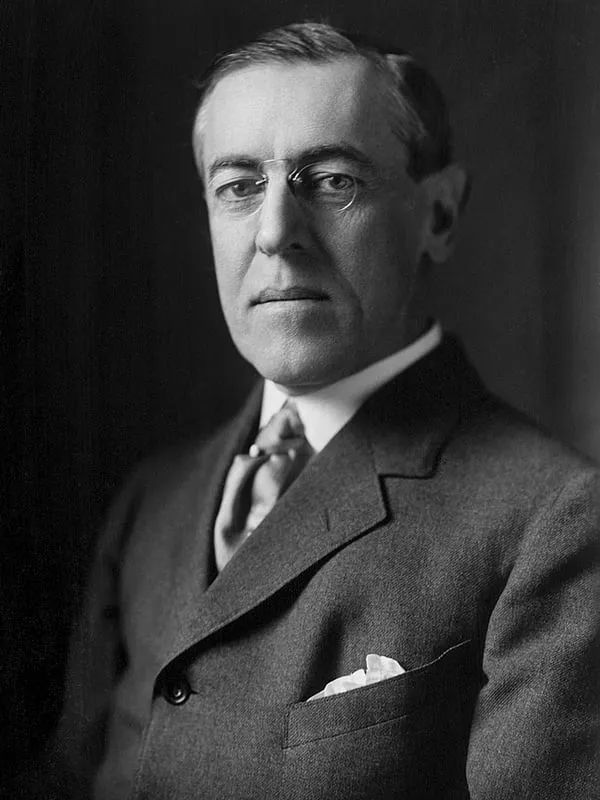
- Born:
- 28 December 1856, Staunton (Virginia, United States)
- Died:
- 3 February 1924, Washington, D.C.
- Author:
- Łukasz Skowroń
- Photo:
- Harris & Ewing, domena publiczna, Wikimedia Commons

Thomas Woodrow Wilson, a professor of history and political science who became President of the United States, was one of the few figures of this war whose influence reached far beyond the battlefield. For two and a half years he kept his country neutral, arguing in endless notes with Germany over submarine warfare and with Britain over the blockade, and he tried to mediate between the belligerents. In April 1917 he took America into the war, which, thanks to its men, money and industry, ended a year and a half later in Germany’s defeat. His Fourteen Points became the best-known peace programme of the age and, for Poles, Czechs, Slovaks and Yugoslavs, a promise of freedom. At the Paris Peace Conference Wilson brought the League of Nations into being, but his own country rejected the Treaty of Versailles, and he himself, paralysed after a stroke, ended his presidency a broken man.
Before the war
He was born on 28 December 1856 in Staunton, Virginia, the son of a Presbyterian minister of Scots-Irish descent and the daughter of a minister from Scotland. He spent his childhood in the South, in Augusta, Georgia, where he lived through the Civil War, and later in South and North Carolina. The stern Calvinist piety of his home, his belief in a moral order of the world and in his own calling stayed with him all his life. In 1879 he graduated from the College of New Jersey, later Princeton University, briefly studied law and tried his hand as a lawyer, and in 1886 he received his doctorate from Johns Hopkins University. He remains the only President of the United States to have held a doctorate.
From 1890 he taught at Princeton, and in 1902 he became president of the university. In 1910 the Democratic Party leaders in New Jersey put him forward for governor, counting on an obedient academic. Wilson won the election, then turned against the party bosses and carried through a series of reforms. In 1912 he won the Democratic nomination for president, and in November he won the election thanks to a split among the Republicans, some of whom followed the incumbent president William Taft and some Theodore Roosevelt. He took just under 42 per cent of the vote, but a huge majority in the Electoral College.
He took office on 4 March 1913. His “New Freedom” programme brought lower tariffs, a federal income tax, the creation of the Federal Reserve System and a new antitrust law. The same administration, however, introduced racial segregation in some federal offices in Washington. In foreign policy Wilson promised a break with his predecessors’ dollar diplomacy, but in practice he repeatedly intervened by force in Latin America. In April 1914 the American navy seized the Mexican port of Veracruz to weaken the dictator Victoriano Huerta, and in the years that followed US troops landed in Haiti and the Dominican Republic.
Neutrality, 1914–1915
The outbreak of war found Wilson in personal tragedy: on 6 August 1914 his wife Ellen died. Two days earlier he had issued a proclamation of neutrality, and on 19 August he appealed to his countrymen to be impartial “in thought as well as in action”. In a nation of immigrants, where millions had German and Irish roots and the East Coast elites sympathised with Britain, he saw neutrality as a condition of national unity. He also hoped that America, by staying out of the fighting, would be able to mediate a peace. At the beginning of 1915 he sent his trusted adviser, Colonel Edward House, to Europe to sound out the capitals’ readiness for talks. The mission came to nothing.
Neutrality, however, meant disputes with both sides. The British blockade hit American trade, and the State Department protested in note after note. In time it became clear that trade with the Entente was bringing the country enormous profits, and from the autumn of 1915 the government no longer stood in the way of American banks lending to it. The United States could supply Germany with little. When in February 1915 Berlin declared a war zone around the British Isles, Wilson warned that he would hold the German government to “strict accountability” for every American death. On 7 May 1915 a German submarine sank the Lusitania, and more than a hundred US citizens died with her. The president did not go to war. Three days later he said in Philadelphia that there is such a thing as a man being “too proud to fight”, and in his notes to Berlin he demanded that such attacks be renounced. The second note was so firm that in June the pacifist-minded Secretary of State William Jennings Bryan resigned in protest, and his place was taken by Robert Lansing.
After the sinking of the Arabic, Germany promised in September 1915 that its submarines would not sink passenger liners without warning. At the same time Wilson listened more and more closely to the advocates of armament. At the end of 1915 he backed a programme of “preparedness” for war, and in 1916 Congress passed an expansion of the army and a great naval construction programme. In December 1915 the president married again, the widow Edith Bolling Galt.
Mediator, 1916
At the end of 1915 Wilson sent House to Europe a second time. In February 1916 House agreed with the British Foreign Secretary Edward Grey a memorandum under which the United States, at the Entente’s request, would call a peace conference and, should Germany reject it, would probably enter the war. London and Paris never formally asked for this. In March 1916 a German submarine torpedoed the ferry Sussex. This time the president issued an ultimatum: in his note of 18 April he threatened to break off diplomatic relations unless Germany stopped attacking merchant ships without warning. Berlin gave way for a few months. At the same time Wilson was struggling with trouble on his own border. After Pancho Villa’s men raided the small town of Columbus, New Mexico, in March 1916, he sent a punitive expedition into Mexico under General John J. Pershing, which did not return until early 1917.
The Democrats fought the November 1916 election under the slogan “He kept us out of war”, and Wilson won it narrowly against the Republican Charles Evans Hughes. Strengthened, he decided to try mediation once more. In his note of 18 December he asked the belligerents to state their peace terms, and on 22 January 1917, before the Senate, he called for “peace without victory”, since only a peace between equals could last. In the same speech he declared himself in favour of “a united, independent and autonomous Poland”. Poles on both sides of the front received these words with great hope.
The road to war
Nine days later Germany declared unrestricted submarine warfare. Wilson, who was still unsure whether an Entente victory was in the world’s interest, broke off diplomatic relations with Germany on 3 February, but still hoped that “armed neutrality” would suffice. At the end of February he asked Congress for authority to arm merchant ships, and when a group of senators blocked the bill, he armed them on his own authority. Public opinion was shaken at this time by the Zimmermann Telegram, revealed by the British, in which the German Foreign Secretary offered Mexico an alliance and the recovery of Texas, New Mexico and Arizona. In March submarines sank three American ships, and the revolution in Russia overthrew the tsar, which made it possible to present the war as a struggle of democracy against autocracy.
On 2 April 1917 Wilson asked Congress to recognise a state of war with Germany, saying that “the world must be made safe for democracy”. On 6 April the United States entered the war. Wilson stressed that America was not fighting for gain, and he concluded no alliance with the Entente. The United States was only an “associated power”, not bound by the Allies’ secret agreements. It declared war on Austria-Hungary only in December 1917, and on Turkey and Bulgaria never.
War president
The country was unprepared for a great war. In April 1917 the regular army numbered about 130,000 men. Wilson relied on conscription, which Congress passed at the end of April, and he placed Pershing at the head of the American Expeditionary Forces. Together with him he rejected the French and British demands that American soldiers be fed into their units. The Americans were to fight in their own army, under their own command. The whole economy worked for the war, directed by new agencies managing industry, food, fuel and transport. At the same time the government set up the Committee on Public Information, the first modern propaganda office, and the Espionage Act of 1917 and the Sedition Act of 1918 were used to prosecute opponents of the war. Among others, the Socialist leader Eugene Debs was sentenced to ten years in prison for an anti-war speech.
On 8 January 1918 Wilson presented to Congress the Fourteen Points, a programme for a peace based on open diplomacy, freedom of the seas, disarmament and the self-determination of nations, crowned by a general association of nations. Point thirteen called for an independent Polish state with access to the sea. A month later he added the Four Principles. At that time he was still promising the peoples of Austria-Hungary only autonomy, but in the summer of 1918 his administration came out for the complete liberation of the Slavs from German and Austrian rule, and in September it recognised the Czechoslovak National Council. On Russia Wilson hesitated for a long time, but in the summer of 1918 he agreed to send small American forces to Vladivostok and Archangel.
In the summer of 1918 as many as 10,000 Americans a day were arriving in France, and by November there were nearly two million of them there. They fought at Belleau Wood, in the Second Battle of the Marne, at Saint-Mihiel and in the Meuse–Argonne offensive. About 116,000 American soldiers died in the war, many of them of disease, above all influenza.
The armistice
At the beginning of October 1918 Germany and Austria-Hungary turned to Wilson with a request for an armistice on the basis of the Fourteen Points. The president conducted the exchange of notes himself, over the heads of the Allies. In his first reply he asked whether Berlin accepted his programme; in the second he demanded that the armistice terms guarantee the superiority of the Allied armies; and in the third he warned that if he had to deal with the military masters and monarchical autocrats of Germany, he would demand not negotiations but surrender. For Emperor Wilhelm II this was a death sentence. To Austria-Hungary he replied that autonomy for its peoples was no longer enough. In Paris Colonel House persuaded the Entente prime ministers to accept the Fourteen Points as the basis of peace, with two reservations, on freedom of the seas and on reparations, which were passed on to Germany by the Lansing Note of 5 November. Six days later the German plenipotentiaries signed the Armistice of Compiègne in the railway carriage of Marshal Ferdinand Foch.
Paris and defeat in the Senate
Wilson decided to lead the American delegation to the peace conference in person. It was a double risk. In the elections of 5 November 1918, despite his appeal for support for the Democrats, the Republicans won a majority in both houses of Congress, and the president took no influential Republican with him to Paris. On 13 December he landed at Brest, the first sitting US president in Europe. In Paris, London and Rome he was greeted by huge crowds, for whom he was the herald of a just peace.
At the conference Wilson was one of the “Big Four”, alongside the prime ministers of France, Georges Clemenceau, Britain, David Lloyd George, and Italy, Vittorio Emanuele Orlando. What mattered most to him was the League of Nations, whose Covenant was drafted by a commission under his chairmanship and written into the peace treaties. On many issues he gave way. He agreed to reparations, to the occupation of the Rhineland, to handing Germany’s rights in Chinese Shandong to Japan and to the mandate system, which in practice divided the German colonies and Arab lands among the victors. On the Adriatic, however, he dug in. When the Italians demanded Fiume, in April 1919 he appealed to them over the heads of their government with a manifesto, after which Orlando and Sidney Sonnino left the conference for several weeks. He supported the rebuilding of Poland and was well disposed towards it, but in the dispute over Danzig he and Lloyd George accepted the compromise of a free city. The Treaty of Versailles was signed on 28 June 1919.
At home the treaty met strong resistance. The Republicans, led by the chairman of the Senate Foreign Relations Committee, Henry Cabot Lodge, were ready to ratify it only with reservations, above all to Article 10 of the League Covenant, which could oblige the United States to defend other states without the consent of Congress. Wilson refused to compromise and in September 1919 set off on a tour of the country to win over the voters. On 25 September he collapsed in Pueblo, Colorado, and on 2 October, in the White House, he suffered a severe stroke that left the left side of his body paralysed. For many months access to him was controlled by his wife and his doctor, and the country in practice had no functioning president. The Senate rejected the treaty in November 1919 and finally on 19 March 1920, when a few votes were lacking for a two-thirds majority. The United States never joined the League of Nations, and it made peace with Germany by a separate treaty in 1921.
After the presidency
In the November 1920 election the Democrats suffered a heavy defeat, and the Republican Warren Harding, who promised a “return to normalcy”, became president. In December 1920 Wilson received the Nobel Peace Prize for 1919. On 4 March 1921 he left the White House and settled in Washington. Gravely ill, he scarcely appeared in public. He died on 3 February 1924 and, as the only president to be so, was buried in the capital, in Washington National Cathedral.
Assessment
Wilson is one of the most disputed presidents of the United States. His admirers, among them the biographer Arthur Link and John Milton Cooper, see him as a visionary who first brought America into world politics and proposed an order based on law, the self-determination of nations and collective security. The ideas of “Wilsonianism” returned after 1945 in the United Nations and in American foreign policy. For the nations of Central Europe, the Poles among them, he was for decades a symbol of justice, and streets and squares in Warsaw, Prague and many other cities bear his name.
His critics charge that his neutrality was partisan from the start, since he tolerated the British blockade while treating submarine warfare as a casus belli. Others, on the contrary, believe that he waited too long to enter the war and to prepare the country for it. In Paris, as the economist John Maynard Keynes, who attended the conference, wrote, he was outplayed by the European politicians, and the Treaty of Versailles was neither a just peace nor a lasting one. His intransigence in the dispute with the Senate, partly a result of his illness, deprived the League of Nations of American participation. Historians also point to the contradictions in Wilson himself: the champion of national self-determination intervened by force in Mexico, Haiti and the Dominican Republic, and the advocate of democracy tolerated racial segregation and the repression of opponents of the war. For this reason in 2020 Princeton University removed his name from its school of public and international affairs. Despite these reservations, most historians agree that no other politician did as much to give the war an aim beyond victory, and that the world after 1918 was shaped to a great extent by his ideas, though not in the way he had wished.
Sources
Spotted a mistake?Report an error
Mentioned in battles
(03)Often appears with
People who appear in the same events.
On the timeline
(103)The 40 most important of 103 events. All tagged “Woodrow Wilson” (41) →