Key event
Sinking of the Lusitania
- Category:
- Military operations
- Front:
- War at sea
- Date:
- 7 May 1915
- Author:
- Natalia
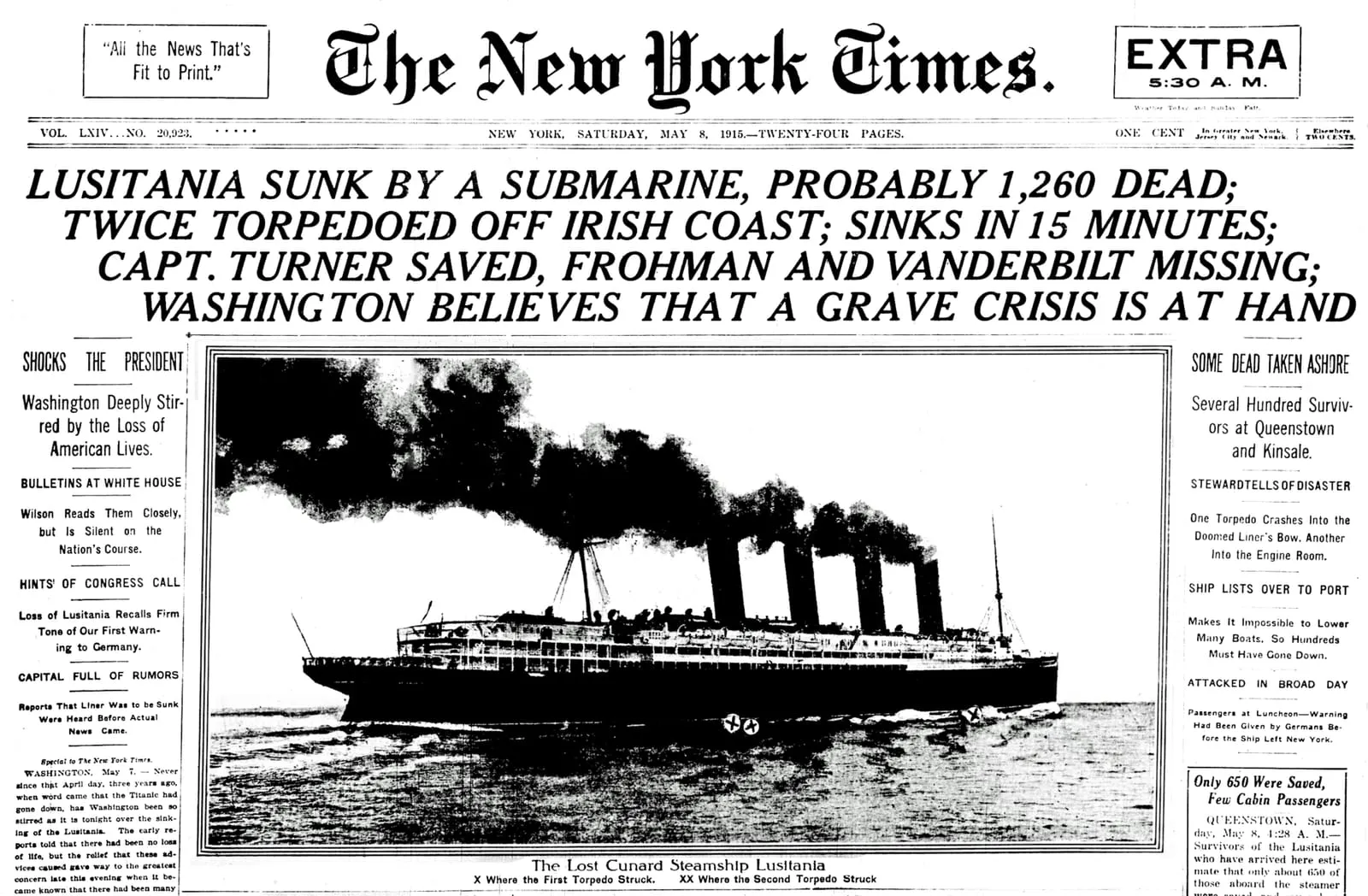
On 7 May 1915 at about 2.10 p.m. the German submarine U-20 torpedoed the British liner Lusitania off the southern coast of Ireland, a dozen or so nautical miles from the Old Head of Kinsale. One of the largest and fastest passenger ships in the world sank within 18 minutes. Almost 1,200 people died, including more than a hundred citizens of the United States. The sinking of the Lusitania became the most notorious episode of the German submarine war and caused the most serious crisis in relations between Berlin and Washington since the beginning of the war.
The last voyage
Lusitania, the pride of the Cunard line, had sailed between Liverpool and New York since 1907. After the outbreak of war she continued on this route. Since February the Germans had regarded the waters around the British Isles as a war zone, in which they sank enemy ships, often without warning. As early as February the liner’s captain, fearing submarines, had hoisted the flag of the United States on the last stage of the voyage. To save coal Cunard had shut down one of the four boiler rooms, so the ship could no longer reach her full speed, although she was still faster than any submarine.
At noon on 1 May Lusitania, under the command of Captain William Turner, sailed from New York on her 202nd crossing of the Atlantic. There were about 1,960 people on board: just under 1,270 passengers, almost 700 crew members and three stowaways. The same day a notice from the German embassy, dated 22 April, appeared in the New York newspapers. It reminded readers that a state of war existed between Germany and Great Britain and that vessels flying the British flag or that of her allies were liable to destruction in the waters around the British Isles. Travellers sailing in them did so at their own risk. In several newspapers the warning was printed right next to the advertisement for Lusitania’s voyage. Few passengers cancelled their journey.
U-20 off the coast of Ireland
U-20, commanded by Kapitänleutnant Walther Schwieger, had left Emden at the end of April. At the beginning of May she reached the waters off the southern coast of Ireland. On 5 May she sank the sailing ship Earl of Lathom there by gunfire, and on 6 May she torpedoed two British steamers, Candidate and Centurion. The Admiralty warned ships bound for Ireland by wireless that submarines were active off the south coast of the island. Turner received these messages. On the morning of 7 May, in fog, he reduced speed. When the fog lifted, Lusitania was steaming along the coast at about 18 knots, without zigzagging, and closed the land to fix her position.
Early in the afternoon Schwieger sighted a large four-funnelled ship. According to his log the liner altered course towards the submarine, which made the attack easier. From a distance of about 700 metres U-20 fired a single torpedo. It struck the starboard side behind the bridge. In his log Schwieger noted that the torpedo’s explosion was followed by a second, unusually powerful one. Its cause remains disputed to this day. The explanations most often given are an explosion of coal dust in the emptying bunkers or the bursting of a boiler or steam lines. Most researchers consider it unlikely that the cargo of ammunition she carried exploded.
Eighteen minutes
Lusitania quickly listed to starboard and began to sink by the bow. The list made it difficult to lower the boats: the lifeboats on the port side swung in over the deck or scraped against the hull, and some of those on the starboard side capsized while being lowered or were dragged under water. Of the 48 boats only a few were lowered properly. The ship disappeared beneath the water about 18 minutes after being hit. Hundreds of people found themselves in the cold water, many without lifejackets.
Fishing boats, tugs and small ships from Queenstown and the nearby ports set out to the rescue, but because of the distance they reached the scene only after some time. The survivors and the dead were brought to Queenstown. Casualty figures differ depending on the source. The figure most often given is 1,198 dead, and more recent studies give from 1,193 to 1,197. Fewer than 770 people survived. Almost 100 children died. Among the victims were 128 Americans (according to some more recent findings slightly fewer, about 124), among them the millionaire Alfred Gwynne Vanderbilt, the theatrical producer Charles Frohman and the writer Elbert Hubbard. The Irish art collector Hugh Lane also died. The bodies of many victims were never found, and some were buried in mass graves in Queenstown.
Ammunition in the holds
The Germans considered Lusitania a legitimate target. They claimed that the liner was an armed auxiliary cruiser and was carrying war materials, and that the passengers had been warned. The first charge was untrue: the ship carried no armament. The second was true. According to the cargo manifest Lusitania was carrying, among other things, about 4.2 million rifle cartridges, several thousand empty shrapnel shell cases and several thousand fuses, in all about 170 tons of war materials. The cargo did not, however, change the principle invoked by the British and Americans: the law of the sea required that before a merchant ship was sunk the safety of the passengers and crew be ensured, which a submarine attacking from under water could not do.
The aftermath
The news of the sinking of the Lusitania shocked public opinion in Great Britain and the United States. In Germany part of the press welcomed it as proof of the effectiveness of the submarine weapon. In Great Britain anti-German riots broke out in the following days, first in Liverpool, Lusitania’s home port, and then in London and other cities. British propaganda exploited the sinking of the liner throughout the war, including in recruiting posters.
The most important consequences were in the United States. President Woodrow Wilson did not opt for war, but in a note of 13 May he demanded that Germany renounce such attacks and make reparation, and reminded it that Washington would hold the Reich government to “strict accountability” for violations of American rights. The dispute, which dragged on for months, cost Secretary of State William Jennings Bryan, an opponent of a hard line towards Berlin, his post. The United States entered the war only in 1917, but the sinking of the Lusitania permanently turned a large part of American public opinion against Germany.
Remember the articles you have read? Only in this browser; nothing is sent anywhere.How it works
Read ·
A voice from the front
“A woman passenger beside me called out to Captain Turner in a perfectly clear and calm voice, “Captain, what do you wish us to do?” “Stay right where you are, Madam, she’s all right.” Then the woman asked him, “Where do you get your information?”--and he replied in rather a severe and commanding voice, “From the engine room, Madam.””
Spotted a mistake?Report an error
Meanwhile
(04)Elsewhere in the same days.
- 7 May 1915 · DiplomacyJapanese ultimatum to ChinaOn 7 May 1915 Japan gave China 51 hours to accept its demands. It set aside most of the far-reaching fifth group for later.
- 8 May 1915 · Western FrontBattle of Frezenberg Ridge beginsOn 8 May 1915, after a hurricane bombardment, the Germans broke the British front on Frezenberg Ridge near Ypres. The last reserves closed the gap at night.
- 6 May 1915 · Middle EastStart of the Second Battle of KrithiaOn 6 May 1915 the Allies at Helles again advanced on Krithia and Achi Baba. Without artillery support the attack stalled after a few hundred metres.
- 8 May 1915 · Middle EastEnd of the Second Battle of KrithiaOn 8 May 1915 New Zealanders, Australians and French renewed the attack on Krithia. Thousands of killed and wounded bought gains measured in hundreds of metres.
Related events
(04)The same battle, people or subject.
- 28 March 1915 · War at seaSinking of the FalabaOn 28 March 1915 U-28 torpedoed the British passenger ship Falaba. Over a hundred died, among them Leon Thrasher, the first American killed by a U-boat.
- 19 August 1915 · War at seaSinking of the ArabicOn 19 August 1915 U-24 torpedoed the liner Arabic off Ireland without warning. 44 people died, Americans among them, setting off a new crisis with the USA.
- 1 May 1915 · War at seaTorpedoing of the tanker GulflightOn 1 May 1915 U-30 torpedoed the American tanker Gulflight off the Scilly Isles. She did not sink, but two seamen drowned and the master died of heart failure.
- 6 February 1915 · War at seaLusitania under the American flagOn 6 February 1915 the British liner Lusitania entered Liverpool flying the US flag. Her captain had hoisted it off Ireland for fear of U-boats.