1918: The German Spring Offensive
Battle of Belleau Wood
- Dates:
- 1–26 June 1918
- Front:
- Western Front
- Location:
- Belleau Wood (Bois de Belleau) with the nearby villages of Bouresches, Lucy-le-Bocage and Torcy and Hill 142, north of the Paris–Metz road, about 8 km north-west of Château-Thierry, Aisne department (France)On the battle map →
- Sides:
- United States and FranceJean Degoutte, Omar Bundy, James HarbordGerman EmpireCrown Prince Wilhelm, Max von Boehn, Richard von Conta
- Result:
- An American victory. The 2nd Division halted the German advance on the road to Paris and then, in heavy fighting, took Bouresches and the whole of Belleau Wood. The ground gained was small and the losses very high (about 8,000–10,000 Americans), but the battle convinced both the Allies and the Germans of the fighting value of American troops.
- Author:
- Natalia
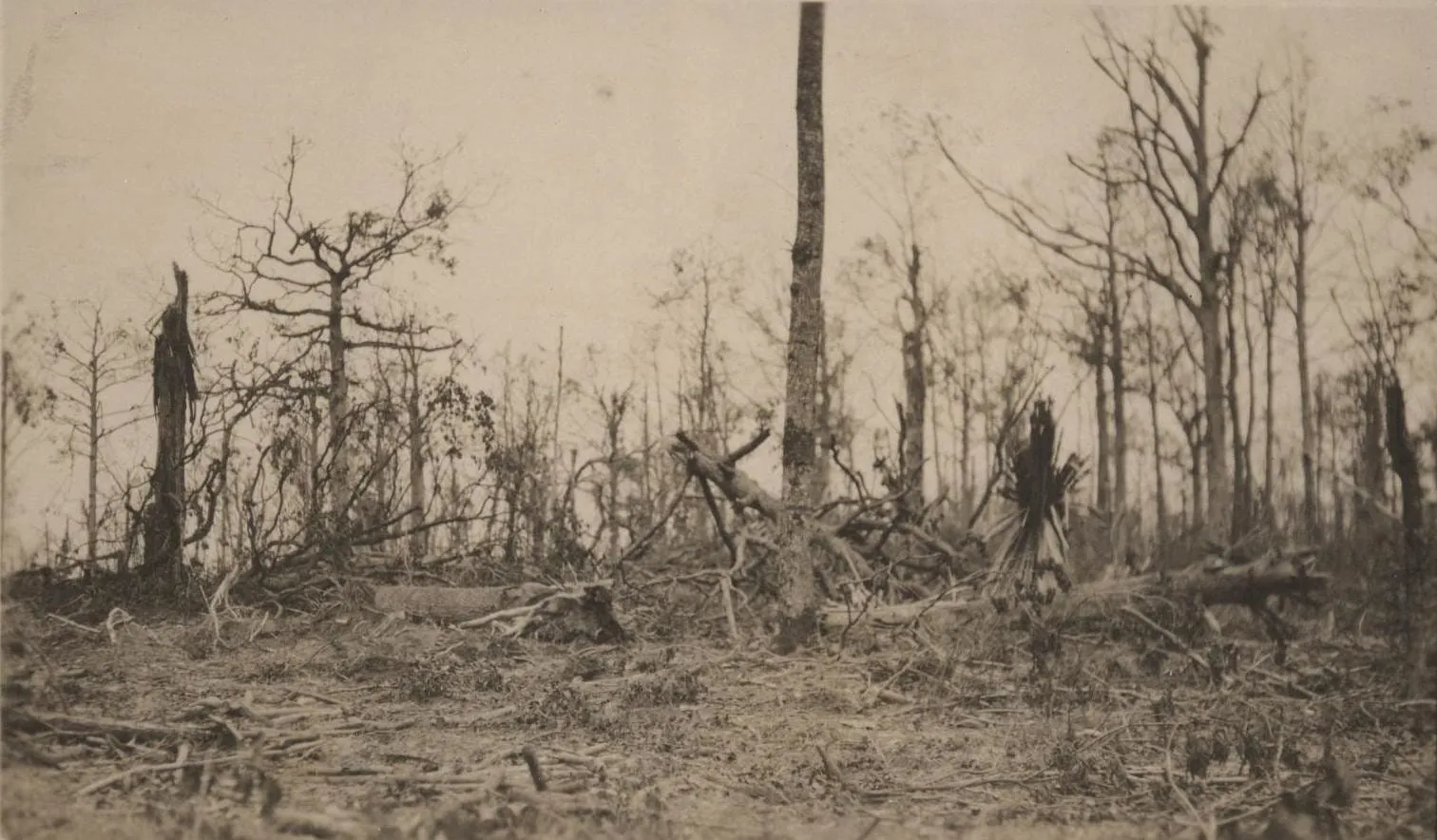
The Battle of Belleau Wood was the first large and long battle fought by an American division in the First World War. When at the end of May 1918 the German Seventh Army, advancing out of the breach on the Aisne, reached the Marne at Château-Thierry, the French threw the American 2nd Infantry Division across the road to Paris. It included a brigade of the Marine Corps, the Marines. From 1 June the Americans held positions north-west of the town, and within a few days they had helped to stop the last German attacks on this sector. On 6 June they went over to the attack to take from the Germans Hill 142, the village of Bouresches and a small, dense hunting wood near the village of Belleau. The first day of the attack was the bloodiest in the history of the US Marine Corps up to that time. The fighting for the wood lasted almost three weeks and ended only on 25–26 June. In terms of ground it was a local affair, but its moral significance proved enormous: for the French, for the Germans and for the Americans themselves.
Name and dates
The name “Battle of Belleau Wood” (French bataille du bois Belleau) comes from American historiography, and the Polish Wikipedia also knows the battle by it. It is usually dated to 1–26 June 1918. The first days, when the 2nd Division was taking up positions and repelling German attacks, still belong to the Third Battle of the Aisne, which the British Battles Nomenclature Committee ends on 6 June. The actual fighting for the wood itself began on 6 June. The Americans took the last part of the wood in the evening and night of 25 June, as stated by the guide of the American Battle Monuments Commission (1938) and the British official history, and the report that the whole wood had been taken was sent on the morning of 26 June. Hence the end date. The capture of the village of Vaux on 1 July is sometimes described as an epilogue to the battle. We give the facts mainly after the Commission’s guide, the British official history (James Edmonds, Military Operations France and Belgium 1918, vol. III) and American histories of the Marine Corps.
Background
On 27 May 1918 the Germans broke through the French front on the Chemin des Dames ridge, and within a few days General Max von Boehn’s Seventh Army crossed the Aisne and the Vesle, took Soissons and on 30–31 May stood on the Marne. French reserves were melting away faster than they arrived. General Ferdinand Foch, since April commander-in-chief of the Allied armies in France, therefore turned to the American divisions which General John Pershing, commander of the American Expeditionary Forces, placed at the disposal of the French in those days. A few days earlier the American 1st Division had taken Cantigny, but that was an attack by one regiment on one village. Now the task was to plug the gap on the road to Paris.
The 2nd Division, some 26,000–28,000 men strong, roughly twice the size of a French or German division of the time, was unusual. Alongside the Army’s 3rd Infantry Brigade (9th and 23rd Infantry Regiments) it included the 4th Marine Brigade (5th and 6th Marine Regiments and 6th Machine Gun Battalion). It was commanded by General Omar Bundy, and the Marine brigade by Brigadier General James Harbord, an Army officer, not a Marine, until recently Pershing’s chief of staff. On the night of 30–31 May the division was loaded onto French lorries and taken to the area of Meaux. From there its infantry set off through Montreuil-aux-Lions towards the front along a road choked with refugees and retreating French units. The division came under General Jean Degoutte’s French XXI Corps, part of General Denis Duchêne’s Sixth Army.
Course
1–5 June: defence. On 1 June the 2nd Division took up positions astride the Paris–Metz road, behind French units still fighting on the hills in front of it. In the evening the Germans broke through the French front to the left of the Americans, and the division’s reserve, the 23rd Infantry and a Marine battalion, closed the gap by a forced march before dawn. By 2 June the Americans held a line from the Triangle farm buildings by the road through Lucy-le-Bocage to Hill 142, across cornfields and small woods, while the retreating French passed through their ranks. These days produced the battle’s most famous anecdote: when a French officer is said to have advised the Marines to withdraw with him, Captain Lloyd Williams of the 5th Marines is said to have replied: “Retreat? Hell, we just got here!”. The commander of his battalion, Major Frederic Wise, later also claimed authorship of these words, and the whole scene belongs to Marine Corps legend rather than to documented fact. According to American accounts Harbord also rejected a French suggestion to dig in further to the rear and ordered his men to hold where they stood.
On 2 June the first German patrols ran into the Americans near Triangle, and on 3 June the Germans attacked the division’s left wing and were repulsed with heavy losses. American accounts stress that the Marines, well trained in marksmanship, opened accurate rifle fire at long ranges. On 4 June the whole of the division’s line was already fighting, and according to the Commission’s guide the German advance on this sector was finally halted. That day Bundy took command of the whole American sector, and the command of the German Seventh Army, on the advice of the Supreme Army Command, decided to suspend larger attacks. The Germans, from various intermingled and exhausted divisions, dug in on a line from Hill 204 above Vaux through Bouresches and Belleau Wood to Torcy. According to the Commission’s guide, the German command, on learning that Americans stood opposite, ordered that they be denied any success and be inflicted the heaviest possible losses.
6 June: the attack. Degoutte ordered the 2nd Division to go over to the attack. At 3.45 a.m. the 1st Battalion, 5th Marines, together with the French 167th Division on its left, struck at Hill 142 and took it by noon, advancing about a kilometre and beating off counter-attacks. In the afternoon, at 5 p.m., two Marine battalions moved against Belleau Wood from the west and south, and a third against Bouresches. Reconnaissance was poor: the wood was assumed to be lightly held, but in fact machine-gun nests of the German 237th Division were waiting in it. The infantry advanced in waves across open wheat fields and fell under crossfire. The Marines nevertheless managed to break into the southern part of the wood, and they took Bouresches and held it despite several German attempts to retake the village over the following days. By nightfall the brigade had lost 31 officers and 1,056 men killed, wounded and missing. These were the heaviest losses in a single day in the history of the Marine Corps up to that time. The commander of the 6th Marines, Colonel Albertus Catlin, was also seriously wounded.
7–13 June: fighting in the wood. Belleau Wood, overgrown with dense undergrowth and strewn with boulders, had the shape of an irregular hourglass, and the Germans defended it from hidden machine-gun nests. On 7 and 8 June attacks in its southern part brought only small gains. On 9 June the Americans briefly withdrew from the wood so that American and French artillery could shell it safely. On 10 June an attack from the south recovered the lost positions, and on 11 June Major Wise’s battalion struck from the west. In the fog it veered off course and crossed the wood across its narrow waist, but it took many prisoners and by evening, for the first time, held the whole southern part of the wood. On 12 June the Americans took roughly a third of the northern part. The Germans counter-attacked with fresh battalions and shelled the wood and its surroundings with gas, including mustard gas. On 10 June Degoutte replaced the dismissed Duchêne at the head of the Sixth Army, and General Stanislas Naulin took over XXI Corps.
14–24 June: relief and further attacks. The exhausted Marines needed rest. On 14 June the 23rd Infantry took over the eastern edge of the wood, and from the night of 15–16 June the Marine battalions in the wood were relieved by the 7th Infantry of the American 3rd Division. They were also helped by engineers of the 2nd Engineer Regiment, who repeatedly fought as infantry. Several days of attacks by the 7th Infantry brought no decision, and from the night of 21–22 June the Marines returned to the wood.
25–26 June: the end. After a fourteen-hour artillery bombardment, during which thousands of shells fell on a small strip at the northern tip of the wood, at 5 p.m. on 25 June Major Maurice Shearer’s 3rd Battalion, 5th Marines, set off on the final attack. The fighting went on until late at night. On the morning of 26 June Shearer reported briefly: “Woods now U.S. Marine Corps entirely”. On 1 July battalions of the 3rd Brigade and engineers of the 2nd Division took Vaux in a smoothly executed attack, capturing about 250 prisoners according to the British official history, and at the beginning of July the 2nd Division was relieved by the American 26th Division.
Losses
Loss figures differ depending on the period and the units they cover. The figure most often quoted for the whole battle is 9,777 Americans killed, wounded and missing, including 1,811 killed. The Commission’s guide states that the 2nd Division lost over 8,100 men in the fighting at Belleau, from 1 June to the beginning of July. The Marine brigade alone lost, by various counts, from about 4,000 to over 5,000 men, roughly half its strength. German losses are not known precisely. The Americans took about 1,600 prisoners, and estimates of total German losses run to several thousand, and according to some studies over 10,000 men. In the nearby American Aisne-Marne war cemetery, at the foot of the hill on which the wood grows, lie about 2,300 soldiers, many of them with the date of death 6 June 1918.
Significance
Militarily the Battle of Belleau Wood was a local engagement. The Germans had already given up any further advance in this direction on 4 June, and the wood and a few villages had no influence on the general situation on the Western Front, as German historiography in particular emphasises. American critics also point to costly mistakes: attacking without reconnaissance, advancing in waves across open fields and weak artillery support in the first days. The moral significance of the battle, however, was enormous. After the defeats of March, April and May the French saw that the Americans were not only arriving in their hundreds of thousands but could and would fight. On 30 June Degoutte, by then commander of the Sixth Army, decreed in an order of the day that “in all official documents” Belleau Wood would henceforth bear the name Bois de la Brigade de Marine, the Wood of the Marine Brigade. France later decorated both Marine regiments, their machine-gun battalion and the 2nd Engineer Regiment with the Croix de Guerre.
The German view of the Americans changed too. On 17 June the German corps fighting opposite the 2nd Division wrote in a report that its soldiers had to be called “excellent” and their spirit high, that the Marines’ attacks had been carried out “smartly and ruthlessly”, and that “the nerves of the Americans are still unshaken”. The battle also became the foundation of the Marine Corps legend, which caused resentment in the Army. The Chicago Tribune correspondent Floyd Gibbons, seriously wounded on 6 June, wrote about the Marines, and the censors, contrary to the rule of not naming units, let the references to them through. The American press therefore gave the whole credit to the Marine Corps, passing over the Army soldiers, the engineers and the French. The battle is also the origin of the Marines’ nickname “Teufelhunde” (devil dogs), supposedly given to them by the Germans, although there is no trace of it in German sources. For the Americans, Belleau Wood, together with Cantigny and Château-Thierry, foreshadowed the role their troops would play in July in the Second Battle of the Marne and in the offensives of the autumn of 1918.
Spotted a mistake?Report an error