1918: The Allied counter-offensive
Battle of Saint-Mihiel
- Dates:
- 12–16 September 1918
- Front:
- Western Front
- Location:
- The Saint-Mihiel salient between the Meuse and the Moselle, from the Meuse heights south-east of Verdun across the Woëvre plain to Pont-à-Mousson, Meuse and Meurthe-et-Moselle departments (France)On the battle map →
- Sides:
- United States and FranceJohn Pershing, Hunter Liggett, Joseph Dickman, George Cameron, Ernest BlondlatGerman Empire and Austria-HungaryMax von Gallwitz, Georg Fuchs
- Result:
- Allied victory. Within two days the Americans and French eliminated the salient, took about 15,000–16,000 prisoners and some 450 guns, and recovered more than 500 km² of French territory.
- Author:
- Łukasz Skowroń
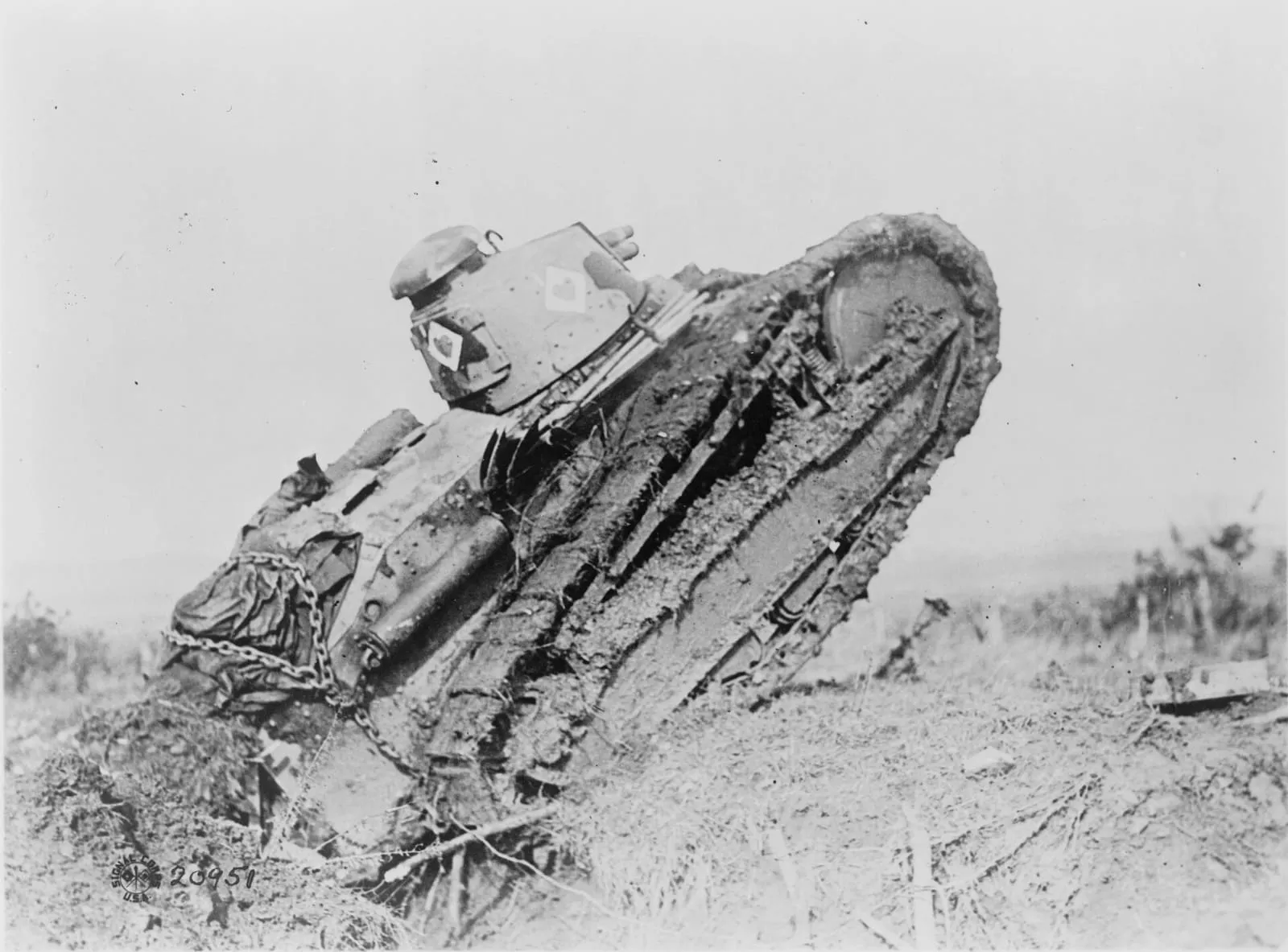
The Battle of Saint-Mihiel was the first major operation carried out by an independent American army under the orders of the American commander-in-chief. On 12 September 1918 General John Pershing’s First Army, with the French II Colonial Corps under its command, attacked the German salient around the small town of Saint-Mihiel on the Meuse, which for four years had cut into the French lines south-east of Verdun. The attack caught the Germans just as they were beginning to evacuate the salient. On the morning of 13 September troops advancing from the south and from the west met near Vigneulles, trapping in a pocket those defenders who had not managed to withdraw. By 16 September the Allies had consolidated on a new, much shorter line in front of the German Michel position. The battle was not as bloody as the earlier American fighting on the Marne, but it was of enormous importance: it proved that the American Expeditionary Forces could conduct a large offensive with their own staffs.
Name and dates
The Americans call the battle the Saint-Mihiel Offensive (St. Mihiel Offensive) and, following the US Army’s official list of campaigns, date it 12–16 September 1918. The attack proper lasted two days: by the evening of 13 September almost all objectives had been taken, and in the following days only local attacks were made and the line was adjusted. That is why some accounts, including the Polish and German Wikipedia, end the battle on 13 or 15 September. Our figures come mainly from Pershing’s final report (1920) and the guide of the American Battle Monuments Commission (American Battle Monuments Commission, American Armies and Battlefields in Europe, 1938), and those for the German side from the account of General Max von Gallwitz and German studies.
The salient
The Germans took Saint-Mihiel on 24 September 1914, while trying to outflank Verdun from the south. They also seized Fort Camp des Romains above the town and a bridgehead on the left bank of the Meuse, but were stopped at Fort Troyon. This created a triangular salient whose corners lay roughly at Verdun, Saint-Mihiel and Pont-à-Mousson. It was about 40 kilometres wide at its base and pushed some 25 kilometres into the French lines. Its western face ran along the wooded heights on the east bank of the Meuse, and its southern face crossed the marshy Woëvre plain, cut by streams and ponds, as far as the Moselle. Inside the salient rose the isolated hills of Loupmont and Montsec, from which the Germans could see far into the French rear.
The salient cut the railway from Verdun to Toul and Nancy and allowed the main line from Paris to Nancy to be shelled. It was largely what made Verdun so hard to supply in 1916. For the Germans it shielded the fortress of Metz and the iron-ore basin around Briey. In 1915 the French tried several times to pinch it out: they fought for the Les Éparges ridge, in the Apremont forest, in the Bois d’Ailly and in the Bois-le-Prêtre near Pont-à-Mousson, and in April they launched an unsuccessful offensive on the Woëvre plain. Over four years the Germans built successive lines of trenches, wire entanglements and concrete shelters here. Behind the base of the salient ran the Michel position (Michel-Stellung), part of the system of fortifications the Allies called the Hindenburg Line.
Pershing’s plan
Pershing had picked out this sector as early as the summer of 1917. At his first meeting with General Philippe Pétain he agreed that once he had gathered enough troops he would form an army precisely here, eliminate the salient, and then strike further, towards Metz and Briey. From January 1918 the quiet front at Saint-Mihiel served American divisions as a school of trench warfare. The German offensives in the spring of 1918, however, forced Pershing to scatter his divisions along the whole front, from Cantigny to the Marne.
After the victory on the Marne Pershing returned to his plan. At the conference of commanders-in-chief at Bombon on 24 July, General Ferdinand Foch put the elimination of the Saint-Mihiel salient on the list of limited attacks intended to free the most important railway lines. On 10 August Pershing announced the formation of the American First Army under his personal command, and on 30 August it took over the front from Port-sur-Seille beyond the Moselle to Watronville south-east of Verdun. That same day Marshal Foch came to Pershing’s headquarters at Ligny-en-Barrois with a new idea. He wanted to limit the Saint-Mihiel attack and distribute most of the American divisions among the French armies for a great offensive towards Mézières. Pershing refused firmly: the Americans would fight as one army or not at all. On 2 September, at a conference with Foch and Pétain, a compromise was reached. The First Army would carry out the Saint-Mihiel operation, but only as far as the Vigneulles–Thiaucourt–Regniéville line, with no march on Metz, and would begin a second, much larger offensive between the Meuse and the Argonne, some 60 kilometres away, no later than 25 September. As the Monuments Commission wrote, never before on the Western Front had a single army undertaken two great offensives on two battlefields within 23 days.
Forces
Under the final plan the main blow was to be struck against the southern face of the salient by two American corps. General Hunter Liggett’s I Corps stood westwards from the Moselle, with the 82nd, 90th, 5th and 2nd Divisions in line and the 78th in reserve. On its left, General Joseph Dickman’s IV Corps had the 89th, 42nd and 1st Divisions in line and the 3rd in reserve. The 1st Division on the left wing was to advance about 20 kilometres north, into the very heart of the salient. The secondary attack on the western face was made by General George Cameron’s V Corps with the 26th Division, the French 15th Colonial Division and part of the 4th Division. The tip of the salient around Saint-Mihiel was held by General Ernest Blondlat’s French II Colonial Corps with three divisions, which was to pin the Germans down and follow them when they began to fall back. The 35th, 80th and 91st Divisions stood in army reserve.
According to the Monuments Commission, more than 550,000 Americans and about 110,000 Frenchmen took part in the operation. Pershing gave a more modest figure in his final report: about 500,000 men, including about 70,000 French. The Americans still lacked artillery, aircraft and tanks, so most of these were supplied by the French and British. About 3,000 guns and 3.3 million shells were assembled. On the airfields around the salient 1,481 American, French, British and Italian aircraft were gathered, the largest concentration of air power yet seen. They were commanded by Colonel William “Billy” Mitchell, chief of the First Army’s air service. There were about four hundred tanks, almost all light Renault FTs. 144 of them were crewed by Americans of Lieutenant-Colonel George Patton’s brigade, the rest by the French. Planning the operation, and immediately afterwards the transfer of the army to the Meuse and the Argonne, fell largely to the operations section of the army staff, where George Marshall, later US Army Chief of Staff in the Second World War, worked.
The salient was defended by the German Army Detachment C (Armee-Abteilung C) of General Georg Fuchs, with headquarters at Conflans-en-Jarnisy, subordinate to the army group of General Max von Gallwitz. According to the Monuments Commission it had eight divisions and two brigades in line and five divisions in reserve. Some of these were Landwehr divisions, and on the western face stood the Austro-Hungarian 35th Infantry Division. Gallwitz had long regarded the salient as a trap that could be attacked from all sides. A plan for withdrawal to the Michel position, code-named “Loki”, had been prepared earlier, and at the beginning of September, when intelligence reported an American concentration, the Supreme Army Command agreed to carry it out. According to the Monuments Commission, the order for a gradual withdrawal and the destruction of everything that could not be taken away was issued on 11 September. Part of the German artillery was already pulling back, but the main forces were still in their positions.
Course of the battle
12 September. After several days of rain the roads had turned to mud. At 1 a.m. some 3,000 guns opened fire on the German positions, batteries and roads. The bombardment was so heavy that the German artillery hardly replied. At 5 a.m. the infantry of I and IV Corps went over to the attack on the southern face of the salient. Most of the tanks got stuck in the mud or fell behind, so the soldiers crossed the broad belts of wire themselves, cutting it with shears, throwing netting over it and trampling it down. On the western face the preparation lasted longer and the V Corps infantry moved off at 8 a.m. Resistance was uneven: some German units fought fiercely in machine-gun nests, others surrendered in whole groups. Around noon the 1st Division took Nonsard, the 5th Division Viéville-en-Haye and the 89th Division Euvezin. In the early afternoon the 42nd Division took Pannes and the 2nd Division Thiaucourt, an important German supply hub, and beat off two counter-attacks. By evening the main attack had advanced about 8 kilometres, as planned or even faster. Montsec was bypassed and cut off. Patton’s tanks that managed to wade through the mud supported, among others, the 42nd Division, in which General Douglas MacArthur commanded an infantry brigade.
The German command quickly realised that this was not a local attack. According to German studies, around noon Fuchs ordered an immediate withdrawal to the Michel position, and the units at the tip of the salient began to fall back hastily to the north-east, burning their depots behind them. In the evening Pershing, seeing this, ordered the 1st and 26th Divisions to advance on Vigneulles by night to cut off the retreating Germans.
13 September. Units of the 26th Division marched all night along a narrow forest road through the Meuse heights. At about 2 a.m. the head of the column reached Hattonchâtel, from where the soldiers could see the Woëvre plain in flames, and soon took Vigneulles. At dawn it met patrols of the 1st Division near Vigneulles. The salient was closed, and the Germans who had not managed to get out of the pocket were taken prisoner. That day, Pershing’s 58th birthday, French troops entered the abandoned Saint-Mihiel without a fight; several thousand civilians had lived there through four years of occupation (some accounts say this happened only on 15 September). By the evening of 13 September almost all the objectives of the operation had been achieved. Also on 13 September a squadron of the American 2nd Cavalry Regiment carried out a reconnaissance at the foot of the Meuse heights, something that rarely happened in this war.
14–16 September. Over the following days the American divisions beat off counter-attacks and made local attacks to improve the line and reconnoitre the new German defences. The 4th Division advanced on the western face, and by 16 September the 90th Division had cleared the Bois des Rappes on the right wing. The new front ran roughly from Haudiomont to Vandières on the Moselle and was about 35 kilometres shorter than the old one. Opposite it the Germans had meanwhile managed to reinforce their line by several divisions.
Losses
According to Pershing’s report the Americans took nearly 16,000 prisoners and 443 guns, and lost fewer than 7,000 men during the attack proper. The Monuments Commission gives more than 15,000 prisoners, about 450 guns and fewer than 9,000 American casualties in the whole operation. German losses in killed and wounded are not known exactly. Various studies estimate them at several thousand men. The Austro-Hungarian 35th Division lost, according to German studies, about 3,300 men on the first day alone. The war cemetery at Thiaucourt, laid out by the American government, holds more than 4,000 American soldiers, most of them killed in this battle.
Metz or the Argonne
Already during the battle, and even more so after the war, there was debate over whether the First Army should have gone further. On 13 September the road to Metz seemed open and the German defences behind the salient were weak. MacArthur later claimed that the city could have been taken, and Pershing wrote in his memoirs that an immediate continuation of the attack might have carried the Americans well beyond the Michel position, and perhaps to Metz. General Liggett, however, believed that such a chance existed only in theory, because the young army was not yet an efficient machine and its supplies were stuck in the mud on a few congested roads. In any case the decision had been taken earlier, on 2 September: Pershing had committed himself to beginning the offensive between the Meuse and the Argonne no later than 25 September, so the 1st, 2nd and 4th Divisions and most of the artillery and aircraft had to set off north at once.
The transfer began even before the battle ended. In less than two weeks, by night, about 220,000 Allied soldiers, mainly French, were withdrawn from the sector between the Meuse and the Argonne, and about 600,000 Americans were brought in. Planning this movement won Marshall a reputation as an outstanding staff officer.
Significance
The Battle of Saint-Mihiel was the first major Allied attack in 1918 on an old, carefully fortified position rather than on the fresh salients created by the German spring offensives. Its success raised Allied morale and depressed the Germans. Gallwitz counted 12 September among his “few black days” in five years of war. The railways around Saint-Mihiel were freed, and France recovered more than 500 km² of territory with a population that had lived under occupation for four years. The French command sent officers to inspect the wire through which the American infantry had passed. The battle was also a dress rehearsal for new tactics of air–ground cooperation, and the First Army’s operational order of 7 September used, as far as is known for the first time, the terms “D-Day” and “H-Hour”. The easy victory, won over an enemy who was withdrawing anyway, nevertheless lulled some commanders into complacency. Two weeks later, in the Meuse-Argonne offensive, American divisions came up against defences that no one intended to give up without a fight.
Spotted a mistake?Report an error