United States · The Entente
Douglas MacArthur
Chief of staff of the 42nd Division (1917–1918), commander of the 84th Infantry Brigade (1918), brigadier general
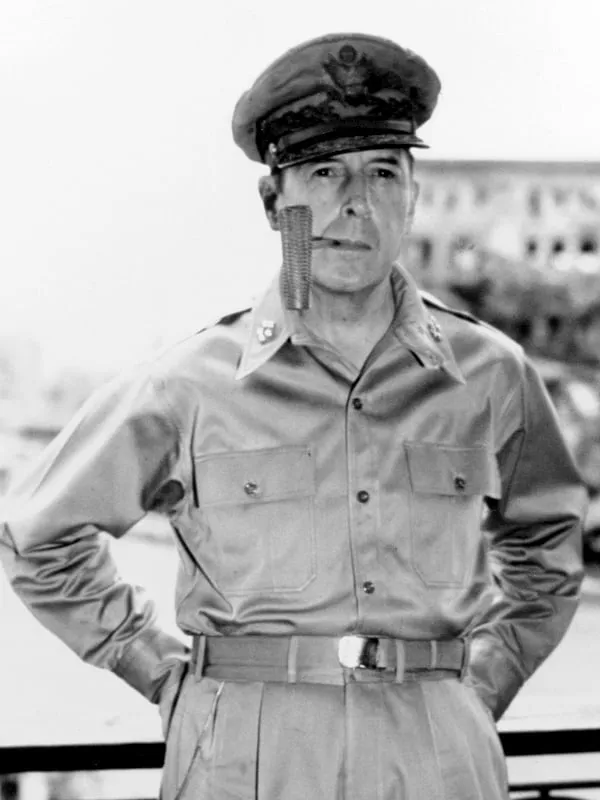
- Born:
- 26 January 1880, Little Rock (Arkansas, United States)
- Died:
- 5 April 1964, Washington, D.C.
- Author:
- Natalia
- Photo:
- autor nieznany, domena publiczna, Wikimedia Commons

Douglas MacArthur went down in history as a commander of the Second World War and the Korean War, but he won fame as early as 1918 in France. He was the originator and chief of staff of the 42nd Division, made up of National Guard units from many states and therefore called the “Rainbow”. In the summer of 1918, as a 38-year-old brigadier general, he took command of its 84th Infantry Brigade and led it at Saint-Mihiel and in the Meuse–Argonne offensive. He went on raids into the German trenches, wore neither a helmet nor a gas mask, was gassed twice and returned home as one of the most decorated American soldiers of the war. Even then he showed the traits that accompanied him all his life: great courage, talent, theatricality and a tendency to speak of himself only in superlatives.
Before the war
He was born on 26 January 1880 in the barracks at Little Rock, Arkansas, the youngest son of Captain Arthur MacArthur, a Civil War hero awarded the Medal of Honor who later rose to the rank of lieutenant general. He spent his childhood in forts in the American West. He was very close to his mother, who, when he entered the West Point military academy, took rooms in a hotel overlooking its grounds. He graduated in 1903 first in his class, with one of the highest scores in the academy’s history, and as top graduate was commissioned into the engineers.
He served in the Philippines, was his father’s aide during his tour of Japan, India and China, and in Washington helped at the White House with President Theodore Roosevelt’s receptions. In 1912 he joined the General Staff. In the spring of 1914, during the American occupation of the Mexican port of Veracruz, he went on his own initiative into the interior in search of locomotives and on the way back exchanged fire with attackers several times. The army’s commander recommended him for the Medal of Honor, but the board refused, fearing the award would encourage other staff officers to act behind their commanders’ backs.
The Rainbow Division
In December 1915 MacArthur was promoted to major, and from 1916 he headed the information bureau at the War Department. He is sometimes regarded as the US Army’s first press officer. When in April 1917 the United States entered the war, according to his biographers he helped the Secretary of War, Newton Baker, win the press over to conscription. Together with Baker he also persuaded President Woodrow Wilson to send to France not only the regular army but also units of the National Guard, the state militia. So that no state would feel left out, he proposed that the first such division be formed from units of many states. According to his memoirs he said it would stretch over the country like a rainbow, and that is where its name came from. General William Mann became commander of the 42nd Division and MacArthur its chief of staff with the rank of colonel, skipping the rank of lieutenant colonel. At his own request he transferred at the same time from the engineers to the infantry.
The division sailed for France in October 1917. In December the ailing Mann was replaced by General Charles Menoher, with whom MacArthur quickly became friends. In February 1918 the division entered a quiet sector of the front near Lunéville in Lorraine to learn trench warfare alongside the French. On 26 February MacArthur volunteered to go with a French unit on a night raid on the German trenches and helped take prisoners. For this he received the Croix de Guerre, the first soldier of the American Expeditionary Forces to do so. On 9 March he went himself with a company of the 168th Infantry Regiment on one of the division’s three raids, for which he received the Distinguished Service Cross, the second-highest American combat decoration. A few days later he was gassed. He made sure the soldiers wore their masks, but often did not carry his own.
Even then he attracted attention with his appearance. He wore no helmet, only a cap with the stiffening removed, and went about in a sweater, with a long scarf and a riding crop. Officers at General Pershing’s headquarters frowned on his insubordinate dress, but the soldiers liked him.
Champagne and the Ourcq
On 26 June MacArthur was promoted to brigadier general and was then the youngest general in the American army in France. The division was moved to Champagne, where it came under the French Fourth Army of General Henri Gouraud. On 15 July the Germans attacked there east of Reims, opening the Second Battle of the Marne. Gouraud almost emptied his first position and received the attack on the intermediate position, and the attack east of Reims ended in a bloody failure for the Germans. The 42nd Division fought in this battle alongside the French.
The division was then sent into the counter-offensive against the German salient on the Marne. On 26 July it relieved the 26th Division near the Croix Rouge farm, and on 28 July crossed the river Ourcq east of Fère-en-Tardenois and fought for several days on the heights on the far bank. Losses were heavy. At the end of July Menoher removed General Robert Brown from command of the 84th Infantry Brigade and gave it to MacArthur. On 2 August, when reports came in that the Germans were withdrawing, MacArthur went out into no man’s land himself to check. In his memoirs he wrote of the thousands of dead he stumbled over and the groans of the wounded. He confirmed that the Germans had gone, and for this he received another Silver Star and the French Legion of Honour.
Saint-Mihiel and the Meuse–Argonne
On 12 September 1918 his brigade took part in the attack at Saint-Mihiel, the first independent operation of the American First Army. The attack went quickly, and the Germans were withdrawing from the salient anyway. On a hill near Essey MacArthur met Lieutenant Colonel George Patton, the tank commander. According to Patton’s letter to his wife, when shelling came their way neither of them wanted to be the first to duck. MacArthur was one of the officers who believed the army should have pushed on to the nearby fortress of Metz while the German defence was in disarray. Pershing, however, was bound by his agreement with Marshal Foch, and the troops were already needed in the Argonne.
In October the 42nd Division entered the Meuse–Argonne offensive, where for weeks the Americans had been bloodily fighting their way through successive German positions. MacArthur’s brigade was given the task of taking the Côte de Châtillon, a strongly fortified hill on the Kriemhilde position. The commander of V Corps, General Charles Summerall, demanded the hill within twenty-four hours. According to MacArthur’s memoirs, he replied that the brigade would take Châtillon or show a casualty list of six thousand dead, with his own name at the top. Air reconnaissance and a night patrol, which MacArthur led himself and from which, by his own account, he was the only one to return, revealed a gap in the wire north-east of the hill. An attack from that side, behind machine-gun fire, was proposed by the commander of the 167th Regiment, Lieutenant Colonel Walter Bare. On 16 October the Côte de Châtillon was in American hands. Summerall recommended MacArthur for the Medal of Honor and promotion to major general, but in the end he received a second Distinguished Service Cross. Some historians point out that MacArthur’s account of those days, written down years later, exaggerates his role at the expense of the regimental commanders.
At the beginning of November the division took part in the pursuit of the Germans to the Meuse. In the race for Sedan, whose capture was to be the Americans’ prize, the 1st Division cut across the 42nd Division’s zone of advance during the night of 6–7 November, and its soldiers detained MacArthur, mistaking him in his unusual dress for a German officer. He later wrote that the operation came close to being one of the great tragedies of American history. On 10 November, the day before the armistice, he took command of the whole division at Menoher’s recommendation, but on 22 November he returned to his brigade, because the ban on promotions issued after the armistice had closed his path to the rank of major general.
He brought back from the war two Distinguished Service Crosses, seven Silver Stars, the Distinguished Service Medal and French decorations, including the Legion of Honour and two Croix de Guerre. He was one of the few American generals wounded in the war.
After the war
With the 42nd Division he took part in the occupation of the Rhineland around Ahrweiler and returned home in April 1919. In June he became superintendent of West Point and tried to modernise the academy on the basis of the experience of the war. In 1930 he became Chief of Staff of the Army, and in 1932 he had a camp of war veterans demanding payment of their promised bonuses in Washington dispersed. From 1935 he built up the army of the Philippines, where he received the title of field marshal. In the Pacific War he lost the defence of the Philippines, received the Medal of Honor that had twice been refused him before, and as commander-in-chief in the South West Pacific led the campaigns in New Guinea and the Philippines. On 2 September 1945 he accepted the surrender of Japan, which he then governed for years as head of the occupation. In the Korean War he commanded the UN forces, and in April 1951 President Harry Truman dismissed him for publicly undermining government policy. He died in Washington on 5 April 1964.
Assessment
No one questions MacArthur’s courage in France. A brigadier general who went on night raids and patrols into no man’s land was an exception in an army whose senior commanders rarely saw the front line. The soldiers valued him for sharing the danger with them, and his superiors, from Menoher to Summerall, recommended him for one award after another. He was also an efficient staff officer who prepared a division of inexperienced guardsmen for battle, and a good brigade commander.
Biographers point out, however, that as early as 1918 MacArthur was carefully building his own legend. His memoirs, written at the end of his life, credit him with decisions and feats that according to other accounts were partly the work of his subordinates, and the numbers of the dead and of the dangers he faced grow with every telling. His insubordination towards Pershing’s headquarters and open contempt for staff officers foreshadowed the conflicts with his superiors that ended his career in 1951. The First World War gave him fame, decorations and the conviction that he was destined for great things. For better and for worse it shaped the commander he was for the next thirty years.
Sources
Spotted a mistake?Report an error
Mentioned in battles
(02)Often appears with
People who appear in the same events.