Key event
Start of the Battle of Saint-Mihiel
- Category:
- Military operations
- Front:
- Western Front
- Date:
- 12 September 1918
- Author:
- Łukasz Skowroń
- Battle:
- Battle of Saint-Mihiel
- Tags:
- United States, John Pershing, tanks, aviation
At 5 a.m. on 12 September 1918 the infantry of the American First Army attacked the German salient around Saint-Mihiel on the Meuse, south-east of Verdun. For the first time in this war a whole American army fought under the orders of its own commander-in-chief, General John Pershing, and the French divisions taking part in it were subordinate to him. By evening the Americans had got through belts of wire thought impassable, taken a dozen or more villages, captured thousands of prisoners and advanced about 8 kilometres on the southern face of the salient. Times are given according to Pershing’s final report and the 1938 guide of the American Battle Monuments Commission.
The night before the attack
The Germans had held the Saint-Mihiel salient since September 1914. It cut the railway from Verdun to Nancy, and the hill of Montsec rising within it let them observe the French rear for a dozen or more kilometres. Since 1917 Pershing had planned that an independent American army would make its debut precisely here. After long disputes with Marshal Ferdinand Foch, who wanted to distribute the American divisions among the French armies, it was agreed on 2 September that the First Army would eliminate the salient but go no further, towards Metz, because two weeks later it was to begin a great offensive between the Meuse and the Argonne. The operation order of 7 September, which went down in history as the first known document to use the terms “D-Day” and “H-Hour”, set the attack for 12 September.
For several nights hundreds of thousands of soldiers, thousands of guns and tanks moved under cover of darkness to their start lines. It had been raining for several days. The roads on the Woëvre plain had turned to mud, and in the trenches men stood ankle-deep, and in places knee-deep, in water. On the night of 11–12 September the whole army was in position: I Corps of General Hunter Liggett and IV Corps of General Joseph Dickman on the southern face of the salient, from the Moselle to the area of Montsec, V Corps of General George Cameron on the western face, on the heights above the Meuse, and between them, around Saint-Mihiel itself, the French II Colonial Corps.
The Germans expected an attack, but not so soon. General Max von Gallwitz, commander of the army group to which the salient belonged, recalled that news had reached them from abroad that the Americans had postponed the attack because they were not ready. As a precaution, the Supreme Army Command had agreed to abandon the salient and pull the troops back to the Michel position behind its base. According to the Monuments Commission, the order for a gradual withdrawal was issued on 11 September. When the first shells fell, part of the German artillery was already on its way to the rear, but the infantry was still in the trenches.
Bombardment and attack
At 1 a.m. about 3,000 guns opened fire on the German trenches, batteries, roads and communication centres. For four hours the sky over the plain glowed with the flashes of the guns. The German artillery, partly withdrawn and partly overwhelmed by the fire, replied weakly. At 5 a.m., at dawn, in rain and gusting wind, the infantry of I and IV Corps left their trenches and advanced behind a creeping barrage. On the western face of the salient the bombardment lasted longer, and the infantry of V Corps went forward at 8 a.m.
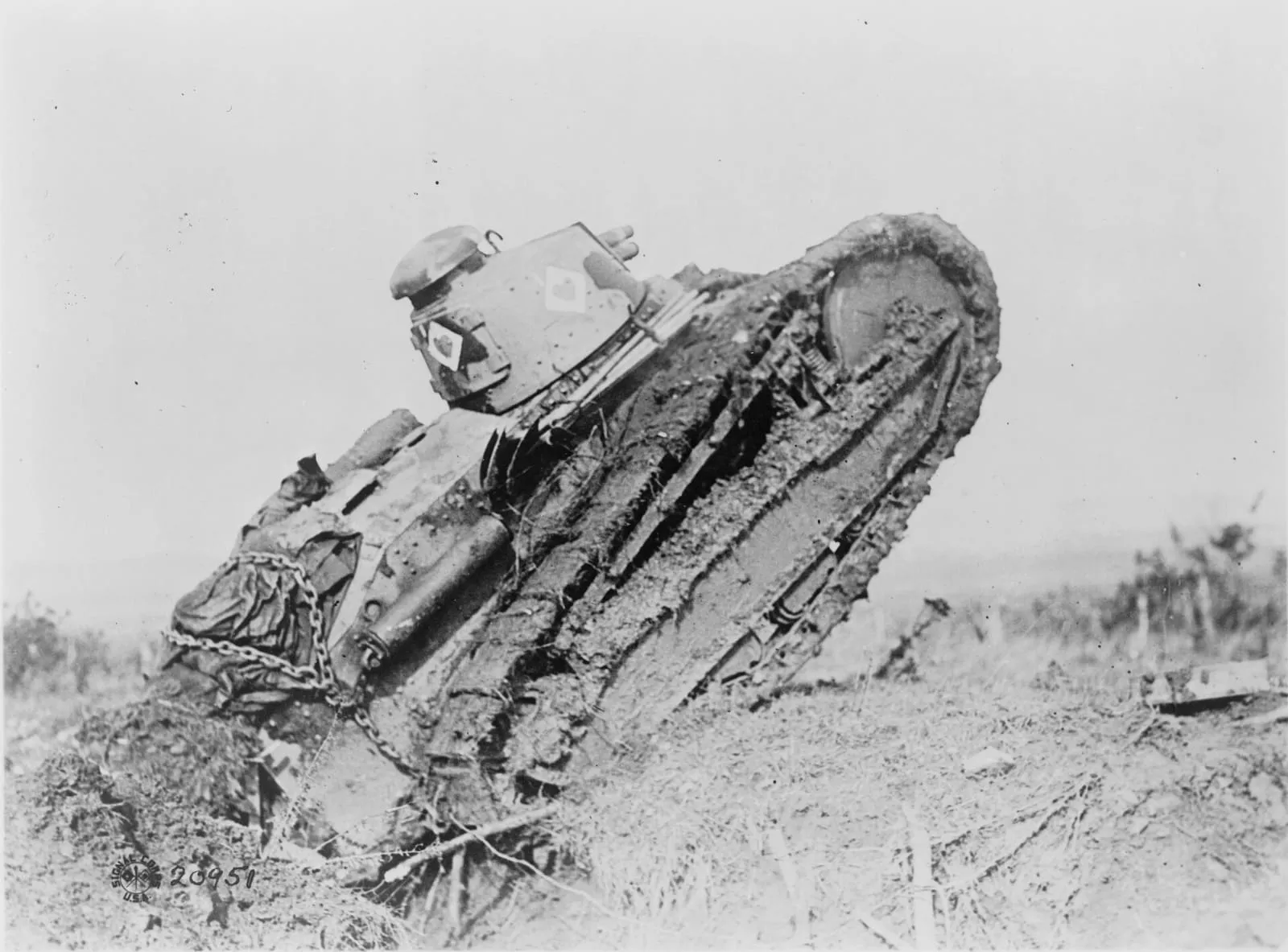
The greatest obstacle turned out to be the wire, dense and broad belts of barbed wire built up over four years. The artillery had made few gaps in it. The tanks were supposed to crush it, but most of them bogged down in the sodden ground, got stuck in trenches or ran out of fuel, and only a few arrived in time. So the American soldiers got through the wire themselves: they cut it with wire cutters, threw netting and planks over it, and often simply trampled across it, walking over the coils as if on a trampoline. The Monuments Commission later wrote that the French were so impressed that they sent officers and men from neighbouring armies to see the wire the American infantry had crossed.
Even so, the attack went according to plan, and in places faster. Some German units, especially machine-gunners, resisted fiercely; others surrendered by whole companies. The 2nd Division took the ruined village of Remenauville and after hard fighting cleared the Bois du Four. By about 9 a.m. it was on the plateau above Thiaucourt, and by 1 p.m. it had covered about 8 kilometres. In the early afternoon it took Thiaucourt, an important German supply centre full of timber yards and equipment, and later repulsed two counter-attacks by the fresh German 31st Division. Around noon the 5th Division took Viéville-en-Haye, the 89th Division Euvezin, and the 1st Division, on the left wing of the attack, Nonsard. In the 89th Division’s attack on a German strongpoint at the Ansoncourt farm, Second Lieutenant J. Hunter Wickersham, badly wounded in four places, first dressed the wound of his wounded orderly and then led his platoon on until he fell. He was posthumously awarded the Medal of Honor. Montsec, from which the Germans had watched the American trenches for years, was not stormed frontally: the attack bypassed it to the east and cut it off.
Patton, MacArthur and the airmen
The American tanks, light French Renault FTs of two battalions, were commanded by Lieutenant Colonel George Patton. He had reconnoitred the ground himself beforehand and told his men not to give up a single tank. When his machines bogged down in the mud he walked in front of them on foot and entered the village of Essey at the head of the infantry, and rode into Pannes sitting on top of a tank. According to his letter to his wife, on a hill near Essey he met General Douglas MacArthur, who commanded a brigade of the 42nd Division. When German shellfire came over, neither wanted to be the first to duck, so they went on talking, standing upright. MacArthur, as usual without a helmet, went forward with his men in the front line.
Over the battlefield operated 1,481 American, French, British and Italian aircraft, the largest concentration of air power yet assembled for a single operation. They were commanded by Colonel William “Billy” Mitchell, chief of air service of the First Army. Low cloud and rain hampered flying, but the aircraft nevertheless attacked columns on the roads, bridges and airfields, reconnoitred and directed the artillery. Gallwitz later wrote that the American airmen “made themselves very unpleasantly felt”.
Retreat and pursuit
Around noon the German commander in the salient, General Georg Fuchs, realised that this was not a local attack but a major offensive and, according to German accounts, ordered an immediate retreat to the Michel position. On the western face, V Corps with the 26th Division and the French 15th Colonial Division broke through the first lines by evening and advanced about 3 kilometres. The French at Saint-Mihiel itself met strong resistance in their raids, but reports were already saying that the Germans were abandoning the tip of the salient. Smoke rose from the plain from burning villages and depots, which the retreating units were destroying so that they would not fall into Allied hands.
In the evening Pershing decided to cut off the retreating Germans. He ordered the 1st Division, which was already in the woods in the middle of the salient, and the 26th Division from the western face to march by night on Vigneulles, where the lines of retreat converged. Units of the 26th Division set off in the dark along a narrow forest road across the heights above the Meuse. Meanwhile, along the roads in the rear, in mud and rain, long columns of prisoners trudged south, escorted to camps near Ansauville. Gallwitz wrote after the war that in five years of war he had been through a great deal, but that he had to count 12 September among his “few black days”.
Remember the articles you have read? Only in this browser; nothing is sent anywhere.How it works
Read ·
A voice from the front
“We did, and passed a most exhilarating hour — like listening to election returns when things are going one's way. […] In the midst of all this someone announced that thousands of prisoners were coming in. The General looked skeptical, remarking that prisoners always dwindled in number or else about half of them got away. Still, we went out and stood on the slippery duckboards commanding a view along the valley where masses of Boches were being herded down the road.”
Spotted a mistake?Report an error
Meanwhile
(04)Elsewhere in the same days.
- 12 September 1918 · Military operationsFighting at ChamovoIn mid-September 1918 the British, supported by a river flotilla, drove the Bolsheviks out of Chamovo on the Dvina. The monitor M25 disabled a Red steamer.
- 11 September 1918 · Military operationsBattle of UkhtaOn 11 September 1918 Colonel Woods's Karelians routed Finnish volunteers at Ukhta in Karelia. General Maynard wrote of the complete defeat of their main base.
- 15 September 1918 · Balkan FrontBattle of Dobro Pole beginsOn 15 September 1918 the Serbs and French took the Dobro Pole–Sokol–Vetrenik ridge in Macedonia, and on 16 September the Bulgarians' second position on Kozjak.
- 15 September 1918 · Middle EastFall of BakuOn the night of 14–15 September 1918 the British sailed from Baku and the Caucasian Army of Islam entered. Its capture came with a massacre of Armenians.
Related events
(04)The same battle, people or subject.
- 16 September 1918 · Western FrontEnd of the Battle of Saint-MihielOn 16 September 1918 the Battle of Saint-Mihiel ended. The Americans dug in on the Haudiomont–Vandières line as their divisions left for the Meuse and Argonne.
- 4 July 1918 · Western FrontAustralians take HamelAt 3.10 a.m. on 4 July 1918 Australians with Mark V tanks and Americans attacked Hamel on the Somme. In about 90 minutes they took the village, woods and ridge.
- 6 November 1918 · Western FrontAmericans at SedanOn 6–7 November 1918, racing for Sedan, the Americans reached the heights above the town and cut the German railway. But Foch sent the French into Sedan.
- 8 October 1918 · Western FrontBattle of Cambrai beginsOn 8 October 1918 the British Third and Fourth Armies and the Americans attacked between Sequehart and Cambrai. At Niergnies the Germans used captured tanks.