Key event
Second Battle of the Marne begins
- Category:
- Military operations
- Front:
- Western Front
- Date:
- 15 July 1918
- Author:
- Natalia
- Battle:
- Second Battle of the Marne
- Tags:
- France, Germany, United States, Erich Ludendorff
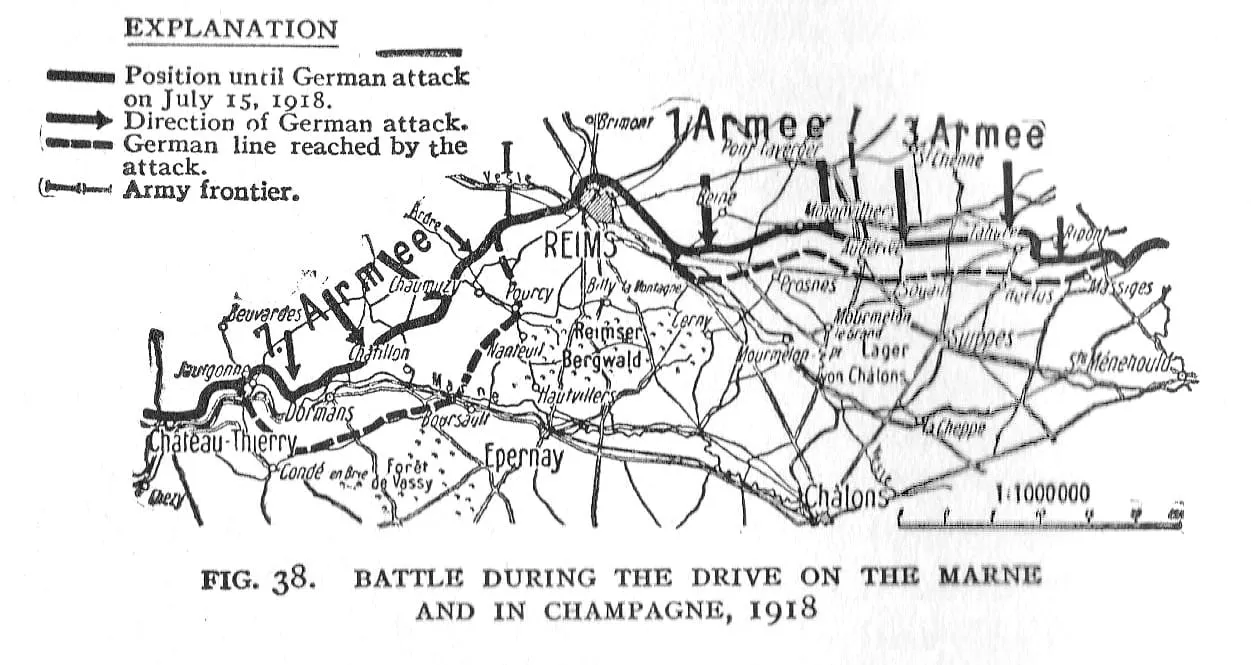
On 15 July 1918, a few minutes after midnight, thousands of German guns opened fire along a front more than 100 kilometres long, from near Château-Thierry on the Marne to the hills of Champagne east of Reims. The fifth and last great German offensive of the year was beginning. General Erich Ludendorff wanted to break the French front on both sides of Reims, cut off the city and draw the Allied reserves south before striking at the British in Flanders. The soldiers were told that this would be a “peace offensive” (Friedensturm) that would end the war. This time, however, the French knew the day and even the hour of the attack. East of Reims the German divisions broke against a defence that had drawn back before their blow, and west of the city, although they crossed the Marne, they stalled after a few kilometres. By evening the French command could consider that the worst was over.
The plan and its betrayal
Since the end of May, when the Germans reached the Marne, their Seventh Army had been sitting in a deep salient between Soissons and Reims, with its apex at Château-Thierry. The plan of the army group of Crown Prince Wilhelm provided for two attacks that would bypass Reims itself. General Max von Boehn’s Seventh Army was to cross the Marne east of Château-Thierry and advance along both banks of the river towards Épernay. General Bruno von Mudra’s First Army and General Karl von Einem’s Third Army were to attack east of the city, in Champagne, towards Châlons. The two groups were to meet at Épernay, enclosing Reims and the wooded Montagne de Reims. The artillery bombardment, as in March and May, was planned by Colonel Georg Bruchmüller. The attack was postponed from 12 to 15 July to complete the preparations.
The secret could not be kept. From the end of June prisoners told the French about equipment being gathered for crossing the Marne and about an attack on both sides of Reims, and airmen saw all the usual signs of an offensive. Ludendorff later wrote bitterly that the attack on Reims was discussed all over Germany, and a German engineer officer who, against orders, swam the Marne to reconnoitre was taken prisoner and, as was established after the battle, gave away a great deal. On 14 July, the French national holiday, soldiers of the French Fourth Army took 27 prisoners in a deep raid. From them they learned that the German artillery preparation would begin ten minutes after midnight and last three to four hours.
A night of fire
The commander of the Fourth Army, General Henri Gouraud, who in 1915 had lost his right arm at Gallipoli, had been preparing for this blow for a week. His 14 divisions, among them the American 42nd (Rainbow) Division, held a long-stabilised front with several lines of trenches. Gouraud did not have enough troops to hold both the first and the second positions strongly, so he decided to fight on the intermediate position, 2–3 kilometres behind the front line. In the forward trenches he left, according to the French account, only a handful of volunteers, who were to give warning of the Germans’ approach and delay their advance. West of Reims, in the Fifth Army of General Henri Berthelot, who had taken it over only on 6 July, the defence was less well prepared. Berthelot judged that the Marne crossings had to be defended and kept a considerable part of his infantry on the first position, right up to the river bank.
Between 11 p.m. and midnight on 14 July the French artillery opened counter-preparation fire on the roads, ravines and trenches where the German infantry was waiting to attack. On the sector of the American 3rd Infantry Division near Château-Thierry all the guns opened up at 11.45 p.m. A German eyewitness later described the terror of the units on which the fire fell just before zero hour. Some units suffered such heavy losses that they had to be replaced before the attack began. At 12.10 a.m. the German artillery opened fire. The bombardment lasted 3 hours and 40 minutes, less than on 21 March, and according to some accounts the Kaiser, Wilhelm II, watched it himself from an observation post. East of Reims, however, it fell mostly on empty trenches. On the Marne, already at about two in the morning, the Germans began crossing in boats and on ferries under cover of smoke, while engineers built pontoon bridges. The infantry went into the main attack at about 3.50 a.m. Allied time, that is 4.50 a.m. by German clocks.
Defeat in Champagne
East of Reims the attack of the First and Third Armies ended in complete failure. The Germans crossed the almost abandoned first position without much resistance, but when they approached the intermediate position they came under the fire of French batteries, placed so that they could change position and surprise the enemy, and then machine-gun fire and counter-attacks. German tanks that appeared on the battlefield were destroyed by direct hits, and French airmen shot down German observation balloons. The Americans of the 42nd Division distinguished themselves in stopping the Germans. The morning was overcast and aircraft could give effective help only from ten o’clock, but by then it was already clear that the attack in Champagne had come to a halt. German units that were to follow the first wave and exploit success came under artillery fire in open country. One French deputy even announced an interpellation about the “scandalous” surrender without a fight of trenches won at great cost, but Gouraud’s tactics saved his soldiers and wasted the Germans’ whole artillery effort.
The crossing at Dormans
West of Reims things went worse. The German bombardment destroyed the French outposts by the river, and under a smoke screen the divisions of the Seventh Army crossed the Marne on the stretch between Jaulgonne and the area of Dormans. Ludendorff himself later called this crossing a remarkable achievement, all the more so because the enemy was prepared for it. The French units, scattered over the first position, in strongpoints and on successive lines, were nowhere strong enough and fell back one after another. According to the French official history, within a few hours the Germans won a bridgehead on both sides of Dormans about 5 kilometres deep and 11–14 kilometres wide and began advancing along the river towards Épernay. Between the Marne and Reims they pushed the French and Italians back to the second position.
On this sector, in the valley of the Ardre, General Alberico Albricci’s Italian II Corps, with the 3rd and 8th Divisions, was holding out. The Italians were driven from some of the hills near Bligny, but the 3rd Division, as it fell back, kept contact with the defenders of Reims and prevented the city from being outflanked. Ludendorff noted that the Italian divisions suffered particularly. Within a few days the corps lost over 9,000 men, most of them in the 8th Division.
About five kilometres beyond the Marne the Germans met resistance so strong that they could break it only after bringing many batteries across the river. Meanwhile French and British aircraft, as soon as the sky cleared, began attacking the bridges and footbridges on the Marne from low altitude. They destroyed some of them, throwing men and wagons into the river, and machine-gunned the troops on the south bank. The British IX Brigade of the RAF, lent to the French on 14 July, took part in these attacks.
“The Rock of the Marne”
The only sector west of Reims on which the Germans gained nothing was the front of General Joseph Dickman’s American 3rd Division, which held the south bank of the Marne from Château-Thierry to near Jaulgonne. Six German regiments attacked it. One crossed the river near Mézy-Moulins and was decimated by the American artillery, and those who reached the railway embankment were thrown back across the river by a counter-attack; at about five in the morning their remnants reached the other bank. Another regiment wiped out the Americans by the river itself but stopped at the edge of the woods above the valley. A third, after several bloody attempts, crossed near Mont-Saint-Père at about 8.45 a.m. and reached the embankment, where many of its soldiers later surrendered.
The hardest task fell to Colonel Ulysses Grant McAlexander’s 38th Infantry Regiment. When the French division on its right fell back, the regiment had to beat off attacks from the front and from both flanks at once, but it did not give way. Beside it the 30th Regiment held out just as stubbornly. On both sides of the 3rd Division units of the American 28th Division from Pennsylvania, mixed in with French divisions, also fought, and some of them were surrounded and almost destroyed. By midnight the Germans in front of the 3rd Division were already falling back across the Marne. The defence of that day gave rise to the nickname “Rock of the Marne”, which the 38th Regiment and the whole 3rd Division still bear today.
Foch, Pétain and Haig
At 9.50 a.m. the commander-in-chief of the French armies, General Philippe Pétain, alarmed by the Germans’ progress on the Marne, ordered a halt to the preparations for the counter-offensive that General Charles Mangin’s Tenth Army was to launch on 18 July from the forests of Villers-Cotterêts, and the return of the American 2nd Division. General Ferdinand Foch, the Allied commander-in-chief, learned of this on his way to a conference with the British and at once countermanded the order: there could be no question of slowing down, let alone halting, Mangin’s preparations. In the afternoon Pétain also asked for permission to use the 2nd Division and to postpone the counter-offensive by a day, but in the evening he agreed with Foch that 16 and 17 July should be enough to break the German attack, and that the counter-stroke would start on 18 July.
At about one in the afternoon Foch met Field Marshal Douglas Haig at Monchy-le-Châtel. Haig had returned from leave in England and wanted to keep the British divisions in Flanders, because he expected a German attack there. Haig found Foch in excellent spirits. The Germans, the generalissimo said, had attacked on two sectors about 42 and 47 kilometres wide and had not attacked Reims itself. The situation was satisfactory, and a great weight had been lifted from his heart, because he had feared that the attack would reach as far as Verdun, where he had no reserves. After the conversation Haig agreed to send the second pair of divisions of the British XXII Corps, the 15th (Scottish) and the 34th, to the Marne. The first two, the 51st (Highland) Division and the 62nd (West Riding) Division, were already on trains to Champagne that day. The next day they were turned west to help the Fifth Army.
The day’s balance
On the evening of 15 July the Germans had behind them one of the longest bombardments of the war and a spectacular crossing of the Marne, but none of what was to decide success. In Champagne they faced an intact French position; on the Marne several divisions were stuck in a narrow bridgehead with the river at their backs and the bridges under constant fire; and neither Reims nor Épernay was threatened. According to the American Battle Monuments Commission, along the whole front west of Reims the Germans advanced about 5–6 kilometres, everywhere except on the sector held by the Americans. At noon the next day the German Supreme Army Command broke off the attack east of Reims, and on the evening of 17 July it was halted on the Marne as well. As late as 9 July Ludendorff had assured the new foreign secretary, Paul von Hintze, that the offensive would finally defeat the enemy. Three days after it began it was the Germans who were taken by surprise, and the initiative on the Western Front passed to the Allies.
Remember the articles you have read? Only in this browser; nothing is sent anywhere.How it works
Read ·
A voice from the front
“That is where the Frenchman deliberately lured us; he offered no resistance in front and had neither infantry nor artillery in this battle 'outpost zone' […]. Our guns shelled empty trenches, our gas shells gassed empty artillery positions; but in small spared hollows, sparsely scattered, the machine-gun nests sat like lice in the seams and folds of a tunic.”
Translated · Original (de)
Dahin lockte der Franzose uns mit Vorbedacht, leistete vorne keinen Widerstand, hatte weder Infantrie noch Artillerie in diesem Kampf-„vorfeld“ [...]. Unsere Geschütze beschossen leere Gräben, unsere Gasgranaten vergasten leere Artilleriestellungen; aber in kleinen ausgesparten Mulden, spärlich verteilt, saßen die Maschinengewehrnester wie die Läuse in den Nähten und Falten eines Rocks.
Spotted a mistake?Report an error
Meanwhile
(04)Elsewhere in the same days.
- 16 July 1918 · PoliticsMurder of the imperial familyOn the night of 16–17 July 1918 in Yekaterinburg the Bolsheviks murdered the former Tsar Nicholas II, his wife, their five children and four companions.
- 16 July 1918 · Italian FrontDismissal of ConradIn mid-July 1918 Karl I removed Field Marshal Conrad from command in the Tyrol, sweetening it with the title of count. Archduke Joseph August replaced him.
- 17 July 1918 · War at seaSinking of the CarpathiaOn 17 July 1918 U-55 torpedoed the liner Carpathia in the Atlantic, the ship that saved Titanic's survivors in 1912. Five engine-room men died.
- 12 July 1918 · DiplomacyHaiti declares war on GermanyOn 12 July 1918 Haiti's Council of State, standing in for the dissolved parliament, declared a state of war with Germany. US-occupied Haiti followed Washington.
Related events
(04)The same battle, people or subject.
- 18 July 1918 · Western FrontMangin's counter-offensiveOn 18 July 1918 Mangin's French Tenth Army, with Americans and hundreds of tanks, struck the German flank from Villers-Cotterêts without a bombardment.
- 23 July 1918 · Western FrontStart of the Battle of the Soissonnais and the OurcqOn 23 July 1918 the British 15th and 34th Divisions, thrown in straight off the march, attacked with Mangin's army south of Soissons. They gained very little.
- 17 August 1918 · Western FrontSecond Battle of Noyon beginsOn 17 August 1918 Mangin's French Tenth Army attacked between the Oise and the Aisne to drive back German outposts. Three days later it struck in full strength.
- 9 June 1918 · Western FrontStart of the Battle of the MatzOn 9 June 1918 the German Eighteenth Army struck between Montdidier and Noyon. The French knew the hour of attack, yet by evening lost 10 km in the centre.