Key event
Murder of the imperial family
- Category:
- Politics
- Date:
- 16 July 1918
- Author:
- Łukasz Skowroń
- Tags:
- Russia, Nicholas II, Vladimir Lenin, Czechoslovaks
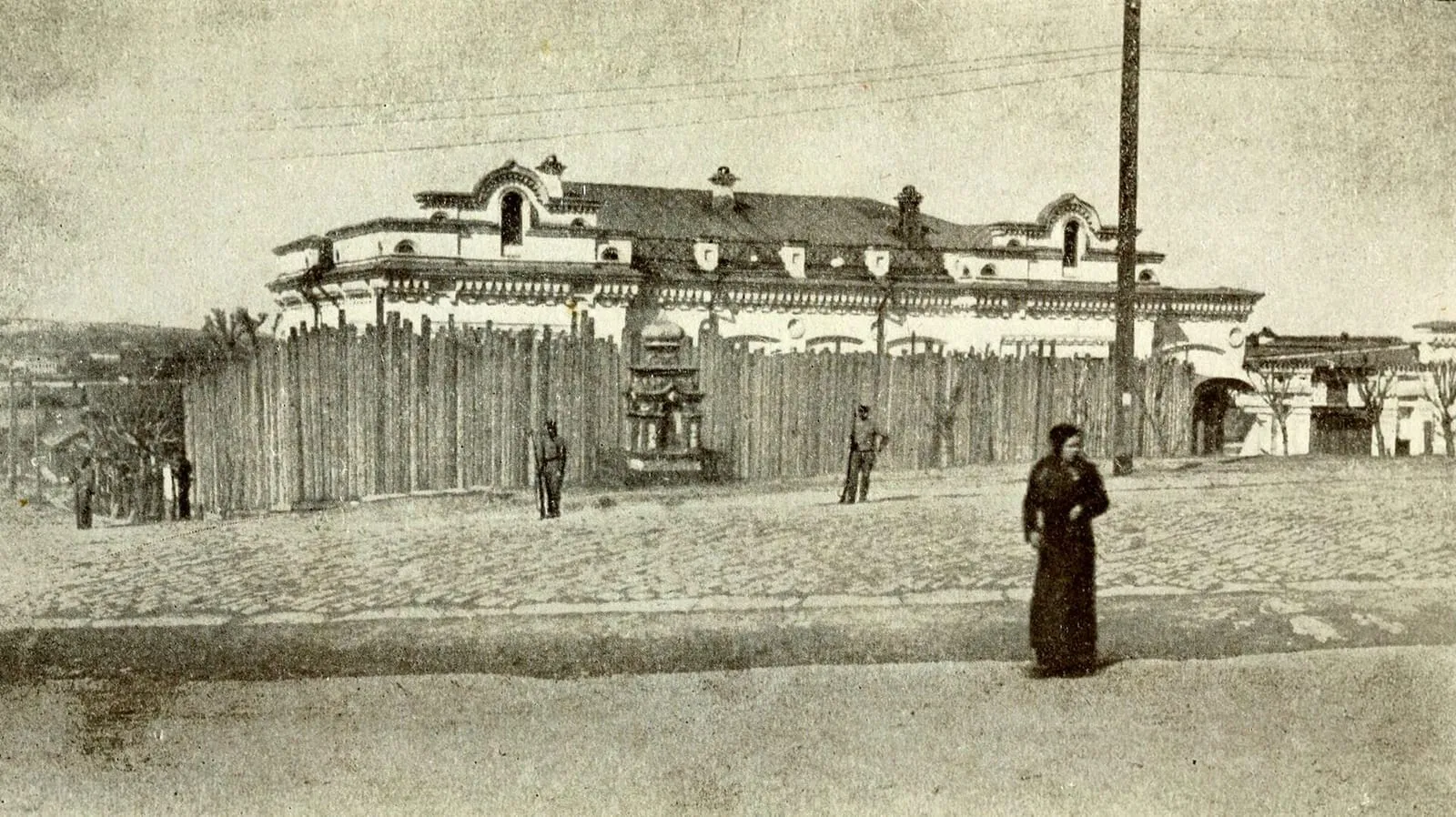
On the night of 16–17 July 1918, in the cellar of the house of the engineer Nikolai Ipatiev in Yekaterinburg in the Urals, a Bolshevik firing squad shot and finished off with bayonets the former Emperor Nicholas II, his wife Alexandra Feodorovna, their five children and four people who had shared their captivity. The killing was directed by the commandant of the house, Yakov Yurovsky, and the formal decision was taken by the presidium of the Ural Regional Soviet. Units of the Czechoslovak Legion and Russian anti-Bolsheviks were then approaching the city, and the Bolsheviks did not want the Romanovs to fall into their hands. The family that had given Russia its rulers for more than three hundred years, and which had lost the throne in March 1917, perished without trial, and its death was concealed for years. How much of the decision was the Urals’ own initiative and how much an order from Moscow is still disputed by historians.
The road to Yekaterinburg
After the abdication Nicholas and his family were held in the palace at Tsarskoye Selo near Petrograd. In August 1917 the Provisional Government, fearing for their safety in the capital, sent them to Tobolsk in Siberia. After the Bolshevik coup the conditions of their captivity grew harsher. In early 1918 the Soviet authorities considered a show trial of the former tsar in Moscow. In April the commissar Vasily Yakovlev (Myachin), sent from Moscow, was to move the prisoners further. The Ural Bolsheviks, who wanted to hold them themselves and, according to some accounts, were ready to kill Nicholas on the way, eventually forced the journey to end in Yekaterinburg. Nicholas, Alexandra and their daughter Maria arrived there on 30 April, and the other children, Olga, Tatiana, Anastasia and the haemophiliac heir to the throne Alexei, on 23 May.
The Romanovs were placed in the requisitioned Ipatiev house, called the “House of Special Purpose”. Surrounded by a high double fence, the building was guarded by Red Guards, and the prisoners were almost completely cut off from the world. They were subjected to searches, and their money and valuables were taken. Besides the family, the house was home to the court physician Eugene Botkin, the empress’s maid Anna Demidova, the cook Ivan Kharitonov, the valet Alexei Trupp and the fourteen-year-old kitchen boy Leonid Sednev. Several members of the former suite had been arrested earlier and murdered in June and early July.
Summer brought war to the Urals. After the revolt of the Czechoslovaks at the end of May, one Bolshevik soviet after another fell along the Trans-Siberian Railway, and in June the legionaries took Omsk. In mid-June in Perm local Chekists murdered the tsar’s brother, Grand Duke Michael Alexandrovich, and the authorities announced that he had escaped. Rumours circulated in Russia and abroad that Nicholas was also dead. Moscow denied them, and the German envoy Wilhelm von Mirbach, killed on 6 July by Left Socialist Revolutionaries, repeatedly enquired about the fate of the empress and her daughters, who were German princesses by birth.
The decision
On 4 July the previous commandant of the house, the worker Alexander Avdeyev, whose guards were accused of drunkenness and theft, was replaced by Yurovsky, a member of the board of the Ural Cheka. He also replaced the sentries with trusted men, including several former prisoners of war and Latvians. In early July the Ural military commissar Filipp Goloshchyokin, a close acquaintance of the chairman of the All-Russian Central Executive Committee Yakov Sverdlov, went to Moscow. According to the Russian prosecutor’s office, which investigated the case after 1993, he was there roughly from 4 to 10 July. What exactly was settled in the capital is not known. According to some historians the Bolshevik leadership agreed that the Urals could choose the moment to execute the former tsar themselves, when the military situation required it. According to the prosecutors’ findings, only the fate of Nicholas was discussed, whom Moscow wanted to put on trial, and the killing of his wife, children and servants was not agreed with Moscow.
When Goloshchyokin returned, the Reds were retreating all over the Urals. On 16 July he and Georgy Safarov sent a telegram via Petrograd to Sverdlov and Lenin: the “trial” agreed with “Filippov”, that is, with Goloshchyokin, could not wait for military reasons, and if Moscow was opposed it should reply immediately. The telegram reached Moscow at 9.22 p.m. No reply has been found in the archives, although Yurovsky later claimed that Goloshchyokin had passed on to him that evening the centre’s consent. The same day Lenin prepared a dispatch for a Danish newspaper denying the rumours of the tsar’s death. It was never sent. Yurovsky already had his plan ready: he had chosen the executioners, assigned each of them a victim, handed out weapons and ordered a lorry to take away the bodies. In the evening young Sednev was led out of the house on the pretext of a visit to his uncle. He was the only one of the house’s inmates to survive.
Night in the cellar
The lorry arrived late, at about half past one in the morning. Yurovsky told Botkin to wake the prisoners: the town was unsettled and they had to be moved downstairs. After roughly half an hour eleven people went down to a small semi-basement room. Nicholas carried his son, who could not walk. At Alexandra’s request two chairs were brought, for her and for Alexei. Then the executioners came in, and Yurovsky read out a decision whose exact wording nobody afterwards remembered in the same way. According to most accounts he announced that, since the former tsar’s relatives and supporters were trying to free him, the Ural Soviet had sentenced them to death. Nicholas only had time to ask: “What?”.
The shooting was chaotic. The room filled with gunpowder smoke and plaster dust, bullets ricocheted off the walls, and the engine of the lorry under the windows did not drown out the noise. The tsar and the empress died at once, but the children, Botkin and Demidova survived the first volleys, partly because the daughters had jewels sewn into their clothes. The executioners finished them off with bayonets and shots to the head. Alexei lived longest. Seven Romanovs were killed: Nicholas (aged 50), Alexandra (46), Olga (22), Tatiana (21), Maria (19), Anastasia (17) and Alexei (13), and with them Botkin, Demidova, Kharitonov and Trupp. The whole thing lasted, according to various accounts, from a few minutes to a quarter of an hour or so.
The bodies were taken out of town, to a forest near the village of Koptyaki, and thrown into the shaft of an abandoned mine at the Ganina Yama site. The very next day, fearing that the place would be discovered, Yurovsky had them retrieved. The lorry got stuck in the mud on a forest road, and in the end the corpses, disfigured with sulphuric acid and partly burned, were buried in shallow pits in the Porosenkov Log meadow. Almost all the Romanovs’ belongings were packed up and sent to Moscow.
The lie of the “evacuation”
At noon on 17 July members of the Ural executive committee reported to Moscow that Nicholas had been shot and the family evacuated. According to the White investigator Nikolai Sokolov, that evening the chairman of the Ural Soviet, Alexander Beloborodov, sent a second, coded dispatch: the whole family had “suffered the same fate as its head”, and “officially the family will die during the evacuation”. On 18 July the presidium of the All-Russian Central Executive Committee, chaired by Sverdlov, deemed the Ural Soviet’s decision correct, and the Council of People’s Commissars headed by Lenin took note of it. On 19 July Izvestia and Pravda announced that the former tsar had been shot because of the threat from “Czechoslovak bands” and the discovery of a plot to free him, and that his wife and son had been taken to a “safe place”. The daughters and servants were not mentioned. On 21 and 22 July newspapers in New York and London reported the tsar’s death. For years afterwards Soviet diplomats assured the Germans and the world that the family was alive, which for decades fed legends of surviving children and the activities of numerous impostors.
Aftermath
The following night, 17–18 July, Chekists in Alapayevsk, about 140 km from Yekaterinburg, threw into a mine shaft the empress’s sister, Grand Duchess Elizabeth, Grand Duke Sergei Mikhailovich, three sons of Grand Duke Konstantin, Prince Vladimir Paley and two of their companions, and then announced that they had been abducted by an unknown gang. On 25 July, eight days after the murder, Yekaterinburg was taken by the Czechoslovaks and the Whites. In the former House of Special Purpose they found a cellar riddled with bullets. The investigation conducted in 1919 by Sokolov on the orders of Admiral Alexander Kolchak established that the whole family had been killed, although the bodies were not found. The Soviet authorities admitted this only in the mid-1920s.
The remains in Porosenkov Log were discovered in 1979 by the geologist Alexander Avdonin and the film-maker Geli Ryabov, but they revealed the find only in the era of perestroika. In 1991 the remains were exhumed, and DNA tests confirmed that they belonged to the imperial family. On 17 July 1998 they were buried in the Peter and Paul Cathedral in St Petersburg. In 2007 a second grave containing the remains of Alexei and one of his sisters, Maria or Anastasia, was found nearby. In 2000 the Russian Orthodox Church canonised the imperial family. In 2011 the Investigative Committee of Russia closed the case, concluding that no document had been found proving that Lenin or Sverdlov had given the order. Many historians nonetheless believe that the Ural Bolsheviks would not have dared to take such a step without Moscow’s consent, and it is certain that the Bolshevik leadership approved the crime and punished nobody for it. On the site of the Ipatiev house, demolished in 1977, there now stands the Church on the Blood.
Remember the articles you have read? Only in this browser; nothing is sent anywhere.How it works
Read ·
A voice from the front
“In the morning, around half past ten, three workmen came up to the open window, lifted a heavy grille and fixed it to the outside of the frame – without any warning from Yu[rovsky]. We like this type less and less! […] Alexei had his first bath since Tobolsk; his knee is getting better, but he cannot straighten it completely. The weather is warm and pleasant. We have no news at all from outside.”
Translated · Original (ru)
Утром около 10½ час. к открытому окну подошло трое рабочих, подняли тяжелую решетку и прикрепили ее снаружи рамы — без предупреждения со стороны Ю[ровского]. Этот тип нам нравится все менее! […] Алексей принял первую ванну после Тобольска; колено его поправляется, но совершенно разогнуть его он не может. Погода теплая и приятная. Вестей извне никаких не имеем.
Spotted a mistake?Report an error
Meanwhile
(04)Elsewhere in the same days.
- 15 July 1918 · Western FrontSecond Battle of the Marne beginsOn 15 July 1918 the Germans attacked either side of Reims. In Champagne they broke against Gouraud's defence; on the Marne they crossed at Dormans and stalled.
- 18 July 1918 · Western FrontMangin's counter-offensiveOn 18 July 1918 Mangin's French Tenth Army, with Americans and hundreds of tanks, struck the German flank from Villers-Cotterêts without a bombardment.
- 19 July 1918 · Middle EastBritish set out for TranscaspiaOn 19 July 1918 a detachment of General Malleson's mission left Mashhad for the border of Transcaspia, where Bolshevik rule had been overthrown a week before.
- 19 July 1918 · War at seaSinking of the San DiegoOn 19 July 1918 off Fire Island near New York the armoured cruiser San Diego struck a mine laid by U-156. Six sailors were killed.
Related events
(04)The same battle, people or subject.
- 10 July 1918 · Asia and the PacificHorvat governmentIn July 1918 Dmitry Horvat, head of the Chinese Eastern Railway, declared himself Provisional Ruler of Russia at Grodekovo. The Allies told him to withdraw.
- 4 July 1918 · Eastern FrontSiberian declaration of independenceOn 4 July 1918 Pyotr Vologodsky's government in Omsk proclaimed Siberia's state independence, while stating that it was not separating it from Russia for ever.
- 24 December 1918 · Eastern FrontCapture of PermOn the night of 24–25 December 1918 Radola Gajda's Siberian Army entered Perm. The Red 3rd Army fell apart and the Bolsheviks spoke of the "Perm catastrophe".
- 7 June 1918 · Eastern FrontCzechoslovaks take OmskOn 7 June 1918 the Bolshevik soviet fled Omsk by steamer down the Irtysh. Russian anti-Bolsheviks took the city, and next day Czechoslovak trains arrived.