Russia · The Entente
Yakov Sverdlov
Secretary of the Bolshevik Central Committee (1917–1919), Chairman of the All-Russian Central Executive Committee (1917–1919)
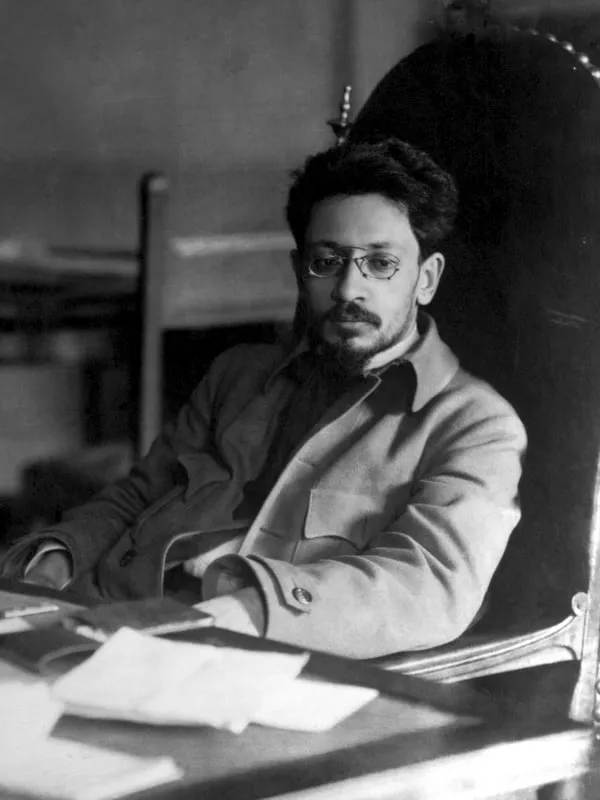
- Born:
- 3 June 1885, Nizhny Novgorod (Russian Empire)
- Died:
- 16 March 1919, Moscow
- Author:
- Natalia
- Photo:
- Пётр Адольфович Оцуп (1883-1963), domena publiczna, Wikimedia Commons

Yakov Sverdlov was the most important organiser of the Bolshevik party in 1917 and 1918 and the man who turned a collection of resolutions into a working apparatus of power. He was neither a theorist nor a great orator, but he remembered hundreds of names and biographies of activists and knew whom to send where. From November 1917 he chaired the All-Russian Central Executive Committee, and was thus formally the Soviet head of state, while at the same time running the party secretariat. In this double role he opened and dispersed the Constituent Assembly, gathered a majority for the Brest peace for Vladimir Lenin, received the credentials of the German envoy and signed the acts that justified the murder of the imperial family and the Red Terror. He was on the side of the Entente only formally: the government he helped to build took Russia out of the war. He died in March 1919, aged 33.
Before the war
He was born on 3 June 1885 (22 May in the Julian calendar) in Nizhny Novgorod into a Jewish family of craftsmen. His father, an engraver, sympathised with the revolutionaries, and stamps for forged documents were made in his workshop. Maxim Gorky, who adopted Yakov’s elder brother Zinovy, visited the Sverdlov home. Yakov completed four classes of the gymnasium and then worked as a pharmacist’s apprentice. At sixteen he joined the Social Democrats, and from the split of 1903 he was a Bolshevik.
During the 1905 revolution he worked in the Urals, in Yekaterinburg and Perm, where he organised party committees and workers’ fighting squads. From 1906 he spent almost all his time in prison and in exile, and in between, after escapes, he worked underground in St Petersburg and Moscow. In 1912, while in exile in the Narym region, he was co-opted onto the Central Committee. After another escape he worked in St Petersburg with the editors of Pravda and the Bolshevik group in the Duma. In February 1913 the police arrested him thanks to a denunciation by Roman Malinovsky, leader of that group and an Okhrana agent, and exiled him for four years to the Turukhansk region in the north of Yeniseysk Governorate.
Exile and organiser
He spent the war in exile on the Yenisei. For a time he lived in the settlement of Kureika in the same house as Joseph Stalin, with whom he did not get on. Later he moved to Monastyrskoye, where his wife, Klavdiya Novgorodtseva, joined him with their two children. He ran an illegal self-education circle and wrote articles on exile and Siberia and an outline history of the international labour movement.
After the February Revolution he returned to Petrograd in March 1917, and the party sent him from there to the Urals to organise a regional conference. At the party conference at the end of April he met Lenin in person for the first time. He joined the Central Committee and became head of its secretariat. From then on all correspondence with local organisations and all appointments passed through his hands. According to Anatoly Lunacharsky it was Sverdlov who effectively ran the party in July, when after the July Days Lenin was in hiding and Trotsky and others were in prison. In August he prepared and led the Sixth Party Congress. He chaired the meeting of the Central Committee of 23 October (10 October Old Style) at which it was decided to prepare an armed uprising, and he joined the party’s military revolutionary centre. He selected people for the Military Revolutionary Committee (PL) and the commissars whom the committee sent to the regiments of the garrison.
Chairman of VTsIK
On 21 November 1917 (8 November Old Style), on Lenin’s proposal, Sverdlov replaced Lev Kamenev as chairman of the All-Russian Central Executive Committee. Kamenev had demanded a government of all the socialist parties, while Sverdlov was Lenin’s man. Under his leadership the committee, which was supposed to oversee the Council of People’s Commissars, became an obedient tool of the Bolsheviks. At the same time Sverdlov built up the soviets in the provinces and sent his own people to them. On 5 January 1918 he handed the Finns the act recognising the independence of their country.
On 18 January it was he who, on behalf of the committee, opened the Constituent Assembly, drowning out the oldest Socialist Revolutionary deputy. He read out the Declaration of Rights of the Working and Exploited People and demanded that the assembly recognise the authority of the soviets over itself. When the majority refused, the Bolsheviks left the hall, and the next day the assembly was dispersed. A few days later Sverdlov brought about the merger of the peasants’ soviets with the workers’ and soldiers’ soviets under a joint executive committee.
In the dispute over peace with Germany he stood by Lenin from the start. On 18 February, when the Germans launched their offensive, he voted to accept their terms, and on 21 February he joined the leadership of the Committee for the Revolutionary Defence of Petrograd, which was to defend the capital against the Germans. On 23 February, together with Lenin, Stalin and Yelena Stasova, he carried a vote in the Central Committee to accept the new, even harsher ultimatum, and that night he pushed the same decision through the Central Executive Committee, where the resistance of the Left Communists and the Left Socialist Revolutionaries was strong. At the Seventh Party Congress at the beginning of March, which approved the Treaty of Brest-Litovsk and renamed the party communist, he was the chief organiser of the majority for Lenin. In mid-March he moved with the government to Moscow and settled in the Kremlin.
Head of state in 1918
In the spring of 1918 he headed the commission that drafted the first constitution of the Russian Socialist Federative Soviet Republic, adopted by the Fifth Congress of Soviets on 10 July. In May he announced in the Central Executive Committee the policy of splitting the village into two hostile camps, the poor and the “kulaks”, which became the prelude to armed grain requisitions. As chairman of the committee he received at the end of April the credentials of the German envoy Wilhelm von Mirbach. Mirbach remembered the ceremony as “the simplest and most icy”, and Sverdlov did not even ask him to sit down. When the Left Socialist Revolutionaries killed Mirbach on 6 July, he went with Lenin to the legation to offer condolences. One of the insurgents’ aims was to arrest Sverdlov, and he himself, together with Lenin, directed the crackdown on them.
A few days later the fate of the former tsar was settled. At the beginning of July the Ural military commissar Filipp Goloshchekin, Sverdlov’s old comrade from exile, came to Moscow to discuss the fate of the Romanovs. The telegram about a “trial” that could not wait was sent by the Urals on 16 July precisely to Sverdlov and Lenin. On 18 July the presidium of VTsIK under Sverdlov’s chairmanship declared the shooting of Nicholas II justified. Whether, and to what, Moscow had agreed beforehand remains disputed. The Russian investigation closed in 2011 found no order signed by Lenin or Sverdlov. Trotsky, however, recorded in his diary a conversation in which Sverdlov allegedly told him that the killing of the whole family had been “decided here”, and many historians believe that the Ural Bolsheviks would not have taken this step without the consent of the centre.
After the attempt on Lenin’s life on 30 August, Sverdlov signed that same evening an appeal announcing “merciless mass terror”. He took over the wounded Lenin’s office and until mid-October chaired the meetings of the Council of People’s Commissars. On his verbal order, on 3 September the commandant of the Kremlin shot the would-be assassin Fanny Kaplan, and her body was burned. On 2 September the committee under his chairmanship declared Soviet Russia a single military camp. Three days later the Council of Commissars adopted the resolution on the Red Terror. In the autumn Sverdlov mediated in the dispute between Stalin and Trotsky over Tsaritsyn, passing on to Stalin that he had to obey the Revolutionary Military Council of the Republic. On 13 November 1918, two days after the Armistice of Compiègne, the Central Executive Committee under his chairmanship annulled the Treaty of Brest-Litovsk.
Death
In the winter of 1918–1919 Sverdlov prepared the founding congress of the Communist International and congresses of soviets in Belarus, Lithuania, Latvia and Ukraine. He is also credited, although historians dispute the authorship, with the secret directive of the party’s Organisational Bureau of 24 January 1919 that began de-Cossackisation, the mass repression of the Don Cossacks. On the way back from Kharkov at the beginning of March he fell ill. According to the official version it was Spanish flu with pneumonia. There were also rumours that workers had beaten him in Oryol, but they were never confirmed. He died in Moscow on 16 March 1919 and was buried by the Kremlin wall. He was succeeded as chairman of the executive committee by Mikhail Kalinin. In 1924 Yekaterinburg, where the imperial family had been killed, was renamed Sverdlovsk in his honour. The city regained its old name in 1991.
Assessment
His party comrades remembered Sverdlov as a genius of organisation. Trotsky recounted that when Lenin rang him with some urgent instruction, he most often heard “already”, because Sverdlov had already carried it out. In his funeral speech Lenin called him the man who most fully expressed the organisational qualities of the proletarian revolution. Soviet historiography presented him as a model Bolshevik, and his name was borne by cities, universities and ships.
Western historians such as Richard Pipes and Yuri Slezkine stress that this efficient administrator shared responsibility for the liquidation of the Constituent Assembly, for the Red Terror, for the repression of the Cossacks and most probably for the murder of the Romanovs. Some scholars draw attention to one more consequence of his death. Sverdlov was the de facto head of the party apparatus, and the post of general secretary, which Stalin took up in 1922, was in a sense made to his measure. Had he lived, the history of Soviet power might have taken a different course, though that is mere speculation.
Sources
Spotted a mistake?Report an error
Mentioned in battles
(01)Often appears with
People who appear in the same events.