Russia · The Entente
Georgy Chicherin
Deputy People's Commissar for Foreign Affairs (1918), People's Commissar for Foreign Affairs of the RSFSR and the USSR (1918–1930)
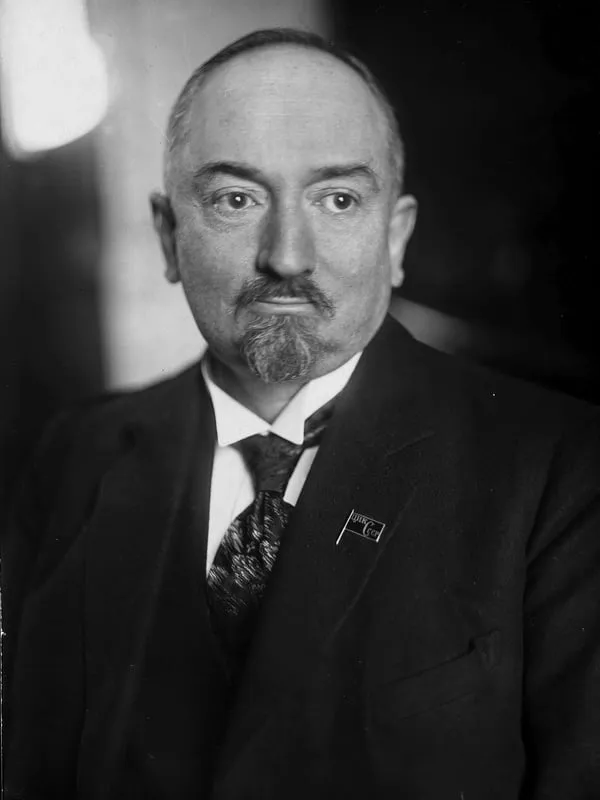
- Born:
- 24 November 1872, Karaul, Tambov Governorate (Russian Empire)
- Died:
- 7 July 1936, Moscow
- Author:
- Łukasz Skowroń
- Photo:
- autor nieznany, domena publiczna, Wikimedia Commons

Georgy Chicherin was the most unusual of the men who ruled Soviet Russia in 1918. A descendant of old nobility, related to Pushkin, a polyglot and a connoisseur of Mozart and Wagner, he had begun his career in the archive of the tsarist foreign ministry. Throughout the war he was an émigré and an opponent of the war, and in London he ended up in prison. He returned to Russia in January 1918, rose in March from deputy to Leon Trotsky to head of Soviet diplomacy, and remained so for twelve years. In 1918 his task was to keep the Brest peace alive: to give way to the Germans as much as was needed to stop them resuming the war, and to protest against Entente landings without breaking with the Entente altogether. He was on the Entente side only formally: the government he served had taken Russia out of the war.
Before the war
He was born on 24 November 1872 (12 November in the Julian calendar) on the Karaul estate in Tambov Governorate, which belonged to his uncle, the eminent jurist and philosopher Boris Chicherin. His father was a diplomat, and his mother came from the Baltic family of the Barons Meyendorff. His parents were Pietists and brought their son up in an atmosphere of prayer and Bible reading. He studied history and philology at the University of St Petersburg, knew many languages, played the piano and was a friend of the poet Mikhail Kuzmin. From 1898 he worked in the archive of the Ministry of Foreign Affairs and helped write the ministry’s jubilee history.
At the beginning of the twentieth century he drew close to the left. In 1904 he went to Germany for medical treatment and never returned to the service. He inherited his uncle’s estate and, by many accounts, devoted a large part of the money to the revolutionary movement. In 1905 he joined the Russian Social Democratic Labour Party and sided with the Mensheviks. He was secretary of its foreign bureau; in 1907 he was arrested in Berlin for using someone else’s passport and expelled from Prussia. He then lived in Paris and was active in the French Socialist Party.
Émigré in London
The outbreak of war found him in Belgium. According to Russian biographers he moved to London as early as 1914, according to some English-language studies in 1915. From the outset he was an internationalist, an opponent of the war and of the Russian government, which brought him closer to the Bolsheviks. He joined the British Socialist Party and, together with the labour activist Mary Bridges-Adams, ran a committee for the relief of Russian political prisoners and exiles. The committee raised money for imprisoned revolutionaries, but under Chicherin’s direction it became a centre of agitation against tsarism.
After the February Revolution he organised the dispatch of political émigrés to Russia and continued to agitate against the war. According to the American historian Richard Debo, what particularly irritated the British was his campaign against the agreement with the Provisional Government that obliged Russian subjects living in Britain, most of them Jews from the East End, either to serve in the British Army or to return to Russia. The Russian chargé d’affaires in London, Konstantin Nabokov, called him a fanatic. On 22 August 1917 the British authorities arrested Chicherin as a danger to public safety and held him in Brixton prison.
Trotsky’s deputy
After the October Revolution Trotsky, as Commissar for Foreign Affairs, demanded the release of the revolutionaries imprisoned in England. When London delayed, he stopped issuing exit visas to British subjects, according to some accounts including the ambassador, George Buchanan. On 3 January 1918 Chicherin was released. In January he arrived in Petrograd, joined the Bolshevik party and became Trotsky’s deputy. In this role he signed, among other things, the decree introducing the Gregorian calendar.
At the end of February, after the German offensive and the acceptance of the ultimatum, he went with Grigori Sokolnikov’s delegation to Brest, and on 3 March signed the treaty there together with Sokolnikov, Grigory Petrovsky and Lev Karakhan. The delegates signed it without discussion, declaring that it was a peace imposed by force. On 13 March, when Trotsky moved to the war commissariat, Chicherin took over foreign affairs, for the time being in an acting capacity. He was formally appointed People’s Commissar on 30 May 1918.
Diplomat of the Brest peace
From Moscow Chicherin conducted the policy Lenin called a “breathing space”: buying time with concessions to Germany, in the hope that the war in the west and revolution in Germany would settle the rest. In April he received the new German envoy, Wilhelm von Mirbach. Mirbach reported that Chicherin was very cordial, but that at every serious conversation his deputy Lev Karakhan would come out of the next room. At the same time Chicherin sent protest after protest to Berlin: against the march of German troops far beyond the lines laid down in the treaty, against the occupation of the Crimea and the landing in Finland, against the demands for the surrender of the Black Sea Fleet. He also protested on Russia’s behalf against the union of Bessarabia with Romania and against the Japanese landing at Vladivostok.
Under pressure from Mirbach, on 21 April he ordered the eastward movement of the Czechoslovak Legion’s trains to be halted. The growing mistrust between Moscow and the Czechoslovaks ended in May in their revolt. At the beginning of June, together with Lenin, he demanded that the Murmansk soviet stop co-operating with the British and French and that the Allies leave Russia. The soviet did not obey and at the end of June threw in its lot with the Entente. After the assassination of Mirbach on 6 July Chicherin had to soothe Berlin’s anger. The Soviet government apologised, but rejected the German demand to send a battalion of German soldiers to Moscow to guard the legation. In the summer, when the Allies landed at Archangel, Moscow bound itself even more closely to Germany. On 27 August the Soviet representative in Berlin, Adolph Joffe, signed the Supplementary Treaty, in which Russia undertook to pay 6 billion marks and to remove Entente troops from the north of the country.
Chicherin went on talking to the Entente representatives who had stayed in Russia until the end of the summer. Contacts broke off when, after the attempt on Lenin’s life, the Cheka arrested the British agent Robert Bruce Lockhart and accused Western diplomats of a conspiracy, and in Petrograd the naval attaché Francis Cromie was killed. In October Lockhart was exchanged for Maxim Litvinov, who had been detained in London and later became Chicherin’s deputy and successor. At the end of October Chicherin sent President Woodrow Wilson a long, ironic note in which he asked, among other things, whether his Fourteen Points also applied to Russia, where American troops had landed. At the beginning of November the Germans expelled Joffe from Berlin, and on 13 November, after the Armistice of Compiègne, Moscow annulled the Treaty of Brest.
After the war
Chicherin directed Soviet diplomacy during the years of the Civil War and the intervention. In March 1919 he took part in the founding congress of the Communist International. In 1920–1921 Soviet Russia concluded peace treaties with its neighbours and treaties with Turkey, Persia and Afghanistan. Chicherin’s greatest success was the Treaty of Rapallo with Germany, concluded in April 1922 on the sidelines of the Genoa Conference. The two states, both excluded from the European concert after the war, established diplomatic relations and renounced their mutual claims. Chicherin was a supporter of co-operation with Germany and a friend of the German ambassador in Moscow, Count Ulrich von Brockdorff-Rantzau. From 1926 he was seriously ill and spent ever longer periods abroad for treatment, while the running of the commissariat passed to Litvinov, with whom Chicherin was on bad terms. In July 1930 he formally retired. He still managed to finish a book on Mozart. He died on 7 July 1936 in Moscow.
Assessment
Lenin wrote of Chicherin in the summer of 1918 that he was a “splendid, extraordinarily conscientious, intelligent and knowledgeable” worker, whose only weakness was a lack of “commanding”. Contemporaries remembered him as a man who worked through the night, buried in papers, and could not delegate anything to subordinates. The British agent Lockhart preferred Trotsky’s energy to his “subtle vagueness”, and the writer Arthur Ransome described him in 1919 as a mortally tired official of the revolution.
Historians such as Timothy O’Connor see him as the creator of Soviet diplomacy, who found a commissariat without people or traditions and left an institution respected by Western governments. They also stress that his influence on decisions was limited: foreign policy was decided by Lenin and later by the Politburo, and Chicherin complained in his farewell memorandum that the greatest “internal enemies” of his work were the Comintern and the political police. In the history of the First World War he is remembered as one of the signatories of the Brest peace and the diplomat who for eight months of 1918 steered Soviet Russia between the two warring camps.
Sources
Spotted a mistake?Report an error
Often appears with
People who appear in the same events.