United Kingdom · The Entente
Frederick Poole
Commander of Allied forces in North Russia (1918), head of the British military mission to Denikin (1918–1919), major-general
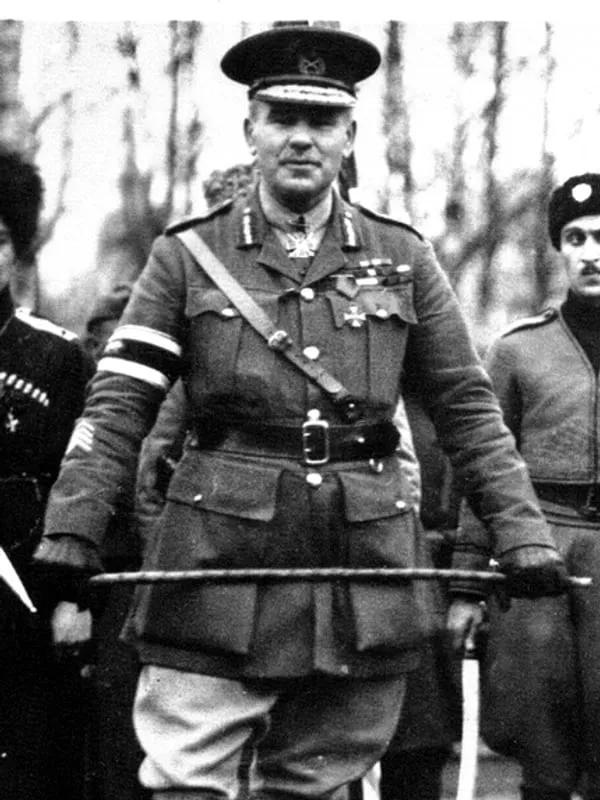
- Born:
- 3 August 1869
- Died:
- 20 December 1936, St Austell (Cornwall)
- Author:
- Łukasz Skowroń
- Photo:
- Not stated, United States Army Signal Corps, domena publiczna, Wikimedia Commons

Sir Frederick Cuthbert Poole was a British gunner who began the war as a retired major and ended it as the general responsible for the first stage of the Allied intervention in Russia. He knew the country from two years’ service with the Tsarist army, so in spring 1918 London sent him to Murmansk to defend the northern ports and depots against the Germans. Poole went much further than the Americans wanted: he took Archangel, sent small columns hundreds of kilometres inland and became in practice master of a region in which a Russian government was operating. After a few months his methods had alienated Allied diplomats and the Russians themselves, so in October he was recalled to London. He then briefly led a mission to General Denikin in southern Russia.
Before the war
He was born on 3 August 1869. He graduated from the Royal Military Academy, Woolwich, and in February 1889 was commissioned into the Royal Artillery. In 1897–1898 he fought on the North-West Frontier of India in the expedition against the tribes of the Tirah valley. In the Boer War he served with the ammunition column of the 8th Division and later commanded a section of quick-firing “pom-pom” guns. Twice mentioned in despatches, he received the Distinguished Service Order (DSO). In 1904 he fought in Somaliland against the rebels of the “Mad Mullah”, Mohammed Abdullah Hassan, and later in Northern Nigeria. In 1909 he was promoted to major, and at the beginning of 1914, aged 44, he retired.
From France to Russia
On the outbreak of war he returned to service. He spent the first year in France in various posts in the artillery brigades of the British Expeditionary Force, and in 1915 he was promoted to lieutenant-colonel. In 1916–1917 he headed the British artillery mission to the Tsarist army in Russia. On 26 May 1917 he received the temporary rank of major-general. He picked up something of the country’s language and customs at the time, which was to prove useful a year later.
He was in Petrograd after the Bolshevik coup as well. The British agent Robert Bruce Lockhart recalls that at the beginning of 1918, when the negotiations at Brest broke down, Poole, like Lockhart himself, believed that the Bolsheviks were worth supporting against the Germans. He soon changed his mind and, according to Lockhart, became an advocate of intervention. In the spring the War Office appointed him commander of the Allied forces in North Russia.
Murmansk
On 24 May 1918 Poole landed at Murmansk. He was to base his forces on the Czechoslovak Legion, which was supposed to come by rail from the interior of Russia and sail from there to France, but the Czechs were stuck in Siberia and on the Volga and soon began fighting the Bolsheviks. He found only a few hundred sailors from the ships, a handful of Frenchmen, Serbs, Russian Red Guards guarding the railway and Finnish Red refugees, from whom he later formed the Finnish Legion. He feared that the Finnish Whites, with German help, would seize the Murmansk railway, so in June he sent Royal Marines and Serbs to Kem on the White Sea.
Moscow, under pressure from Berlin, demanded the withdrawal of the Allies. On 8 June members of the local soviet read Poole a telegram from Lenin and Chicherin, but they themselves preferred the Allies to stay. At the end of June reinforcements arrived under General Charles Maynard, who took command at Murmansk, together with the “Elope” training mission, which was to create a Russian army at Archangel. On 30 June the soviet broke with Moscow, and at the beginning of July Poole signed on the Allies’ behalf an agreement under which they undertook to defend and feed the region. Maynard remembered him as a chief under whom he served with pleasure, although Poole several times took troops away from him for his own expeditions.
Archangel
Poole’s real objective was Archangel, where huge stocks delivered earlier for the Tsarist army lay. He waited for a French colonial battalion, which arrived on 26 July, but the conspirators in Archangel would wait no longer. On 1 August ships and seaplanes silenced the batteries on Mudyug Island, and on 2 August, when the officers of Captain Georgy Chaplin had overthrown Bolshevik rule, Poole sailed into the city. Cheering crowds greeted him. Power was taken over by the Supreme Administration of the Northern Region, headed by the veteran revolutionary Nikolai Chaikovsky. The Bolsheviks, however, had managed to move a large part of the stocks that were the reason for the expedition into the interior.
Poole had about one and a half thousand soldiers, but he immediately sent detachments up the Dvina towards Kotlas and along the railway towards Vologda, hoping to link up with the Czechoslovaks on the Volga. When the American 339th Infantry Regiment arrived on 4 September, he sent it straight to the front, although President Woodrow Wilson had stipulated that the Americans were only to guard the depots and help the Russians organise their self-defence. That same day the Allies took Obozerskaya station. Further on, however, the columns got bogged down in swamps and forests, hundreds of kilometres from their objectives.
Politics caused Poole even more trouble. He declared martial law in Archangel, appointed the French Colonel Donop military governor, banned red flags and meetings, took over the best buildings as quarters, and informed the Russian government of his decisions after the fact, if at all. A Foreign Office official later wrote that the general treated Archangel and its surroundings like a conquered country. Poole relied on Russian officers hostile to the socialists. At the beginning of September Chaplin kidnapped members of Chaikovsky’s government and took them to the Solovetsky Islands. Poole publicly distanced himself from the coup, but some historians do not believe he knew nothing of it. A general strike broke out, and Washington threatened to withdraw its soldiers if the government did not return. Chaikovsky was brought back, and Poole had to accept a Russian general as governor. The American ambassador David Francis complained about him to Washington again and again.
London decided to change the commander without publicity. On 14 October Poole sailed for England, officially for consultations, and never returned. Command at Archangel passed to his chief of staff, General Edmund Ironside.
Mission to Denikin
At the end of 1918, when after the Armistice of Mudros the route across the Black Sea opened, the government sent Poole at the head of a temporary mission to General Anton Denikin, commander of the Volunteer Army in southern Russia. He was to find out what help the Whites needed. According to British historians he again exceeded his instructions: he assured the White leaders of British support for “one and indivisible Russia”, although the War Office had forbidden him to make promises, while at the same time London was supporting the new states in the Caucasus and on the Baltic. He helped bring about the subordination of the Don Cossack ataman Pyotr Krasnov to Denikin. He submitted his lengthy report weeks late, on 14 February 1919. In it he argued that deliveries of guns, tanks and aircraft alone would not be enough and advised sending an expeditionary corps to southern Russia. The government did not agree. By then the permanent military mission had been taken over by General Charles Briggs.
After the war
In 1919 Poole was knighted (KBE), and in 1920 he retired as a major-general. He settled in Cornwall, where he was a deputy lieutenant of the county. Three times, in a by-election in 1922 and in the general elections of 1922 and 1923, he stood as a Conservative for the House of Commons in the Bodmin constituency, and each time he lost to the Liberal Isaac Foot. He died on 20 December 1936 at St Austell.
Assessment
Poole is one of the less well-known British generals of the war. Historians of the intervention judge him severely. They accuse him of planning expeditions into the depths of Russia for which he had no troops, of drawing the Americans into fighting against their president’s wishes, and of undermining, by disregarding the Russian government, the very idea that the Allies came as friends and not occupiers. He was criticised not only by Americans but also by British diplomats, among them the chargé d’affaires Francis Lindley. His defenders point out that he operated with a handful of weak troops in a country sunk in civil war, and that the orders from London, intent on rebuilding the Eastern Front against Germany, themselves encouraged bold moves. Maynard, who knew him best, remembered him as a good superior.
Sources
Spotted a mistake?Report an error
Often appears with
People who appear in the same events.
On the timeline
(15)1918
May
June
July
August
September
- 04
- The Allies take ObozerskayaOn 4 September 1918 the Allies took Obozerskaya station on the Archangel–Vologda railway. Its defence collapsed when a Red regiment went over to them.
- Americans arrive in ArchangelOn 4 September 1918 about 4,500 Americans, mainly of the 339th Infantry Regiment, arrived in Archangel. The British sent them straight to the front.