Key event
Armistice of Mudros
- Category:
- Diplomacy
- Front:
- Middle East
- Date:
- 30 October 1918
- Author:
- Łukasz Skowroń
- Tags:
- Ottoman Empire, Great Britain, Royal Navy, Dardanelles
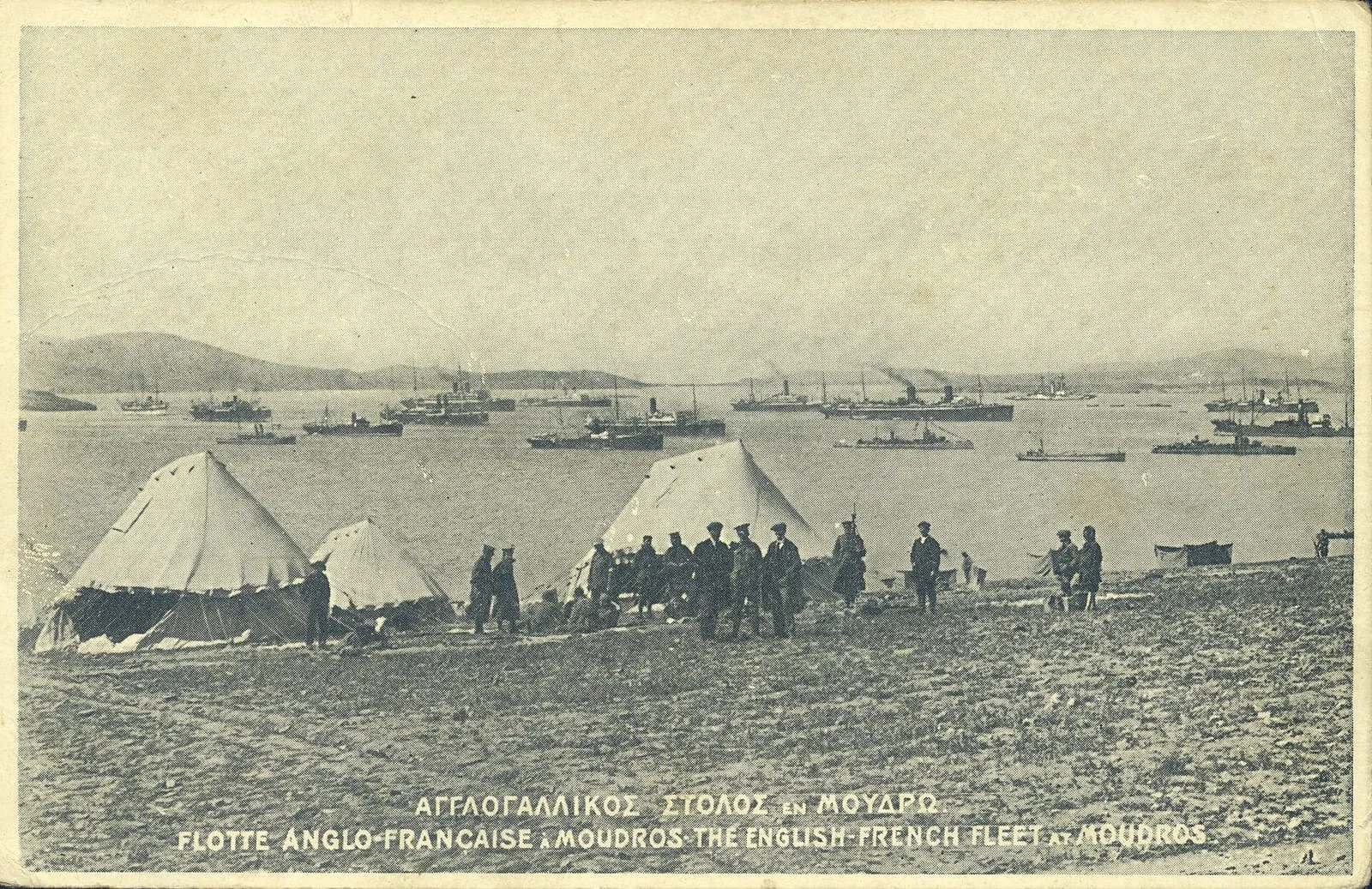
At 9.40 p.m. on 30 October 1918, aboard the British battleship Agamemnon, lying in the harbour of Mudros on the Greek island of Lemnos, an armistice was signed between the Entente and the Ottoman Empire. The signature for the Allies was that of the British commander-in-chief in the Mediterranean, Vice-Admiral Somerset Gough-Calthorpe; for the Ottoman government the signatories were the minister of marine, Rauf Bey, the under-secretary of state at the foreign ministry, Reşat Hikmet Bey, and Lieutenant-Colonel Sadullah Bey of the general staff. Hostilities were to cease at noon local time on Thursday, 31 October. Four years after the Ottoman fleet had bombarded Russian ports on the Black Sea, Turkey became the second of the Central Powers, after Bulgaria, to leave the war.
The road to Mudros
The empire’s fate was sealed by Bulgaria’s capitulation. Turkey was cut off from Germany by land, and to defend Constantinople and the Dardanelles it had a mere four worn-out divisions. A British army from Salonika was already marching through Thrace towards the Maritsa. In the south, after the battle of Megiddo, the British and the Arabs had taken Damascus and, on 26 October, Aleppo. In Mesopotamia the last British offensive up the Tigris had begun on 23 October, leading to the battle of Sharqat.
Immediately after Bulgaria’s collapse the British government instructed the Admiralty and the War Office to draw up armistice terms for Turkey. On 7 October the prime ministers of Britain, France and Italy agreed in Paris that whichever of the three powers the Turks approached could conclude the armistice. Calthorpe was ordered to Mudros, where he arrived on 11 October. In Constantinople, meanwhile, Talat Pasha’s cabinet resigned, and the new grand vizier, Ahmed İzzet Pasha, who had asked President Wilson to mediate without success, released from captivity General Charles Townshend, the defender of Kut. On 20 October Townshend arrived at Mytilene on Lesbos with the news that Turkey was ready to make a separate peace. London replied that Britain could not discuss peace without its allies but was ready to discuss armistice terms at once, and that Calthorpe would receive authorised representatives of the government.
In Constantinople there was a brief dispute over the make-up of the delegation. Sultan Mehmed VI wanted to send his brother-in-law Damat Ferid Pasha, but the government objected and Rauf was put at the head of the delegation. According to Turkish historians, the government, which placed great faith in Wilson’s principles, instructed him to seek assurances that the Allies would not interfere in the administration of the state and would not land anywhere on the empire’s territory. The Straits were to be opened on condition that no Greek warships entered them. Late in the afternoon of 26 October the British cruiser Liverpool brought the delegates to Mudros.
Negotiations aboard the Agamemnon
Calthorpe had clear instructions. He had to obtain the first four points unconditionally: the opening of the Dardanelles and the Bosporus and the occupation of their forts by the Allies, help in clearing mines and obstructions, and the surrender of all prisoners. On the remaining twenty matters he could give way if insistence threatened to wreck the talks. He was to conduct the negotiations alone. The French Vice-Admiral Amet, commander of the French squadron in the Aegean, received orders from Paris to take part, but Calthorpe refused. He explained that the Turks were accredited only to the British government and that referring every agreed point to Paris would prolong the talks. The Turkish delegates declared that they wished to deal with the British alone.
On the first day, 27 October, the talks were almost entirely about the forts on the Straits. The Turks proposed disarming them or placing them under the supervision of a mixed commission, but Calthorpe would not agree. He did, however, obtain the Admiralty’s consent to promise that the forts would be occupied only by British and French troops. At the second session, on 28 October, the Turks accepted several points without much discussion, and at the request of Rauf, who argued that the capital was in ferment, the admiral softened the wording of Article 7 on the occupation of strategic points and of Article 9, from which the mention of Constantinople disappeared. The delegates had to seek their government’s approval, however, and telegraphic communication with the capital was slow, so there was no session on 29 October.
On the morning of 30 October Rauf announced that the government agreed to hand over the forts to the British and French. But when it turned out that further points would again have to be referred to Constantinople, Calthorpe set a deadline: if the armistice was not signed by 9 p.m., he would consider that the Turks had rejected it. In the final hours he softened two more disputed articles, on Cilicia and on the Armenian vilayets. The delegates waited all day for new instructions, but none came. Shortly before nine Rauf declared that they were ready to sign. The text was read out point by point, and at 9.40 p.m. the signatures were affixed. According to some historians, neither side knew how much the other wanted an agreement: the Turks would have accepted almost any terms, and the British could have demanded more.
The terms
The armistice had 25 articles. Turkey had to open the Dardanelles and the Bosporus, guarantee the Allies free access to the Black Sea and hand over to them the forts on the Straits. It was to point out the minefields and help clear them, surrender unconditionally all Allied prisoners and all interned and imprisoned Armenians, and leave Turkish prisoners in Allied hands. The army was to be demobilised immediately, except for the troops needed to guard the frontiers and maintain order, and all warships were to be surrendered and interned in designated ports.
The garrisons in the Hejaz, Asir, Yemen, Syria and Mesopotamia were to surrender to the nearest Allied commander, the officers in Tripolitania and Cyrenaica were to give themselves up to the Italians, and the troops in Cilicia were to be withdrawn, apart from those needed to keep order. Turkish troops were to leave north-western Persia and, at the Allies’ demand, the whole of Transcaucasia, and Turkey could not object to the occupation of Batum and Baku. The Allies took control of the railways, wireless stations and cables, the right to use ports and dockyards, and the tunnels in the Taurus Mountains. Germans and Austrians had to leave the empire within a month, and Turkey broke off all relations with the Central Powers.
Two articles caused the greatest apprehension. The seventh gave the Allies the right to occupy any strategic point “in the event of a situation arising which threatens the security of the Allies”. The twenty-fourth allowed them to occupy any part of the six “Armenian vilayets” in eastern Anatolia in the event of disorder. The armistice was a military one and did not prejudge the frontiers of the future peace.
The end of the fighting
At noon on 31 October the guns fell silent on all the Ottoman fronts. On 30 October the encircled Turkish Tigris Group had capitulated on the Tigris, and in Syria the British cavalry stood north of Aleppo facing the positions of Mustafa Kemal. The British made use of Article 7 at once. Their cavalry, which at the moment the armistice came into force stood some tens of kilometres south of Mosul, pressed on despite the protests of the commander of the Turkish Sixth Army, Ali Ihsan Pasha. On 3 November a British general entered the city, and in mid-November the Turkish troops had to leave Mosul. The dispute over this vilayet dragged on for years.
The French were indignant that Britain had negotiated the armistice on its own. Prime Minister Georges Clemenceau protested, but David Lloyd George replied that the armistice with Bulgaria had been concluded by a French general without British participation, and that on the Turkish front the burden of the war had been borne above all by Britain. France eventually regarded the matter as closed.
Significance
İzzet’s government presented the armistice to the public as moderate and hoped that Wilson’s principles would protect the Turkish part of the empire. Parliament, however, judged the terms very harsh. On 1 November the Committee of Union and Progress decided at its last congress to dissolve itself, and its leaders, Talat, Enver and Djemal, fled the country by night aboard a German warship. On 13 November the Allied fleet sailed through the Dardanelles to Constantinople, which remained under their occupation until 1923.
The Armistice of Mudros ended the war in the Middle East and opened the way to the partition of the Ottoman Empire. Invoking Articles 7 and 24, the Allies occupied further parts of the country in the months that followed, which became one of the causes of Mustafa Kemal’s Turkish national movement. The Treaty of Sèvres, imposed in 1920, never came into force, and the empire outlived the armistice by a mere four years.
Remember the articles you have read? Only in this browser; nothing is sent anywhere.How it works
Read ·
A voice from the front
“As these lines are being written, the delegates of Ahmed İzzet Pasha's government are perhaps signing, on the island of Chios, an agreement with the English on the cessation of hostilities. As this armistice is being settled over the still unchilled and still bleeding blessed bodies of more than a million Ottoman heroes who gave their lives in the name of the “fatherland”, the eternal and tragic whims of history come to our mind.”
Translated · Original (tr)
Bu satırlar yazılırken Ahmet İzzet Paşa hükümetinin murahhasları da ihtimal ki, Sakız Adası’nda İngilizlerle ta’tîl-i muhâsamâtı mutazammın bir karara vaz’-ı imza ediyorlar. Canlarını “vatan” namına isar eden bir milyonu mütecaviz Osmanlı dilâverlerinin henüz soğumayan ve hâlâ kanayan mübarek naaşları üstünde bu mütareke takarrür ederken, hatırımıza tarihin ezelî ve feci’ cilveleri geldi.
Spotted a mistake?Report an error
Meanwhile
(04)Elsewhere in the same days.
- 30 October 1918 · PoliticsFiume National CouncilIn October 1918 the Hungarians left Fiume. A State of SHS commissioner took over, but on 30 October the Italian National Council proclaimed union with Italy.
- 31 October 1918 · PoliticsLiberation of KrakówOn 31 October 1918 Polish soldiers of the Austro-Hungarian army disarmed the Kraków garrison without a shot. The Austrian command handed power to the Poles.
- 29 October 1918 · Balkan FrontItalians occupy San Giovanni di MeduaAt the end of October 1918 the Italians took Lezhë and the port of San Giovanni di Medua in northern Albania. The Austrians fell back towards Shkodër.
- 31 October 1918 · Balkan FrontItalians occupy ScutariOn 31 October 1918 the Italians fought their way into old Scutari. The Serbs had taken the new town a day earlier, causing a dispute between allies.
Related events
(04)The same battle, people or subject.
- 13 November 1918 · Middle EastAllies in ConstantinopleOn 12 November 1918 the Allied fleet passed through the Dardanelles and on the morning of 13 November lay off Constantinople. The occupation began.
- 9 November 1918 · Middle EastOccupation of AlexandrettaOn 9 November 1918 British and French warships entered the Gulf of Alexandretta. Mustafa Kemal wished to defend the port, but Constantinople made him yield.
- 28 October 1918 · Middle EastCapture of MuslimiyaAt the end of October 1918 Faisal's Arabs took the Muslimiya junction near Aleppo and cut the railway from Constantinople to Mesopotamia.
- 26 October 1918 · Middle EastCapture of AleppoOn the night of 25/26 October 1918 Faisal's Arabs broke into Aleppo; General Macandrew rode in next morning. At Haritan Mustafa Kemal halted the British.