1918: Palestine, Syria and Persia
Battle of Megiddo
- Dates:
- 19–25 September 1918
- Front:
- Middle East
- Location:
- Northern Palestine, from the Mediterranean coast (the Plain of Sharon between Jaffa and Tulkarm) through the hills of Samaria near Nablus to the Jordan Valley, the Jezreel Valley with Afulah, Beisan and Nazareth, Haifa and Acre, and the Transjordan plateau as far as AmmanOn the battle map →
- Sides:
- United Kingdom, British India, Australia, New Zealand, France and the Arab rebelsEdmund Allenby, Edward Bulfin, Philip Chetwode, Harry Chauvel, Edward Chaytor, FaisalOttoman Empire, Germany and Austria-HungaryOtto Liman von Sanders, Mustafa Kemal, Cevat Pasha, Mehmed Cemal Pasha
- Result:
- Decisive British victory. The infantry broke the front by the sea and the cavalry closed the lines of retreat. The Turkish Seventh and Eighth Armies were destroyed and the Fourth Army fell back in disorder towards Damascus.
- Author:
- Natalia
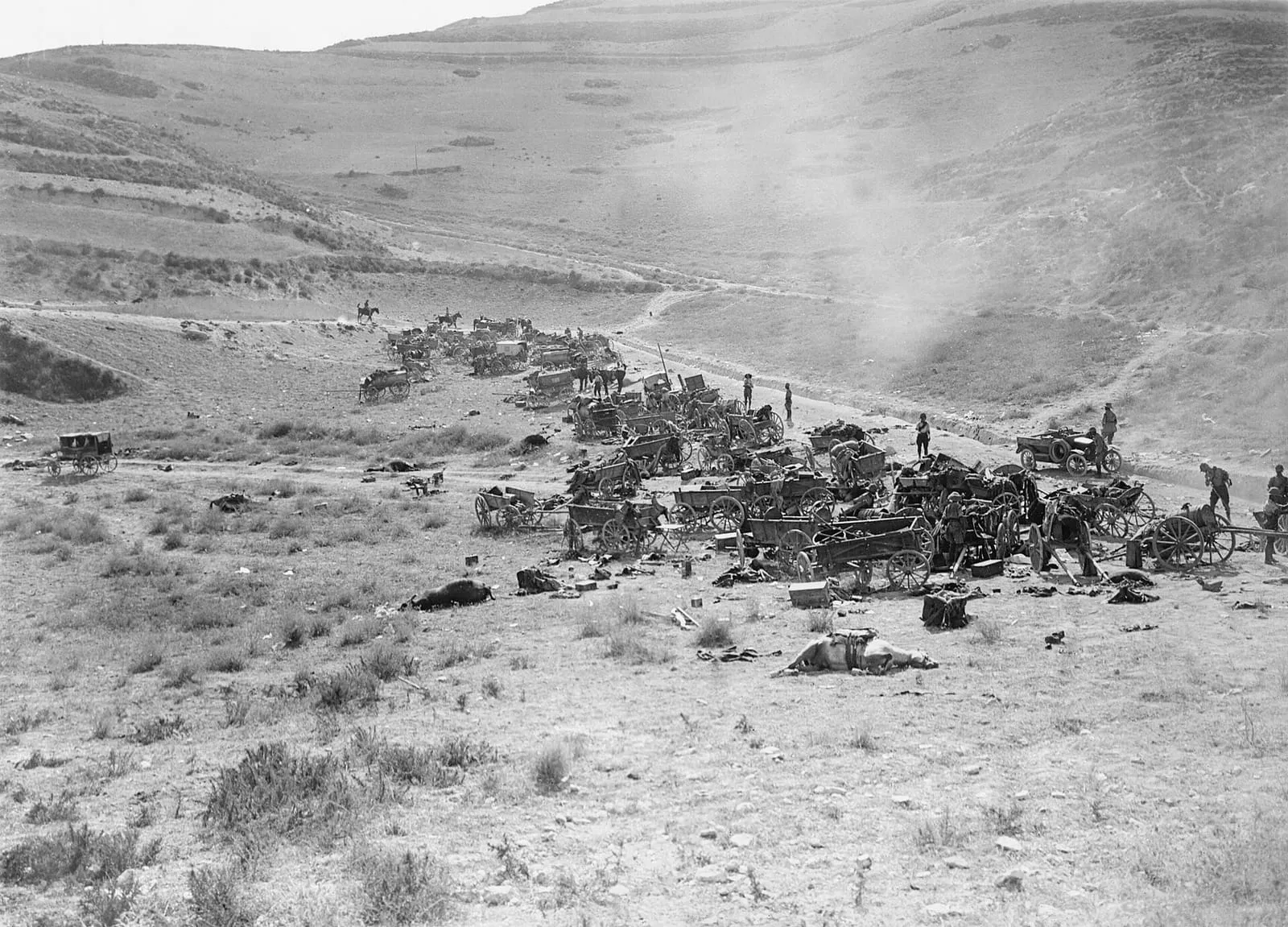
The Battle of Megiddo was the last great battle of the Palestine campaign and one of the most crushing victories of the whole war. General Edmund Allenby, who had spent the summer rebuilding his army after giving up experienced divisions to France, secretly massed an overwhelming superiority in infantry and artillery on a narrow stretch of the coast. At dawn on 19 September 1918 his infantry broke the Turkish front on the Plain of Sharon within a few hours, and three cavalry divisions raced through the gap. By the next morning they were already standing in the Jezreel Valley, several dozen kilometres behind the enemy, on the roads by which he could retreat. The Turkish Seventh and Eighth Armies, trapped in the hills of Samaria, disintegrated under blows from the ground and from the air, and the Fourth Army beyond the Jordan had to flee north. British intelligence did not overrate the enemy: the Turks no longer had either the men or the supplies to stop a blow planned in this way.
Name and dates
The British Battles Nomenclature Committee named the whole operation the Battles of Megiddo (The Battles of Megiddo) and fixed their dates as 19–25 September 1918. They comprised two battles: the Battle of Sharon (Battle of Sharon), that is the breakthrough by the sea and the cavalry raid through the Jezreel Valley, and the Battle of Nablus (Battle of Nablus), that is the attack in the hills of Samaria and in the Jordan Valley. The name was taken from ancient Megiddo, a mound at the mouth of the pass leading from the coastal plain into the Jezreel Valley. Through the same pass, in the 15th century BC, Pharaoh Thutmose III led his army before the Battle of Megiddo, regarded as the first battle whose course was described in detail. In Christian tradition the biblical Armageddon derives from the name Megiddo, and so the historian Cyril Falls later titled his book on this battle Armageddon 1918. Allenby, raised to the peerage in October 1919, took the title Viscount Allenby of Megiddo.
The account is based mainly on the British official history (Cyril Falls, Military Operations: Egypt and Palestine, vol. II, part 2) and on the memoirs of the commander of the Turkish army group, General Otto Liman von Sanders. The Turkish side left few documents, because Liman’s staff burned most of its files during the attack on Nazareth. The figures for prisoners and losses are therefore reliable only on the British side, and some times in the two sides’ accounts differ by an hour.
Background
After taking Jerusalem in December 1917, Allenby wanted to push further north in the spring of 1918. His plans were wrecked by the great German offensive in France. From March he had to give up experienced divisions and battalions to the Western Front, and their place was taken by units from India, often newly formed. The last of them joined their divisions only in the first days of August. Two spring raids across the Jordan, on Amman and on Es Salt, ended in retreat, but they had an effect that Allenby did not waste: they convinced Liman von Sanders that the British would strike across the Jordan on the eastern flank again.
Allenby decided to attack in mid-September, before the autumn rains, which at the beginning of November turn the plains of Sharon and Jezreel into mud. It was his own plan, not an idea from London. When in July the Chief of the Imperial General Staff, Henry Wilson, asked what he could do with a few divisions lent from France for the winter, Allenby replied that he would attack even without them. Wilson rather advised an “active defence”.
Facing him stood Liman von Sanders’s Turkish Yildirim Army Group, with its headquarters in Nazareth. From the sea to the hills of Samaria the front was held by Cevat Pasha’s Eighth Army, with Colonel von Oppen’s German Asia Corps. In the hills near Nablus stood the Seventh Army of Mustafa Kemal, and beyond the Jordan, around Amman, Mehmed Cemal Pasha’s Fourth Army. Allenby estimated the enemy’s strength at about 3,000 sabres, 26,000 rifles and 370 guns; he himself had about 12,000 sabres, 57,000 rifles and 540 guns. Falls noted that the Turkish divisions, though they numbered only 1,300–1,600 riflemen each, had more heavy machine guns than the British ones, so these figures do not fully reflect their firepower. The British superiority was nevertheless clear, and greater still in morale and supply. Turkish horses and mules received less than a kilogram of grain a day and were dying in large numbers, the overloaded railway could barely bring up food and ammunition, and deserters came over to the British lines every day.
Plan and preparations
The original plan of 1 August envisaged breaking the front on the coastal plain and a short wheel by the cavalry towards Tulkarm and Sebastia to cut the lines of retreat in the hills of Samaria. On 22 August Allenby surprised his corps commanders with a far bolder idea. Lieutenant-General Edward Bulfin’s XXI Corps, with five infantry divisions (the 3rd and 7th Indian and the British 54th, 60th and 75th) and the French Detachment of Palestine and Syria (Détachement français de Palestine et de Syrie), was to break the front on a stretch of about 13 kilometres between the railway and the sea, then swing to the right like a door on its hinges and drive the Turks into the hills. Through the open door was to pass Lieutenant-General Harry Chauvel’s Desert Mounted Corps, made up of the 4th and 5th Cavalry Divisions (mainly Indian regiments and British yeomanry) and the Australian Mounted Division. The cavalry was to gallop north along the coast, cross the Carmel hills by two passes and come out into the Jezreel Valley at Afulah, a railway and telephone junction about 65 kilometres in a straight line from the front, and then close the roads at Beisan on the Jordan. One of the groups was to burst into Nazareth and try to capture Liman and his staff. Lieutenant-General Philip Chetwode’s XX Corps, with two divisions, was to attack in the hills near Nablus, and Major-General Edward Chaytor’s force, with the Anzac Mounted Division, in the Jordan Valley.
The most important railway junction in the Turkish rear, Deraa, where the Palestine line joined the Hejaz Railway, lay beyond British reach. Allenby entrusted this task to the Arab Northern Army of Emir Faisal. On 16 and 17 September an Arab column with British armoured cars and a French mountain battery, accompanied by Major Thomas Edward Lawrence, blew up a bridge and sections of track south, north and west of Deraa. The Turks brought up reinforcements there from Haifa and Damascus, and Liman concluded that something dangerous was happening precisely there.
The whole preparation rested on surprise. In the Jordan Valley tents were left standing and old, worn-out ones were pitched, and in place of the horses that had gone west, dummies made of canvas were set up. Troops moved west only by night, and east ostentatiously by day. Mules dragged sledges along the roads around Jericho, raising clouds of dust. Rumours of a concentration near Jerusalem were spread, the largest hotel in the city was requisitioned for a general headquarters, and horse races were announced near Jaffa for 19 September. On 16 September Chauvel’s headquarters moved to the Nahr el Auja, leaving a working wireless station and the old camp in the Jordan Valley. The mounted divisions hid in the orange groves around Sarona and Ramleh, where the horses were watered from irrigation channels without leaving the cover of the trees. In the camouflaged camps no fires might be lit and no movement was allowed by day. All this was covered by the Royal Air Force, which in July and August had almost driven the German airmen from the sky: during the concentration only four German aircraft crossed the front line, compared with more than a hundred in one week in June. An intelligence map of 17 September, later found in Nazareth, still showed the Desert Mounted Corps in the Jordan Valley.
The secret could not be kept entirely. On 17 September a havildar, an Indian non-commissioned officer, deserted to the Turkish lines and announced a great attack on the coast. According to the Turkish staff, Cevat Pasha and the commander of XXII Corps, Colonel Refet Bey, asked Liman for permission to fall back to the second line so that the British bombardment would fall on empty trenches. Liman judged the deserter to be a British provocation and refused to yield a single step.
Course
The breakthrough on the coast (19 September)
At 4.30 a.m. on 19 September about 380 guns and howitzers opened fire on the XXI Corps sector, three quarters of them on a front about 11 kilometres long between the Jaffa–Tulkarm road and the sea. There was no preliminary bombardment: the fire was the signal for the assault, and more than a thousand shells a minute fell on the Turkish line. Two destroyers supported it from the sea. The heavy guns engaged the Turkish batteries and shelled headquarters and telephone exchanges. The infantry, including many Indian battalions going into action for the first time, broke into the Turkish trenches within minutes. Right by the sea the 180th Brigade of the 60th Division, led by Indian battalions, took three lines of trenches in under three hours, and at 7.20 a.m. a London battalion seized the bridge over the Nahr el Faliq. On the right flank French tirailleurs and a battalion of the Eastern Legion (Légion d’Orient), made up mainly of Armenian volunteers, took the hills near Rafat.
Between 7.30 and 9 a.m. the cavalry set off through the gap. Meanwhile British aircraft bombed the telephone exchange at Afulah and the headquarters of the Seventh and Eighth Armies at Nablus and Tulkarm. Liman’s headquarters in Nazareth lost contact with the coastal front at about 7 a.m. and for the whole day did not know what was happening there. In the afternoon the Australian 5th Light Horse Brigade cut the road and railway east of Tulkarm and rounded up about 2,000 fugitives, and at 5 p.m. the London infantry entered the town. By evening the XXI Corps front, swung like a door on its hinge at Rafat, ran from Bidya to Tulkarm. The corps had taken about 7,000 prisoners and 100 guns, and the remnants of two Turkish divisions from the plain were fleeing in disorder to the north-east. In the hills near Nablus, Chetwode’s XX Corps, which had made a preliminary attack on the night of 18/19 September, went over to the main assault once success on the coast was certain.
The cavalry in the Jezreel Valley (20 September)
Major-General George Barrow’s 4th Cavalry Division passed through the gap at 8.58 a.m. and reached the Musmus Pass in the Wadi Ara by evening without a fight. One of its brigades lost its way in the dark, but the Indian 2nd Lancers crossed the pass and at 3.30 a.m. on 20 September stood at Lajjun, at the foot of ancient Megiddo. A Turkish depot regiment, which Liman had sent from Nazareth at noon on 19 September to block the pass, arrived too late. At dawn the lancers broke it with a charge on the plain: 46 Turks were killed by the lance and 470 were taken prisoner. Between 7.15 and 8 a.m. the cavalry of the 4th and 5th Divisions took Afulah with ten locomotives, trains, an airfield and depots, and at 6 p.m. the 4th Division stood at Beisan (Beit She’an). In 34 hours it had covered about 110 kilometres, losing only 26 horses.
The 5th Cavalry Division crossed the hills further west. Its 13th Brigade burst into Nazareth at dawn on 20 September. Liman, woken by gunfire, organised a defence from German clerks, orderlies and the remains of the depot regiment. The brigade, exhausted by its night march and without a guide, did not find his headquarters and did not close the road to Tiberias, and before noon it was ordered to withdraw. It took about 1,250 prisoners, many of them Germans, but Liman escaped in the afternoon to Tiberias. His command, however, was shattered, and from then on he could no longer direct the battle. In the evening the Australian 3rd Light Horse Brigade took Jenin on the road from Nablus to Damascus. By morning it had taken nearly 8,000 prisoners there, including 2,800 men of a column that surrendered in the dark to a 23-man detachment with machine guns. According to Falls, by the evening of 20 September the British already held about 25,000 prisoners, and the Turkish Eighth Army, apart from Oppen’s group, had ceased to exist.
The rout of the Seventh Army (21–22 September)
Mustafa Kemal’s Seventh Army was falling back from the hills near Nablus, and its main line of retreat was a narrow track in the Wadi el Fara, descending towards the Jordan crossing at Jisr ed Damieh. On 21 September British airmen bombed the head of the column moving along it and blocked the road. When officers inspected the track the next day, abandoned guns, lorries and hundreds of wagons lay strewn over more than three kilometres. Falls noted, however, that there had been few direct hits and few killed there: panic did the most damage. The same day the British took Nablus. Those who turned north towards Beisan fell into the hands of the 4th Cavalry Division waiting there. All through the night of 21/22 September and the whole of the following day exhausted Turks marched up to its outposts and surrendered at the first challenge. Some troops, however, including Oppen’s German units, broke through across the Jordan south of Beisan, where the British net had a 40-kilometre gap. On 22 September Chaytor’s force captured the bridge at Jisr ed Damieh.
Haifa, Acre, Es Salt and Amman (23–25 September)
On 23 September the 5th Cavalry Division took the port of Haifa and the fortress of Acre. Haifa was captured in a daring charge by the Indian 15th Imperial Service Cavalry Brigade, made up of lancers from the princely states of Jodhpur and Mysore, which burst into the town through the defile between Mount Carmel and the marshy river Kishon. From then on the port allowed supplies to be brought by sea closer to the front. The same day, beyond the Jordan, Chaytor’s New Zealanders took Es Salt for the third time in half a year, and on 25 September his horsemen captured Amman and cut the Hejaz Railway. That same morning the Australian 4th Light Horse Brigade, after fierce hand-to-hand fighting, took Samakh station on the Sea of Galilee, defended mainly by Germans, and in the afternoon the abandoned Tiberias was occupied. With this the battle ended. The Fourth Army, which Liman had ordered to fall back as early as 21 September, was withdrawing north towards Deraa and Damascus, harried by airmen and by Faisal’s Arabs.
Losses
The British suffered losses that were small for a victory on this scale, and mostly in the first infantry assault. XXI Corps lost 3,378 men in the whole operation, and the Desert Mounted Corps only about 650 throughout the pursuit to the end of October. According to Falls, Allenby’s total losses from 19 September to 31 October 1918 amounted to 5,666 killed, wounded and missing. No one counted the Turkish losses. According to Falls, the British already held about 25,000 prisoners by the evening of 20 September, and by the end of the campaign in October they had taken more than 75,000, including about 3,700 Germans and Austrians, as well as 360 guns. Most of them fell to the Battle of Megiddo and the first days of the pursuit.
Significance
In six days Allenby destroyed two of the three Turkish armies in Palestine and occupied the land from the coast to the Jordan and beyond it. The Battle of Megiddo is regarded as one of the last in which a great mass of cavalry decided the outcome by a deep manoeuvre, but its success was made possible by modern cooperation between infantry, artillery and aircraft, which blinded and paralysed the enemy. Falls considered the operation one of the most successful of the whole war. The battle opened the road to Damascus, which British and Arab troops entered on 1 October, and then to Beirut and Aleppo. The defeat in Palestine, together with the collapse of Bulgaria on the Salonika front in the same days, sealed the fate of the Ottoman Empire, which on 30 October signed the Armistice of Mudros. To this day the Indian Army marks 23 September as Haifa Day, in memory of the charge of the lancers from Jodhpur and Mysore.
Spotted a mistake?Report an error