1918: Palestine, Syria and Persia
Second raid on Es Salt
- Dates:
- 30 April – 4 May 1918
- Front:
- Middle East
- Location:
- The Jordan valley north of the Dead Sea, from the Ghoraniyeh bridgehead to the fords of Umm esh Shert, Mafid Jozele and Jisr ed Damieh, and the hills of Moab from Shunet Nimrin and the El Haud hill to Es Salt (Ottoman Transjordan, today Jordan)On the battle map →
- Sides:
- United Kingdom, Australia, New Zealand and British IndiaEdmund Allenby, Harry Chauvel, John Shea, Henry Hodgson, Edward ChaytorOttoman Empire and German EmpireOtto Liman von Sanders, Mehmed Cemal Pasha
- Result:
- British defeat. Australian horsemen took Es Salt, but the infantry failed to take the Turkish position at Shunet Nimrin, and a counter-attack from the Jordan threatened to cut off the troops in the hills. On 4 May the British returned across the river.
- Author:
- Łukasz Skowroń
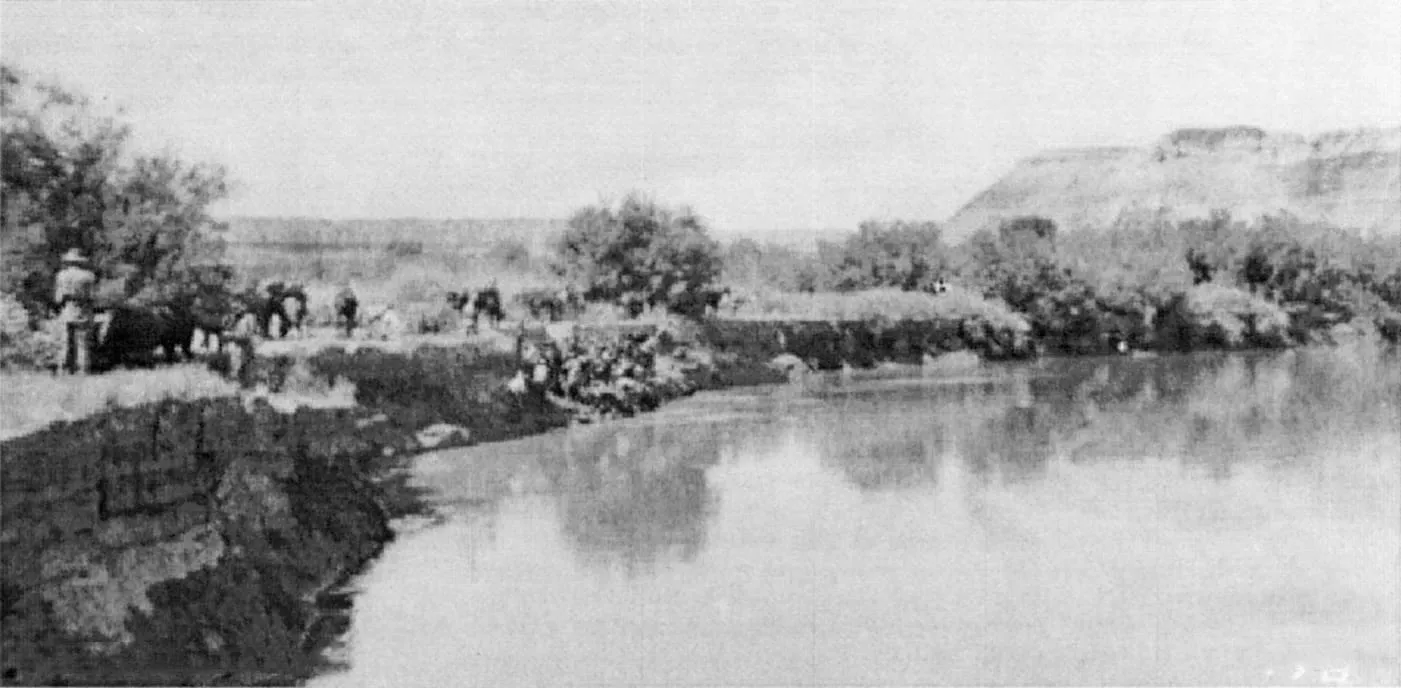
The second raid on Es Salt was the second British expedition to the east bank of the Jordan in less than six weeks. This time General Edmund Allenby sent much larger forces across the river: Lieutenant-General Harry Chauvel’s Desert Mounted Corps, with two mounted divisions and the London 60th Division. The plan was ambitious. The infantry was to pin down and surround the main Turkish position at the foot of the hills at Shunet Nimrin, while the Australian horsemen, racing north up the Jordan valley, were to climb onto the plateau, take the town of Es Salt and strike the Turks from the rear. The enemy’s other line of retreat was to be closed by Bedouin of the Beni Sakhr tribe. On the first day the Australians took Es Salt in dashing style, but the infantry was held up at Shunet Nimrin, the Bedouin never appeared, and on 1 May a Turkish-German counter-attack from the Jordan drove back the screen in the valley and threatened to cut off the whole force in the hills. On the night of 3–4 May the British abandoned Es Salt and returned across the river.
Name and dates
The British Battles Nomenclature Committee named this fighting the Second Action of Es Salt and dated it from 30 April to 4 May 1918. The British official history (Cyril Falls, Military Operations: Egypt and Palestine, vol. II), on which the account below is based, speaks of the second raid across the Jordan, and the literature also uses the name Second Transjordan attack on Shunet Nimrin and Es Salt. The Turks and some historians call it the second battle of the Jordan. The events are also described in detail in Henry Gullett’s Australian official history. Figures for Turkish strength and losses are uncertain, because what survives is mainly the accounts of Liman von Sanders and German officers. Discrepancies are noted below.
Background
The first raid on Amman ended on 2 April with a retreat across the Jordan. The British kept the bridgehead at Ghoraniyeh, and on 11 April they repulsed a Turkish attack on that bridgehead and on the Mussallabeh hill on the west bank. In mid-April the Arab forces of Emir Faisal struck the Hejaz Railway near Ma’an and destroyed stations and long stretches of track south of the town. To support them and to stop the Turks from sending reinforcements south, on 18 April Major-General Edward Chaytor’s Anzac Mounted Division made a demonstration at Shunet Nimrin. The Turks met it with such heavy fire that no patrol got near the foot of the hills. Falls later remarked that the demonstration warned them of another raid.
Allenby wanted to strike again for several reasons. According to his report, he intended to destroy the Turkish force at Shunet Nimrin and to hold Es Salt until the Arabs could take it over. Harvest was approaching on the plateau of Moab, and the British wanted to deny the Turks their stocks of barley and wheat. If they could hold on to the plateau, they would not have to keep many men in the sweltering Jordan valley in summer. Allenby was also thinking about the future. Since March, after the outbreak of the great German offensive in France, he had had to give up experienced British units to the Western Front, and their places were taken by divisions and regiments from India, some of them untried. The 74th Division was to sail for France at the end of April, and the yeomanry mounted division was exchanging its yeomanry regiments for Indian ones. A great offensive was therefore possible only after the summer, and Allenby was already considering making it on the coast, on the Plain of Sharon. All the more, he wanted the Turks to watch the opposite flank and fear a thrust across the Jordan towards the railway junction at Deraa.
He would have preferred to wait until mid-May, when the reorganised mounted division would be ready. But envoys of the Beni Sakhr tribe, whose camp lay near Madaba, about 30 kilometres south-east of Ghoraniyeh, came to his headquarters. They assured him that their men would take part in an advance beyond the Jordan, but only before 4 May, because after that, for lack of food, they would have to disperse to distant pastures. Allenby therefore set the start of the operation for 30 April. According to Falls, he fell victim to an illusion: the envoys represented only one clan of the tribe, and most of its fighters were already fighting alongside Faisal’s Arabs on the railway further south.
On the east bank the Turks had, by British estimates, 6,000 to 8,000 men. Most of them, grouped in Colonel Ali Fuad Bey’s VIII Corps, held a position about 5.5 kilometres long at the mouth of the road to Es Salt at Shunet Nimrin, with the commanding hill of El Haud. Es Salt was defended by only a few companies, but the town housed the headquarters of Mehmed Cemal Pasha’s Turkish Fourth Army, whose chief of staff was Major Franz von Papen, formerly German military attaché in Washington. On the west bank, near the Mafid Jozele ford, where the Turks had built a pontoon bridge, stood the Turkish 3rd Cavalry Division, hidden from the airmen, with Colonel Esad Bey’s Caucasus Cavalry Brigade. The army group commander, General Otto Liman von Sanders, happened to be preparing an attack on the west bank and had therefore, on 29 April, assembled in reserve near the river the rested and well-trained Turkish 24th Division under the German Colonel Böhme. This coincidence was to decide the fate of the raid.
Chauvel’s plan provided for Major-General John Shea’s 60th Division (less one brigade) to attack the position at Shunet Nimrin and turn its right flank. Major-General Henry Hodgson’s Australian Mounted Division, reinforced by the Australian 1st Light Horse Brigade, was to race north up the valley, leave the 4th Light Horse Brigade as a screen by the road from the Jisr ed Damieh ford to Es Salt, and climb onto the plateau by two roads. Once the town was taken, part of it was to descend the main road towards Shunet Nimrin, into the Turks’ rear. The only other supply and retreat route left to the Turks was the track through Ain es Sir, which the Beni Sakhr were to close. Chaytor’s reduced division formed the reserve. Supplies for the mounted troops beyond the river were to be carried by 5,400 camels.
Course
Capture of Es Salt (30 April)
On the night of 29–30 April Hodgson’s horsemen left their camp near Jericho, leaving the fires burning, crossed the bridge at Ghoraniyeh and at 4 a.m. set off north. At the same time, by moonlight, the infantry attacked. On the right the London 180th Brigade advanced on the plateaux of Mukhar ed Derbasi and Tell Buleibil on either side of the Wadi Nimrin, and on the left the 179th Brigade on the El Haud hill. The 2/19th Battalion of the London Regiment tried no fewer than five times to climb the steep slopes of Mukhar ed Derbasi by two narrow paths, but each time it was stopped by machine-gun fire. The 2/20th, 2/14th and 2/16th Battalions took the forward trenches and nearly 300 prisoners, but were held up in front of the main position. The attack was postponed to the following morning.
In the valley, meanwhile, the horsemen moved fast. The 4th Light Horse Brigade, in clouds of dust, ever faster until it was at the gallop, swept through the Turkish outposts at Umm esh Shert and at 5.30 a.m. was at the road from Jisr ed Damieh, 24 kilometres from Ghoraniyeh. A squadron sent to the bridge at Damieh was stopped by machine-gun fire, and when Turkish cavalry and infantry crossed the bridge, the Australians fell back 1.5 kilometres. According to Falls, this was in keeping with their orders, which required not the capture of the crossing but only a screen for the road, but it allowed the Turks to bring more units over to the east bank unhindered. General Grant, the brigade commander, considered his position dangerous: between his left flank and the squadron on Red Hill above the Umm esh Shert ford yawned a gap about 6 kilometres wide. He asked for at least one more regiment, but Chauvel replied that he had no one to give him.
Brigadier-General Lachlan Wilson’s 3rd Light Horse Brigade climbed into the hills by the road from Damieh, and the British 5th Mounted Brigade, made up of yeomanry, by the track from Umm esh Shert. On the ridge of Jebel Jil’ad the Australians came upon a Turkish position and took it with a dismounted attack, capturing 28 prisoners. Wilson kept the 8th Light Horse Regiment with its horses, ready to move on the town at once. At 6.30 p.m. the first troop burst into Es Salt at the gallop. Its commander, Lieutenant Foulkes-Taylor, forced the surrender of a German officer who was rallying the Turks to defend the town. The Australians, often using their bayonets like swords, quickly broke the resistance and took about 200 prisoners, a good deal of transport and 28 new machine guns still in their cases. The Fourth Army headquarters barely managed to escape. Liman von Sanders later called this raid on Es Salt a “quite exceptional” feat.
Counter-attack in the Jordan valley (1 May)
On 1 May at 5.30 a.m., after a 75-minute bombardment, the 60th Division renewed its attack at Shunet Nimrin. The scrub gave cover only as far as the foot of the hills, and the Turks concentrated their machine-gun fire precisely on its edge and beat off each attempt to cross the open ground. At Es Salt the 5th Mounted Brigade was ordered to descend the main road into the Turks’ rear, but its commander, General Kelly, after reconnoitring, judged the position above the El Howeij bridge, on top of a steep cliff, impregnable. The attack was postponed until dawn.
Meanwhile the blow fell in the valley. As early as the morning of 30 April Liman von Sanders had ordered the 24th Division to march to the Jordan and cross to the east bank together with Esad Bey’s cavalry. During the night part of it crossed the river on pontoons at Mafid Jozele, but at 1 a.m. an order from the Seventh Army sent the whole division to the bridge at Damieh, and one regiment had to turn back. On the morning of 1 May the Turkish 143rd Regiment, with an assault battalion and German companies, emerged from behind the clay hillocks by the river and advanced across the plain on the gap between the left flank of the 4th Brigade and Red Hill, while Turkish cavalry turned its right flank from the direction of the Jabbok river. Australians who watched this advance recalled that the Turks came on “as if on the parade ground”. General Grant estimated the attackers at 5,500 men, while according to Falls the strength of the main attack did not exceed 1,750.
At 10 a.m. the Germans who had come over from Mafid Jozele took Red Hill. Then the Turks struck the brigade’s right flank and drove back the 4th Light Horse Regiment, exposing the artillery. The guns could not withdraw straight south, because steep ridges and ravines barred the way, and from the west the Turks were cutting them off. B Battery of the Honourable Artillery Company lost one gun, which stuck in a wadi, but saved the other three. A Battery of the same company and the Nottinghamshire battery of the Royal Horse Artillery could no longer get away, because Turkish and German fire had killed the teams. The gunners fired to the last moment and then abandoned their guns. According to Falls, these were the only guns the British lost in the whole Palestine campaign. About 50 wagons, ambulances and water carts also fell into enemy hands. Two Australian regiments withdrew on foot, leading their horses, through a maze of ravines on the hillsides, carrying the wounded in their cloaks. Chaytor, to whom Chauvel had subordinated the 4th Brigade and sent reinforcements, formed a new line north of the Umm esh Shert track. The Australians, New Zealanders and yeomen held this line, but the road from Damieh to Es Salt was now in enemy hands. The only line of retreat left for the four brigades in the hills was the track from Umm esh Shert.
Hodgson learnt of the reverse in the valley only at 4.40 p.m. At the same time more Turkish units, gathered by Cemal Pasha from trains and nearby garrisons, were approaching Es Salt from Amman by way of Suweile. The Beni Sakhr near Madaba did nothing. According to Turkish accounts they had been bribed; at any rate they struck camp and left when the fighting began. By the track through Ain es Sir, which they were to have closed, the Turks freely supplied and reinforced the defenders of Shunet Nimrin.
Deadlock and retreat (2–4 May)
On 2 May the 60th Division tried to take Mukhar ed Derbasi with a night attack without artillery preparation, and then renewed its attack along the whole front. The 2/13th Battalion advanced almost a kilometre and outflanked the El Haud hill from the north, and two companies of infantry from the Indian princely state of Patiala reached a hill north-west of it. Liman wrote that the position of VIII Corps was serious that day, and the Turkish official history that its right flank was in great danger. Under machine-gun fire, however, the attack stalled once more. From the direction of Es Salt the 5th Mounted Brigade, weakened by the dispatch of further regiments to the town, descended to the edge of the deep ravine of Wadi Nahr, but after losses and in the heat it broke off the attack. Chauvel refused to call it off, because success would have solved all the infantry’s problems, but there were too few men left. Es Salt was now defending itself on two sides: on the west against Esad Bey’s cavalry coming up the road from Damieh, and on the east against the units from Amman. The horsemen in the hills had already eaten their three days’ rations and were living on grain, raisins and meat requisitioned in the town. Dressings for the wounded were dropped from an aeroplane.
On the night of 2–3 May Shea’s infantry attacked El Haud once more, in the dark, without any belief in success, only to relieve the troops in the hills. Two companies lay flat all day on an exposed hill under fire and withdrew after dark. On the morning of 3 May near Es Salt two squadrons of the Australian 8th Light Horse Regiment, supported by flanking fire from the 5th Regiment, attacked the Turkish units advancing from the direction of Amman and took 319 prisoners, which quietened that sector for a while. In the afternoon Allenby came to Chauvel’s headquarters. He knew that the infantry attack had failed, that Es Salt was under attack from two sides, and that the enemy in the valley had been reinforced. He judged that further resistance could achieve little and risked disaster, and agreed to a withdrawal.
The withdrawal from the hills went more easily than feared, probably thanks to the lesson the Turks had been taught near Es Salt that morning. By 2.20 a.m. on 4 May the troops had left the town. A column of men, horses, camels and prisoners descended in the dark by the track to Umm esh Shert. The wounded, many of whom had lain in Es Salt for three days, rode on horseback if they could stay in the saddle at all. Several badly wounded Australians preferred to be lifted onto a horse rather than travel in camel litters. The road was choked with refugees from the town. A column with ammunition and biscuits, the first food for the troops in the hills, reached Es Salt just as the order to withdraw was given, so the biscuits were dropped by the roadside for the passing soldiers. Before noon the last units came down to the plain, under fire from the advancing Turks and German aircraft. Allenby gave up the idea of holding a large bridgehead on the east bank. Only two bridgeheads remained on the east bank, at Ghoraniyeh and a new one at the bridge at the mouth of the Wadi el Auja, and by midnight on 4 May all the other units were back across the Jordan.
Losses
According to the official history, the British lost 1,649 men: 214 killed, 1,298 wounded and 137 missing. About two-thirds of these losses were suffered by the 60th Division with the attached Patiala infantry. Guns and transport were abandoned in the valley, and some equipment in Es Salt. Prisoners taken numbered 44 Germans, 898 Turks and 39 Bedouin. The Turkish general staff put the losses of VIII Corps at 831 men and wrote that the units brought across at Damieh had reportedly lost as much as half their strength. Falls judged that the enemy’s total losses probably exceeded 2,000 men and were higher than the British.
Significance
The second raid, like the first, ended in retreat, and for the second time in a month the Turks could proclaim a victory. Falls saw the causes of the failure in several misfortunes at once: the driving back of the screen in the Jordan valley, the failure of the 5th Mounted Brigade’s attack on the rear of Shunet Nimrin, and the fact that the Turks had prepared the Ain es Sir track for wheeled traffic while the Bedouin had not closed it. Luck also favoured the enemy, as the Turkish 24th Division happened to be near the river. The British, for their part, were lucky that one of its regiments wasted more than a day marching between fords because of the Seventh Army’s order. General Philip Chetwode, whose XX Corps had conducted the first raid, was later to call both expeditions across the Jordan Allenby’s most foolish undertakings.
The raid did, however, have an effect that became apparent only months later. The two thrusts across the Jordan convinced Liman von Sanders that the British were preparing their main offensive on the eastern flank, through the Jordan valley towards Amman and Deraa. The Turks kept a large part of their forces there through the summer, and Allenby carefully fostered this belief with dummy camps and movements. In September 1918 he struck on the coast, in the Battle of Megiddo, and took the enemy completely by surprise. Only then, on 23 September 1918, in the third advance across the Jordan, did the British take Es Salt. For the time being, however, after the departure of further divisions for France, they could not dream of larger operations until the autumn, and the horsemen from Australia and New Zealand spent the summer in the stifling, malarial Jordan valley that Allenby had wanted to spare them.
Spotted a mistake?Report an error