Hejaz · The Entente
Faisal I
Commander of the Arab Northern Army in the Arab Revolt (1916–1918), King of Syria (1920) and of Iraq (1921–1933)
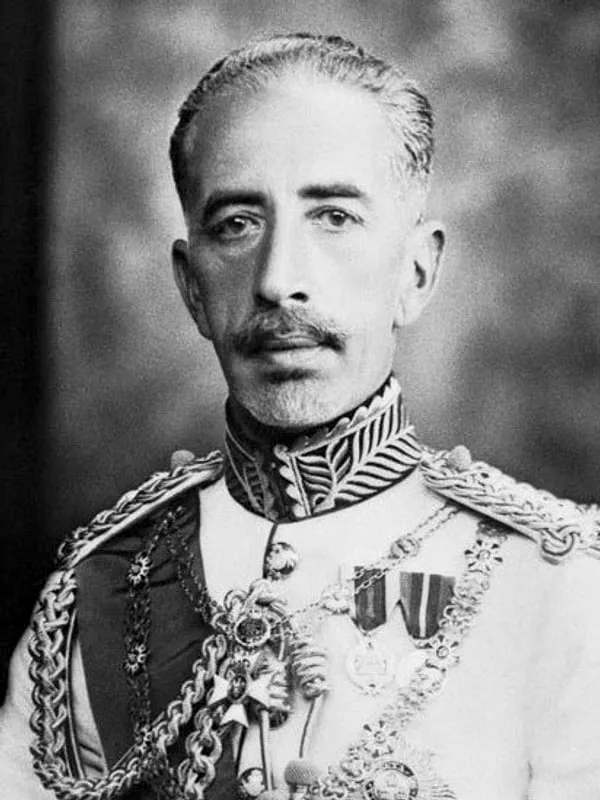
- Born:
- 20 May 1885, Mecca (Ottoman Empire)
- Died:
- 8 September 1933, Bern (Switzerland)
- Author:
- Łukasz Skowroń
- Photo:
- Vandyk photographic studio, domena publiczna, Wikimedia Commons

Emir Faisal, the third son of the Sharif of Mecca Hussein bin Ali, was the most important commander and politician of the Arab Revolt. In June 1916 he proclaimed the independence of the Arabs from the Turks outside Medina, and then, with British gold, weapons and advisers, the most famous of whom was Thomas Edward Lawrence, he led the Arab Northern Army from the Hejaz via Al Wajh and Aqaba all the way to Damascus. In the autumn of 1918 he headed an Arab government in Syria, a year later he fought for its independence at the peace conference in Paris, and in March 1920 he was proclaimed king. Four months later the French drove him out. The British, who had not kept their promises to him in Syria, placed him on the throne of Iraq in 1921. He is regarded as one of the ablest Arab leaders of his age: a military leader out of necessity and a diplomat by talent.
Before the war
According to most sources he was born on 20 May 1885 in Mecca. Some works give 1883 and Taif. Like other boys of the sharifian house, he spent part of his childhood among the Bedouin, where he learned riding, the language and the customs of the desert. From the early 1890s, however, he grew up in Constantinople, where the authorities had sent his father. He was educated by private tutors, spoke Turkish and knew the world of the Ottoman capital well. In 1904 he married his cousin Huzaima bint Nasser.
When his father became Emir of Mecca in 1908, Faisal returned with him to the Hejaz. In 1911 he fought at his side against Muhammad al-Idrisi in Asir. Afterwards, like his elder brother Abdullah, he sat in the Ottoman parliament as deputy for Jeddah. In the family he was considered cautious and prudent, unlike Abdullah, who was the chief architect of the contacts with the British.
Damascus: conspirator and hostage
At the beginning of 1915 his father sent him to Constantinople to sound out the government’s intentions and explain why the sharif did not support the jihad. On the way, in Damascus, Faisal came into contact with the secret Arab societies, the civilian al-Fatat and the military al-Ahd, and according to most historians became a member of the former. In the capital he talked with Enver and Talaat. On his way back, in May 1915, the conspirators handed him a document known as the Damascus Protocol: they promised to support a revolt led by the sharif if Great Britain recognised Arab independence within wide borders. At a family council in Taif Faisal counselled caution, but his father decided to negotiate with the British.
At the beginning of 1916 Faisal went to Damascus again, this time as the sharif’s envoy to the Ottoman commander in Syria, Djemal Pasha. He was there at once a guest and a hostage. Djemal was crushing Arab activists, and Faisal pleaded in vain for clemency for those arrested. According to George Antonius, when 21 of them were hanged in Damascus and Beirut on 6 May 1916, he tore the headcloth from his head and cried “Tab al-maut ya Arab!”, calling on the Arabs to be ready to die for revenge. Shortly afterwards his father summoned him. Faisal persuaded Djemal that he had to bring volunteers from the Hejaz from Medina in person, and on 16 May he left Damascus.
The revolt in the Hejaz
On 5 June 1916 Faisal and his elder brother Ali proclaimed outside Medina the independence of the Arabs. The next day Faisal attacked the city, but Fakhri Pasha’s garrison drove off the tribes with artillery fire, and the Bedouin, unused to guns, dispersed. While his father took Mecca and the Red Sea ports passed into the rebels’ hands, Faisal held out all summer in the mountains by the roads from Medina to Mecca, trying to keep together the undisciplined tribes paid in gold.
On 23 October 1916, in his camp at Hamra in Wadi Safra, he was visited by a young captain of British intelligence from Cairo, Thomas Edward Lawrence. In “Seven Pillars of Wisdom” Lawrence wrote that at first glance he felt that this was the man he had come to Arabia to seek, the leader who would bring the revolt to glory. His reports persuaded Cairo to back Faisal, and Lawrence soon returned as liaison officer at his headquarters. The two built a close, though not tension-free, partnership.
In December 1916 the Turks from Medina routed Faisal’s forces in the mountains and pushed him back to Yanbu, which he held with the help of Royal Navy ships. The way out of the crisis proved to be a plan Faisal had proposed earlier and Lawrence helped to put into effect: a march north along the coast. In January 1917 some 10,000 men set off along the Red Sea towards Al Wajh, which was taken on 23–24 January by a landing party from British ships. Faisal wanted to show the tribes along the way the strength of his father’s cause, and he succeeded. From then on the Turks no longer thought of marching on Mecca, and the revolt began to reach towards Syria.
The Arab Northern Army
From Al Wajh Faisal’s men attacked the Hejaz Railway, and in May 1917 an expedition of Sharif Nasir, Auda abu Tayi and Lawrence set out from there, which on 6 July took Aqaba. Faisal provided money and men for it. In August he moved to Aqaba, and his forces, named the Arab Northern Army, came under the operational authority of General Edmund Allenby, the British commander in Egypt and Palestine. Alongside the Bedouin, a regular army grew within it from former Ottoman officers and soldiers of Arab origin, largely prisoners of war and deserters. It was commanded by Ja’far al-Askari, and its chief of staff was Nuri al-Said. The British supplied gold, rifles, armoured cars and aircraft, and the French sent a mountain battery.
In October 1917 the Arabs repulsed the Turks at Petra, in January 1918 Faisal’s younger brother Zeid took Tafilah, and in April Ja’far’s regulars stormed the fortified Ma’an for several days without success. Faisal commanded from headquarters, not from the saddle. His greatest talent was reconciling quarrelling sheikhs, settling blood feuds and holding together men united only by hatred of the Turks and British gold. On 4 June 1918, in a camp near Ma’an, he received the Zionist leader Chaim Weizmann and discussed cooperation with him.
Faisal knew that the British promises were uncertain. At the end of 1917 the Turks publicised the Sykes–Picot Agreement revealed by the Bolsheviks, and Djemal Pasha proposed negotiations to him. Faisal sent the letters on to his father, who passed them to the British. Some historians, among them Efraim Karsh and Ali Allawi, nevertheless describe further contacts between Faisal and Turkish commanders in 1918, when the new commander of the Fourth Army, Djemal Pasha known as “the Lesser”, renewed the offer of Arab autonomy within the empire. Faisal replied and explored the terms. Lawrence, who knew of this, later explained that the aim was to deepen divisions among the Turks. Critics see it as hedging against a victory of the Central Powers, which in the spring of 1918 seemed possible. No change of sides took place.
Damascus
In September 1918, as part of Allenby’s offensive, an Arab column with British armoured cars and a French battery cut the railway around the junction at Deraa, and after the Turks were routed in Palestine it harried the retreating Fourth Army. On 1 October the Australians rode into Damascus, and an hour or two later Sharif Nasir’s Arab horsemen. Faisal arrived in the city on 3 October and met Allenby at the Victoria Hotel. He was told that he could set up an Arab administration east of the Jordan and in the interior of Syria, but not on the coast, which under the Sykes–Picot Agreement was to go to France, and that until the end of the war supreme authority lay with the British commander-in-chief. The capture of Damascus fulfilled the rebels’ dreams, but at once began a dispute with France. When Faisal’s men hoisted the Arab flag in Beirut, Allenby ordered it taken down. In October Faisal’s Arabs also entered Homs together with the British, and on the night of 25/26 October they broke into Aleppo. At the beginning of November Great Britain and France issued a declaration that they wanted governments chosen by the local peoples.
After the war
As his father’s representative Faisal went to Europe in November 1918, and in January 1919 he appeared at the Paris Peace Conference, with Lawrence as interpreter and adviser. On 3 January he signed with Weizmann an agreement in which he consented to Jewish settlement in Palestine, but added a reservation in Arabic that the agreement would cease to be valid if the Arabs did not obtain the independence he was seeking. On 6 February he presented the Arab demands to the Council of Ten. He did not convince France, and the British, for whom friendship with Paris mattered more, eventually withdrew their troops from Syria. The conference adopted the American idea of ascertaining the wishes of the inhabitants through the King–Crane Commission, but its report had no influence on the decisions of the powers.
On 8 March 1920 the Syrian National Congress in Damascus proclaimed the independence of Syria and acclaimed Faisal its king. A month later the San Remo conference gave France the mandate over Syria and Lebanon. The French High Commissioner, General Henri Gouraud, issued an ultimatum. Faisal accepted it, but French troops marched on Damascus all the same, and the handful of volunteers of the war minister Yusuf al-Azma perished on 24 July at the Battle of Maysalun. The Kingdom of Syria ceased to exist, and Faisal had to leave.
The British, struggling with the revolt in Iraq, were looking for a ruler for that country who would secure their influence at lower cost. In March 1921, at the Cairo Conference, convened by Winston Churchill and attended by Lawrence and Gertrude Bell, it was decided to give the throne to Faisal. After a plebiscite organised by the British, on 23 August 1921 he was crowned in Baghdad as King of Iraq. For twelve years he manoeuvred between British advisers and Iraqi nationalists, tried to bring Sunnis and Shias closer together and built an army and an administration, largely from his former comrades of the revolt. In 1932 Iraq became the first mandated territory to gain formal independence and joined the League of Nations. In the summer of 1933, during the crisis after the massacre of Assyrians at Simele, which strained his relations with London, the ailing king was receiving treatment in Switzerland. He died of a heart attack in Bern on 8 September 1933, aged 48. The throne passed to his son Ghazi.
Assessment
The image of Faisal in the West was shaped above all by Lawrence, who in “Seven Pillars of Wisdom” portrayed him as a noble, inspired leader and at the same time a man dependent on the advice of his British friend. This portrait, fixed by David Lean’s 1962 film, in which Faisal was played by Alec Guinness, is now regarded as one-sided. Arab historians such as Suleiman Mousa, and Faisal’s Iraqi biographer Ali Allawi, stress that it was he, not Lawrence, who for two years held together the coalition of tribes and officers, pursued his own policy towards the British, the French and the Zionists, and thought about a state rather than about raids on the railway.
Critics such as Efraim and Inari Karsh see him above all as a dynastic politician who sought a throne for himself, played a double game with the Turks and, at the price of British support, agreed to compromises, not least towards the Zionists. Most historians agree that as a military commander he was no outstanding tactician and that the revolt owed its successes to the British fleet, British gold and Allenby’s army. As a politician, however, he showed skill and perseverance: he lost Syria to France, which he could not resist, but in Iraq he built a state that survived his death. For Arab nationalists he remained a symbol both of the hopes of 1918 and of the disappointment brought by the post-war division of the Middle East.
Sources
Spotted a mistake?Report an error
Commanded in battles
(02)Mentioned in battles
(05)Often appears with
People who appear in the same events.