Hejaz · The Entente
Ja'far al-Askari
Commander of the Senussi forces (1915–1916), commander of the regular troops of the Arab Northern Army (1917–1918), later Prime Minister of Iraq
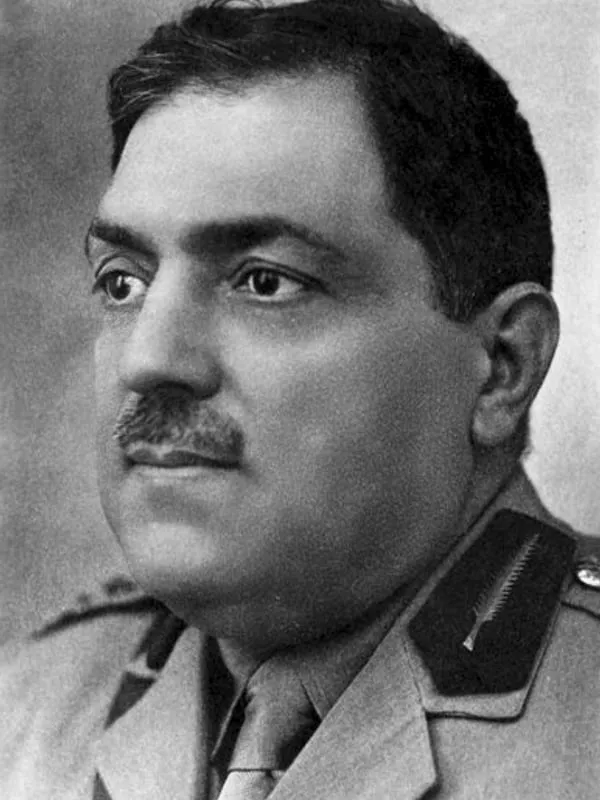
- Born:
- 15 September 1885, Baghdad (Ottoman Empire)
- Died:
- 29 October 1936, Baghdad
- Author:
- Natalia
- Photo:
- J. S. Murry -- Baghdad, domena publiczna, Wikimedia Commons

During the Great War Ja’far al-Askari travelled a road that probably no other officer travelled: he fought first against the British, and then at their side. An Arab from Baghdad, educated in Constantinople and in Germany, in 1915 he organised and led the forces of the Senussi order in their expedition against the western border of Egypt. In February 1916 he was taken prisoner at Agagia. In a Cairo prison, shaken by the executions of Arab activists in Syria, he decided to join the revolt of the Sharif of Mecca. From 1917 he commanded the regular units of the Arab Northern Army of Emir Faisal, with which he fought at Petra, Tafilah and Ma’an, up to the taking of Syria. After the war he helped build the Iraqi army and state, was twice Prime Minister of Iraq, and was killed in 1936 during the country’s first military coup.
Before the war
He was born on 15 September 1885 in Baghdad. Some sources give Kirkuk as his birthplace, and the Polish Wikipedia gives 1887 as the year. His father was a colonel in the Ottoman army, and the family derived the name “al-Askari” from the village of Askar near Kirkuk, where an ancestor had settled centuries before. He grew up in Mosul. He studied at the military school in Baghdad and in 1901–1904 at the military academy in Constantinople, after which he joined the 6th Army in Iraq as a second lieutenant. After the Young Turk Revolution he was among the first group of officers sent for training in Germany, and in 1910–1912 he served in Berlin and in a Baden grenadier regiment in Karlsruhe.
On news of the outbreak of the Balkan War he returned home, commanded a company and was wounded in October 1912. He then worked on the staff of a corps whose chief was Enver, taught at the officers’ school in Aleppo and passed the entrance examination for the general staff academy. He was a tall, stout, sociable man, knew several languages and, by many accounts, easily won people over, opponents included.
The Senussi
When the Ottoman Empire entered the war, Ja’far was working on the staff of the German admiral Guido von Usedom, who was strengthening the defences of the Dardanelles. At the beginning of 1915 Enver sent him, together with Enver’s half-brother Nuri Bey, to Cyrenaica, to the leader of the Senussi order, Sayyid Ahmed al-Sharif. They were to persuade him to make war on the British in Egypt and to prepare his forces. Sayyid Ahmed, entangled in fighting with the Italians and the French, was not eager for a new war. According to Ja’far’s later account, he was won over only by German money and pressure from Enver. In the meantime Ja’far trained regular units of the order, the muhafiziya, from local volunteers. In his memoirs he also described how, disguised as a pilgrim, he made his way through Egypt to Syria and returned from Beirut in a sailing vessel carrying arms for the order.
In November 1915 the order’s men attacked Sollum, and the British withdrew to Mersa Matruh. Nuri took command, and Ja’far was his deputy and commanded in the field. In December his muhafiziya surprised a British column at Wadi Senab. The British official history acknowledged that their loose formation and skilful use of cover did credit to his training. On 25 December at Wadi Majid Ja’far had to withdraw, losing his office papers and personal belongings, and on 23 January 1916 at Halazin, although he again gave ground, he inflicted heavy losses on the British by turning their flank. Each time his forces escaped pursuit.
He fought his last battle on 26 February 1916 at Agagia, south-east of Sidi Barrani. The South African infantry of General Henry Lukin drove his roughly 1,500 men from fortified dunes, and the retreating column was caught by a charge of the Dorset Yeomanry. Ja’far, wounded, did not escape with the Bedouin and was taken prisoner. The British official history judged the loss of their ablest commander a blow after which the order’s forces became much less dangerous. Nuri escaped.
From captivity to revolt
Ja’far was held in the citadel in Cairo. He tried to escape by lowering himself from a window on a rope made of blankets, but the blankets did not hold his weight and he fell, breaking or injuring his leg. According to his memoirs, when he was questioned he offered to pay for the torn blankets, which amused the guards. At this time news reached him that changed his attitude to the war. In May 1916 the governor of Syria, Djemal Pasha, had Arab nationalist activists executed in Beirut and Damascus, and in June the Sharif of Mecca, Hussein, proclaimed a revolt. Under the influence of his friend and later brother-in-law Nuri al-Said, Ja’far volunteered for service with the Sharif.
According to most sources, the British released him in the spring of 1917 and took him to the Hejaz, where he joined Faisal at Wejh. Faisal entrusted him with command of the regular units, formed from former Ottoman officers and soldiers of Arab origin, largely prisoners from British camps and deserters. Nuri al-Said became chief of staff. When in July 1917 the Arabs took Aqaba, Faisal’s army, named the Arab Northern Army, moved there and came under the operational authority of General Edmund Allenby. The British supplied money, arms and instructors, and Ja’far’s regular battalions became the core of the army alongside the Bedouin tribal forces.
The Arab Northern Army
On 21 October 1917 the Turks from Ma’an attacked Arab outposts in Wadi Musa, but the regulars, commanded according to the official history by Ja’far, drove them off at Petra. In November Djemal Pasha, taking advantage of the Bolsheviks’ disclosure of the Sykes–Picot Agreement, sent Faisal and Ja’far letters proposing reconciliation and autonomy for the Arab provinces. Faisal sent them on to his father, and the rebels rejected the offer.
In January 1918 Ja’far was military adviser to Emir Zeid, Faisal’s younger brother, on the expedition to Tafilah. When the Turks approached the town, he advised giving it up and defending the hills to the south of it. The Arabs repulsed the attack on 25 January. In April, while the British, after the raid on Amman, were tying down the Turks beyond the Jordan, Ja’far’s regular forces struck at the Hejaz Railway around Ma’an and for several days assaulted the town itself. They briefly took some positions but did not overcome the fortified garrison and had to withdraw.
In the summer of 1918 Ja’far found himself at the centre of a dispute between Faisal and his father. King Hussein, distrustful of the former Ottoman officers and jealous of his son’s position, publicly challenged the title Faisal had conferred on Ja’far. Faisal and his officers threatened to resign, and the crisis, which could have broken up the army a few weeks before Allenby’s offensive, was resolved only after British intervention.
In September, during the Battle of Megiddo, regular units under Nuri al-Said advanced with Lawrence on the railway junction at Deraa, and on 23 September the Arab regulars occupied Ma’an, abandoned by the Turks. At the beginning of October Ja’far entered captured Damascus with Faisal. Before the end of the war Allenby decorated him with a British order. According to Ja’far’s memoirs, the guard of honour at the ceremony was formed by soldiers of the Dorset Yeomanry who had taken him prisoner two and a half years earlier, and he himself pinned the German Iron Cross to his uniform beside the new order.
After the war
In the Arab government in Damascus Ja’far was inspector of the army and then military governor of Aleppo. After the French expelled Faisal in 1920, he supported his candidacy for the throne of Iraq, and in October 1920 he became minister of defence in the provisional Iraqi government, with the task of building an army. Many of its officers came, as he did, from the former Ottoman army and from Faisal’s army. He was twice Prime Minister, in 1923–1924, when his government carried the treaty with Britain through the constituent assembly, and in 1926–1928. He also served as foreign minister and as envoy in London. On 29 October 1936 (according to some sources a day later), when General Bakr Sidqi carried out a coup d’état, Ja’far, then minister of defence, went out to meet the rebel troops to persuade them to return to barracks, and was murdered on the orders of the coup’s leader. His memoirs, which run to 1919, were published in Arabic in 1988 and in English in 2003.
Assessment
The British valued Ja’far as an able tactician and a brave commander. Their official history acknowledged that the Senussi forces he had trained fought much better than expected. Lawrence remembered him in “Seven Pillars of Wisdom” with evident warmth. For Iraqi and Jordanian historians he is one of the fathers of the Iraqi army and an example of the generation of officers who during the war abandoned the Ottoman Empire for the Arab cause.
Critics point out that he belonged to the narrow elite of former Ottoman officers, tied to the Hashemite dynasty and to the British, which ruled Iraq after the war and was seen by many Iraqis as a tool of the mandate. At the same time his life shows well how fluid loyalties were in the Middle East in 1914–1918: within three years the same officer received the German Iron Cross and a British decoration.
Sources
Spotted a mistake?Report an error
Commanded in battles
(03)Often appears with
People who appear in the same events.