Hejaz · The Entente
Hussein bin Ali
Sharif and Emir of Mecca (from 1908), leader of the Arab Revolt, King of the Hejaz (1916–1924)
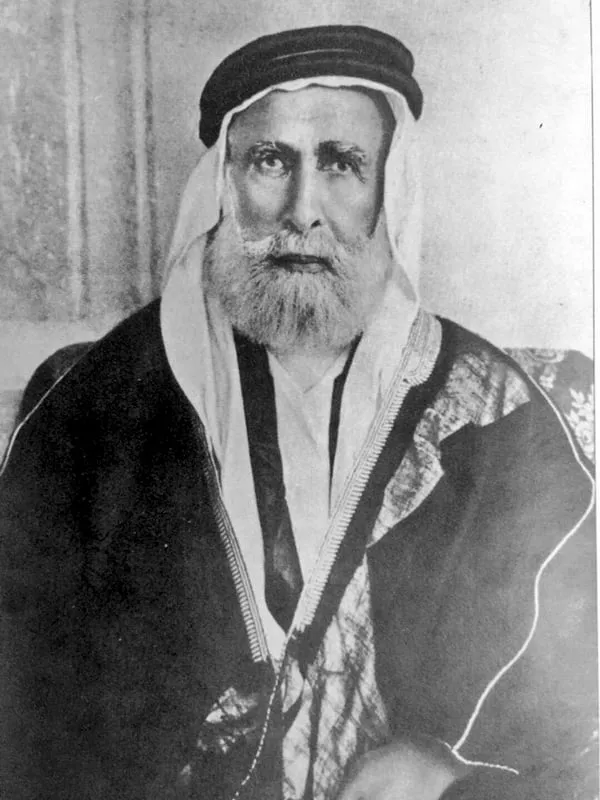
- Born:
- 1853, Constantinople (Ottoman Empire)
- Died:
- 4 June 1931, Amman (Transjordan)
- Author:
- Natalia
- Photo:
- autor nieznany, domena publiczna, Wikimedia Commons

Hussein bin Ali, Sharif and Emir of Mecca of the Hashemite house, was the guardian of the holiest cities of Islam who in June 1916 renounced his allegiance to the sultan and caliph in Constantinople. His revolt, backed by British gold, weapons and ships, took the Hejaz from the Turks and then, led by his sons, reached as far as Damascus and Aleppo. For the Central Powers it was a propaganda blow, because a descendant of the Prophet had sided with the Christian powers against the jihad proclaimed by the sultan. Hussein hoped to be rewarded with the leadership of a great Arab state. He received the title of King of the Hejaz, and after the war felt cheated by his allies, with whom he broke. In 1924, abandoned by the British, he lost a war with Ibn Saud and died in exile.
Before the war
He was born in Constantinople in 1853 or 1854. The exact date is uncertain, and some sources give 1 May 1853. His clan, the Dhawu Awn, belonged to the branch of the descendants of Hasan, Muhammad’s grandson, which since the Middle Ages had given Mecca its sharifs, the hereditary rulers of the city under the sultan’s suzerainty. He spent his childhood and youth in Mecca, where he studied law and theology, and on expeditions to the tribes he came to know the desert and the customs of the Bedouin. Around 1893, during power struggles within the clan, he was sent to Constantinople. For fifteen years he lived there as a dignitary under the eye of Sultan Abdul Hamid II, sat on the Council of State and brought up his sons, three of whom, Ali, Abdullah and Faisal, were later to play a great role in Arab politics. The fourth and youngest, Zeid, was born to another wife in 1898.
In the autumn of 1908, after the Young Turk Revolution, the sultan appointed him Emir of Mecca, against the candidate preferred by the ruling Committee of Union and Progress. From the start he distrusted the Young Turks. He defended the traditional autonomy of the sharifate against centralisation, opposed the extension of the Hejaz Railway from Medina to Mecca, which would have given the Turks permanent control over the province, and quarrelled with successive governors. He did not, however, abandon his loyalty to the sultan. In 1910–1911 he fought on the Turkish side against Ibn Saud in Najd and against Muhammad al-Idrisi in Asir, where he broke the siege of Turkish-held Abha. Abdullah and Faisal sat in the Ottoman parliament. In 1914 rumours grew that Constantinople wanted to remove him, and he clashed openly with the new governor, Wehib Pasha. In the spring Abdullah asked the British in Cairo whether they would help his father, but was turned down.
Between the sultan and the British
The war changed the sharif’s position. In the autumn of 1914 Lord Kitchener, through Abdullah, offered him protection and help if the Arabs supported Britain, and hinted that the caliphate might return to the Arabs. Hussein gave evasive answers. When in November the sultan proclaimed jihad, the sharif did not support it publicly, explaining to the Turks that the British fleet could blockade the ports of the Hejaz and starve a country that lived on imported grain. At the same time he did not break with Constantinople and sent his sons for talks with the authorities. In 1915 Faisal made contact in Damascus with secret Arab societies, which promised to support a revolt under the sharif’s leadership.
After consulting his sons in Ta’if, Hussein decided to negotiate with the British. In July 1915 he sent his first letter to Cairo, demanding recognition of the independence of the Arab lands from the Mersin–Adana line in the north to the Indian Ocean, and from Persia to the Mediterranean. So began the correspondence with the British High Commissioner in Egypt, Sir Henry McMahon. In his letter of 24 October 1915 McMahon promised, with reservations concerning the Syrian coast, French interests and Mesopotamia, “to recognise and support the independence of the Arabs”. Hussein bargained over Beirut and Aleppo until March 1916. He did not know that at the same time Britain and France were agreeing on the division of the empire’s Arab provinces in the secret Sykes–Picot Agreement.
In the spring of 1916 the situation became urgent. The Ottoman commander in Syria, Djemal Pasha, was cracking down on Arab activists, and on 6 May 21 of them were executed in Damascus and Beirut. A strong Turkish force with a German mission was to pass through the Hejaz to Yemen, and Hussein feared that it would reinforce the garrisons and seal his removal. At his request British ships blockaded the ports of the Hejaz, and weapons began to arrive from Sudan.
The revolt
On 5 June 1916 Ali and Faisal proclaimed near Medina the independence of the Arabs from the Turks, and on 10 June Hussein himself gave the signal to fight in Mecca. The Battle of Mecca lasted until 9 July, when the last barracks surrendered under the fire of Egyptian guns. In June the Arabs, with the help of British ships, took Jeddah, and in September Abdullah took Ta’if together with the governor of the Hejaz. Constantinople stripped Hussein of his office and appointed his rival, Ali Haidar, as emir, but this no longer mattered. Medina, however, with Fahreddin Pasha’s strong garrison and linked by rail to Damascus, held out for the whole war.
In his proclamation of late June Hussein justified the revolt almost exclusively on religious grounds. He accused the Young Turks of departing from Islam, of taking power away from the sultan and of shelling the Kaaba during the fighting in Mecca. He said little about the Arab nation. For the British the most important thing was that the guardian of the holy cities had stood up against the caliph and robbed the call to jihad of its credibility.
At the end of October 1916 the notables and scholars of Mecca proclaimed him “King of the Arab Lands”. The Allies, surprised and embarrassed, because the title irritated other rulers of the Peninsula as well as France, recognised him only as King of the Hejaz. Hussein went on using the wider title all the same. For the rest of the war he hardly left Mecca and Jeddah. His sons did the fighting, while he governed and received British envoys and money. According to British figures, by April 1919 he had received about 6.5 million pounds in subsidies. He could be a trying ally: suspicious, stubborn and jealous of his authority, he refused to take responsibility for bringing a British brigade into the Hejaz, and he received the successes of his sons, especially Faisal, with distrust.
In May 1917 Mark Sykes and François Georges-Picot, the authors of the secret agreement, came to see him in Jeddah. They presented their plans to him in general terms, and Hussein, according to their account, agreed that France should have the same position in Syria as the British were to have in Baghdad. Each side understood this formula in its own way. When at the end of 1917 the Bolsheviks published the text of the agreement and the British issued the Balfour Declaration, Hussein demanded explanations. In January 1918 Commander Hogarth assured him in a special message that Jewish settlement in Palestine would not infringe the freedom of its Arab inhabitants, and in February London confirmed its promise of Arab liberation. Hussein rejected Turkish peace proposals passed on through Faisal and forwarded them to the British. He stayed with the alliance until the end of the war.
After the war
Victory did not bring him what he had expected. Medina surrendered only in January 1919. Faisal ruled in Damascus and represented the Hejaz at the Paris Peace Conference, but Syria went to France, and Iraq and Palestine to Britain, as mandated territories. Hussein regarded this as a betrayal of McMahon’s promises and refused to ratify the Treaty of Versailles. In May 1919 Abdullah’s army was routed at Turabah by Ibn Saud’s Wahhabi warriors. In 1921, when Faisal became King of Iraq and Abdullah Emir of Transjordan, the British sent T. E. Lawrence to Jeddah to persuade Hussein to sign a treaty with Britain. The king refused, because he would not put his hand to a document that gave Palestine to the Zionists and Syria to foreigners. The British subsidies ran out.
In March 1924, a few days after Turkey abolished the caliphate, Hussein assumed the title of caliph in Transjordan. Outside the Hejaz and parts of the Arab world hardly anyone recognised him. A few months later Ibn Saud attacked the Hejaz. In September Ta’if fell, and at the beginning of October Hussein abdicated in favour of Ali and left for Aqaba. The British gave him no help, and in 1925, at Ibn Saud’s demand, they took him to Cyprus. At the end of 1925 the Saudis occupied the rest of the Hejaz. On the island he lived modestly and alone. After a stroke in 1930 he was allowed to move to Amman, where he died on 4 June 1931. He was buried in Jerusalem, on the Temple Mount.
Assessment
For a long time Hussein was regarded in the Arab world as the father of modern Arab nationalism. That is how the Lebanese historian George Antonius presented him in his classic book The Arab Awakening (1938), and in Jordan, ruled by his descendants, he is revered as the leader of the Great Arab Revolt. The colours of the revolt, black, white and green with a red triangle, survive in the flags of several Arab states. In Turkey he was remembered as a traitor who stabbed the empire in the back at its hardest moment.
Many historians judge him more coolly. The American historian C. Ernest Dawn and the Israeli Joshua Teitelbaum show that in 1916 Hussein was not yet a nationalist in the modern sense, but a ruler defending the autonomy of the sharifate and the future of his dynasty, who took up Arab slogans when they offered him the chance of more. The British historian Elie Kedourie saw him as an ambitious politician with a poor grasp of the world. The British who worked with him, Lawrence among them, wrote of his stubbornness, cunning and lack of realism. Many historians agree, however, that it was he who bore the cost of the vague and contradictory promises of British diplomacy: he trusted McMahon’s letters, did not learn of the Sykes–Picot Agreement in time, and when he was no longer needed was left alone to face Ibn Saud. Armenian memorial institutions also recall that in 1917–1918 he issued appeals calling on the tribes to take in and protect survivors of the Armenian genocide.
Sources
Spotted a mistake?Report an error
Commanded in battles
(02)Mentioned in battles
(02)Often appears with
People who appear in the same events.