Key event
Start of the Arab Revolt
- Category:
- Military operations
- Front:
- Middle East
- Date:
- 5 June 1916
- Author:
- Łukasz Skowroń
- Tags:
- Ottoman Empire, Great Britain, Arab Revolt
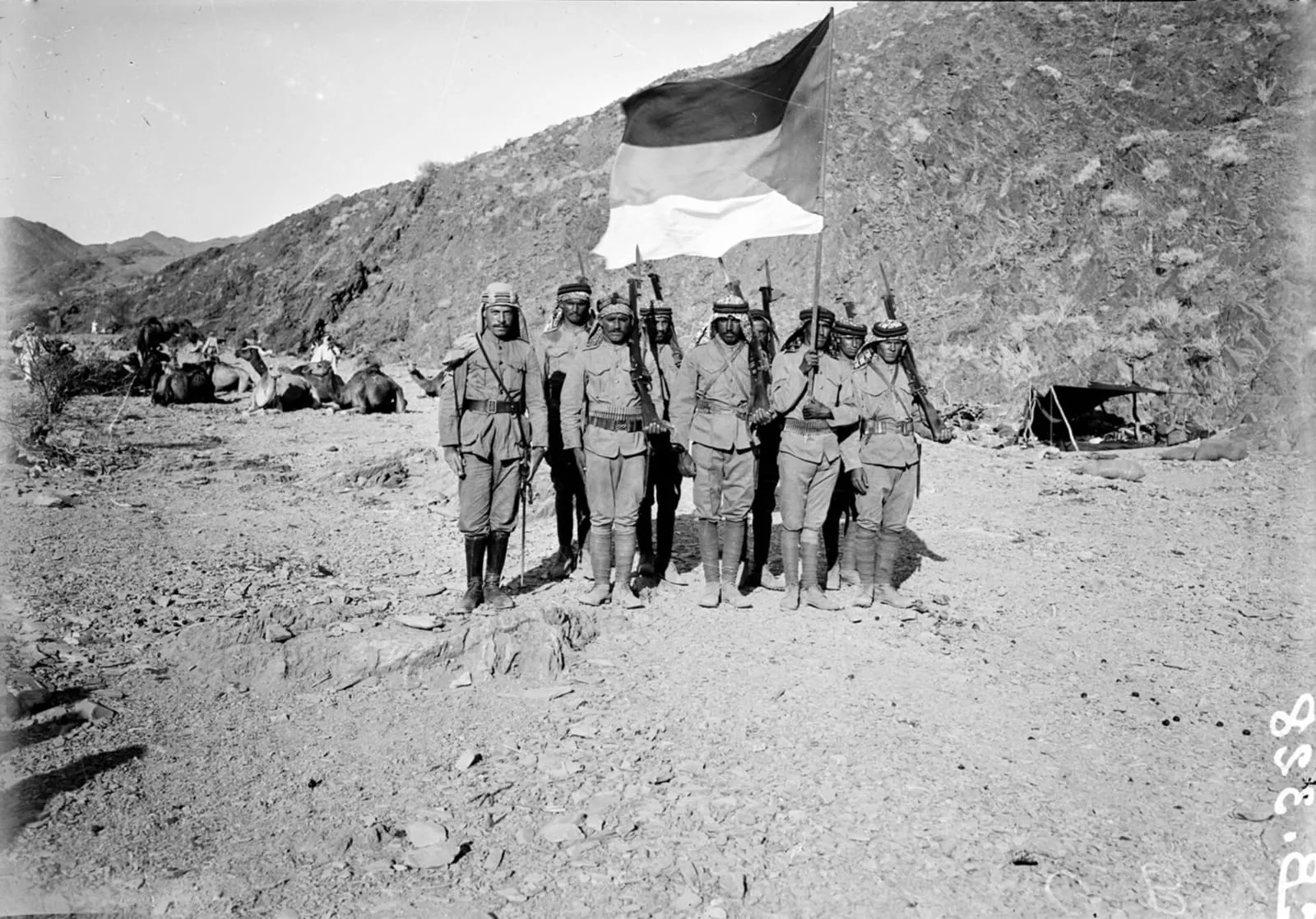
At sunrise on 5 June 1916 two sons of Hussein bin Ali, Sharif and Emir of Mecca, rode out of Medina to the tomb of Hamza, the Prophet’s uncle, just outside the city. About 1,500 volunteers were camped there, whom the sharif had raised at the demand of the Ottoman authorities, officially for the army fighting the British. The sharif’s eldest son, Ali, and his third son, Faisal, proclaimed before them, in their father’s name, the independence of the Arabs from Turkish rule. Then they rode off with the volunteers to the south-east of the city, where the warriors of the neighbouring tribes were waiting for them. Thus, according to the Lebanese historian George Antonius, author of the classic history of the Arab national movement, began the Arab Revolt.
Faisal’s ruse
Only three weeks earlier Faisal had been in Damascus, in practice as the guest and at the same time the hostage of the Ottoman commander in Syria, Djemal Pasha. A few days after the executions of Arab activists on 6 May he received a message from his father, in an agreed code, that the revolt was near, and he had to leave without arousing suspicion. Antonius describes how he managed it. Faisal himself asked Djemal for an audience and told him that volunteers from the Hejaz were waiting in Medina ready to march to Damascus, so it would be fitting for one of the sharif’s sons to come at their head. Djemal not only agreed but insisted that it should be Faisal who went. On 16 May Faisal set out for Medina, where his brother Ali was already waiting. On 24 May the sharif instructed Ali to fix the day of the rising, and the brothers chose Monday 5 June.
The haste had another cause. An elite Ottoman detachment under Hayri Bey had just reached Medina; it was to pass through the Hejaz to Yemen together with the German mission of Baron Othmar von Stotzingen. The sharif feared that it would reinforce the Turkish garrisons in Arabia, and ordered Ali to prevent it at all costs from marching on Mecca. The Turks were uneasy too. According to the Turkish historian Mustafa Bostancı, on 28 May Djemal appointed the energetic general Fahreddin Pasha (in British sources Fakhri Pasha) commander in Medina.
5 or 10 June
The date of the start of the revolt is given in various ways. The British chronology of the war, on which our timeline is based, and the British official history (MacMunn and Falls, Military Operations: Egypt and Palestine) begin it on 5 June, with the proclamation near Medina. In Mecca itself fighting broke out only at dawn on Saturday 10 June, that is, on the 9th day of the month of Sha’ban 1334 according to the Islamic calendar. According to Hashemite tradition, repeated in many studies, the signal was a shot that the sharif fired from a window of his palace. Many works, especially Arab ones, regard this day as the true start of the revolt, and in Jordan, ruled by Hussein’s descendants, the anniversary of the Great Arab Revolt is celebrated precisely on 10 June. The British official history places the first fighting in Mecca and the attack on the port of Jeddah on 9 June, while Turkish studies write that on 9 June the railway from Damascus to Medina was cut and that on 10 June at sunrise the sharif’s rebellion began. The difference therefore arises chiefly from whether the start is taken to be the proclamation by the sharif’s sons near Medina or the rising of Hussein himself in Mecca.
Causes
Hussein had been sharif since 1908 and from the outset was on bad terms with the Committee of Union and Progress ruling in Constantinople. The Young Turks wanted to centralise the state and curtail the traditional autonomy of the Hejaz. The British official history points out that the sharif opposed the extension of the Hejaz Railway from Medina to Mecca, because he understood that the railway would make it easier for the Turks to supply and reinforce their garrisons, and would subject him to closer control. There were also rumours that the government intended to remove him and give the dignity of sharif to his rival from another branch of the family, Ali Haidar.
At the same time, from July 1915 the sharif had been conducting a secret correspondence with the British High Commissioner in Egypt, Sir Henry McMahon. In the letter of 24 October 1915 the British promised, with several reservations, to recognise and support Arab independence. In the spring of 1916 they began to deliver arms, and at the sharif’s request their ships blockaded the ports of the Hejaz. McMahon advised delay until the Arabs were better armed. Events in Syria, however, tipped the balance. Djemal Pasha was cracking down on Arab nationalist activists there, and on 6 May 21 of them were hanged in Damascus and Beirut. Antonius writes that Faisal, when their names were read out to him, tore the headcloth from his head, trampled on it and cried “Tab al-maut ya Arab!”. These words, a call to the Arabs to avenge the dead at the risk of their lives, became the battle cry of the revolt.
Aims and forces
The sharif wanted an independent Arab state, to embrace the Arabian Peninsula, Syria and Mesopotamia, under the rule of his dynasty. These were the borders he demanded in his correspondence with McMahon. Some historians stress, however, that in 1916 the revolt was not so much a national movement in the modern sense as a defence of the old rights of the sharifate and the dynasty against centralisation, and Hussein justified his rising above all on religious grounds, accusing the Young Turks of departing from Islam. The Arabs of Syria and Mesopotamia, contrary to the sharif’s hopes, did not rise in 1916.
The forces were very unequal. According to the British official history, the Turks had more than 15,000 soldiers in the Hejaz, mainly from the 22nd Division, with artillery and machine guns. The sharif could count on tribal warriors who came and went as they pleased. By the end of June there may have been as many as 50,000 of them, but only a small fraction had modern rifles, and they had no artillery or machine guns at all. Near Medina some 30,000 men reportedly gathered, who had only 6,000 rifles.
What came next
The next day Faisal attacked Medina, but the strong garrison beat off the assault, and Ali set off north to cut the railway. On 8 June envoys of the British Arab Bureau in Cairo, who had sailed to the vicinity of Jeddah for a meeting with the sharif’s son Abdullah, found there instead the youngest of the brothers, Zeid. From him they learned that the revolt had already been going on for three days. On 10 June Mecca rose, and the sharif’s second son, Abdullah, began to besiege the summer residence of the Turkish governor, Ta’if. Medina, linked by railway to Damascus, nevertheless held out for the whole war. In the autumn of 1916 a young British intelligence officer, Thomas Edward Lawrence, arrived in the Hejaz; he was to become Faisal’s most famous adviser.
Remember the articles you have read? Only in this browser; nothing is sent anywhere.How it works
Read ·
A voice from the front
“This morning I find myself faced with a situation which has changed in the most remarkable way. One of Sherif Ali Bey's men brought me some letters. […] I immediately sent a detachment to the place occupied by the volunteers yesterday. It was deserted. […] It seems to me certain that the railway will be attacked to-night or to-morrow morning at the latest […]. Please don't leave us without reinforcements!”
Spotted a mistake?Report an error
Meanwhile
(04)Elsewhere in the same days.
- 6 June 1916 · Balkan FrontPacific blockade of GreeceOn 6 June 1916 Entente warships began stopping Greek ships, and vessels under the Greek flag were held in Allied ports. No one explained the reason to Athens.
- 6 June 1916 · Asia and the PacificDeath of Yuan ShikaiOn 6 June 1916 the Chinese President Yuan Shikai died in Peking. The next day Vice-President Li Yuanhong took office, recognised also by the rebel south.
- 3 June 1916 · Balkan FrontMartial law in SalonikaOn 3 June 1916, King Constantine's name day, Gen. Sarrail declared a state of siege. Entente troops seized the offices, post office and telegraph in Salonika.
- 3 June 1916 · Italian FrontEnd of the Trentino offensiveOn 3 June 1916 the Austrians took Monte Cengio, but Cadorna said he would stop them in the mountains. The attack faded, though assaults went on two more weeks.
Related events
(04)The same battle, people or subject.
- 6 June 1916 · Middle EastAttack on MedinaOn 6 June 1916 Faisal's Arabs attacked Medina. Fahreddin Pasha's garrison drove them off with artillery fire, and the torn-up Hejaz Railway was soon repaired.
- 27 July 1916 · Middle EastArabs take YanbuOn 27 July 1916 the Turkish garrison of Yanbu, the old Red Sea port of Medina, surrendered to the Sharif's insurgents. Medina lost its nearest port.
- 15 May 1916 · Middle EastBlockade of the Hejaz coastIn mid-May 1916 British warships began blockading the ports of the Hejaz. The blockade was requested by the Sharif of Mecca himself, who was preparing a revolt.
- 27 June 1916 · Middle EastProclamation of the Sharif of MeccaOn 27 June 1916 the Sharif of Mecca issued an appeal to the world's Muslims. He accused the Young Turks of godlessness and proclaimed the Hejaz independent.