Key event
Brusilov offensive begins
- Category:
- Military operations
- Front:
- Eastern Front
- Date:
- 4 June 1916
- Author:
- Łukasz Skowroń
- Battle:
- Brusilov offensive
- Tags:
- Russia, Austria-Hungary, Aleksei Brusilov, Bukovina
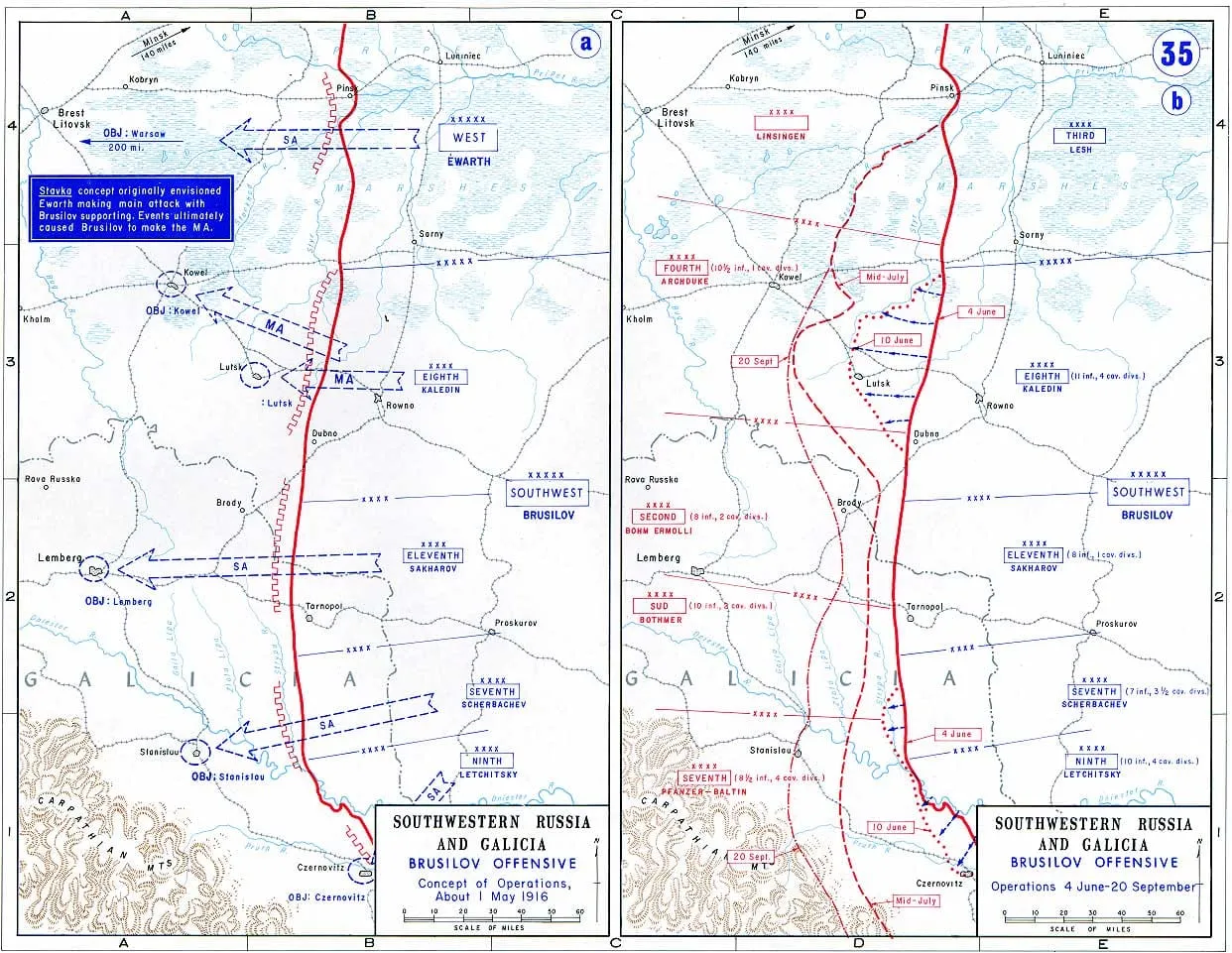
On 4 June 1916 (22 May by the Julian calendar then used in Russia) the Russian South-Western Front began a great offensive against Austria-Hungary. At dawn the Russian batteries opened fire along the whole front, from the Styr in Volhynia to Czernowitz in Bukovina. The Austrian official history writes that on the most important sectors the bombardment reached an intensity the Eastern Front had never yet known. That day all four armies of General Aleksei Brusilov began their attack: in Volhynia with a bombardment intended to prepare the assault for the following day, near Tarnopol and on the Dniester with infantry attacks as well. On the Austro-Hungarian side it happened to be the 60th birthday of Archduke Friedrich, the nominal commander-in-chief of the army.
Attack on every sector
Russian plans for the summer of 1916 envisaged that the main blow would be struck by the Western Front towards Vilna, while the South-Western Front, which Brusilov had commanded since April, was to pin down the enemy and make a subsidiary attack towards Lutsk. The date was brought forward by the Austrian offensive in the Tyrol, after which the Italians begged the Russians for help. The Chief of Staff to the Supreme Commander, General Mikhail Alekseyev, set Brusilov’s attack for 4 June and the Western Front’s for 10–11 June. Brusilov did not want to repeat the mistakes of the March offensive at Lake Naroch, where an attack concentrated on a single sector had allowed the Germans to bring up reserves in time. Each of his armies therefore prepared its own breakthrough, and the enemy, seeing preparations along the whole front, did not know where the main blow would fall.
Alekseyev regarded such a plan as a dispersal of forces. According to Brusilov’s memoirs, as late as the evening of 3 June he urged him by telephone, invoking the wishes of Nicholas II, to postpone the attack for a few days and concentrate his forces in one place. Brusilov refused and offered to be relieved. Alekseyev replied that the Tsar was already asleep and it would not be proper to wake him, and ended the conversation with the words: “God be with you. Act as you see fit.” In the morning Austrian wireless operators intercepted Brusilov’s order of the day to his troops: “The time has come to drive out the vile enemy. All the armies of our front are attacking simultaneously.”
Volhynia: a day of bombardment
The main blow was to be struck by the 8th Army of General Aleksei Kaledin east of Lutsk, where the Austro-Hungarian 4th Army of Archduke Joseph Ferdinand stood on the defensive. Kaledin concentrated about a hundred battalions and 320 guns on the sector of attack. From 4 a.m. the Russian artillery methodically destroyed the wire, breastworks and trenches of the 2nd Infantry Division and the 70th Honvéd Division west of Olyka and shelled Austrian headquarters. The defenders survived the bombardment in deep dugouts and suffered moderate losses, but their positions were wrecked in many places. At about 5 p.m. Russian units burst out of their trenches in strong reconnaissance attacks, which the Austrians took for the real assault and repulsed with barrage fire, using up ammunition. In the north the Russian XXX Corps attacked the Austro-Hungarian 4th Infantry Division without success from half past four until 8 p.m. and, according to Russian figures, lost about 1,900 men. In the evening the 4th Army command reported with satisfaction that all units had held their positions. Kaledin, who was to decide himself on the moment of the assault, set it for 9 a.m. the next day.
11th Army: Cebrów and Sapanów
The 11th Army of General Vladimir Sakharov was above all to pin down the enemy. At 11 a.m. its VI Corps, with 13 armoured cars waiting behind it, attacked along the railway from Tarnopol to Lviv the positions of the Budapest 32nd Infantry Division near Cebrów. The Russians broke in places as far as the second line, but in night counter-attacks the Hungarians recovered almost all their trenches. According to Russian figures the VI Corps lost about 5,000 men that day. Greater success attended the attack of two regiments of the Russian 3rd Infantry Division near Sapanów on the Ikva, on the sector of the Austro-Hungarian 1st Army. The Viennese Landsturm men retook their trenches, but north of them the Russians held on in a bend of the river. According to Russian figures, in the fighting at Sapanów on 4 and 5 June they took almost 3,000 prisoners. Fearing a breakthrough, the Austro-Hungarian command sent its reserve, the 25th Infantry Division, in that direction, taking it away from Lutsk, where it was soon to be needed.
The Dniester: the first breach
The most dangerous situation arose on 4 June at the southern end of the front. The 9th Army of General Platon Lechitsky attacked the Austro-Hungarian 7th Army of General Karl Pflanzer-Baltin east of Czernowitz, between the Dniester and the Prut. For weeks the Russians had been sapping towards the Austrian positions, and in front of some divisions their assault trenches had come within a few dozen paces of the wire. From 4 a.m. their artillery kept switching targets to deceive the defenders, and finally concentrated its fire on the positions of the Hungarian 79th Honvéd Brigade. When the fire suddenly stopped at noon, the Russian infantry reached the trenches within moments, before the defenders had time to leave their dugouts. The brigade was shattered, and only about 600 of its men came back. The Russians claimed to have taken 7,000 prisoners here.
In the afternoon the Russian XI Corps broke into the village of Dobronouc (Dobronăuți), and the 3rd Zaamur Division broke through the positions of the 42nd Honvéd Division on the Dniester. Two Croatian regiments of that division were almost destroyed, and the Russians took more than 4,000 prisoners there. The Russians penetrated 5 kilometres deep into the Austrian positions, and at about 5 p.m. the village of Okna fell. The Austrians threw all their reserves into a counter-attack and by nightfall had retaken Dobronouc and Okna, but did not recover the lost trenches. General Benigni’s group lost a third of its guns that day, and its soldiers tried to dig in in the open. Pflanzer-Baltin, confined to bed with fever at his headquarters in Kolomea, did not yet realise the extent of the defeat. On the sector of the 7th Army of General Dmitry Shcherbachev on the lower Strypa, 4 June saw only bombardment; the assault was planned for 6 June.
What the following days brought
On the evening of 4 June the Austro-Hungarian command in Volhynia could still believe that the front had held. The army group commander, General Alexander von Linsingen, wrote that day of “weak attacks” with which the Russians sought to offset the Austrian successes in the Tyrol. The next day Kaledin’s infantry went over to the assault near Olyka and within a few hours broke through the first and second lines of defence of the 4th Army. On the evening of 7 June the Russians entered Lutsk. So began the offensive that brought the Russian army its greatest victory of the war.
Remember the articles you have read? Only in this browser; nothing is sent anywhere.How it works
Read ·
Voices from the front
“I must admit that our artillery attack was everywhere crowned with complete success. In most cases enough gaps were cut, and thoroughly, and the first fortified belt was swept away entirely and, together with its defenders, turned into a heap of rubble and mangled bodies. Here the other side of the coin showed clearly: many shelters were not destroyed, but the parts of the garrison sitting in them had to lay down their arms and surrender…”
Translated · Original (ru)
Должен признать, что везде наша артиллерийская атака увенчалась полным успехом. В большинстве случаев проходы были сделаны в достаточном количестве и основательно, а первая укрепленная полоса совершенно сметалась и вместе со своими защитниками обращалась в груду обломков и растерзанных тел. Тут ясно обнаружилась обратная сторона медали: многие убежища разрушены не были, но сидевшие там части гарнизона должны были класть оружие и сдаваться в плен…
“A few weeks after the Polish Club had taken its stand, the Austrian army suffered an enormous catastrophe at Lutsk on 4 June. […] Had it not been for the Germans and the Legionaries (the Second Brigade of the Legions lost up to 30 per cent!), who held back the Russian drive westward, the whole Eastern Front would have been shaken. After the Lutsk catastrophe I raised in the N.K.N. a heated criticism of Biliński's policy towards Austria, which was content entirely with the non-binding words of Minister Burián.”
Translated · Original (pl)
W kilka tygodni po zajęciu stanowiska przez Koło Polskie, armja austrjacka uległa pod Łuckiem 4 czerwca olbrzymiej katastrofie. […] Gdyby nie Niemcy i Legjoniści (Druga Brygada Legjonów poniosła do 30% strat!), którzy powstrzymali parcie rosyjskie ku zachodowi, cały front wschodni byłby zachwiany. Po katastrofie łuckiej podniosłem w N. K. N. gorącą krytykę polityki wobec Austrji Bilińskiego, zadawalniającego się zupełnie nieobowiązującemi słowami ministra Buriana.
Spotted a mistake?Report an error
Meanwhile
(04)Elsewhere in the same days.
- 5 June 1916 · War at seaDeath of KitchenerOn 5 June 1916 the cruiser Hampshire, carrying Lord Kitchener to Russia, struck a mine off Orkney. The war minister died with almost all the crew; 12 survived.
- 3 June 1916 · Italian FrontEnd of the Trentino offensiveOn 3 June 1916 the Austrians took Monte Cengio, but Cadorna said he would stop them in the mountains. The attack faded, though assaults went on two more weeks.
- 5 June 1916 · Middle EastOttoman offensive in western PersiaAt the start of June 1916 the whole Ottoman XIII Corps stood at Khanaqin. Baratov's Russians began to fall back, and the Turks moved into Persia.
- 2 June 1916 · Western FrontGermans take Fort VauxOn 2 June 1916 the Germans broke into Fort Vaux at Verdun. Major Raynal's garrison held out underground until 7 June, when the water ran out.
Related events
(04)The same battle, people or subject.
- 11 June 1916 · Eastern FrontStart of the Battle of the StrypaOn 11 June 1916 the Russian 7th Army, having taken Buczacz, attacked Bothmer's South Army beyond the Strypa. A German counter-attack threw it back at Olesza.
- 17 June 1916 · Eastern FrontRussians retake CzernowitzOn 17 June 1916 the Russian 9th Army broke into the Czernowitz bridgehead and crossed the Prut at night. On 18 June the Austrians left the Bukovinian capital.
- 21 June 1916 · Eastern FrontRussians take RădăuțiOn 21 June 1916 Petrograd announced the capture of Rădăuți in southern Bukovina. Terek Cossacks had passed through it a day earlier, pursuing the Austrians.
- 24 June 1916 · Eastern FrontAustrians driven out of BukovinaBy 24 June 1916 the Russians had taken Kuty and Kimpolung, and the Austrians fell back into the Carpathians, keeping only a strip of Bukovina by Jakobeny.