1916: The Eastern Front
Lake Naroch offensive
- Dates:
- 18 March – 28 April 1916
- Front:
- Eastern Front
- Location:
- The lake district on the border of present-day Belarus and Lithuania, from around Postavy to the isthmus between Lakes Naroch and Vishnev, about 100 km east of Vilna (Vilna Governorate, Russian Empire)On the battle map →
- Sides:
- Russian EmpireAlexei Evert, Alexander Ragoza, Mikhail Pleshkov, Pyotr Baluyev, Leonid-Otto SireliusGerman EmpirePaul von Hindenburg, Hermann von Eichhorn, Oskar von Hutier
- Result:
- Russian defeat. After two weeks of attacks the Second Army had gained only a few square kilometres by Lake Naroch, which the Germans retook on 28 April 1916.
- Author:
- Natalia
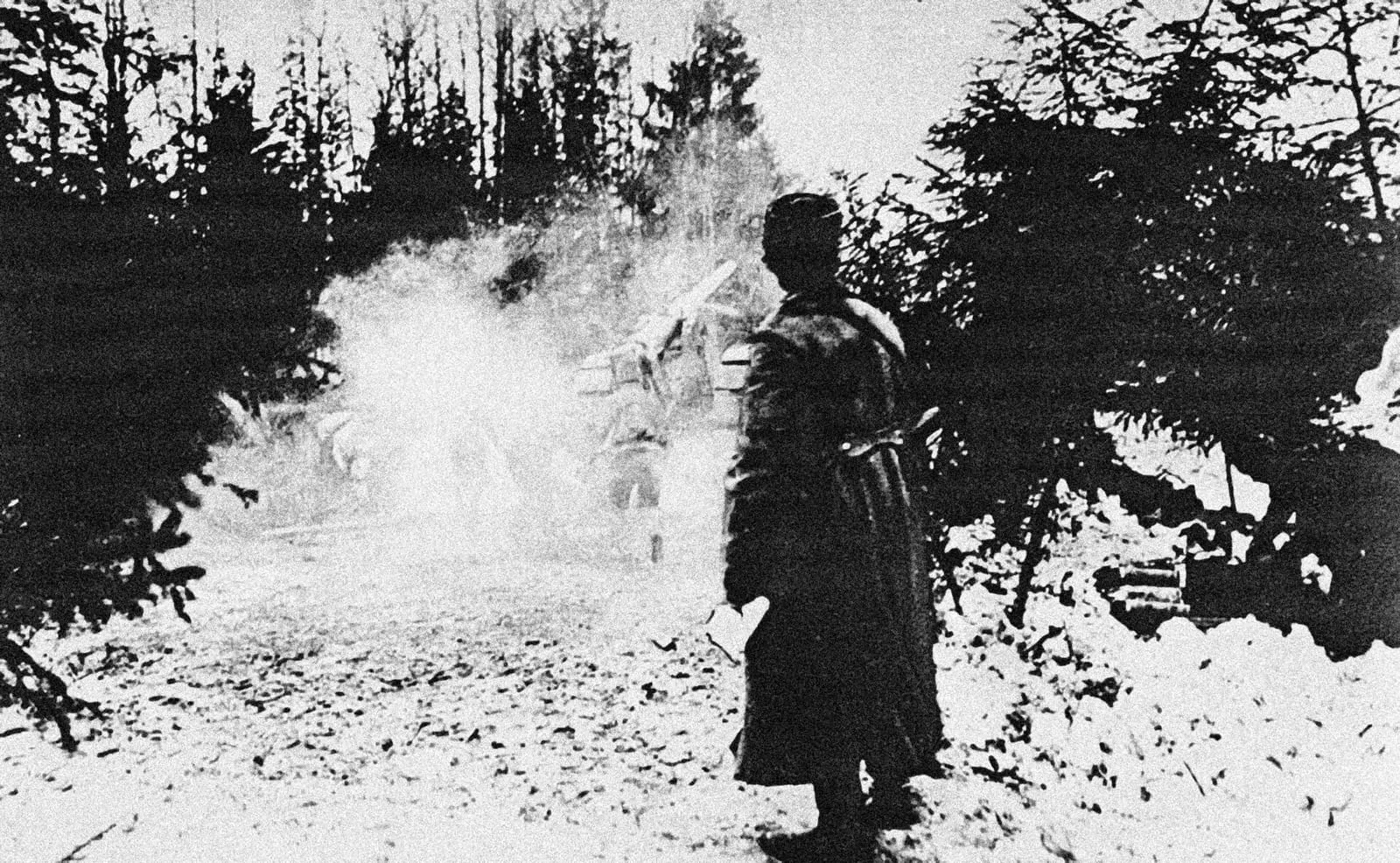
The Lake Naroch offensive was the first great offensive of the Russian army after the Great Retreat of 1915. The Russians undertook it at the request of the French, who had been bleeding at Verdun since 21 February, in order to draw German reserves to the east. On 18 March 1916 the reinforced Second Army of the Western Front struck on both shores of Lake Naroch at the German Tenth Army. It had an enormous numerical advantage, but its artillery failed to destroy the German fortifications, the group commanders did not co-operate with one another, and after a few days the thaw set in, turning the lake district into a swamp. After two weeks of attacks the Second Army had lost almost 80,000 men and gained only a scrap of ground on the southern shore of the lake. On 28 April the Germans retook it in a single blow.
Name and dates
The Russians speak of the “Naroch operation” (from the Russian name of the lake, Naroch), the Germans of the “battle of Lake Naratsch”, and some Polish studies of the battle of Postavy. We use the name “Lake Naroch offensive”, although fighting also took place a dozen or so kilometres north of the lake, near Postavy.
Russian documents of the time used the Julian calendar, which was 13 days behind. The infantry assault began on 18 March, 5 March by that calendar. According to the Soviet monograph by Nikolai Podorozhny (1938), based on Russian archives, the batteries registered their guns from 14 to 17 March, and the artillery preparation proper began at dawn on 18 March. Erich Ludendorff wrote in his memoirs that the Russian bombardment began as early as 16 March, which is why some studies give dates from 16 March.
The offensive was halted on 29 March by a directive of the Chief of Staff of the Supreme Commander, General Mikhail Alekseyev, and on 30 March (17 March by the Julian calendar) by an order of the commander of the Western Front. The last Russian attack, on a hill known as “Ferdinand’s Nose”, collapsed on the morning of 31 March. Russian and English-language studies therefore end the battle on 30 March. A British chronology of the war records its end only under 30 April. On this page we close the battle on 28 April 1916 (15 April by the Julian calendar), when a German counter-attack took from the Russians everything they had gained in March.
Background
At the second conference at Chantilly in December 1915 the Allies agreed to strike simultaneously on all fronts in 1916, but not until the summer. The German attack at Verdun on 21 February upset this plan. General Joseph Joffre asked the Russians to strike earlier and not allow the Germans to take divisions from the east. On 24 February Alekseyev gathered the front commanders at Mogilev. Since the South-Western Front had bled itself white on the Strypa in January, the main blow was to be delivered by the Western Front of General Alexei Evert and the Northern Front of General Aleksei Kuropatkin, at the junction of the two fronts, in the lake country between Dvinsk and Smorgon.
The front had stood there since the autumn of 1915, when after the Battle of Vilna it settled on the line of Lakes Drysviaty and Naroch. The plan envisaged the Second Army breaking through the German positions north and south of Lake Naroch and advancing on Sventsiany, and if successful further on, towards Vilna and Kovno. At the same time the Fifth Army of the Northern Front was to strike from the bridgehead at Jakobstadt on the Dvina, and the neighbouring armies were to launch supporting attacks. As early as January Evert had advised attacking while the lakes and marshes were still frozen. The preparations, however, took so long that the offensive began on the eve of the spring thaw.
The commander of the Second Army, the 66-year-old General Vladimir Smirnov, fell ill on 11 March. For the duration of the operation Evert entrusted the army to General Alexander Ragoza, commander of the neighbouring Fourth Army, who arrived on the eve of the attack and knew neither the troops nor the terrain. Ragoza divided the army into three groups. The northern group of General Mikhail Pleshkov (I Army Corps, I Siberian Corps, with XXVII Corps and VII Cavalry Corps in reserve) was to break through the front near Postavy. The southern group of General Pyotr Baluyev (V and XXXVI Corps, III Siberian Corps) was to strike in the isthmus between Lakes Naroch and Vishnev. The central group of General Leonid-Otto Sirelius (PL) was only to pin down the Germans between them. According to Podorozhny the Second Army numbered about 356,000 infantry and 17,000 cavalry and had 887 guns, 282 of them heavy. It lacked shells and transport, however, and more than 23,000 soldiers did not even have rifles.
On the other side stood the Tenth Army of General Hermann von Eichhorn, subordinate to the Commander-in-Chief in the East, Field Marshal Paul von Hindenburg. The sector near Postavy was held by XXI Corps under General Oskar von Hutier. According to Podorozhny the Germans initially had about 74,000 infantry, 8,000 cavalry and 720 guns on the front under attack. Their positions, built throughout the winter, had several lines of trenches, deep dugouts and dense barbed-wire entanglements. The Germans expected an attack, though rather near Smorgon. Ludendorff, Hindenburg’s chief of staff, was still in Berlin on 11–12 March and returned to Kovno when news of the Russian preparations arrived.
Course
The first day, 18 March. At dawn hundreds of Russian guns opened fire. On the sector of I Siberian Corps the fire was the heaviest Russian soldiers had seen in this war, but it was concentrated on a strip 2–3 kilometres wide. In Baluyev’s group the artillery was spread along the whole front, and the light guns could not break up the frozen ground. The Russian infantry went into the attack in the afternoon. Where it broke into the first line, it came under crossfire from machine guns on the flanks and in the evening fell back to its starting positions. Sirelius’s group spent the whole day merely exchanging artillery fire, so the Germans moved reserves from in front of it to the threatened sectors. According to Podorozhny the Second Army lost more than 15,000 killed and wounded that day and nowhere held the trenches it had captured.
The German crisis, 19–21 March. The Russians renewed their attacks at night as well. On 19 March the Germans shelled the sector of the Russian 25th Division with gas shells. During the night of 20–21 March the artillery of Baluyev’s V Corps fired thousands of chemical shells, one of the first uses of such ammunition by the Russian army, although its effect proved slight. Early on 21 March Baluyev’s regiments broke into the German trenches on the southern shore of Lake Naroch, near the villages of Zanarocz and Blizniki, and took several lines. They captured about 1,250 prisoners and 18 machine guns. Ludendorff admitted that the success “on the narrow lake sector” was dangerous for the Germans, and called 18–21 March the critical days of the Tenth Army. Near Postavy, too, Pleshkov’s group briefly occupied the first line of German trenches, but lost it again.
The thaw and the petering out of the attack, 22–31 March. As early as 21 March the soldiers were lying in wet snow among puddles, and by 22 March the full thaw had arrived. The roads across the marshes became impassable, the artillery could not follow the infantry, and the wounded froze to death during the night frosts. Meanwhile the Germans brought up reinforcements from other sectors of the Eastern Front, among them the 80th Reserve Division and the 107th, 119th and 86th Infantry Divisions. Ludendorff wrote that by 26 March, when the Russian attacks reached their last peak, the crisis had in practice been overcome. Pleshkov’s group attacked in vain near Postavy on 26 and 27 March. Until the end of the month Baluyev tried to take the hill “Ferdinand’s Nose”, so called from its resemblance to the nose of the Bulgarian tsar. In the north, troops of the Northern Front attacked at the same time near Vidzy, Dvinsk and Jakobstadt, also without success. On 29 March Alekseyev ordered the operation halted, and on 30 March Evert ordered the First and Second Armies to go over to the defensive, holding only the ground gained between Lakes Naroch and Vishnev. On 2 April Smirnov returned to command the Second Army.
The German counter-attack, 28 April. At the beginning of April the front calmed down. On 28 April the Tenth Army, after an artillery preparation lasting several hours with about 200 heavy guns and using gas shells, struck between Lakes Naroch and Vishnev and recovered all the ground lost in March. According to Russian studies, among those taken prisoner were about 1,200 newly arrived replacements. Ludendorff stressed that this was the first time artillery methods known from the west had been used on the Eastern Front. According to his biographers the fire was planned by the artillery officer Georg Bruchmüller, who in 1918 prepared the great German offensives in the west.
Losses
The most precise Russian figures were given by Podorozhny. In the fighting from 18 March to 1 April the Second Army lost 1,018 officers and 77,427 men killed and wounded, about 30 per cent of its strength. Pleshkov’s group lost more than half its men, Baluyev’s group almost a third, and Sirelius’s inactive group fewer than 900. The figure included about 12,000 cases of frostbite and men frozen to death. After the battle about 5,000 bodies were removed from the German wire. The German official history put Russian losses at 110,000, and some historians give figures of about 100,000, counting the attacks of the Northern Front as well.
German losses are less certain. According to the German official history they amounted to about 20,000 men. Podorozhny considered this figure understated and estimated them at 30,000–40,000. In March the Russians took about 1,200–1,500 prisoners.
Significance
The Lake Naroch offensive was a costly defeat. An army which, according to the Russians, had a nearly fivefold superiority in men on the sector under attack gained about 10 square kilometres of ground, and lost even that a month later. The defeat was decided by poor reconnaissance and dispersed artillery, the lack of co-operation between the groups, a new army commander who did not know his troops, and also the season: the thaw halted the attack just when the Germans were in the greatest difficulty.
Nor did the offensive bring the French any clear relief. The Germans repulsed it with reserves gathered on the Eastern Front itself, without taking divisions from Verdun, where their attacks continued. The Russians did, however, keep the promise they had made to their allies, and the Germans came away from the battle convinced of the weakness of the Tsarist army. The defeat robbed Evert and Kuropatkin of their self-confidence, which according to many historians weighed on the passivity of their fronts in the summer of 1916. General Aleksei Brusilov, on the other hand, drew lessons from the failure, and his South-Western Front broke through the Austro-Hungarian front in June in the Brusilov Offensive.
Spotted a mistake?Report an error