Germany · The Central Powers
Hermann von Eichhorn
Commander of the 10th Army (1915–1918), Army Group "Eichhorn" (1916–1918) and Army Group "Kiev" (1918), field marshal
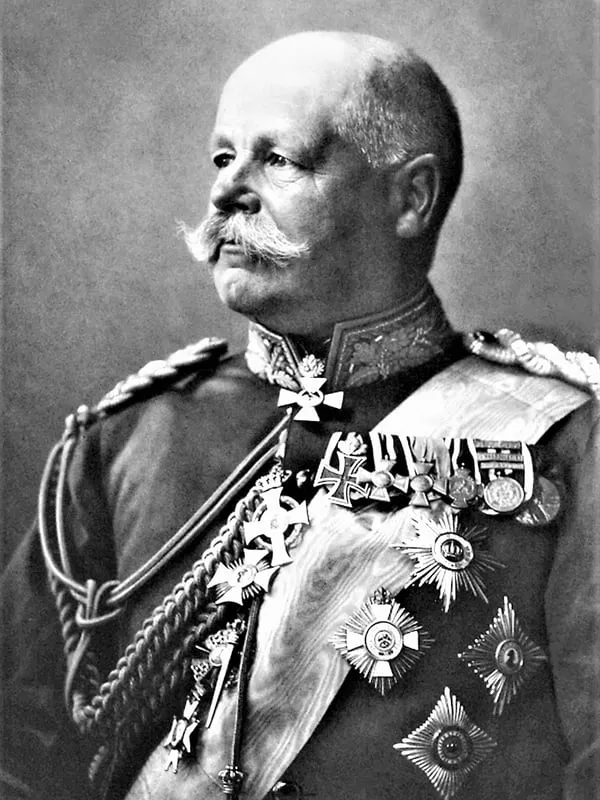
- Born:
- 13 February 1848, Breslau (Prussia)
- Died:
- 30 July 1918, Kiev
- Author:
- Łukasz Skowroń
- Photo:
- Hoffotograf J. B. Ciulina, Frankfurt am Main, domena publiczna, Wikimedia Commons

Hermann von Eichhorn was one of the oldest German army commanders of the First World War and one of the least talked about, although for three years he led one of the most effective armies on the Eastern Front. His 10th Army was the northern arm of the pincers in the Second Battle of the Masurian Lakes, in 1915 it took Kovno and Vilna, and in 1916 at Lake Naroch it repulsed the first great Russian offensive after the Great Retreat. From the summer of 1916 Eichhorn commanded an army group in Lithuania and Courland whose troops took Riga and the Estonian islands and in the spring of 1918 occupied Livonia and Estonia. His last task was command of the troops occupying Ukraine. In that post his name became linked with the overthrow of the Central Rada and the rule of the Hetman, and on 30 July 1918 he was killed in Kiev by a bomb thrown by a Left Socialist Revolutionary.
Before the war
He was born on 13 February 1848 in Breslau into a family of Prussian officials. His father was later president of the government district of Minden, his paternal grandfather, Johann Albrecht Friedrich Eichhorn, was Prussian Minister of Religious Affairs and Education, and his maternal grandfather was the philosopher Friedrich Schelling. In 1866 he joined the 2nd Foot Guards Regiment as a volunteer and, while still an officer cadet, fought in the war against Austria, among other places at Königgrätz. In the war against France he was adjutant of a Guards Landwehr battalion at Strasbourg and Paris and received the Iron Cross, Second Class.
After the war he graduated from the War Academy in Berlin, where he came into contact with Paul von Hindenburg and Karl von Bülow, and for many years served on the Great General Staff and on the staffs of divisions and corps. In the early 1890s he headed the General Staff section that prepared new infantry regulations. He was chief of staff of the corps at Karlsruhe and Breslau, commanded a regiment of Leib-Grenadiers, a brigade and the 9th Division at Glogau, and from 1904 to 1912 the XVIII Corps at Frankfurt am Main. In 1912 he took over the VII Army Inspectorate at Saarbrücken, and on 1 January 1913 he became a colonel general.
In the event of war he was to command the 5th Army, concentrating near Metz. In May 1914, however, during an inspection of troops, he fell from his horse and was badly bruised, and then fell ill with pneumonia. When war broke out he was unfit for service, and the 5th Army was taken over by Crown Prince Wilhelm. Eichhorn took several months to recover and at the end of 1914, with the Emperor’s consent, joined his old grenadier regiment.
1915: Masuria, Kovno, Vilna
In January 1915, according to most sources on 26 January, Eichhorn took command of the new 10th Army, formed in East Prussia from the corps that Hindenburg and Ludendorff had won for the Eastern Front. It deployed on the northern wing, between Gumbinnen and the Niemen. In February, in blizzards and frost, it struck the right wing of the Russian 10th Army and advanced as far as Suwałki and Sejny, while the 8th Army of Otto von Below attacked from the south. Encircled in the Augustów Forest, the Russian XX Corps laid down its arms. The battle drove the Russians out of East Prussia, although it did not bring the destruction of the whole enemy army that Ludendorff had hoped for.
In the summer of 1915, as the Russian armies were retreating from Congress Poland, Eichhorn’s army struck the strongest Russian fortress on the Niemen. In the siege of Kovno the main burden fell on the XL Reserve Corps of Karl Litzmann, which Eichhorn reinforced at the expense of the rest of his front. The fortress fell in less than two weeks, and on 18 August Eichhorn received the Pour le Mérite. In September his army led the last great German offensive in the east that year. In the battle of Vilna it struck north of the city into the gap between two Russian armies, and cavalry passed through the breach and reached Smorgon and Molodechno. On 18 September the Germans occupied Vilna, and on 28 September Eichhorn received the oak leaves to the Pour le Mérite. The Russian 10th Army, however, could not be encircled, and the exhausted offensive came to a halt on the line of Lakes Drisvyaty and Naroch and on through Smorgon.
Eichhorn was an executive commander. The plans of operations were drawn up at the headquarters of Hindenburg and Ludendorff, and the name of the commander of the 10th Army seldom appeared in their memoirs except in words of praise. In these months his army had such able generals commanding in the field as Litzmann and Oskar von Hutier, commander of the XXI Corps.
Naroch and the army group
The army spent the winter of 1915/1916 building fortifications between the lakes of Lithuania and Belarus. In March 1916, at the request of the French, who were bleeding at Verdun, the Russians attacked precisely this army. In the battle of Lake Naroch the Russian 2nd Army had an enormous numerical superiority, but its artillery failed to destroy the German trenches, and the thaw turned the lake district into a swamp. Ludendorff called 18–21 March critical days for the 10th Army. The Russians lost almost 80,000 men and gained only scraps of ground, which the 10th Army retook on 28 April after a short, heavy bombardment using gas shells.
In the summer of 1916, during the reorganisation of command in the east, when Hindenburg took over the greater part of the front down to Galicia, the headquarters of the 10th Army was turned into the headquarters of Army Group “Eichhorn”. Sources give various dates, from the end of June to August, most often 30 July. Eichhorn kept command of the 10th Army, and the German troops in Courland were also subordinated to him. The front in his sector was quiet in 1916 and for most of 1917. In September 1917, after Russian discipline had already collapsed, Hutier’s 8th Army, which was under his command, took Riga. Eichhorn rode into the city beside Prince Leopold of Bavaria, the supreme commander in the east. In October, in Operation Albion, the army and the navy seized the islands off the coast of Estonia. In December 1917, according to most sources on 18 December, Eichhorn became a field marshal.
When the negotiations at Brest-Litovsk stalled in February 1918, Eichhorn’s armies formed the northern wing of Operation Faustschlag. The 8th Army marched through Livonia and Estonia towards Reval and Pskov, and the 10th Army occupied Minsk and reached the Dnieper. Resistance was negligible. After the signing of the Treaty of Brest-Litovsk in March, Eichhorn was transferred to the south.
Kiev
German and Austro-Hungarian troops entered Ukraine as allies of the Ukrainian Central Rada, with which the Central Powers had concluded a separate peace in February, and in return were to receive grain. At the end of March the army group of Alexander von Linsingen, which had taken Kiev, was dissolved, and the occupation was taken over by the new Army Group “Kiev” under Eichhorn’s command. The dates on which he took command differ in the sources by several weeks, from early March to 3 April. By May his troops had occupied the rest of Left-bank Ukraine with Kharkov, the Crimea, Taganrog and Rostov. He controlled the lands from southern Belarus to the Crimea and part of the lands of the Don Host, except for the governorates occupied by the Austro-Hungarians. His chief of staff was General Wilhelm Groener, who, according to historians, was the main author of German policy in Ukraine.
Cooperation with the socialist Rada soon broke down. The Ukrainian government was unable to organise grain deliveries, and the land law, which abolished private ownership of land, threatened in German eyes chaos and fields left unsown. On 6 April Eichhorn issued an order on the sowing of fields, which instructed German troops to see that the spring sowing was carried out, by force if necessary. The Rada regarded this as interference in the internal affairs of the state. On 25 April, after the kidnapping of a Kiev banker, another order from Eichhorn placed offences against public order under German courts martial. On 28 April a German detachment burst into a session of the Rada and arrested several ministers, and the next day General Pavlo Skoropadskyi, who had earlier agreed terms with Groener, was proclaimed Hetman. Eichhorn himself did not appear in the foreground, but the coup was prepared by his staff, and German troops disarmed the formations loyal to the Rada.
In the spring and summer the occupation army disarmed units it did not control. Among them was the Polish II Corps, which on 11 May fought Eichhorn’s troops in the battle of Kaniów and had to lay down its arms. In the countryside the occupation meant requisitions and the return of landowners to their estates, often escorted by German soldiers, and in June a great peasant uprising broke out in the Zvenigorodka and Tarashcha districts. From Kiev Eichhorn also maintained contacts with other forces on the ruins of the Russian Empire. In June his envoy brought Ataman Pyotr Krasnov the news that Germany recognised the Don authorities.
The assassination
For the revolutionaries Eichhorn became the symbol of the occupation. The Left Socialist Revolutionaries, opponents of peace with Germany, decided to kill him, hoping, as with the assassination of the envoy Mirbach in Moscow on 6 July, to provoke a break between the Bolsheviks and Berlin. On 30 July 1918, shortly before 2 p.m., as the field marshal was walking with his adjutant, Captain Walter von Dressler, through the Lypky district, the 24-year-old Boris Donskoy threw a bomb at them. Some contemporary accounts said that Eichhorn was riding in a carriage. Both officers died the same day, the field marshal in the evening. He was 70. A German field court sentenced Donskoy to death, and on 10 August he was publicly hanged in Kiev.
Skoropadskyi, who ran to the scene of the explosion, remembered Eichhorn as a “worthy old man”, sensible and kindly. The coffin was taken to Berlin and on 6 August was buried in the Invalids’ Cemetery. Eichhorn’s successor in Kiev was General Günther von Kirchbach. The assassination did not change German policy, but for the people of Kiev it was a sign that the occupation was drawing to an end. Mikhail Bulgakov described it in The White Guard as one of the evil omens for the Hetman’s rule.
Assessment
Eichhorn is not one of the generals over whom historians argue. In the German military tradition he was regarded as a conscientious and capable army commander who, without fanfare, carried out the plans of the high command in the east. His 10th Army won several clear successes, from Masuria to Vilna, and in 1916 withstood the heaviest Russian attack on this sector of the front. At the same time his most famous operations ended in a similar way: with gains of ground and prisoners, but without the encirclement and destruction of a Russian army that Ludendorff dreamed of. Part of the credit is attributed to his subordinates and to Hindenburg’s staff.
Ukrainian and Russian historians see him above all as the symbol of the occupation of 1918. His April orders opened the way to the overthrow of the Central Rada, and the requisitions and the return of the landowners, carried out under the protection of his troops, turned a large part of the countryside against the Germans and the Hetman. The Ukrainian historian Ruslan Pyrih, who devoted a separate study to him, describes the occupation of 1918 as “atypical”, because formally the Germans were allies of the Ukrainian state. Many authors stress that the real author of this policy was Groener, and that the old field marshal in Kiev was its face rather than its maker.
Arnold Zweig modelled on him General von Lychow, the old, honest Prussian commander in the novel The Case of Sergeant Grischa.
Sources
Spotted a mistake?Report an error
Commanded in battles
(06)- 7–22 February 1915Winter Battle in MasuriaEastern Front
- 6–18 August 1915Siege of KovnoEastern Front
- 9 September – 2 October 1915Battle of VilnaEastern Front
- 18 March – 28 April 1916Lake Naroch offensiveEastern Front
- 18 February – 3 March 1918Operation FaustschlagEastern Front
- 11 May 1918Battle of KaniówEastern Front
Often appears with
People who appear in the same events.