1915: The Great Retreat of the Russian army
Siege of Kovno
- Dates:
- 6–18 August 1915
- Front:
- Eastern Front
- Location:
- Kovno Fortress and its approaches on the left bank of the Neman, between the Neman and the Jiesia, and the forts on the right bank of the river, Kovno Governorate, Russian Empire (now Kaunas, Lithuania)On the battle map →
- Sides:
- German EmpireHermann von Eichhorn, Karl LitzmannRussian EmpireVladimir Grigoryev, Yevgeny Radkevich, Mikhail Alekseyev
- Result:
- German victory. After ten days of fighting Litzmann's troops broke through the western forts, took the city on 17 August and the last forts on 18 August. The Russians lost over 20,000 prisoners and an enormous number of guns.
- Author:
- Natalia
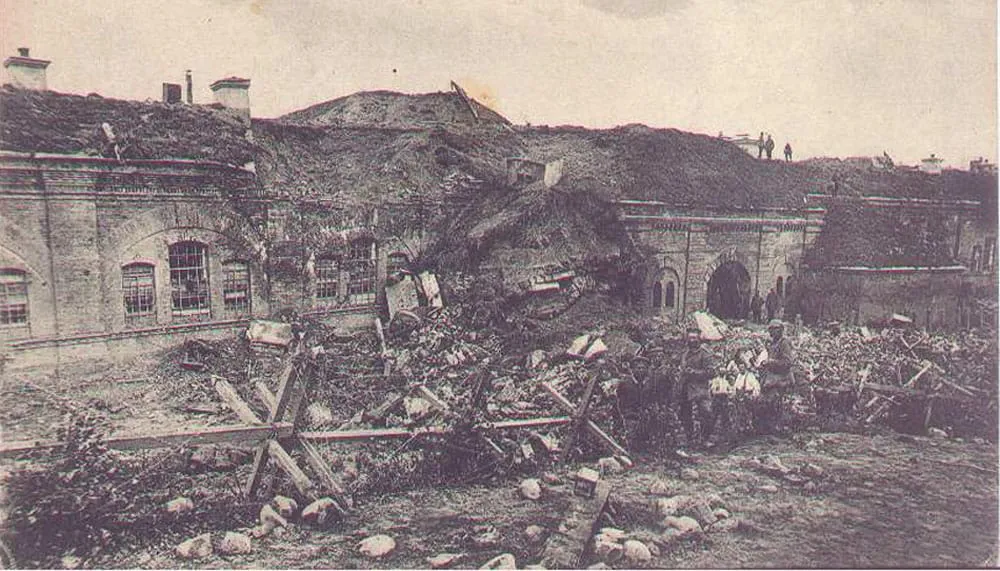
Kovno was the strongest Russian fortress on the Neman and one of the pillars of the defence of the empire’s western borders. In the summer of 1915, as the Russian armies were withdrawing from the Kingdom of Poland, Kovno was to cover their northern flank and the road to Vilna. The Germans took it in less than two weeks. The XL Reserve Corps of General Karl Litzmann, part of General Hermann von Eichhorn’s 10th Army, attacked from the west, between the Neman and its tributary the Jiesia, smashed the oldest forts with heavy artillery and broke through their line on 16 August. The next day the garrison abandoned the fortress in disorder, and its commandant, General Vladimir Grigoryev, fled to the rear. On 17 August the Germans entered the city, and on 18 August they took the last forts.
Name and dates
On this page we use the dates 6–18 August 1915. According to the German report from headquarters, the attack on the fortress began on 6 August, when the infantry advanced towards the Russian positions to gain observation points for the artillery. The heavy guns opened fire on 8 August, and some works, among them the Austrian official history, count the siege from that day. Russian works count the defence of Kovno from 4 August, when the Germans approached the advanced positions, while fighting for the approaches to the fortress had gone on intermittently since June.
The German communiqué of 18 August announced that the fortress “with all its forts” had been in German hands since the night, and German works give 17 August as the date of the capture of Kovno. According to Russian sources, however, the last fort still holding out, Fort V, fell only on 18 August, and we take that day as the end of the fighting.
Background
The fortress was built in the 1880s. Its main ring consisted of nine forts and several permanent batteries, spread on both sides of the Neman. The forts were mostly of brick and had not been rebuilt in time. A modernisation plan of 1910 was not due to be completed until 1920, and the roofs of the oldest forts had been designed with 21 cm shells in mind, not the 42 cm shells that the Germans brought to Kovno. The weakest was the south-western sector, where the three oldest forts, I, II and III, stood, and through which the railway from East Prussia via Virbalis ran. It was this line that made it possible to bring up the heavy siege guns.
According to Russian tallies, at the beginning of August the garrison numbered over 66,000 men and about 1,370 guns, mostly of medium calibre. Many of the soldiers were poorly trained recruits and older classes of reservists. Ammunition was short, all the more so because the garrison had rifles of three different calibres, including Japanese ones, for which there were no cartridges in the fortress. The commandant since 1909 had been the 64-year-old General of Cavalry Vladimir Grigoryev. The fortress was subordinate to the Russian 10th Army of General Yevgeny Radkevich.
The Germans had stood before Kovno since the spring. After the June fighting their line ran through the forests west of the fortress, a dozen or so kilometres from the forts. Field Marshal Paul von Hindenburg and his chief of staff, General Erich Ludendorff, had long wanted to take Kovno and strike further, through Vilna, into the rear of the retreating Russian armies. The Chief of the German General Staff, General Erich von Falkenhayn, preferred an offensive across the Narew, described as the Battle of the Narew and the Biebrza. Only when the Army of the Niemen had achieved success in Courland, and the offensive on the Narew had bogged down in frontal fighting, did Hindenburg decide to strike at Kovno with the forces he had at hand.
Preparations
The attack was entrusted to the XL Reserve Corps of Litzmann, “the Lion of Brzeziny” from the Battle of Łódź, reinforced with units gathered from other sectors of the 10th Army. Ludendorff later admitted that Eichhorn had greatly weakened the rest of his front for this purpose. The heaviest German mortars had been assigned in July to the troops besieging Novogeorgievsk, so only individual batteries were sent to Kovno. According to Lithuanian research, they included two semi-fixed 42 cm Gamma mortars and one wheeled mortar of that calibre, the famous Big Bertha, as well as 30.5 cm mortars and 28 and 21 cm guns. Some of them reached their positions only during the fighting. To bring them up, the Germans built a branch railway about 11 kilometres long through the forests. A narrow sector between the railway from Virbalis and the Neman was chosen for the attack. The right flank of the attack was exposed throughout to fire and counter-attacks from the direction of the Jiesia, while from the north, across the Neman, it was covered only by a Landsturm brigade.
Course
Fighting for the approaches (6–15 August). During the night of 5/6 August the German infantry advanced to within a few kilometres of the line of forts. On the morning of 8 August the heavy artillery began its bombardment, corrected from observation balloons and aircraft. The shells fell on the forts, but also on depots and the artillery park in the rear. Over the following days Litzmann’s units stormed one strongly fortified advanced position after another. According to the German report, by 15 August they had taken eight such positions, each of which the Russians had been building up for months. The fighting turned into bayonet clashes, and some manor farms changed hands several times. The Russians counter-attacked from the south and from the fortress. German communiqués of those days reported hundreds of prisoners, and on 15 and 16 August over a thousand a day. The attack was advancing slowly, however, and according to Ludendorff its momentum was weakening. From 12 August the wheeled Big Bertha shelled Fort III. Grigoryev warned army headquarters of heavy losses and asked for reinforcements, to no avail.
Breaking through the line of forts (16 August). Before noon on 16 August Litzmann’s artillery, according to Russian works over 200 guns, including 80 heavy ones, opened hurricane fire on the sector between the Neman and the Jiesia. By noon almost all the forts’ artillery had fallen silent. The German infantry broke through the line near Fort II, burst into it from the rear and then rolled up the whole line of forts in that sector. By the evening Forts I, II and III had fallen. The German communiqué of 17 August spoke of over 4,500 prisoners and 240 guns. According to Russian figures, the first sector of the defence lost three quarters of its men. The commander of the 10th Army was meanwhile asking the commander-in-chief of the North-Western Front, General Mikhail Alekseyev, whether the fortress should be defended to the end or evacuated. Only on the morning of 17 August did Alekseyev agree to use his reserves, the 4th Finnish Rifle Division and the 65th Infantry Division, for the defence of Kovno, but by then it was too late.
Fall of the fortress (17–18 August). During the night of 16/17 August the remnants of the garrison on the western bank fell back across the Neman, and soldiers began to leave further sectors for fear of encirclement. The Russians blew up the bridges over the Neman. At about 4 a.m. Grigoryev reported that the garrison had abandoned the fortress and was demoralised. He himself drove off eastwards. Radkevich reported to Alekseyev that the garrison was “fleeing in complete disorder”, and that the commandant had been found in the morning near Rumšiškės, about 20 kilometres east of Kovno. Command of the remnants of the defence was taken over by General Nikolai Lopushansky. The Germans meanwhile took the inner rampart on the western bank, crossed the river under fire and built two bridges. During the day the forts of the northern front fell, attacked from the north as well, and then the eastern forts. Kovno was in German hands. Alekseyev and Radkevich still ordered the fortress to be retaken, but the night counter-attacks failed, and the Cossack units and Lopushansky’s group were thrown back. On 18 August the Germans took the last fort, Fort V, defended by the units of General Vladimir Alftan.
Losses
The figures are incomplete and differ. The German report of 21 August spoke of over 20,000 prisoners and over 600 guns, but cautioned that counting the booty would take many days. Later tallies cited by Lithuanian historians give about 1,350 guns, and Russian works about 1,300, including 350 heavy ones, as well as enormous stocks of ammunition, including over 800,000 shells. According to Russian estimates, apart from the prisoners, the garrison lost about 7,000–8,000 killed and over 17,000 wounded. Russian works put German losses at about 10,000 men. According to the German communiqué, about 15,000 unarmed recruits managed to escape from the city at the last moment.
Kovno itself suffered. Shells fell on the old town, the retreating Russians blew up the bridges and the factories burned down. Ludendorff noted that the city had survived apart from the factories, but most of the inhabitants had fled.
Significance
In less than two weeks the Germans took a fortress that the Russians regarded as the strongest on their western border. Emperor Wilhelm II congratulated Hindenburg on the capture of the “first and strongest bastion” of Russia’s inner line of defence; Eichhorn received the Pour le Mérite, and Litzmann the oak leaves to it. From Kovno the road lay open to Vilna and to the rear of the Russian armies retreating from Brest and Grodno. Ludendorff wrote that he could not understand why the Russian field army had not helped the garrison, which was not encircled and was still connected with the rear.
For the Russians the fall of Kovno was a shock, especially as Novogeorgievsk capitulated a few days later. Grigoryev was arrested. In the autumn of 1915 a military court found him guilty of neglecting preparations for the defence and of abandoning the fortress during the fighting. He was stripped of his rank, decorations and nobility and sentenced to 15 years of penal servitude. Historians also point to other causes of the defeat, however: obsolete forts, a weak and frequently changed garrison, a shortage of ammunition, the withdrawal of some of the guns even before the siege and the lack of support from outside. In October 1915 Hindenburg and Ludendorff moved the headquarters of the German Eastern Front command to Kovno.
Spotted a mistake?Report an error