Ukraine · The Central Powers
Pavlo Skoropadskyi
Commander of the 34th Army Corps and the 1st Ukrainian Corps (1917), Hetman of the Ukrainian State (April–December 1918)
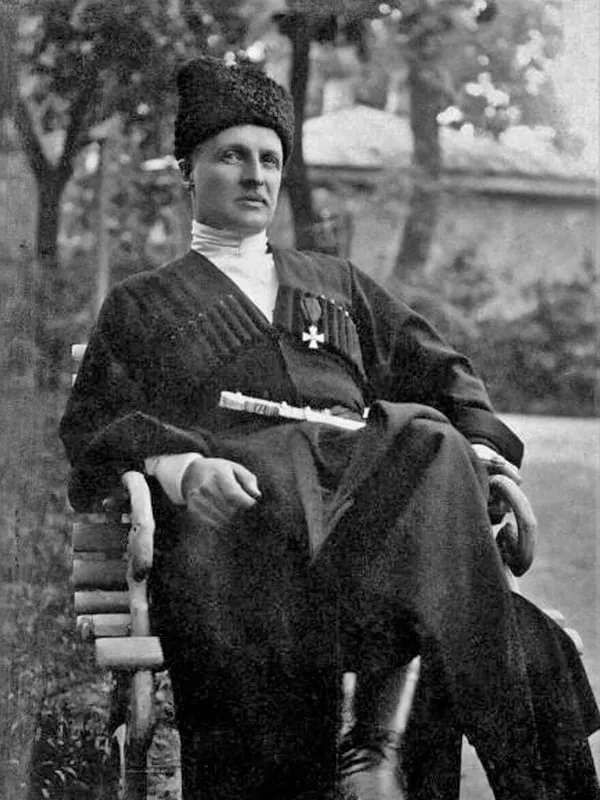
- Born:
- 15 May 1873, Wiesbaden (Germany)
- Died:
- 26 April 1945, Metten (Germany)
- Author:
- Łukasz Skowroń
- Photo:
- autor nieznany, domena publiczna, Wikimedia Commons

Pavlo Skoropadskyi was one of the most extraordinary figures of the Eastern Front. An aristocrat from a family of the Cossack elite, a Guards officer and an aide-de-camp to the Tsar, he commanded Russian cavalry against the Germans for three years of the war, and in 1918, with their help, became Hetman of Ukraine. He was not formally an ally of the Central Powers, but his power rested from the first day to the last on the German and Austro-Hungarian troops who had come to Ukraine for the grain promised at Brest. For seven and a half months he built a state in Kyiv with its own administration, schools and academy of sciences, while at the same time restoring estates to the landowners and watching the occupiers carry off food. When Germany lost the war, his Ukrainian State collapsed within a month. The Ukrainian left regarded him as Berlin’s puppet, the monarchists as the founder of the first effective Ukrainian state. Historians still weigh these two verdicts today.
Before the war
He was born on 15 May 1873 in the German spa town of Wiesbaden, where his family was living at the time. He came from a wealthy family whose most famous member was his ancestor’s brother, Ivan Skoropadsky, Hetman of Left-bank Ukraine in 1708–1722. He spent his childhood on the family estate at Trostianets in the Poltava region, among relics of the Cossack past, which was revered at home. The family, however, belonged wholly to the elite of the empire. Skoropadskyi graduated from the elite Page Corps in St Petersburg and in 1893 joined the Chevalier Guard Regiment, in which his father had served before him.
In the Russo-Japanese War he volunteered for the front. He commanded a sotnia of Transbaikal Cossacks, was aide-de-camp to General Fyodor Keller and then to the commander-in-chief, Nikolai Linevich, and received the Golden Weapon for bravery. In 1905 Nicholas II made him his personal aide-de-camp. Further promotions came quickly: in 1910 he took over the 20th Finland Dragoon Regiment, and in 1911, already a major general of the imperial suite, the Horse Guards Regiment, one of the most prestigious units in the army. He married Alexandra Durnovo, daughter of General Pyotr Durnovo. At that time he was a typical Guardsman: loyal to the throne, speaking Russian in everyday life, and having nothing to do with the Ukrainian national movement.
A cavalryman at war
He began the war at the head of the Horse Guards in the army of Paul von Rennenkampf, which entered East Prussia in August 1914. On 19 August (6 August Old Style), on the eve of the Battle of Gumbinnen, the Guards cavalry ran into a German Landwehr brigade at Kauschen. Skoropadskyi’s regiment, attacking under heavy artillery fire in the centre of the formation, near Krauprischken, took part of the German positions. The fight was costly, but for his part in it Skoropadskyi received the Order of St George, 4th class, the most highly prized Russian combat decoration.
In October 1914 he took over a brigade of the 1st Guards Cavalry Division, and for a time commanded an ad hoc cavalry division. In the summer of 1915, during the Great Retreat from Poland, he was given the 5th Cavalry Division, and in January 1916 he was promoted to lieutenant general. In April 1916 he returned to the Guards as commander of the 1st Guards Cavalry Division. He was not one of the commanders written about in communiqués, but he had a reputation as a reliable and brave officer. At the turn of January and February 1917, a few weeks before the revolution, he took over the 34th Army Corps on the South-Western Front. The corps was stationed in Volhynia and Podolia, and it was there that Skoropadskyi first came into contact with the mass Ukrainian national movement.
1917: the Ukrainian corps
After the February Revolution the Ukrainian Central Rada was formed in Kyiv, and among soldiers of Ukrainian nationality the demand for units of their own grew quickly. After the failure of the July Offensive, Lavr Kornilov, then commander of the South-Western Front and soon commander-in-chief, decided that Ukrainisation might restore discipline to some of the troops, and in the summer of 1917 ordered Skoropadskyi’s corps to be converted into the 1st Ukrainian Corps. Russian soldiers and officers were transferred to other units and Ukrainians took their place. The general accepted the task without enthusiasm. Anton Denikin, who took over the South-Western Front from Kornilov in August, recalled that Skoropadskyi assured him that he was a “truly Russian man” and had no sympathy for Ukrainian separatism. Over time his attitude changed. In October 1917 a congress of the Free Cossacks at Chyhyryn, a volunteer peasant self-defence force, elected him its otaman. The descendant of hetmans was becoming popular.
After the Bolshevik coup Skoropadskyi placed himself under the Central Rada, although its socialist programme was alien to him. In the autumn his disciplined corps, numbering by various estimates between 40,000 and 60,000 men, was the most serious armed force of the Ukrainian People’s Republic. It occupied the railway junctions of Right-bank Ukraine, from Vinnytsia and Zhmerynka to Koziatyn and Bila Tserkva, and disarmed Bolshevised units heading from the front towards Kyiv. On the orders of the Secretary for Military Affairs, Symon Petliura, and General Dmitry Shcherbachev, in November he stopped the 2nd Guards Corps, which had set off for Kyiv to disperse the Rada. The Red troop trains were disarmed almost without a fight and sent back to Russia.
The socialist leaders of the Rada, however, did not trust an aristocrat and one of the richest landowners of the former empire. They feared he would become their rival, and the corps, as historians sympathetic to him maintain, received weapons, uniforms and food late. At the end of 1917, after conflicts with the republic’s new military leadership, Skoropadskyi resigned. When the Bolsheviks took Kyiv in February 1918, he went into hiding in the city.
Hetman
After the Rada’s return to Kyiv in March 1918 the general placed himself at the head of the conservative opposition. His Ukrainian People’s Hromada brought together officers and landowners, and cooperated with the Ukrainian Democratic Agrarian Party of Viacheslav Lypynsky and with the Union of Landowners. The German command, disappointed with a government that could not secure grain deliveries, was looking for someone to restore order. At the end of April Skoropadskyi agreed with the chief of staff of Field Marshal Hermann von Eichhorn, General Wilhelm Groener, the terms of German support: recognition of the Treaty of Brest-Litovsk, the free export of grain and raw materials, and German approval of the make-up of the government and the size of the army. On 29 April a congress of landowners and well-to-do peasants in a Kyiv circus proclaimed him hetman. The Germans disarmed the last units loyal to the Rada, and the Ukrainian People’s Republic gave way to the Ukrainian State.
The hetman concentrated legislative and executive power in his own hands until elections to a parliament, which were never held. He dissolved the Rada and the land committees, restored private ownership of land and appointed the government of Fedir Lyzohub, dominated by Kadets and officials of old Russia. The Ukrainian socialist parties boycotted the new order. The Hetmanate concluded an armistice with Soviet Russia, established relations with the Don and the Kuban, and won recognition from the Central Powers. At the beginning of September Skoropadskyi visited Germany and talked with Emperor Wilhelm II. He obtained consent to build his own army, but by the autumn little more than cadres and a Guards division of serdiuks had been formed.
The most lasting achievement of the Hetmanate lay in culture and learning. Two Ukrainian state universities were founded, in Kyiv and Kamianets-Podilskyi, along with hundreds of Ukrainian gymnasia, a national library, an archive and, in November 1918, the Ukrainian Academy of Sciences, today the National Academy of Sciences of Ukraine. Calm, trade and social life returned to the cities, and Kyiv became a refuge for thousands of people fleeing Soviet Russia, among them Russian officers and politicians who dreamt of restoring “one and indivisible Russia”.
The countryside saw the Hetmanate quite differently. Landowners, among them many Poles from Volhynia, Podolia and the Kyiv region, returned to their manors, often escorted by punitive detachments, and demanded that the peasants return the land and pay compensation. German and Austro-Hungarian troops requisitioned grain, and a land reform plan, with compulsory buy-out of the large estates, was prepared only in November, when it was too late. In the summer peasant uprisings and railway strikes broke out, and on 30 July a Left SR killed Eichhorn in Kyiv. The hetman, who heard the explosion in his residence, was himself the target of a further assassination attempt. The opposition, united in August in the Ukrainian National Union, accused him of Russifying the administration, of subservience to the occupiers and of serving the landowners. He himself wrote in his memoirs that on the land question he wanted to side neither with the left-wing demagogues nor with the irreconcilable Russian and Polish landlords.
Downfall
In the autumn, when Germany’s defeat was already apparent, Skoropadskyi looked for new support. In October he tried to reach an understanding with the moderate part of the opposition and admitted to the government several ministers connected with the Ukrainian National Union. After the Armistice of Compiègne, however, he staked everything on the victorious Entente and the Russian Whites. On 14 November he issued a federation charter (hramota) announcing the union of Ukraine with a future non-Bolshevik Russia, and entrusted the government to Serhiy Gerbel (PL), a supporter of unity with Russia. For the Ukrainian parties this was the end of independence. The next day the Directorate of Volodymyr Vynnychenko and Petliura called for an uprising.
The hetman’s army was falling apart, and units went over to the insurgents. Kyiv was defended mainly by detachments of Russian officers, while the Germans, by now governed by soldiers’ councils, wanted only to go home. On 14 December, as the insurgents were forcing their way into the city, Skoropadskyi renounced power. He wrote in the act that for seven and a half months he had devoted all his strength to leading the country out of its grave situation, but God had not given him the strength to accomplish this task. He hid for several days, according to accounts in a German uniform, and then left with the Germans for Germany via Switzerland.
After the war
He settled in Wannsee near Berlin, where he relied on financial support from German friends in Junker circles. He stressed that he had renounced power but not the title, and from 1920 he led the Ukrainian monarchist movement, whose ideologue was Lypynsky. On his initiative the Ukrainian Scientific Institute was founded in Berlin in 1926. He also wrote extensive memoirs of 1917–1918, an important source for the history of the Hetmanate. In April 1945, fleeing the front, he was badly wounded during an air raid on the railway station at Plattling. He died on 26 April 1945 in a hospital in the monastery at Metten and was buried in Oberstdorf.
Assessment
For a long time the judgement of Skoropadskyi depended on the political camp. For Ukrainian socialists such as Vynnychenko he was a tsarist general who, with the help of foreign bayonets, restored the power of the landowners and the Russian bureaucracy. Soviet historiography saw him simply as a puppet of German imperialism. Émigré monarchists and some present-day Ukrainian historians stress, on the other hand, that the Hetmanate was the first Ukrainian state with a functioning administration, treasury and budget, that it spared Ukraine civil war for several months, and that it left institutions which outlived it by whole decades.
Many scholars, Western ones among them, combine both perspectives. They acknowledge the hetman’s personal commitment to building a Ukrainian state and culture, but point out that his power had no support in the Ukrainian countryside, and that his closest allies were people for whom an independent Ukraine was merely a stop on the way to a reborn Russia. Dependence on the Germans was not only the Hetmanate’s weakness but the condition of its existence. When that support disappeared after November 1918, the federation charter alienated the Ukrainians without winning him either the Entente or the Russian Whites.
Sources
Spotted a mistake?Report an error
Often appears with
People who appear in the same events.