Key event
Kerensky Offensive begins
- Category:
- Military operations
- Front:
- Eastern Front
- Date:
- 1 July 1917
- Author:
- Łukasz Skowroń
- Battle:
- Kerensky Offensive
- Tags:
- Russia, Austria-Hungary, Alexander Kerensky, Galicia
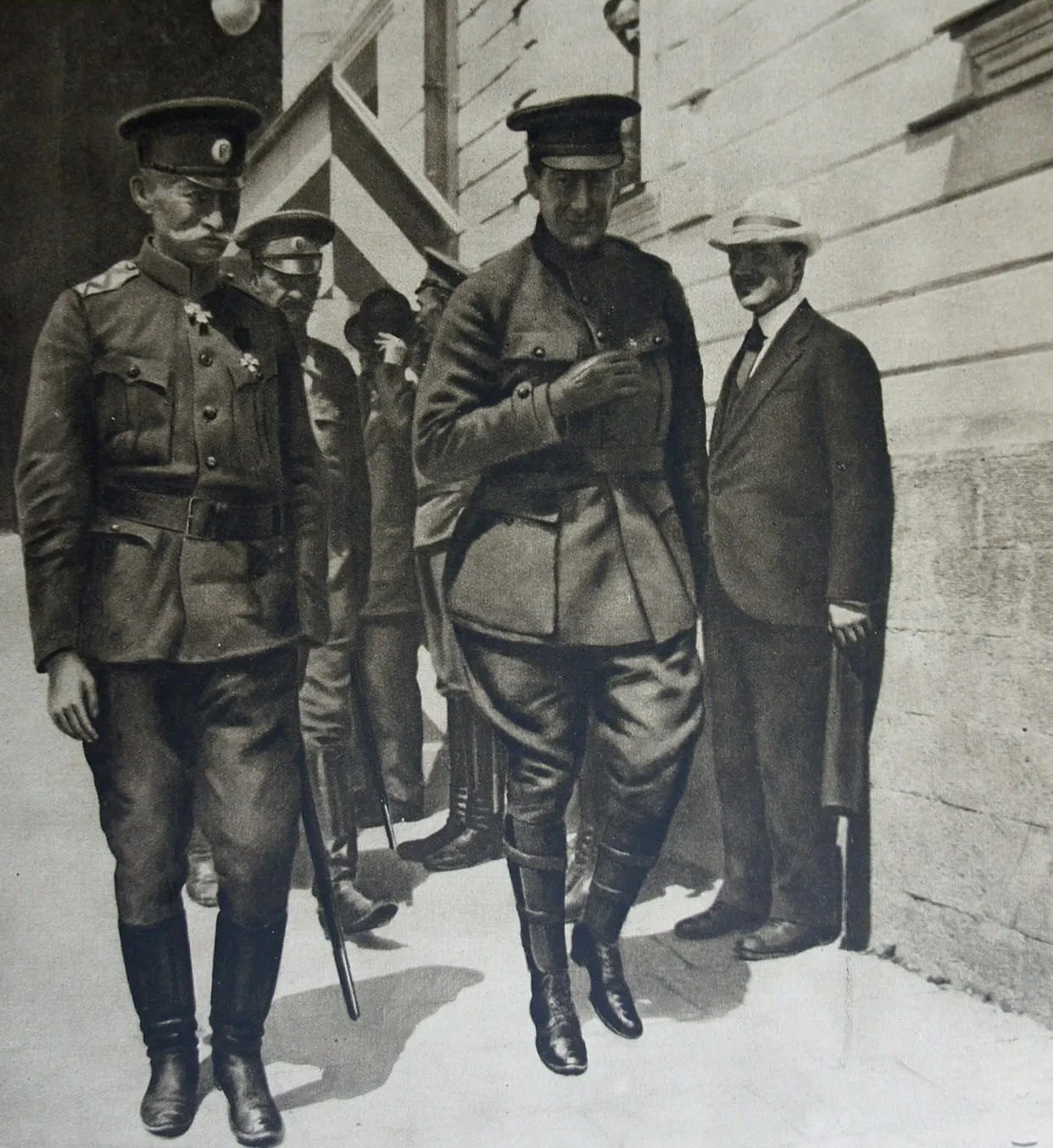
On 1 July 1917 (18 June in the Julian calendar) the army of revolutionary Russia began its first and last great offensive. In the morning the infantry of the Russian Eleventh and Seventh Armies left their trenches in eastern Galicia, between Zborów and Brzeżany, and advanced on the Austro-Hungarian, German and Turkish positions. The attack was preceded by a two-day artillery bombardment that had begun on 29 June. That is the date the British chronology of the war gives as the start of the offensive. At Koniuchy the Russians broke through the front and took thousands of prisoners; at Brzeżany they were repulsed after a day-long fight. In the evening the war minister, Alexander Kerensky, telegraphed Petrograd about a “great triumph of the revolution”.
The minister at the front
For weeks Kerensky had been touring the front and urging the soldiers to fight. On 29 June he arrived in Tarnopol and issued an order to the army: “Soldiers! The fatherland is in danger. Freedom is threatened, the revolution stands on the brink of collapse. The time has come for the army to do its duty.” He invoked the commander-in-chief, Aleksei Brusilov, who believed that every day of delay worked in the enemy’s favour and that one decisive blow could upset his plans. He reminded them that Austria and Germany had offered Russia a separate peace and had tried to deceive it with fraternisation, and that when this failed they had begun to threaten it. He ended with the words: “I order you: forward!”
Brusilov’s plan was for General Ivan Erdeli’s Eleventh Army to break through the front on both sides of Zborów and advance through Złoczów on Lviv, while General Leonid Belkovich’s Seventh Army struck at Brzeżany. On a sector about 65 kilometres wide more than 30 divisions and, according to the Austrian official history, more than 1,300 guns were concentrated. For the first time in this war the Russians had a superiority in firepower that in 1915–1916 they could only have dreamed of. The Eleventh Army’s artillery opened fire at dawn on 29 June, and the Seventh Army’s a day later. The defenders admitted that it fired much more accurately than a year before.
The enemy was waiting for the attack. Russian deserters had announced a great assault for the morning of 1 July, and during the night of 30 June – 1 July Austro-Hungarian and German soldiers repaired their shattered trenches and wire. Prince Leopold of Bavaria, commander-in-chief of the German forces in the east, had decided as early as 30 June to prepare a counter-stroke from Złoczów and ordered divisions to be brought from the west.
Breakthrough at Koniuchy
At about five in the morning of 1 July the Russian fire turned into a hurricane bombardment. At nine the VI and XLIX Corps of the Eleventh Army attacked the village of Koniuchy, at the junction of the German South Army and the Austro-Hungarian Second Army. The Russian 16th Division broke into the lines of the 54th Division, and the 4th Division pierced the positions of the neighbouring 19th Division and drove into the centre of the village. Wheeling north and south, the Russians surrounded and captured most of the defenders, including the 81st Infantry Regiment, the storm battalion of the 54th Division and a battalion of the Ukrainian Sich Riflemen. The Austrian gunners had to blow up their guns. A gap several kilometres wide opened in the front.
Before noon Koniuchy was in Russian hands, and the attackers were climbing the slopes west of the village. German reinforcements sent from the reserves moved slowly in the stifling heat. Only in the afternoon did regiments of the German 223rd Division, together with the remnants of Austro-Hungarian units, occupy the second position at the edge of the woods and halt the attack. The Russians did not reach their objective for the day, the heights above the Złota Lipa, but they won a clear victory. At Zborów itself the Austro-Hungarian 32nd Division repulsed an attack by the 4th Finnish Rifle Division that day. The next day, in the same place, it was the turn of the Czechoslovak brigade.
A bloody day at Brzeżany
An even heavier fight raged at Brzeżany, which a year earlier had withstood the Brusilov Offensive. At ten o’clock, after four hours of hurricane fire, masses of Russian infantry advanced on the Łysonia and Dzikie Łany heights on both sides of the Złota Lipa, defended by the Saxon 24th Reserve Division and the Honvéd troops of the 55th Division. The trenches on Łysonia turned into a field of craters and the wood on its slopes into a tangle of broken trunks. The Russians took several lines of trenches and in the evening broke right into the wood just outside Brzeżany. Only the last reserves of the Saxons and Hungarians, in a night bayonet fight, threw them out of most of the captured ground. Further south Turkish and German units repulsed every attack. On the Seventh Army’s left wing the Russian 52nd Division refused to attack at all.
By the evening the Seventh Army could boast only scraps of captured trench and about two thousand prisoners. The Austrian official history admits, however, that the Russians were within a step of a breakthrough and that the Eastern Front had never yet seen an artillery battle as mighty as the one at Brzeżany in those days.
“A great triumph of the revolution”
Kerensky was euphoric. On 1 July itself he telegraphed the Provisional Government: “Today is a great triumph of the revolution. The Russian revolutionary army has gone over to the offensive with enormous enthusiasm.” He also asked for red banners for the victorious regiments. The prime minister, Georgy Lvov, readily agreed and replied that 1 July had shown the whole world the strength of a revolutionary army built on democratic foundations and imbued with the ideals of the revolution. When news of the attack reached the cities in the following days, patriotic demonstrations were held in the streets of Petrograd.
On that same 1 July hundreds of thousands of workers and soldiers took to the streets of Petrograd. The demonstration had been called by the First All-Russian Congress of Soviets, then sitting in the capital, to show support for its policy. Most of the banners carried, however, bore Bolshevik slogans: “All power to the soviets!” and “Down with the ten capitalist ministers!” On the day the army went into the attack, the capital showed how weary of it the country already was.
The joy proved premature. The shock units that had led the attack suffered heavy losses, and many soldiers decided they had done their part. The next day the Eleventh Army deepened the breakthrough at Zborów still further, but the Seventh Army was no longer able to resume the attack.
Remember the articles you have read? Only in this browser; nothing is sent anywhere.How it works
Read ·
A voice from the front
“The news of the offensive is known in Petrograd from Monday 19 June/2 July, where it rouses great enthusiasm. Processions form on the Nevsky and the Morskaya and, for the first time since March, the national tricolour flag is seen again. In the workers' districts, no reaction, and yet it is certain that the maximalist party will not let pass without a demonstration an offensive which it sees as a challenge to the doctrines it preaches.”
Translated · Original (fr)
La nouvelle de l'offensive est connue à Petrograd dès le lundi 19 juin/2 juillet où elle excite un grand enthousiasme. Des cortèges se forment dans Nevski et Morskaïa et, pour la première fois depuis le mois de mars, on voit reparaître le drapeau national aux trois couleurs. Dans les quartiers ouvriers, aucune réaction, et pourtant il est certain que le parti maximaliste ne laissera pas passer sans manifestation une offensive qui lui parait un défi aux doctrines qu'il prêche.
Spotted a mistake?Report an error
Meanwhile
(04)Elsewhere in the same days.
- 2 July 1917 · War at seaFirst regular convoyOn 2 July 1917 convoy HH 6 left Hampton Roads, the first of a regular series of convoys sailing every four days from Virginia to Britain.
- 28 June 1917 · Middle EastAllenby replaces MurrayOn 28 June 1917 Gen. Edmund Allenby took over command in Egypt from Archibald Murray. London expected him to take Jerusalem before Christmas.
- 4 July 1917 · War at seaShelling of Ponta DelgadaOn 4 July 1917 the German submarine cruiser U-155, formerly the Deutschland, shelled Ponta Delgada in the Azores. The US collier Orion drove her off.
- 4 July 1917 · MilitaryWomen's Battalion of DeathOn 4 July 1917 in Petrograd the banner of Maria Bochkareva's women's battalion of death was blessed. The women were meant to shame war-weary soldiers.
Related events
(04)The same battle, people or subject.
- 2 July 1917 · Eastern FrontBattle of ZborovOn 2 July 1917 a Czechoslovak brigade in the Russian army broke the Austro-Hungarian front at Zborov. Facing it were two Czech regiments.
- 9 June 1917 · Eastern FrontRussia rejects a German armistice offerOn 9 June 1917 Petrograd published its reply to a German radio message urging Russian troops to a separate armistice. Russia rejected it.
- 19 July 1917 · Eastern FrontThe counter-offensive in Eastern Galicia beginsOn 19 July 1917 the Germans struck the Russian Eleventh Army near Złoczów. Within hours they broke through all its lines, and Russian soldiers began to flee.
- 15 March 1917 · PoliticsAbdication of Nicholas IILate on 15 March 1917 at Pskov Nicholas II gave up the throne for himself and his son in favour of his brother Michael. The next day Michael declined the crown.