1917: The Kerensky Offensive and its defeat
Kerensky Offensive
- Dates:
- 1–16 July 1917
- Front:
- Eastern Front
- Location:
- Eastern Galicia, from Zborów and Koniuchy through Brzeżany on the Złota Lipa to Stanisławów, Halicz and Kałusz on the Łomnica (today western Ukraine)On the battle map →
- Sides:
- RussiaAleksei Brusilov, Aleksei Gutor, Lavr Kornilov, Ivan Erdeli, Leonid BelkovichGermany, Austria-Hungary and the Ottoman EmpirePrince Leopold of Bavaria, Eduard von Böhm-Ermolli, Felix von Bothmer, Karl Tersztyánszky von Nádas
- Result:
- Russian defeat. The 11th and 7th Armies' drive on Lviv stalled after two days, and the gains of Kornilov's 8th Army at Stanisławów and Kałusz were lost. On the night of 15–16 July the Russians abandoned Kałusz.
- Author:
- Łukasz Skowroń
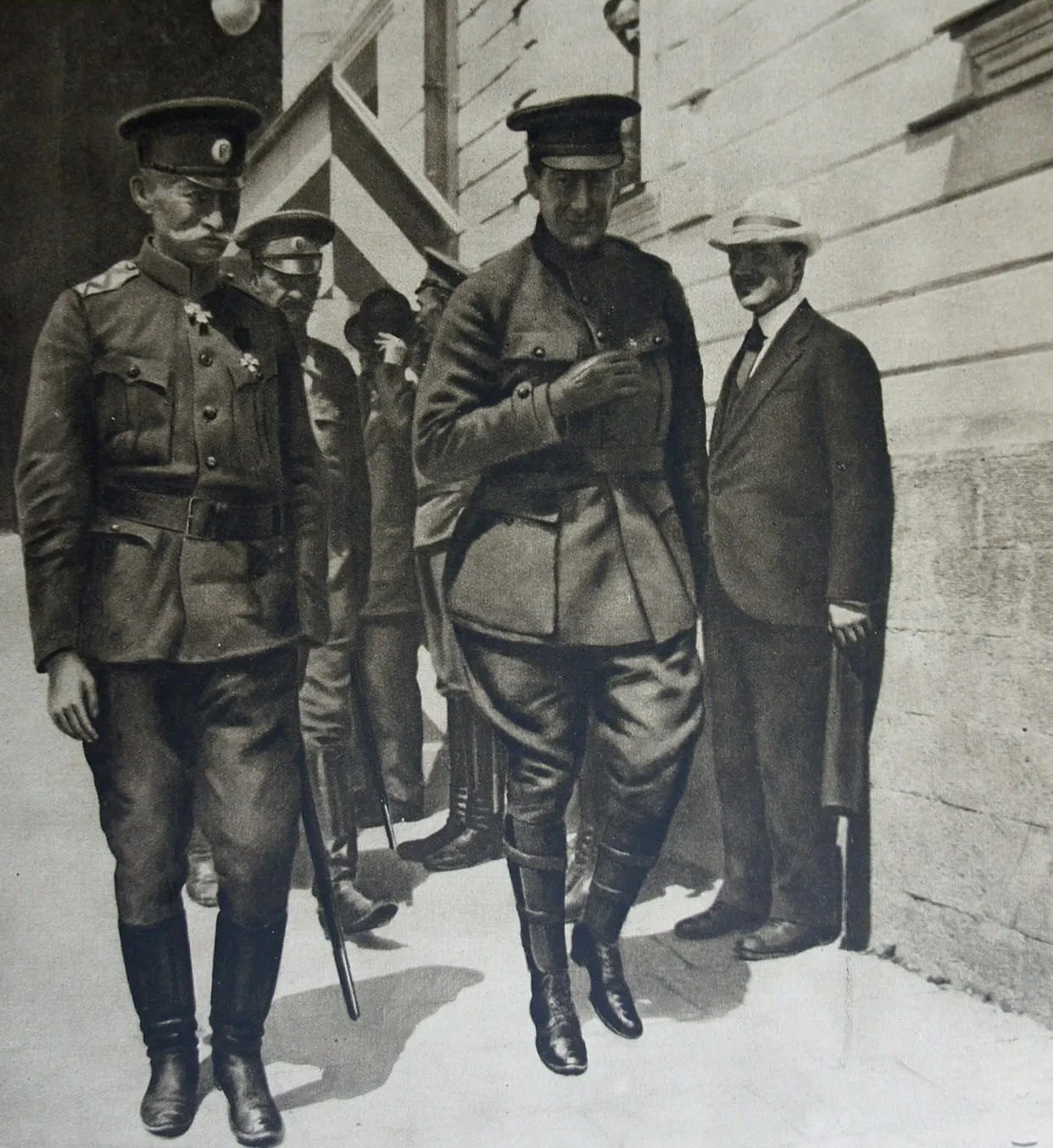
The Kerensky Offensive was the last great offensive of the Russian army in the First World War. The Provisional Government, pressed by the Allies and convinced that victory would strengthen revolutionary Russia and restore discipline in the army, threw the armies of the South-Western Front into the attack. Their objective was Lviv. After two days of artillery fire, on 1 July 1917 the infantry of the 11th and 7th Armies attacked between Zborów and Brzeżany. At Koniuchy and Zborów the Russians, with the Czechoslovak brigade fighting at their side, shattered two Austro-Hungarian divisions, but at Brzeżany the German South Army threw the attack back. From 6 July the 8th Army of General Lavr Kornilov struck south of the Dniester. It broke through the front at Stanisławów, took Halicz and Kałusz, but was halted by German reinforcements on the swollen Łomnica (PL). Russian units more and more often refused to go into the attack. By mid-July the offensive had petered out, and a few days later the Germans and Austrians went over to the counter-attack.
Name and dates
The name comes from the Minister of War and the Navy, Alexander Kerensky, who was the political father of the attack and personally urged the soldiers on. Russian literature speaks of the “June Offensive”, because by the Julian calendar then in force in Russia the attack began on 18 June. In the West it is also called the “July Offensive” or the Galician offensive. The Austrian official history divides it into several battles: the “double battle of Koniuchy–Zborów and Brzeżany” (29 June – 3 July) and the battle of Stanisławów and Kałusz (6–16 July).
The bombardment began on 29 June (16 June Old Style), and the British chronology of the war gives this date as the start of the offensive. The infantry went in on 1 July, and we date the battle from that day. We take 16 July as its end. On the night of 15–16 July the Russians abandoned Kałusz, Kornilov’s last conquest, and according to Russian studies the attack of the whole front had already died out on 14–15 July. The Polish and English Wikipedias give the dates 1–19 July, counting up to the day the German-Austrian counter-attack from Złoczów began. We treat that counter-attack as a separate operation.
Background
After the February Revolution the Russian army still numbered millions of men, but its discipline was rapidly collapsing. Order No. 1, soldiers’ committees, fraternisation at the front and anti-war agitation had undermined the officers’ authority. Even so, the government and the Stavka decided that an offensive was necessary. Russia was bound by its obligations to the Entente, which demanded relief for the Western Front, and Allied credits were saving it from bankruptcy. Kerensky, Minister of War in the coalition government, hoped that a victory of the “revolutionary army” would strengthen Russia’s hand in talks on a peace without annexations or indemnities. Many politicians and generals also believed that an army idle in the trenches would disintegrate faster than one that was fighting.
In May and June Kerensky toured the front and spoke at countless meetings. His fiery speeches carried away crowds of soldiers, though the enthusiasm often vanished when he left. The officers reportedly nicknamed him the “Persuader-in-Chief” (Russian glavnougovarivayushchiy). New “shock battalions”, also called death battalions, built on volunteers from all over the army and beyond, were meant to carry wavering regiments into the attack. On 4 June Kerensky brought about the replacement of Alekseyev by Brusilov. The South-Western Front was taken over by General Aleksei Gutor, the 11th Army by General Ivan Erdeli, the 7th Army by General Leonid Belkovich and the 8th Army by Kornilov. Kerensky’s people sought out commanders willing to work with the committees. In June the First All-Russian Congress of Soviets, meeting in Petrograd, backed the army’s readiness for offensive action in an ambiguous resolution. The Bolsheviks voted against.
Under the plan of Aleksei Brusilov, the main blow was to fall where his great offensive had stalled a year earlier. The 11th Army was to break through on both sides of Zborów and advance through Złoczów on Lviv, the 7th Army to strike at Brzeżany and on towards Bóbrka, and the 8th Army to pin the enemy down south of the Dniester. On a sector some 65 kilometres wide, between the upper Strypa and the Narajówka, Gutor concentrated, according to the Austrian official history, 31 divisions and more than 1,300 guns, 370 of them heavy. The British attaché Alfred Knox gave somewhat lower figures. Support was to come from attacks by the Western, Northern and Romanian Fronts.
The enemy knew well what was coming: deserters, radio intercepts and airmen gave it away. The front from Brody to the Carpathians was held by the army group of General Eduard von Böhm-Ermolli. In the north stood the Austro-Hungarian 2nd Army; in the centre, between Koniuchy and the Dniester, the South Army of General Felix von Bothmer, made up of German, Austro-Hungarian and Turkish (20th Division) troops; and south of the Dniester the Austro-Hungarian 3rd Army of General Karl Tersztyánszky. The Commander-in-Chief in the East, Prince Leopold of Bavaria, and his chief of staff Max Hoffmann had no intention of stopping at defence. The German Supreme Command agreed to transfer six divisions from the west, which were to strike in mid-July from Złoczów towards Tarnopol, into the flank of the advancing Russians.
Course
29–30 June. At dawn on 29 June the artillery of the 11th Army opened fire, and a day later, on the advice of a French adviser, that of the 7th Army. The Austrians and Germans admitted that the Russians now had far more guns and ammunition than in 1916 and fired much more accurately. On the same day Kerensky, who had arrived in Tarnopol, issued an order to the army: “Soldiers! The fatherland is in danger. Freedom is threatened, the revolution is on the brink of collapse. The time has come for the army to do its duty.” He ended with the words: “I order you: forward!” On 30 June, in heat broken by thunderstorms, the Russians tried several reconnaissance attacks at Brzeżany and Koniuchy, which were repulsed.
1 July. At nine in the morning the VI and XLIX Corps of the 11th Army struck at Koniuchy, at the junction of the South Army and the Austro-Hungarian 2nd Army. The Russians broke through the lines of the 54th and 19th Divisions, burst into the village and captured most of the units defending it, including a battalion of the Ukrainian Sich Riflemen. The gunners had to blow up their guns. Only regiments of the German 223rd Division, rushed up in haste, stopped the attack on the second position, at the edge of the woods west of Koniuchy. At Brzeżany, after four hours of drumfire, the 7th Army attacked the heights of Łysonia and Dzikie Łany on the Złota Lipa at ten o’clock. The Russians took several lines of trenches, but in the evening Saxon and Honvéd counter-attacks won back most of their gains. On the left wing of the 7th Army the Russian 52nd Division refused to attack. Attacks on the Turkish 20th Division near Mieczyszczów broke down under the fire of its artillery.
2 July. Erdeli exploited his success at Zborów. The Czechoslovak Rifle Brigade and the 4th Finnish Rifle Division broke the front of the Austro-Hungarian 19th and 32nd Divisions on the heights south-west of the town. The infantry regiments facing the Czechs, No. 35 (from Pilsen) and No. 75 (from Jindřichův Hradec), broke and scattered, and thousands of their soldiers were taken prisoner. By evening the defence lay about five kilometres west of the old line. On 30 June the Austro-Hungarian IX Corps had had more than 16,000 men in the line; now it had 6,700 left. During the night both shattered divisions were replaced by German ones. According to the Austrian official history the 11th Army recorded more than 14,000 prisoners and 31 guns in two days. The 7th Army, exhausted by the previous day’s fighting, did not renew its attack, although Brusilov demanded it.
3–7 July. At Brzeżany the Germans had restored a continuous front almost on the old line by 3 July. Russian losses on the South Army’s sector were estimated at about 40,000 men. The defenders lost about 12,500 men between 29 June and 5 July, including more than 5,000 Germans, about 4,500 Austrians and Hungarians and about 2,500 Turks. On the captured ground some Russian regiments decided they had done their bit and held meetings instead of advancing. The shock units, which had borne the brunt of the first days, had been bled white. On 6 July the 11th Army threw the I Guards Corps into an attack west of Zborów. The attack broke on the fresh German 223rd and 96th Divisions, and disintegration set in among the Guards regiments. The next day the 11th Army went over to the defensive. The drive on Lviv was over.
6–9 July. Meanwhile, south of the Dniester, the 8th Army went into the attack. Its XII Corps, commanded by General Vladimir Cheremisov, struck the Austro-Hungarian 15th Division on the heights west of Stanisławów, which the Russians had held since August 1916. The first attacks on 6 and 7 July were repulsed, but on the morning of 8 July, after an artillery and gas bombardment, three Russian divisions broke through near Jamnica and took the height of Jutrena Góra, which commanded the road and railway to Kałusz. Whole batteries were captured. Of the 7,700 men who had stood in the 15th Division’s trenches on 3 July, only 800 had been gathered by the morning of 9 July, and the division had lost 43 guns. Austrian counter-attacks failed. On the evening of 9 July the Russians broke through again, and during the night the 3rd Army fell back behind the Łomnica. According to Russian figures the 8th Army took more than 7,000 prisoners and 48 guns, and some studies speak of as many as 10,000 prisoners.
10–13 July. On 10 July the Austrians recalled Tersztyánszky and General Karl Křitek took over the 3rd Army. On the same day the Russians occupied Halicz. Urged on by a telegram from Kerensky, Kornilov gave the enemy no respite. On the morning of 11 July the leading regiment of the Russian 164th Division approached Kałusz unnoticed, where the headquarters of the 3rd Army had been until recently, surprised the defenders and took the town. Kornilov’s victories were greeted enthusiastically in the Russian press. The German command had to send several divisions to the 3rd Army, including some of those earmarked for the counter-attack at Złoczów, and for a few days even considered abandoning that plan. In Kałusz the discipline of the Russian soldiers collapsed: according to Russian and Austrian accounts they looted shops and houses, and there was also a pogrom. From 12 July downpours turned the Łomnica into a torrent and destroyed the Russian crossings. On 13 July the Russians broke through the lines of the Croatian 36th Division at Nowica. The Austrian official history regards that day as both the peak and the end of the Russian offensive.
14–16 July. Further Russian attacks grew ever weaker. According to Austrian estimates the 8th Army had lost almost 40,000 men, and reinforcements arriving from other armies often refused to fight. According to some accounts Kornilov ordered machine guns and artillery to fire on soldiers fleeing the battlefield. Brusilov several times called on him to turn the attack north, towards Rohatyn and the rear of the South Army, but Kornilov pressed on westwards. On 15 July the German 16th Reserve Division launched counter-attacks north of Kałusz. The Russians, threatened with being pushed into the swollen river, abandoned the town on the night of 15–16 July. Gutor still tried to regroup his forces for a new blow, but whole divisions refused to take up new positions.
Losses
Figures for the losses vary widely. According to the Stavka, the armies of the South-Western Front lost 58,329 men between 1 and 19 July (18 June – 6 July Old Style), including 6,905 killed, more than 36,000 wounded, more than 5,600 missing and almost 3,900 deserters. The 11th Army lost the most (more than 28,500), followed by the 8th Army (about 14,800) and the 7th Army (almost 14,000). Many historians consider these figures heavily understated, and estimates reach more than 100,000. Russian losses, though numerically smaller than in the bloody campaigns of 1915–1916, were nevertheless catastrophic for the army, because those who fell were above all the volunteers and the most combative soldiers.
By 14 July, according to their own figures, the Russians had taken 834 officers and 35,809 men prisoner, including more than 4,000 Germans, and 121 guns. The Austro-Hungarian army suffered most: its 19th, 32nd and 15th Divisions were shattered, and its units surrendered en masse.
Significance
The first days of the offensive caused euphoria in Russia. On 1 July Kerensky telegraphed the government that it was a “great triumph of the revolution”, and the Prime Minister, Georgy Lvov, replied that the day had shown the whole world the strength of the revolutionary army. The joy was short-lived. The attack proved that the army could still break through a front, but could not exploit its success. The best soldiers fell in the first attacks, and the rest refused to fight on. The supporting attacks on other fronts started late. The attack of the Western Front at Krewo and Smorgon and of the Northern Front at Dvinsk (21–23 July) collapsed after a few days, because most of the units assigned to them would not fight. On the Romanian front Averescu’s army struck at Mărăști only on 22 July, when the German-Austrian counter-attack in Galicia was already under way.
On 19 July the Germans and Austrians struck from Złoczów. The demoralised 11th Army fled, and within a couple of weeks the Russians lost almost all of Eastern Galicia and nearly everything they had taken a year earlier. Even before that, when the attack had stalled, armed demonstrations known as the July Days broke out in Petrograd. The defeat, on the other hand, raised up Kornilov, the only commander who had achieved success. He soon took command of the South-Western Front, and then of the whole army. Few historians today doubt that the failed offensive was one of the nails in the coffin of the Provisional Government.
The offensive went down in history for another reason too. At Zborów, for the first time in this war, a large unit made up of citizens of Austria-Hungary defeated their own state’s army. The success of the Czechoslovak brigade opened the way to the expansion of the Czechoslovak forces in Russia, from which the Czechoslovak Legion grew, and in Vienna it heightened distrust of the Czech regiments. In the reserve of the 7th Army there was also a Polish rifle division, formed from Poles serving in the Russian army, while at Koniuchy the Ukrainian Sich Riflemen fought on the Austro-Hungarian side. In the fields of Eastern Galicia, where Poles, Ukrainians and Jews had lived side by side for centuries, it was not only the fate of empires that was being decided, but also that of the nations which were to win independence after their fall.
Spotted a mistake?Report an error