Germany · The Central Powers
Prince Leopold of Bavaria
Commander of the Ninth Army and of an army group (1915–1916), Commander-in-Chief of German forces in the East (1916–1918), field marshal
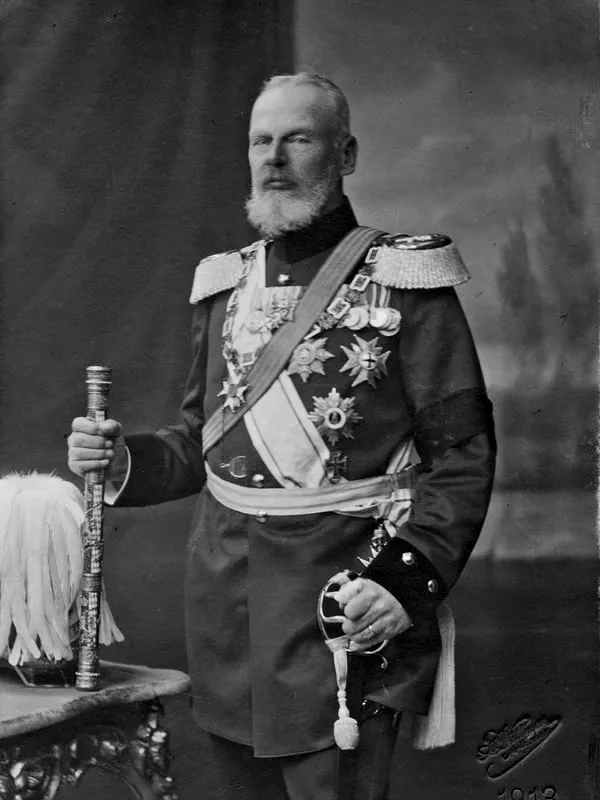
- Born:
- 9 February 1846, Munich (Bavaria)
- Died:
- 28 September 1930, Munich
- Author:
- Natalia
- Photo:
- autor nieznany, domena publiczna, Wikimedia Commons

At the outbreak of the war Prince Leopold of Bavaria was a sixty-eight-year-old field marshal who had been in retirement for a year and a half. In the spring of 1915 he returned to service and until the end of the war commanded on the Eastern Front, first the Ninth Army, which entered Warsaw in August 1915, then an army group, and from 1916, as Hindenburg’s successor, all the German forces in the East. Behind him worked an outstanding chief of staff, General Max Hoffmann, who usually receives the credit for the decisions of this command. The prince was not merely a figurehead, however: he had two wars and half a century of service behind him, he knew how to work with people and how to manage the conflicting interests of the allies. It was at his headquarters in Brest-Litovsk that the armistice and the peace with Soviet Russia were signed.
Before the war
He was born on 9 February 1846 in Munich, the second son of Prince Luitpold, later Prince Regent of Bavaria, and a grandson of King Ludwig I. His elder brother became king in 1913 as Ludwig III, and his nephew was the heir to the throne, Rupprecht, during the war commander of an army group in the West. Leopold joined the Bavarian army at fifteen, in 1861. In the war of 1866 he fought as an artillery officer against Prussia; in the war with France of 1870–1871 he was already on the Prussian side, at Sedan and in the fighting on the Loire. For the battle of Villepion he received the highest Bavarian decoration for bravery, the Military Order of Max Joseph.
In 1873 he married in Vienna Archduchess Gisela, daughter of Emperor Franz Joseph. He was thus the Austrian monarch’s son-in-law, and during the war his daughter Augusta was the wife of Archduke Joseph August, one of the commanders of the Austro-Hungarian army. These family ties later mattered for his role in commanding the troops of both states.
The prince’s career advanced quickly, as befitted a member of the ruling family, but it was not purely titular. He commanded in turn a cavalry brigade, the 1st Division in Munich and the Bavarian I Corps, and from 1892 he was an army inspector, with the Bavarian corps and some Prussian ones under him. Close relations with the Berlin court and regular participation in the imperial manoeuvres made him the Bavarian prince most closely bound to the Reich, although emotionally he remained close to Vienna. In 1905 he received the baton of a Bavarian field marshal. In 1913 he retired from the service to make room for Rupprecht.
1915: Warsaw
The war found him in retirement. In April 1915, when August von Mackensen left for Galicia to prepare the blow at Gorlice, Leopold was recalled to service and given Mackensen’s Ninth Army, which stood west of Warsaw, on the Rawka and the Bzura. He was subordinate to Hindenburg. For the first weeks the front here was static. The Germans, deprived of some of their divisions, tried to break it with chlorine. The largest gas attack on the Eastern Front, on 31 May, poisoned thousands of Russians but produced no breakthrough, and in July the wind blew the gas cloud back onto the German trenches.
In the summer of 1915 the great offensive of the Central Powers struck Congress Poland from the north and from the south, while the Ninth Army was to pin the Russians from the front. When in mid-July the Russians began to fall back, Leopold’s troops followed them, broke through the positions at Błonie and the line of the Warsaw forts, and on 5 August entered Warsaw, abandoned by the Russians. The prince reported this to his brother, King Ludwig III, who awarded him the Grand Cross of the Order of Max Joseph. A few days later he received the Pour le Mérite from Emperor Wilhelm II.
From the Ninth Army and neighbouring troops the Prince Leopold of Bavaria Army Group was formed, which in the second half of 1915 advanced east in the central part of the front until in the autumn the front froze around Baranovichi. The prince set up his headquarters at Slonim, where in February 1916 he celebrated his seventieth birthday.
1916: defence and command in the East
In 1916 Leopold’s army group was the target of Russian offensives. The heaviest came in July, when the Russian Fourth Army struck at Baranovichi on the sector defended by the army of General Remus von Woyrsch. The Russians lost about 80,000 men and did not break through the front. After this defeat the Russian Stavka gave up major offensives north of Polesia.
On 1 August 1916 Leopold became a Prussian field marshal. On 29 August, when Paul von Hindenburg and Erich Ludendorff took over the supreme command, the prince succeeded Hindenburg as Commander-in-Chief in the East, and Max Hoffmann became his chief of staff. This division of roles corresponded to the customs of the German army: the prince represented the command and took the final decisions, while the chief of staff prepared them. Hoffmann valued his superior as a wise soldier who left him a great deal of freedom. In time Leopold’s authority extended from the Baltic to the Carpathians and also covered the Austro-Hungarian, Turkish and Bulgarian troops on this front.
1917: Galicia and Riga
After the February Revolution an uncertain quiet fell on the Eastern Front. In June 1917 the prince addressed the Russian soldiers by radio, offering them the way to an honourable peace without breaking with their allies. The Provisional Government rejected the proposal. At the end of June Leopold received the Emperor’s order: if the Russians attacked the army group of the Austrian General Eduard von Böhm-Ermolli, it was to go over to a counter-offensive. When in July the Kerensky Offensive broke through the Austro-Hungarian front, troops brought from the West struck on 19 July from near Złoczów. In the counter-offensive in Eastern Galicia the Russians lost almost all of eastern Galicia and Bukovina, and at the beginning of August Leopold ordered the advance halted on the Zbruch.
A few weeks later, on his instructions, the Eighth Army of Oskar von Hutier prepared the attack on Riga. On 3 September 1917 the Germans entered the city, and the prince drove through its streets, greeted by the local Germans. In October the army and the navy took the islands of the Gulf of Riga.
Brest and Faustschlag
In November 1917 the Bolsheviks proposed an armistice. Leopold had the authority of the supreme command to negotiate, and the delegations met at his headquarters in the Brest fortress. At the opening of the talks he welcomed the Russians with a short speech and handed over the conduct of the proceedings to Hoffmann. The armistice was signed on 15 December, and a week later the prince opened the peace conference. He also gave dinners for the delegates, at which the diplomats of the Central Powers sat beside the Bolsheviks. The negotiations themselves, however, were conducted by the diplomats and Hoffmann.
The peace with Ukraine was signed on 9 February 1918, the prince’s seventy-second birthday. When after Trotsky’s declaration the Germans resumed hostilities, Leopold issued a proclamation that his troops were coming as liberators, to put an end to the tyranny that had raised its bloody hand against Russians, Poles, Lithuanians, Latvians and Estonians. He formally commanded Operation Faustschlag, in which German troops, almost without fighting, occupied Livonia, Estonia and vast areas of Belarus and Ukraine. On 3 March peace with Soviet Russia was signed at Brest. The next day Leopold received the Grand Cross of the Iron Cross, awarded in this war to only a few commanders.
In 1918 the importance of his command declined. The supreme command created separate commands for occupied Ukraine, and Ober Ost dealt mainly with the Baltic and Belarusian lands. After the armistice in the West the German troops deep in Russia began a difficult return home through lands engulfed in civil war.
After the war
In January 1919 Leopold returned to Munich. In February, when the revolution in Bavaria intensified, he left with his family for Austria, returning to Munich a few months later. He wrote memoirs, published only in 1983, and hunting stories. He died in Munich on 28 September 1930, at the age of 84. He rests in the crypt of St Michael’s Church in Munich.
Assessment
Prince Leopold of Bavaria belongs to that group of wartime commanders in which monarchs and princes held high posts by virtue of birth, while their chiefs of staff prepared the operational decisions. Historians usually attribute the most important ideas of his command, such as the blow from near Złoczów in 1917, to Hoffmann, and Hoffmann himself in his notes treated the prince with respect, but as a superior who left him a free hand.
He should not, however, be reduced to the role of decoration. Unlike some other commanders from ruling houses, Leopold was a professional soldier with many years of experience; he did not interfere harmfully in the work of the staff and lent it an authority that Hoffmann, as a colonel and major general, did not have. His position as Franz Joseph’s son-in-law may also have eased the difficult command of allied troops. He remains a symbol of the German victory in the East, whose fruits, set down in the Treaty of Brest-Litovsk, were lost as early as the autumn of 1918.
Sources
Spotted a mistake?Report an error
Commanded in battles
(06)- 18 December 1914 – 17 July 1915Fighting on the Rawka and BzuraEastern Front
- 2–9 July 1916Battle of BaranovichiEastern Front
- 1–16 July 1917Kerensky OffensiveEastern Front
- 19–28 July 1917Counter-offensive in Eastern GaliciaEastern Front
- 1–5 September 1917Battle of RigaEastern Front
- 18 February – 3 March 1918Operation FaustschlagEastern Front
Often appears with
People who appear in the same events.