Austria-Hungary · The Central Powers
Archduke Joseph August of Austria
Commander of VII Corps (1914–1916), commander of the front in the Eastern Carpathians (1916–1918), of the Sixth Army and of an army group in the Tyrol (1918), the last field marshal of Austria-Hungary
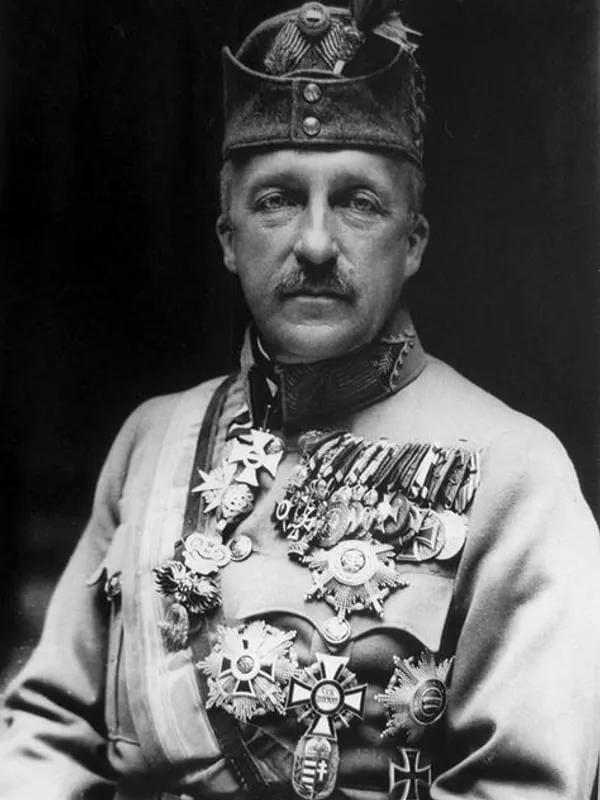
- Born:
- 9 August 1872, Alcsút (Hungary)
- Died:
- 6 July 1962, Rain near Straubing (Germany)
- Author:
- Natalia
- Photo:
- A Magyar Nemzeti Múzeum Történeti Fényképtár tulajdona, domena publiczna, Wikimedia Commons

Archduke Joseph August was the most Hungarian of the Habsburgs who held command during the war. The Hungarians called him simply “Archduke Joseph”. For a year and a half his VII Corps, made up largely of Hungarians, defended the Karst plateau on the Isonzo, scene of some of the bloodiest fighting on the whole Italian front. From December 1916 he commanded the front in the Eastern Carpathians and in Moldavia, and in 1918 an army on the Piave and an army group in the Tyrol. In the last days of the monarchy Emperor Charles made him a field marshal and his plenipotentiary in Hungary, where he had to hand power over to the revolution. A year later he briefly stood at the head of the Hungarian state himself.
Before the war
He was born on 9 August 1872 in Alcsút near Budapest, into the Hungarian line of the Habsburgs. His grandfather, Archduke Joseph, had for half a century been palatine, that is, viceroy of Hungary, and his father, Archduke Joseph Karl, was a general of cavalry and commander-in-chief of the Hungarian home defence force, the Honvéd. His mother, Clotilde, came from the Coburg line of the dukes of Saxony. Joseph August grew up in Hungary, spoke Hungarian as his mother tongue and felt himself above all a Hungarian aristocrat. In 1893 he married the Bavarian princess Augusta, a granddaughter of Emperor Franz Joseph I through his daughter Gisela. They had six children.
He began his military service in 1890 as an infantry lieutenant and later served in the dragoons. In 1902, at his own request and with the emperor’s consent, he transferred to the Honvéd and took command of a hussar regiment, while studying law in Budapest at the same time. In 1908 he became a major-general and commander of a Honvéd infantry brigade, and in 1911 a lieutenant field marshal and commander of the Budapest 31st Infantry Division.
1914–1915: Galicia and the Carpathians
At the start of the war the 31st Division belonged to the Second Army, which according to plan was to support the forces fighting Serbia and, in the event of war with Russia, to go to Galicia. It was first deployed on the Danube opposite the Serbs, and at the end of August was transported east. In September it fought in the final phase of the Battle of Galicia south of Gródek, and then covered the army’s retreat behind the San. On 1 November 1914 Joseph August became a general of cavalry, and in the autumn he took over VII Corps from Temesvár, with the 17th Infantry Division and the 20th Honvéd Division. In the winter the corps fought as part of Eduard von Böhm-Ermolli’s Second Army in the Carpathians, defending the passes into Hungary.
The Isonzo: defending the Karst
After Italy’s declaration of war in May 1915, VII Corps was moved first to the Carinthian border and at the beginning of July to the Isonzo, to Svetozar Boroević’s Fifth Army. From 10 July the archduke commanded the defence of the whole Doberdò plateau, the southern part of the Karst, which barred the Italians’ road to Trieste. On the bare rock it was impossible to dig trenches, so the soldiers sheltered behind low stone walls, which under shellfire burst into deadly splinters. In the Second Battle of the Isonzo in July 1915 the corps held the summit of Monte San Michele and the hill of Sei Busi, but by 26 July it had lost about 25,000 men. In the Third Battle in the autumn it suffered the heaviest losses of the whole army, almost 24,000 men, and the fighting went on in the Fourth Battle.
The archduke was often in the trenches and at observation posts, and was a demanding commander but one close to his soldiers. Hungarian soldiers saw him as “their” Habsburg, and his popularity outlasted the war. On 6 August 1916, however, in the Sixth Battle of the Isonzo, the Italians took all four summits of San Michele within an hour, and the Hungarian battalions of the 20th Honvéd Division only briefly retook the eastern peak. After the fall of Gorizia, VII Corps withdrew unnoticed from the Doberdò plateau behind the Vallone valley on the night of 9–10 August. On the new line it defended itself in September in the Seventh Battle, one day of which, 15 September, the archduke later called one of the hardest of the entire war, and then in the Eighth and Ninth. In the last of these, at the beginning of November, he refused to commit the 17th Division, the last reserve on the Karst, so only eight battalions went into the counter-attack ordered by Boroević. The Italians then advanced a few kilometres but did not break the front. On 1 November 1916 the archduke became a colonel-general, and on 22 November he handed the corps over to his successor. Soldiers of the 43rd Infantry Regiment erected a monument to him on the Karst, next to a rock seat known as Boroević’s throne.
The Carpathians and Moldavia
On 2 December 1916, when Charles I assumed supreme command, Joseph August took over from him the army group on the southern wing of the Eastern Front, henceforth named after him. Its chief of staff for most of 1917 remained the German general Hans von Seeckt. The archduke’s front stretched from Bukovina through the Eastern Carpathians to the border of Moldavia, where it met the army group of Field Marshal August von Mackensen. According to Hungarian studies, at the same time part of the opposition wanted him to assist at Charles’s coronation in Budapest as deputy palatine, but Prime Minister István Tisza claimed that role for himself and the archduke gave way, which permanently soured his relations with Tisza.
In the summer of 1917 the archduke’s front went through its heaviest fighting. On 22 July the Romanian Second Army of General Alexandru Averescu began its offensive at Mărăști. The archduke’s staff underestimated the threat and that day even sent part of its reserves north, and over the next few days the Romanians broke through the front on a width of about 30 kilometres. At the same time, in the north, the Central Powers’ forces went over to the counter-offensive in Eastern Galicia and Bukovina. On 3 August the archduke rode at the head of the 5th Infantry Division into Czernowitz, which the Russians this time lost for good. On 8 August his troops struck in the Oituz valley, and for 19 August he planned, together with Mackensen, a simultaneous assault in that valley and at Mărășești. The Romanians and Russians nevertheless held the front, and the Central Powers failed to break through into the depths of Moldavia. In May 1917 the archduke received the Prussian Pour le Mérite, and in August the Commander’s Cross of the Order of Maria Theresa for the defence of the Karst. On 4 December 1917 the Russian commander of the Romanian Front, General Dmitry Shcherbachev, proposed negotiations to him and Mackensen, which a few days later ended in the Armistice of Focșani.
1918: the Piave, the Tyrol and Budapest
In January 1918 the archduke took over the Sixth Army on the Piave. In the Second Battle of the Piave on 15 June its XXIV Corps crossed the river and took the eastern part of the Montello hill, one of the few successes of the whole offensive. The attack, however, stalled under Allied counter-attacks and the swollen river, and on the night of 22–23 June the troops returned to the left bank. On 15 July, after Conrad’s dismissal, Joseph August took over the army group in the Tyrol, with the Tenth and Eleventh Armies. In the last weeks of the war he had to watch his army fall apart. On 24 October, the first day of the Battle of Vittorio Veneto, the Hungarian battalions of the 27th Division and the 38th Honvéd Division beyond the Asiago plateau refused to fight and demanded to return to Hungary. The archduke tried to persuade them, but the mutineers fired on anyone who approached their camp.
That same day the emperor made him a field marshal. He was the last officer to receive that rank in the Austro-Hungarian army. On 26 October Charles made him his plenipotentiary, “homo regius”, in Hungary, hoping that the popular archduke would calm the Hungarian politicians. Joseph August handed the army group in the Tyrol over to Field Marshal Alexander von Krobatin and went to Budapest. On 29 October, contrary to the expectations of the street, he entrusted the task of forming a government not to the opposition leader Mihály Károlyi but to a conservative, Count János Hadik. The following night the Aster Revolution broke out, Hadik stepped down, and on the morning of 31 October the archduke received Károlyi, who soon afterwards was appointed prime minister by the king over the telephone. In the evening the government took its oath before the archduke, still in the king’s name, but the very next day it was released from that oath and swore again, this time to the Hungarian National Council. According to Hungarian sources the archduke himself also declared his loyalty to the Council. On 16 November Hungary was proclaimed a republic.
After the war
Joseph August remained in Hungary during the Hungarian Soviet Republic as well, and the communists, mindful of his popularity, did him no harm. After its fall, on 6 August 1919, a group of right-wing conspirators, with the Romanian occupation forces standing by passively, overthrew the Social Democratic government in Budapest. The archduke proclaimed himself regent and appointed István Friedrich prime minister. The Entente powers, however, had no intention of recognising a Habsburg at the head of Hungary, and on 23 August he had to step down. He then supported Miklós Horthy, who was elected regent in 1920. In the interwar period he was a member of the upper house of parliament, the first knight of the Order of Vitéz (Vitézi Rend) founded by Horthy, and from 1936 to 1944 president of the Hungarian Academy of Sciences. He also published seven volumes of memoirs, “A világháború, amilyennek én láttam” (“The World War as I Saw It”). According to Hungarian historians, in October 1944 he supported the seizure of power by Ferenc Szálasi’s Arrow Cross, which weighed heavily on later judgements of him. At the end of 1944 he left Hungary, first for the United States and later for West Germany. He died on 6 July 1962 in Rain near Straubing in Bavaria, the last surviving field marshal of the former monarchy. In 1992 his remains were moved to the Palatine Crypt in Buda Castle.
Assessment
In Hungarian memory Joseph August is remembered above all as the defender of Doberdò, a commander who shared the hardships of the front with his soldiers, and whose popularity among Hungarian units was exceptional in an army where many senior commanders knew the front only from maps. The Austrian official history and Hungarian military historians stress his personal courage and commitment. On the Karst, however, he commanded within a defensive plan imposed by Boroević, who ordered every scrap of ground to be held, and the price of those tactics was the enormous losses of his corps. On the Eastern Front operational decisions lay to a large extent with Seeckt and the German command, and on the Piave the fate of the offensive was decided by the plans of the supreme command. As a politician in October 1918 the archduke tried to save the monarchy in Hungary, but he had neither the strength nor the support to do so. His later career, from the brief regency of 1919 to his stance in 1944, means that in Hungarian historiography he is judged far more critically as a politician than as a soldier.
Sources
Spotted a mistake?Report an error
Commanded in battles
(10)- 23 June 1915 – 9 November 1917Battles of the IsonzoItalian Front
- 18 July – 3 August 1915Second Battle of the IsonzoItalian Front
- 18 October – 4 November 1915Third Battle of the IsonzoItalian Front
- 10 November – 2 December 1915Fourth Battle of the IsonzoItalian Front
- 6–17 August 1916Sixth Battle of the IsonzoItalian Front
- 14–18 September 1916Seventh Battle of the IsonzoItalian Front
- 9–12 October 1916Eighth Battle of the IsonzoItalian Front
- 31 October – 4 November 1916Ninth Battle of the IsonzoItalian Front
- 22 July – 1 August 1917Battle of MărăștiBalkan Front
- 15–24 June 1918Second Battle of the PiaveItalian Front
Mentioned in battles
(03)Often appears with
People who appear in the same events.