1915: The Italian front and the Battles of the Isonzo
Fourth Battle of the Isonzo
- Dates:
- 10 November – 2 December 1915
- Front:
- Italian Front
- Location:
- The Plava bridgehead, the Gorizia bridgehead (Sabotino, Oslavia, Podgora) and the northern part of the Karst plateau (Monte San Michele, San Martino del Carso, Sei Busi hill), towards the end also the Tolmin bridgehead and the Mrzli vrh ridge, Austria-Hungary (now Italy and Slovenia)On the battle map →
- Sides:
- ItalyLuigi Cadorna, Prince Emanuele Filiberto, Duke of Aosta, Pietro Frugoni, Luigi CapelloAustria-HungarySvetozar Boroević, Archduke Eugen of Austria, Archduke Joseph August of Austria, Erwin Zeidler
- Result:
- Austro-Hungarian defensive victory. The Italians took part of the ridge by the church at Oslavia and stretches of trench on Podgora, at San Martino and on Monte San Michele, but not Gorizia.
- Author:
- Natalia
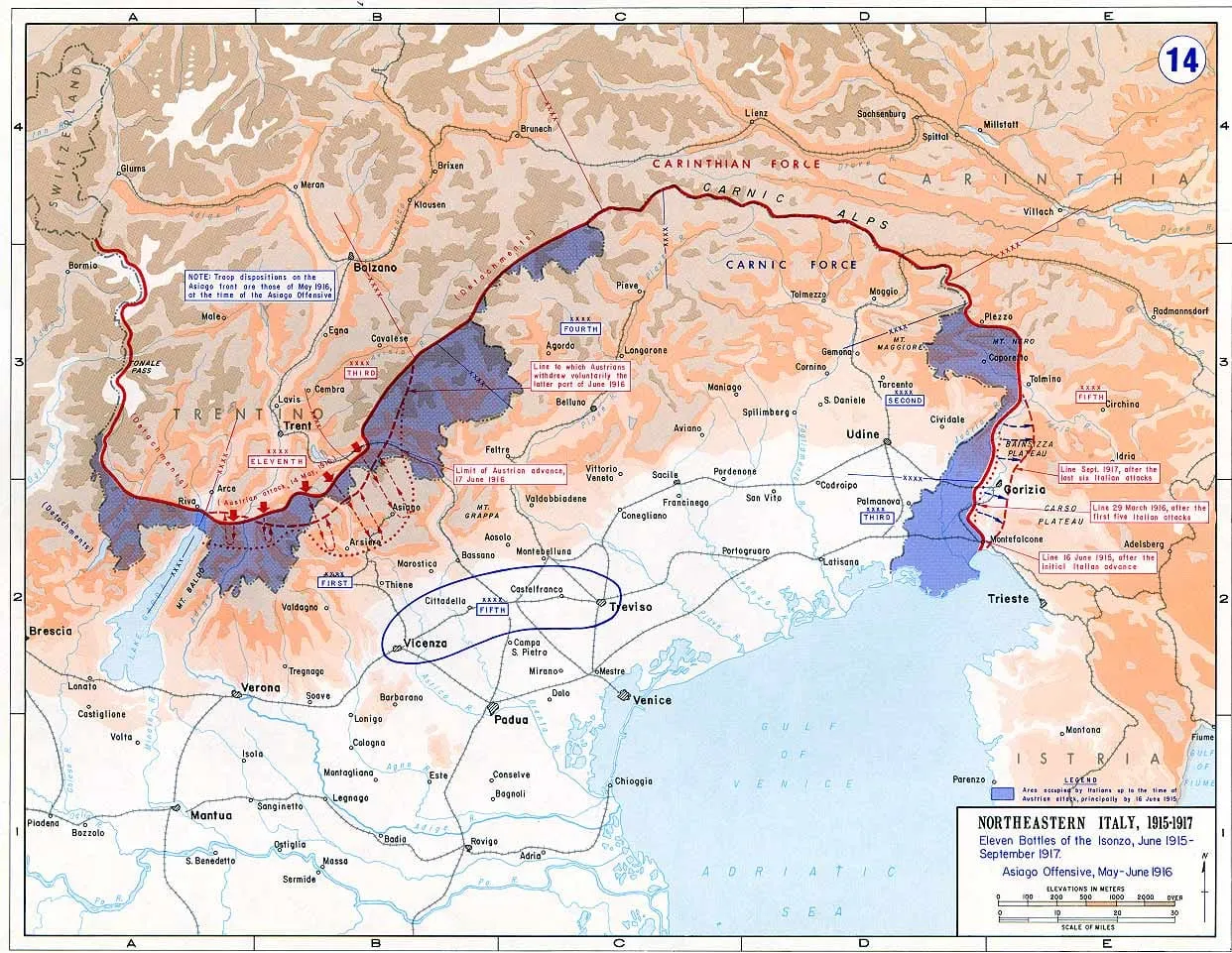
The Fourth Battle of the Isonzo was the second part of the Italian autumn offensive on the Isonzo. Only five days after the end of the third battle, General Luigi Cadorna again threw the 2nd and 3rd Armies against the Austro-Hungarian 5th Army of General Svetozar Boroević. This time he attacked on a narrower front, from the bridgehead at Plava to Sei Busi hill on the Karst plateau, and his objectives were the Gorizia bridgehead and Monte San Michele. After the first week the battle broke up into a series of bloody, separate attacks on narrow sectors of the front. In mid-November the Italian artillery began systematically to destroy Gorizia itself. By early December the Italians had lost almost 49,000 men, but had taken only isolated stretches of trench and part of the ridge at Oslavia. Gorizia and Monte San Michele remained in Austrian hands.
Name and dates
In Italian the battle is called the quarta battaglia dell’Isonzo, in German the Vierte Isonzoschlacht, and in Slovene the četrta soška bitka. Its beginning is not in doubt. On 10 November 1915, after a bombardment of several hours, the Italian infantry went into the attack along the whole front from Plava to the Karst. Some works date the battle from 9 November, when in the afternoon the Italians made the first local attacks at Plava and on Podgora and the artillery began a heavy bombardment of the northern Karst.
The end is harder to fix, because the offensive did not break off on a single day but gradually died away. 2 December is the date most often given, and that is what we adopt on this page. The Austro-Hungarian official history regards 1 December, when the last great attacks collapsed, as the last day of the battle, but its chapter on the battle covers the period up to 14 December, because isolated attacks, among them those on Monte San Michele from 7 to 9 December, went on for another two weeks. The dates 5 and 15 December are also found. Both sides agreed in seeing the third and fourth battles as a single two-month offensive. The Austrians called this second part of it the “parliamentary battle”, because they believed that Cadorna was fighting it above all with an eye to the opening of the Italian parliament on 1 December.
Background
The Third Battle of the Isonzo had cost the Italians about 67,000 men and had not given them Gorizia. On the evening of 4 November Cadorna halted the attacks, but at once ordered their renewal to be prepared and the defenders to be kept under fire the whole time. At home the mood was growing worse. The spring promise of a rapid march on Trieste and Trento had not been fulfilled, and the supreme command’s communiqués kept naming the same small places on the Isonzo. The government of Antonio Salandra and the general staff feared sharp criticism once parliament met. The Allies, for their part, demanded that the Italians help Serbia, either by pressing on along the Isonzo or by sending troops to the Balkans. The foreign minister, Sidney Sonnino, was thinking above all of Albania and the eastern coast of the Adriatic, while Cadorna did not want to weaken the front. He decided that before winter he would try once more to take Gorizia, and if that did not succeed by the end of November, he would at least show that the army was still fighting.
From 5 to 9 November the most depleted Italian divisions, especially those of the 3rd Army, were replaced by fresh ones. According to the Austrian official history about 28 divisions in all were prepared for the battle. Popular tables give 370 battalions and 1,374 Italian guns against 155 battalions and 626 Austro-Hungarian guns. The plan was more modest than in October. On the snow-covered peaks above the upper Isonzo and at Monfalcone there were to be only holding attacks. The 2nd Army of General Pietro Frugoni was to take the Gorizia bridgehead. The main blow of General Luigi Capello’s VI Corps was aimed at the ridge at Oslavia, between Hill 188 and the church. The Italians were to move against Podgora only after the first successes, and this time they did not intend to attack the formidable Mount Sabotino seriously at all. The 3rd Army of the Duke of Aosta was to take Monte San Michele, attacking it from the north-west and from the direction of San Martino del Carso.
Boroević could not count on reinforcements, because the supreme command in Teschen had committed all its forces against Serbia and Russia. In the pause between the battles he therefore brought his depleted regiments back up to strength, sent the most exhausted units to rest for a few days and gathered about 22 battalions in reserve, including the 20th Honvéd Division. On Monte San Michele the 20th Honvéd Division was relieved by the Alpine 6th Infantry Division, while the Gorizia bridgehead was still held by General Erwin Zeidler with the 58th Division, in which Dalmatian Landwehr riflemen, among others, were fighting.
Course
The first blow (10–15 November)
On 10 November a downpour and a storm delayed the start of the battle. Before noon the Italian artillery opened fire on the whole bridgehead, and at about noon it went over to an hour of drumfire. The Austrian official history notes that it was then, on the Isonzo, that the “Trommelfeuer” typical of this war was born: a short, concentrated bombardment immediately before the assault, instead of days of fire along the whole front. On Sabotino the Italian 4th Division reached the wire, but flanking fire drove it back to its starting trenches. The attack on Oslavia stopped in front of the obstacles, and on Podgora the fighting went on in the dark until midnight. On the Karst the infantry of XI and XIII Corps moved off at about 11 a.m. against Monte San Michele, San Martino and Sei Busi hill. The Hungarian 39th Infantry Regiment threw the Italians out of two breaches with a counter-attack, and at 5 p.m. a storm put an end to the fighting. At Plava the Italian 3rd Division broke into Zagora after seven assaults, but on the morning of 11 November a counter-attack restored the old line.
On 11 November the Italians repeated the attack along the whole front, again without success. After that they no longer attacked everywhere at once. At Plava the fighting died down on 12 November. At Gorizia on 12 November several brigades broke onto the ridge beside the church at Oslavia, but on 13 November riflemen of the 37th Landwehr Infantry Regiment and a Hungarian battalion of the 69th Regiment retook it, capturing more than 500 men. After a report from Capello describing the terrible state of his soldiers, Cadorna ordered the attacks on the bridgehead to be broken off. The grenadiers reported that of 6,000 men they had 3,200 left.
On the Karst from 12 to 15 November the Italians tried to envelop Monte San Michele from two sides: from the north, from Peteano, and from the south, from San Martino. Several times they broke into the Austrian lines, and night counter-attacks by riflemen and Bosnian infantry took their gains away again. On 13 and 14 November the Sardinian Sassari Brigade took fortified trenches at San Martino that the Italians called the “Frasche” and the “Razzi”. The Italian communiqué of 15 November reported that it had taken 278 prisoners, including 11 officers. The Austrians, who were unable to recover the lost stretch below Hill 111, built a new line 200 paces behind it. By 15 November, when the fighting on the Karst died down, the defenders had held almost all their positions, but their strength was melting away. From 18 October to mid-November the 5th Army had lost about 60,000 men. The supreme command in Teschen then decided to send the 9th Infantry Division from the Eastern Front to the Isonzo, followed by another brigade from Bukovina.
The destruction of Gorizia
After two days of snowstorms Cadorna ordered the attacks to be resumed on 17 November along the whole front from Sabotino to the sea. He left the choice of objectives to the army commanders and reserved only one thing for himself: the bombardment of Gorizia. At five in the morning on 18 November all the medium and heavy batteries of both armies that could reach the town opened fire on it. According to the Austrian official history about 3,000 shells, mostly heavy, fell on Gorizia by noon, and at midday aircraft bombed it for two hours. The Italians justified the bombardment by saying that Austrian staffs and troops were quartered in the town and that the population had almost entirely left it. According to the Austrians, however, about 2,500 people were still living there out of 30,000 before the war. Hospitals marked with the red cross and the lunatic asylum were hit. The bombardment was repeated on the following days, and was heaviest on 2 December. According to the Austrians it completely destroyed about a quarter of the roughly 2,000 houses of the town and its suburbs and damaged hundreds of others, but had no effect on the defence.
The attacks on Oslavia and Monte San Michele (18–29 November)
At Gorizia Frugoni concentrated three divisions on a sector less than two and a half kilometres wide in front of Oslavia. On 20 November at least twelve regiments went into the assault. The Italians took Hill 188 and part of the trenches by the church, but on 21 November a counter-attack by Dalmatian riflemen retook most of them together with several hundred prisoners. Further attacks on Podgora on 21, 22 and 26 November broke down under the defenders’ fire. At the southern end of Podgora the Austrians had already pulled back about 200 metres on the night of 14–15 November, from the exposed slope of Hill 184 to a line prepared in advance on the crest. Italian sources accordingly speak of the capture of Calvario hill.
The heaviest fighting at Gorizia came on 27–29 November. On the narrow sector from Sabotino to the railway the Italians concentrated five divisions. On 27 November they attacked six or seven times along the road to Oslavia, and when the last attack collapsed the defenders retook the rest of the trenches lost on 20 November. On Podgora the Dalmatians, who had run out of hand grenades, beat off the Italians even with stones. On 29 November fresh regiments at last took the ridge on both sides of the church at Oslavia. There the Austrian line fell back about 700 paces, but elsewhere the defenders did not give up a single metre. On 30 November, as the weather broke, the Italians halted the attacks on the bridgehead.
On the Karst from 18 November XI and XIII Corps again tried to encircle Monte San Michele from the north and the south. The Austrian official history describes the same method day after day. The Italian artillery and trench mortars concentrated their fire on a narrow sector until the trenches and their garrison ceased to exist, after which the infantry occupied the rubble and held it until the first counter-attack. On 21 November the Italians bit into the line west of the church at San Martino, and on 22 November they pushed the right wing of the 17th Division back to the western edge of the village. In the end Boroević had to throw his last reserve division, the 20th Honvéd Division, onto Monte San Michele. After a brief lull in the fighting on 26 November, 28 and 29 November were the last two great days of fighting on the Karst. On the evening of 28 November the Hungarian 39th Regiment and Landsturm from the Egerland smashed an attack by several regiments, and on 29 November the Honvéd held Monte San Michele and lost only one stretch of trench at San Martino.
Tolmin and the end of the battle (26 November – 2 December)
On the snowbound northern wing there was a lull throughout November. Only after a sharp order from Cadorna, who had noticed that the Austrians were moving battalions from Tolmin to Gorizia, did IV and VIII Corps advance on 26 November against the Mrzli vrh and Vodil vrh ridge and the Tolmin bridgehead. For six days Alpini, Bersaglieri and infantry assaulted the snow-covered slopes and the hill of Sv. Maria. The defenders repulsed them everywhere, and on 1 December a snowstorm broke off the last attack. On the same day the last attacks on Monte San Michele collapsed, and on 2 December the Italians fired more shells at Gorizia than on any day since the bombardment began. After that they made only isolated attacks. The last, on Monte San Michele, lasted from 7 to 9 December. By mid-December silence had fallen on the Isonzo.
Losses
According to the Italian official history, which the Austrian one cites, the Italians lost 48,967 men in the fourth battle: 7,498 killed, 33,956 wounded and 7,513 missing. The whole autumn offensive, from 18 October, cost them about 116,000 men. The Austro-Hungarian 5th Army lost 25,391 men from 10 November to 1 December: 3,895 killed, 16,444 wounded and 5,052 missing, plus 8,256 sick. In the cold and rain the number of sick rose quickly on both sides. From 18 October to 1 December the 5th Army lost 71,691 men in combat, and Austrian units took about 200 officers and 8,600 Italian soldiers prisoner. Popular tables give rounded figures: about 49,500 Italian casualties (7,500 killed) and 32,000 Austro-Hungarian (4,000 killed).
Significance
The Fourth Battle of the Isonzo ended the first year of fighting on the Italian Front in the same way as the three before it. According to the Austrian official history the Italians took the ridge by the church at Oslavia, isolated stretches of trench on Podgora and on the northern slope of Monte San Michele, and on the Karst pushed the defenders back to the western edge of San Martino. Nowhere did they advance more than a kilometre. Italian sources count the capture of Calvario hill and of Oslavia as tactical successes, but Gorizia, Sabotino and Monte San Michele remained in Austrian hands. The ruin of Gorizia changed none of this.
Austrian historians blamed Cadorna for tying himself to methodical plans, for failing to use the advantage of nearly ten idle divisions on the wings, and finally for handing the conduct of the battle over to the army commanders, who broke it up into separate, costly attacks. The defenders, for their part, experienced in full for the first time what they themselves called the “battle of matériel”. On Podgora, by their own count, they repulsed about forty assaults in the eight weeks of the two battles, and at Oslavia about thirty. Nor did the offensive help Serbia, whose army at the end of November was already retreating through the mountains of Albania. After the battle Cadorna is said to have remarked that this war could end only in the exhaustion of men and means, and that Austria was closer to it than Italy. The next, Fifth Battle of the Isonzo began in March 1916.
Spotted a mistake?Report an error