Italy · The Entente
Antonio Salandra
Prime Minister of Italy (1914–1916)
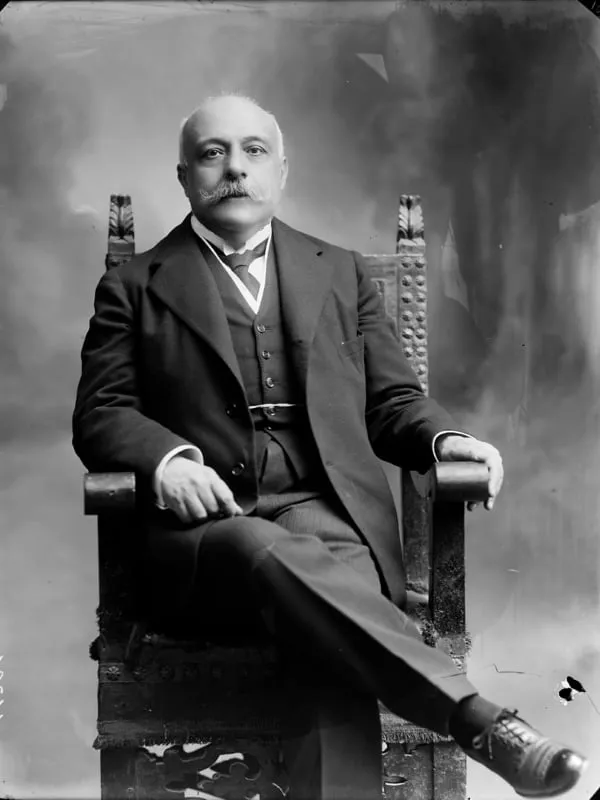
- Born:
- 13 August 1853, Troia (Apulia, Italy)
- Died:
- 9 December 1931, Rome
- Author:
- Łukasz Skowroń
- Photo:
- Mario Nunes Vais, domena publiczna, Wikimedia Commons

Antonio Salandra was Prime Minister of Italy for two years and three months, from March 1914 to June 1916, but those two years decided the fate of the country. In August 1914 he declared the neutrality of Italy, which was bound to Germany and Austria-Hungary by the Triple Alliance. In the autumn he announced that Italy would be guided by “sacred egoism”, and together with the Foreign Minister Sidney Sonnino he bargained with both sides over the price of Italian participation in the war. In April 1915 he concluded a secret agreement with the Entente, and in May, against the majority of parliament and with the support of the King and the street, he took Italy into the war against Austria-Hungary. He was counting on a short campaign. When the war proved long, bloody and unsuccessful, and the Austrian offensive in the Trentino threatened Venice, parliament brought him down.
Before the war
He was born on 13 August 1853 in Troia in Apulia, into a wealthy family of landowners and lawyers. He studied law in Naples, where he also attended the lectures of the literary critic Francesco De Sanctis, his mentor. He became professor of administrative law and the science of administration at the University of Rome, and the author of works on public finance and administrative law. From 1886 he was a deputy for a constituency in Apulia, associated with the liberal right and with the circle of Sidney Sonnino. He was under-secretary in the ministries of finance and the treasury, Minister of Agriculture in the government of General Luigi Pelloux in 1899–1900, and in both of Sonnino’s short cabinets, in 1906 and in 1909–1910, Minister of Finance and of the Treasury. He was regarded as a conservative, a defender of the state, the monarchy and landed property, distrustful of the socialists and of mass democracy.
For years he was in opposition to Giovanni Giolitti, who dominated Italian politics. Paradoxically, it was Giolitti who, on stepping down in March 1914, recommended him to King Victor Emmanuel III as his successor, expecting to return to power after a few months. Salandra’s government, sworn in on 21 March 1914, was the most conservative cabinet in years. Antonino di San Giuliano remained Foreign Minister. In June the government suppressed the revolt known as “Red Week”, a wave of strikes and riots in the Romagna and the Marche.
Neutrality and “sacred egoism”
After the outbreak of war Salandra and San Giuliano concluded that the Triple Alliance, a defensive alliance, did not oblige Italy to take part in a war begun by Austria-Hungary without consulting Rome. On 3 August 1914 the government declared neutrality. Salandra took this decision without asking Giolitti or Sonnino, although the former supported it and the latter was irritated. For him neutrality was not a goal but a breathing space. The army was unprepared, and the Prime Minister soon became convinced that Italy could gain a great deal if at the right moment it chose the right side.
On 16 October San Giuliano died. Salandra took over his ministry temporarily and on 18 October told officials that Italy must be guided solely by “sacred egoism” (sacro egoismo). These words became the watchword of Italian policy throughout the period of neutrality, and his opponents took them as proof of cynicism. At the end of the month the Prime Minister reshuffled the government. He got rid of the Treasury minister, who opposed military spending, obtained extraordinary credits for the army and entrusted the Foreign Ministry to Sonnino. According to Italian biographers, it was in October that Salandra decided to postpone any entry into the war until the spring of 1915, so that the army of General Luigi Cadorna would have time to arm.
Through the winter Salandra and Sonnino conducted parallel negotiations with Vienna and with the Entente. Austria-Hungary, pressed by Germany, agreed to ever greater concessions, but not enough to satisfy Rome, and wanted to hand them over only after the war. The Entente promised more, because it was promising other people’s lands. In March 1915 news of Russian victories in the Carpathians and the fear that Italy would come for its share too late made Salandra hurry. On 26 April the ambassador in London signed the Treaty of London, which committed Italy to enter the war within a month. Only the Prime Minister, Sonnino, the King and a few diplomats knew of it. Giolitti did not know, parliament did not know, and neither did the Chief of Staff, whom nobody asked for his opinion.
“Radiant May”
At the beginning of May Italy renounced its alliance with Austria-Hungary. On 9 May Giolitti came to Rome, convinced that the war would be long and the army unready for it, and that “a good deal” could be obtained from Austria through negotiation. About three hundred deputies left their visiting cards at his residence as a sign of support. Salandra understood that parliament could bring him down, and on 13 May tendered the resignation of the government. Some historians believe that this was also a clever move: responsibility for breaking commitments signed by the King now fell on Giolitti. The streets of the great cities were taken over by supporters of the war, among them the poet Gabriele D’Annunzio and Benito Mussolini. Giolitti refused to take power, as did the other candidates, and on 16 May the King rejected Salandra’s resignation. On 20 May the Chamber of Deputies, until then mostly neutralist, granted the government full powers for the duration of the war, and on 23 May Italy declared war on Austria-Hungary.
For Italian opponents of the war, “Radiant May” was an assault on parliament, in which the monarch, two ministers and a nationalist crowd imposed on the country a war that the majority of its representatives did not want. For the interventionists it was a national awakening and the completion of the work of unification. Salandra later wrote that he had acted in accordance with the will of the nation, not of party cliques.
War Prime Minister
Salandra expected the war to end by the autumn of 1915 at the latest, with Italy arriving when everything was ready, once Austria-Hungary had already been broken by the Russians. Instead, in May the attack at Gorlice began, the Russians retreated from Galicia, and Cadorna’s offensives on the Isonzo brought small gains at the cost of tens of thousands of killed and wounded. The government had no influence on the conduct of the war. Cadorna presented his plans to the King, not to the cabinet, and the Prime Minister himself did not even inform the War Minister of his contacts with the high command. Italy declared war on Turkey in August and on Bulgaria in October 1915, but not on Germany, which aroused the distrust of the allies. In March 1916 Salandra went to Paris for the inter-Allied conference.
At home his position weakened. He refused to broaden the government to include the Radicals and to form a cabinet of national unity, and he was accused of incompetence both by the neutralists and by supporters of a more vigorous conduct of the war. In May 1916 the Austro-Hungarian offensive in the Trentino threatened to descend from the mountains onto the Venetian plain. Salandra went to headquarters intending to dismiss Cadorna, but the King did not support him. On 10 June, in a speech in the Chamber, he implied that a better-prepared defence would have stopped the enemy sooner. The deputies took this as shifting the blame onto the army while it was fighting. The Chamber refused him its confidence by 197 votes to 158, and he was succeeded by Paolo Boselli, whom he had recommended.
After the war
Salandra never again headed a government, although several times he came close. In 1919 he joined the Italian delegation to the peace conference in Paris, but after April he withdrew from it. Like many Italian liberals, he saw in the Fascists a force capable of taming the socialists. In October 1922, during the March on Rome, the King entrusted him with forming a government with Fascist participation, but Mussolini would not accept the role of a subordinate minister and Salandra gave up. He then supported Mussolini’s government, in 1923 represented Italy at the League of Nations, and in 1924 entered the Chamber on the government list. After the murder of the socialist deputy Giacomo Matteotti, in January 1925, he withdrew his support for the Fascists and stepped back from politics. In 1928 he became a senator. In his last years he wrote two books of memoirs, “La neutralità italiana” (1928) and “L’intervento” (1930), in which he defended his policy of 1914–1915. He died in Rome on 9 December 1931.
Assessment
Salandra is regarded as the man who, more than anyone else apart from the King, was responsible for Italy’s entry into the war. His supporters stress that neutrality gave the army time to arm, and that the agreement with the Entente secured for the country the Trentino, Trieste and the Brenner frontier, which Austria would never have given up. His critics, from Giolitti to many modern historians, reproach him for deciding on war in secret and against parliament, for misjudging its length and costs, for failing to prepare the country for it politically, and for handing the conduct of the war to Cadorna, leaving the government no control over the army. Historians also point out that the way in which, in May 1915, the pressure of the street and the court overrode the will of the Chamber weakened Italian parliamentarism and foreshadowed the crisis that seven years later opened the way to power for the Fascists, which Salandra himself at first applauded.
Sources
Spotted a mistake?Report an error
Mentioned in battles
(02)Often appears with
People who appear in the same events.