1915: Gorlice and the Russian retreat from Galicia
Battle of Gorlice
- Dates:
- 1–5 May 1915
- Front:
- Eastern Front
- Location:
- The foothills of Western Galicia between the Vistula and the Low Beskids, from the Dunajec and the Biała near Tarnów through Ciężkowice and Gorlice to Magura Małastowska, and further east to Biecz, Jasło and the Wisłoka (today Lesser Poland and Subcarpathia)On the battle map →
- Sides:
- German EmpireErich von Falkenhayn, August von Mackensen, Hans von Seeckt, Hermann von FrançoisAustria-HungaryFranz Conrad von Hötzendorf, Archduke Joseph Ferdinand, Svetozar BoroevićRussian EmpireNikolai Ivanov, Radko Dimitriev
- Result:
- Victory for Germany and Austria-Hungary. The front of the Russian Third Army was broken, and the Russians had to fall back from Western Galicia and the Carpathians.
- Author:
- Łukasz Skowroń
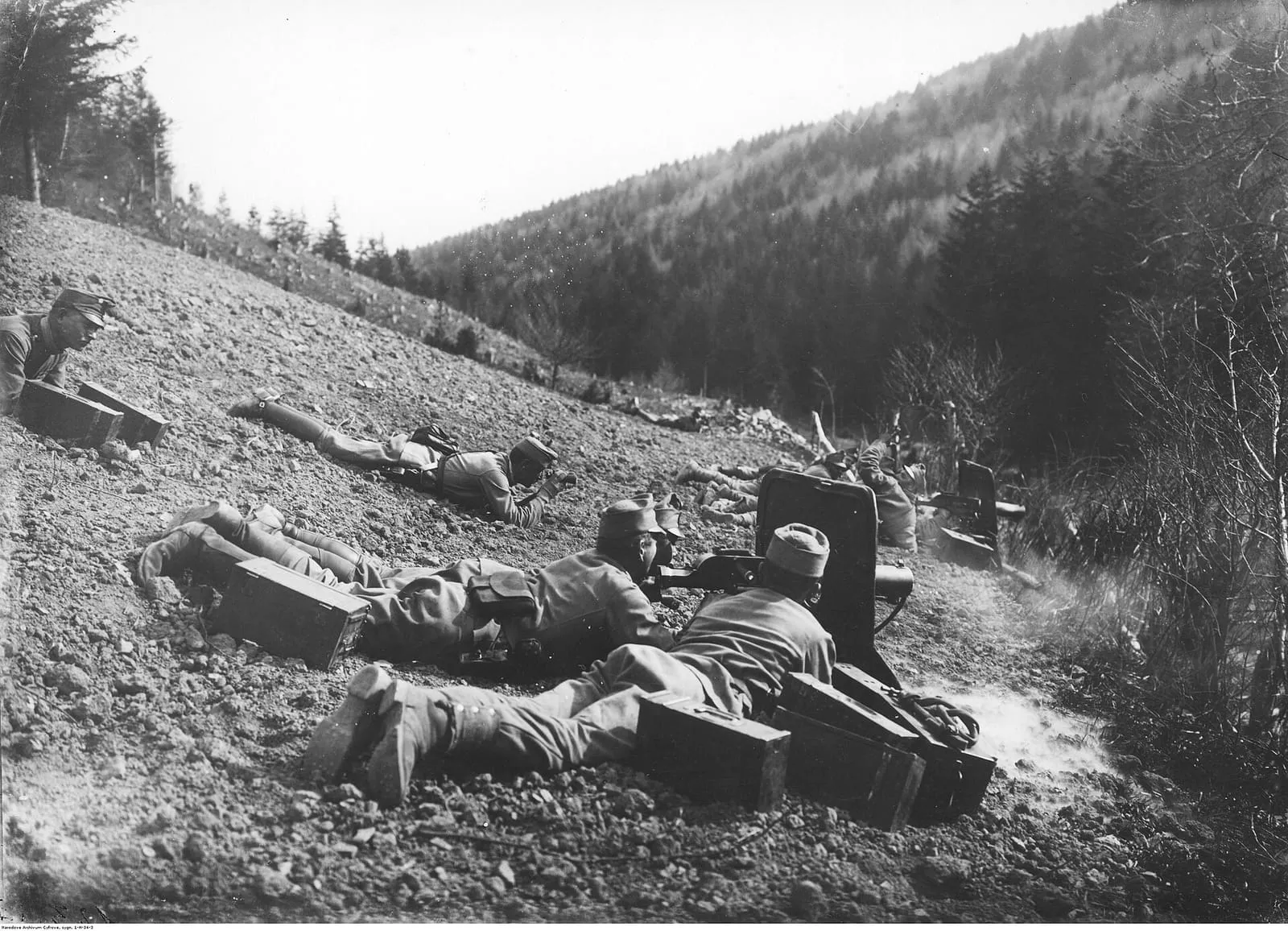
The Battle of Gorlice was the greatest victory of the Central Powers on the Eastern Front in 1915 and one of the few cases in the whole war in which an attack broke through a stabilised front of trenches and grew into an operation reaching hundreds of kilometres. On 2 May 1915, after several hours of bombardment by more than a thousand guns and mortars, the new German Eleventh Army of General August von Mackensen, supported by Austro-Hungarian armies, struck the positions of the Russian Third Army between Ciężkowice and Gorlice. Within four days the Russian defence collapsed throughout its depth, and on the evening of 5 May the commander of the Third Army ordered a retreat. The fighting took place on land that today lies in Lesser Poland and Subcarpathia, and there were Poles on both sides of the front.
Name and dates
On this page we use the dates 1–5 May 1915. This is how the battle is dated by the British chronology of the war on which our timeline is based, which calls it the Battle of Gorlice-Tarnow. On 1 May the artillery of the Central Powers began ranging on the Russian positions and firing harassing fire, and Russian accounts even speak of an artillery preparation lasting more than ten hours that began on the evening of that day. The actual hurricane bombardment of several hours and the infantry assault, however, came on the morning of 2 May, and it is this date that most historians regard as the start of the battle. The end date is set by the order of General Radko Dimitriev, who late on the evening of 5 May ordered the whole Third Army to fall back behind the Wisłoka. Similarly, the Austrian historian Ernst Joly, writing in 1922 for the Encyclopaedia Britannica, spoke of a “five-day battle of the breakthrough” of 2–5 May.
Different frameworks are found in the literature. Polish Wikipedia speaks of fighting on 2–12 May, English Wikipedia dates the battle of the Dunajec, as Russian accounts call it, to 1–10 May, and the names “Gorlice operation” or “Gorlice breakthrough” are often used for the whole offensive, which lasted until the capture of Lviv in June 1915, and according to some historians until July. The further fighting, the pursuit of the Russians to the San, is described separately.
Background
In the winter of 1914 and 1915 the Austro-Hungarian army bled itself white in the Carpathians, where it tried in vain to relieve Przemyśl, and in March the fortress capitulated. The Russians stood on the mountain ridges and threatened to descend into the Hungarian Plain. In spring these worries were joined by Italy, which on 26 April secretly bound itself to the Entente, and by a wavering Romania. The Chief of the General Staff of the Austro-Hungarian army, Franz Conrad von Hötzendorf, had long proposed a blow against the Russian flank between the Vistula and the Carpathians, where since December 1914, since the Battle of Limanowa, the front had stood on the line of the Dunajec, the Biała and the hills near Gorlice. The Russians had moved some of their forces from here into the Carpathians, and the terrain of the foothills favoured an attack: the flanks were protected by the Vistula and the Beskids, and the railways made it possible to concentrate troops.
The Chief of the German General Staff, Erich von Falkenhayn, had long preferred to seek a decision in the west, but in April he concluded that the ally had to be helped before it collapsed. On 13 April he proposed to Conrad an attack by at least eight German divisions from the line Gorlice–Gromnik towards Sanok, and the next day the two chiefs of staff agreed the details in Berlin. The Germans set one condition: the whole attack was to be commanded by a German general. At the turn of April and May the German Supreme Army Command moved to Pless, close to the Austro-Hungarian headquarters in Teschen. To distract the Russians, at the end of April the Germans attacked in Lithuania and Courland, where they took Shavli.
Plan and forces
The divisions brought from the Western Front were formed into a new Eleventh Army. It was commanded by Mackensen, who in the autumn of 1914 had fought near Warsaw and then, at the head of the Ninth Army, at Łódź, and his chief of staff was Colonel Hans von Seeckt. From the north the line consisted of the Prussian Guards Corps, the Austro-Hungarian VI Corps of General Arthur Arz von Straussenburg, the XLI Reserve Corps of General Hermann von François and the composite corps of General Paul von Kneussl with the 11th Bavarian Infantry Division and the 119th Infantry Division. The X Corps of General Otto von Emmich waited in reserve. Mackensen was also given command of the Austro-Hungarian Fourth Army of Archduke Joseph Ferdinand, which stood north of the Eleventh Army, on the Dunajec and the Biała near Tarnów, while Mackensen himself was formally subordinate to the Austro-Hungarian high command. From the south the attack was to be supported by the X Corps of the Austro-Hungarian Third Army of General Svetozar Boroević, attacking from the slopes of Magura Małastowska (PL).
According to the most frequently cited estimates, Mackensen’s two armies numbered about 216,000–218,000 men and more than a thousand guns and mortars, including heavy howitzers and siege mortars of a kind not yet used on such a scale on the Eastern Front. On the sector of the main attack, about 35–40 kilometres wide, Russian and Soviet accounts count 10 infantry divisions, about 126,000 men, 457 light and 159 heavy guns and 96 mortars. Facing them, according to the same calculations, were about 60,000 Russians from five understrength divisions, with 141 light guns and only four heavy ones. The Russian Third Army as a whole was large, with more than 18 infantry divisions and several cavalry divisions, but it was stretched from the Vistula to the Łupków Pass and exhausted by the winter fighting. The Gorlice sector was defended mainly by the X Corps of General Nikolai Protopopov, with the IX Corps to the north of it. The Russian artillery had very few shells. The trenches, built since the winter, were extensive but shallow and without proper rear positions.
The Russians were not entirely taken by surprise. From prisoners and deserters they knew that an attack was being prepared at the end of April, and they began bringing up reserves, including the III Caucasian Corps. The commander of the South-Western Front, General Nikolai Ivanov, nevertheless expected an attack in the Carpathians instead and underestimated the scale of the preparations. Nobody on the Russian side imagined that a whole new German army would appear on a narrow sector. On 27 April Mackensen instructed his subordinates that the attack had to be fast: the divisions were not to wait for their neighbours or for the objectives set for the day, but to go as far as possible, and the artillery was to keep up with the infantry.
Course
1 May. The German and Austro-Hungarian batteries, most of them in position for several days, began ranging on the Russian trenches and firing harassing fire, which continued intermittently through the night. During the night and at dawn the infantry moved up to its jumping-off positions for the assault.
2 May. At 6 a.m. the whole artillery opened fire. The bombardment lasted nearly four hours, and at about 9 the heavy mortars joined in. Observation was helped by the weather and by aircraft directing the fire of the batteries. At 10 the artillery lifted its fire into the depth and the infantry went into the assault. The Prussian Guard on the left wing of the Eleventh Army made the fastest progress, on the hills east of Ciężkowice, where the shallow Russian trenches had been smashed and the wire was weak. The Austro-Hungarian 12th Infantry Division (PL) had a much harder fight as it stormed the Pustki (PL) hill above Łużna. It took the first trenches easily, but the further ones, hidden in the forest and untouched by the fire, it broke only with the bayonet, according to Polish accounts at about 11. At Gorlice itself units of the XLI Reserve Corps broke into the Gorlice cemetery and then got stuck in street fighting among the ruins. Russian resistance was broken only by a further artillery bombardment. On the right wing the 11th Bavarian Infantry Division, attacking the Zamczysko hills above the Sękówka valley near Sękowa, was pinned down by fire and only in the second half of the day, after several assaults and heavy losses, took the Russian trenches. Further south still, the Austro-Hungarian X Corps had taken the Russian positions on the hills above Ropica and Małastów by 5 p.m.
As early as 5.42 p.m. the commander of the Russian X Corps permitted his divisions to withdraw after dark to the rear position. Dimitriev, however, saw no reason to retreat, ordered the positions to be held and announced a counter-attack as soon as the III Caucasian Corps arrived. By the evening the Russian first line had been broken along the whole sector of the attack, to a depth of several kilometres. According to various sources, between some fifteen and about 20,000 Russians were taken prisoner. In the north, near Tarnów, the Fourth Army advanced much more slowly: the Russian positions on the ridges above the Biała and the Dunajec were fiercely defended.
3 May. The Russians fell back to their second position. Mackensen’s troops took Zagórzany, Kobylanka, Libusza and Lipinki and towards evening reached Biecz. In the north the Austro-Hungarian XIV Corps took the hills near Tarnów for which it had fought the previous day. Mackensen combined the divisions of his right wing into a corps under Emmich’s command and ordered it to press on towards the Wisłoka. Dimitriev reported the breakthrough to General Ivanov and asked for reinforcements, and the Commander-in-Chief, Grand Duke Nicholas Nikolaevich, sent the first division from the reserves to help.
4 May. The Russians made a last attempt to turn the tide of the battle. The group of General Vladimir Irmanov, made up of the arriving III Caucasian Corps and the remnants of the X Corps, counter-attacked south of Biecz. The heaviest fighting was for Cieklin, where the Russians routed several German battalions, but in the afternoon the village was taken by the Germans. The counter-attack collapsed, and the Germans broke the front at the junction of the III Caucasian Corps and the XXIV Corps. That day units of the Austro-Hungarian VI Corps entered Biecz. The commander of the Russian 61st Infantry Division reported that only “pitiful remnants” were left of his division and that the division itself had “perished in position”.
5 May. Emmich’s corps reached Żmigród and threatened the lines of retreat of the Russian XII and XXIV Corps, which were still standing in the Low Beskids. These began to give way before the Austro-Hungarian Third Army. Near Tarnów part of the Austro-Hungarian XIV Corps crossed the Biała. The staff of the South-Western Front argued to the high command that it was necessary to fall back as far as behind the San, but the Grand Duke’s Stavka categorically forbade a retreat and demanded that the positions be held. On the front of the Third Army, however, this could no longer be done. At 11 p.m. Dimitriev’s staff issued the order for the whole army to retreat behind the Wisłoka. During the night the Russians also abandoned their positions near Tarnów, which Austro-Hungarian and German troops entered on the morning of 6 May.
Losses
There are no exact figures. According to the medical report of the German army, from 1 to 10 May the Eleventh Army lost 2,634 killed, 11,470 wounded and 1,067 missing, but there is much to suggest that these figures are too low. The American historian Richard DiNardo estimates the Eleventh Army’s losses in killed and wounded at about 20,000. According to German accounts, the Austro-Hungarian VI Corps lost about 10,000 men, roughly a third of its strength. The Fourth Army near Tarnów also suffered heavy losses.
Russian losses were many times higher, especially in prisoners. Ernst Joly estimated the haul of the five days of battle at 50,000 prisoners and 50 guns, and by 6 May Mackensen was already counting about 60,000 prisoners. By the middle of May, after further fighting in the pursuit, the Russian X and XXIV Corps had practically ceased to exist as fighting units, and the IX Corps had lost 80 per cent of its strength according to the British historian Prit Buttar. According to German and Austrian communiqués, the number of Russian prisoners exceeded 140,000.
Poles at Gorlice
The battle was fought in the very heart of Polish Galicia and has particular significance for Poles. Many conscripts from the Kingdom of Poland served in the Russian ranks, while on the Austro-Hungarian side the attack involved the 12th Infantry Division from Kraków, made up mostly of Poles, with regiments from Nowy Sącz, Tarnów and Cieszyn among others. It was its soldiers who took Pustki on 2 May, paying for it, according to Polish accounts, with the loss of nearly 900 men. The 100th Infantry Regiment from Cieszyn under Colonel Franciszek Latinik, later a general of the Polish Army, stormed Pustki and in the following days fought near Biecz and Jasło. Polish tradition also attributed a great role in the breakthrough to General Tadeusz Rozwadowski, who was said to have commanded the division’s artillery. More recent research based on the records of Austro-Hungarian units shows, however, that in the days of the battle he held no command post, and that the fire of the 12th Division’s artillery was directed by Colonel Ludwig Riedl.
The inhabitants suffered most. Gorlice lay on the front line for several months and after the battle was largely in ruins. The villages of the foothills were destroyed by shellfire and fires. The fallen were first buried where they fell, and in 1916–1918 the Austro-Hungarian war graves department in Kraków built more than 400 war cemeteries (PL) in Western Galicia, in most of which soldiers of both warring sides lie side by side. Many of them, designed among others by the Slovak architect Dušan Jurkovič, still stand on the battlefields of Gorlice, including the cemetery on Pustki. Since 2010 a re-enactment of the battle has been held every year in Sękowa.
Significance
The Battle of Gorlice achieved what neither side had managed on the Western Front: a breakthrough of the trench front after which the defender was unable to build a new line. Several factors contributed: an enormous superiority of artillery on a narrow sector, a short but powerful bombardment, aerial observation and telephone communications that kept up with the attackers, as well as exhaustion and a lack of ammunition on the Russian side. The Russian command also made serious mistakes: it committed its reserves to the fighting piecemeal, and the ban on retreat meant that the shattered corps lost thousands more men in positions that could no longer be held.
The victory opened the way to a pursuit. In the following weeks the troops of the Central Powers reached the San, in June they recovered Przemyśl and Lviv, and in the summer the Russians had to abandon the whole Kingdom of Poland. Russia lost its gains of 1914, and the Russian army never again came near Kraków. Austria-Hungary, which as late as April had been on the brink of catastrophe, could face Italy’s entry into the war more calmly, though at the price of ever greater dependence on Germany. Mackensen and Seeckt, who conducted this operation together, became one of the most famous command partnerships of the war. In the autumn of 1915 they led another campaign together, against Serbia.
Spotted a mistake?Report an error