Poland · The Polish cause
Tadeusz Rozwadowski
General of the Austro-Hungarian army (until 1916), chief of the General Staff of the Polish Army (October–November 1918), commander of Army "East" in Lviv (1918–1919)
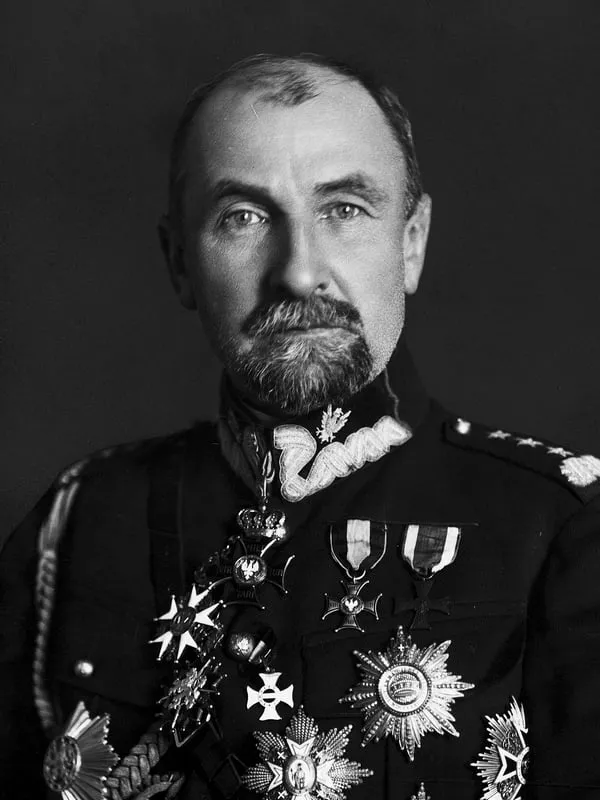
- Born:
- 19 May 1866, Babin near Kałusz (Galicia, Austria-Hungary)
- Died:
- 18 October 1928, Warsaw
- Author:
- Natalia
- Photo:
- autor nieznany, domena publiczna, Wikimedia Commons

Tadeusz Jordan Rozwadowski was one of the highest-ranking Poles in the Austro-Hungarian army, an artilleryman and inventor who in 1916 was pensioned off for defending the population of Galicia. In October 1918 the Regency Council in Warsaw made him the first chief of the General Staff of the Polish Army, and from November 1918 to March 1919 he commanded the defence of Lviv, besieged by the Ukrainians. He is best known as chief of staff during the Battle of Warsaw in 1920 and as Piłsudski’s opponent in May 1926. His biography, however, has become overgrown with legends. Polish tradition credited him with a decisive role in breaking the front at Gorlice in 1915, while newer research based on Austrian records shows that on the key days of that battle he held no command post.
Before the war
He was born on 19 or 20 May 1866 at Babin near Kałusz, into a landed family with strong military and insurrectionary traditions. His father Tomisław commanded cavalry in the January Uprising and later sat in the Galician Diet and the parliament in Vienna. Tadeusz attended the cavalry cadet school at Hranice in Moravia, and in 1886 graduated top of his year from the Technical Military Academy in Vienna and was commissioned as an artillery second lieutenant. He then went through the War School, which trained General Staff officers.
From 1896 to 1907 he was military attaché in Bucharest. He won the confidence of King Carol I and Crown Prince Ferdinand, and as an observer witnessed the defeat of the Greeks in their war with Turkey in 1897. After returning to Galicia he commanded an artillery regiment in Stanislau, and in 1913 he was promoted to major-general. He was also an inventor. He designed a sighting device and the shrapnel-shell, a projectile that burst twice, in the air and on impact, which was used during the war by Austrian and German artillery. As the only senior Polish officer of the Austrian army, he kept in touch before the war with the Riflemen’s movement and helped it in its difficulties with the authorities.
In the Austro-Hungarian army, 1914–1916
He began the war as commander of the 12th Field Artillery Brigade of the Kraków 12th Infantry Division, which became part of the 1st Army of General Victor Dankl. At the beginning of September 1914, during the Battle of Galicia, he distinguished himself at Borów in the Lublin region, for which he later received the highest Austrian military decoration, the Order of Maria Theresa. On 6 September he became artillery chief of the I Corps, early in 1915 he temporarily commanded the 46th Landwehr Infantry Division for some two weeks, and in February he returned to the 12th Division. On 3 March he took command of the artillery group of the IX Corps at Gorlice. According to the historian Tomasz Woźny, the corps then had 212 guns at its disposal, more than the VI Corps in the May battle. The February and March attempts to break the Russian front in this area, however, brought no success.
A legend grew up around the great Battle of Gorlice in May 1915. The general’s biographies, written by his family and supporters, and many studies following them, presented him as the commander of the 12th Division’s artillery who broke the Russian front, and as the inventor of the creeping barrage, later adopted by the Germans and the French. The historian Sławomir Kułacz, who in 2022 examined the records of Austrian headquarters, reached different conclusions. At the end of April Rozwadowski was to take over an infantry brigade in another division, but he did not accept the post, and on 1 May he remained with the 12th Division headquarters as a supernumerary officer. The artillery preparation was planned and conducted by the VI Corps artillery chief, Colonel Adam Nowotny, and by Colonels Franz Dobner and Ludwig Riedl. On 2 May the Army High Command categorically ordered that Rozwadowski be given back command of the brigade, but the order was not carried out. According to Kułacz, the general joined the artillery’s operations only in the last days of the battle or just after it, in an unspecified post, and directed the fire of the heavy artillery during the pursuit. Polish studies credit him, among other things, with breaking up a Russian counter-attack at Jarosław by artillery fire, but here too his formal role remains unclear. Kułacz believes that Rozwadowski, writing his memoirs in prison in 1926, claimed the merits of others, and that the Gorlice myth overshadowed his real achievements at Borów and in the March fighting at Gorlice.
On 23 May 1915 Rozwadowski took command of the 43rd Landwehr Infantry Division. In the second half of the year he came into conflict more and more often with the Army High Command. He protested against the treatment of the Polish and Ukrainian population in Galicia, against requisitions and executions without proper trial. On 1 February 1916 he was retired, officially on grounds of health. His personnel file is said to contain a note that he was “pensioned off for defending the population and the whole Galician province”. He left with the rank of Feldmarschalleutnant, equivalent to a Polish divisional general.
Chief of the General Staff
In retirement Rozwadowski did not stop taking an interest in politics. According to Jan Lewandowski, as early as June 1916 he made no secret of wanting the post of Austro-Hungarian governor-general in Lublin, which ultimately went to Karl Kuk. He kept in touch with politicians of the Kingdom, and later with the Regency Council, which from the autumn of 1917 sought an army of its own. The opportunity came when the Habsburg monarchy began to fall apart. After the regents’ declaration of 7 October 1918, in which they announced an independent Poland, the Regency Council on 25 October created the office of chief of the General Staff, and Rozwadowski took it up on 28 October.
For a few weeks he organised central military institutions and new units from scratch. On his orders an Economic-Military Guard was formed to watch the borders, Polish troops took over the monastery of Jasna Góra, and on 8–10 November took over the Vistula Flotilla from the Germans. On 4 November he issued an order to form a cavalry division. He also prepared a plan for the organisation of the military authorities, in which supreme command was to belong to the Regency Council and the chief of staff was to rank equal with a minister. The plan lost its meaning when the regents handed power to Józef Piłsudski. Rozwadowski wanted to build the army by conscription, Piłsudski from volunteers, and on 15 November the general resigned. His place was taken by Stanisław Szeptycki.
The defence of Lviv
Immediately afterwards he sought a command in the east, where the fighting for Lviv had been going on since 1 November. On 17 November Piłsudski appointed him commander-in-chief of the Polish forces in Eastern Galicia, that is, of Army “East” (PL). He arrived in Lviv on the night of 24–25 November, a few days after the relief force from Przemyśl had driven the Ukrainians out of the city. The city remained surrounded on the east, north and south, however, and from the start Rozwadowski maintained that he had too few troops and demanded reinforcements from Warsaw in vain. He turned volunteer units into regular ones, and against the guerrilla actions of armed Ukrainian peasants issued an order that they be shot. He also came into conflict with the Provisional Governing Committee in Lviv, dominated by the National Democrats.
At the end of December 1918 he repulsed a great Ukrainian assault on the city. In January and February Lviv was again cut off, and its inhabitants were threatened with hunger. On 7 March 1919 the High Command ordered him to break through with the garrison to Przemyśl. Rozwadowski replied that he would rather die with the garrison than leave Lviv. In mid-March the relief force of General Wacław Iwaszkiewicz set out, restored the link with Przemyśl, and Iwaszkiewicz replaced Rozwadowski as commander. The general was transferred to head the Polish Military Mission in Paris, which he took as an injustice.
After the war
In Paris he sought the support of the Powers on the question of Eastern Galicia and an alliance with Romania, and in the autumn of 1919 he helped to form a squadron of American volunteer airmen. On 22 July 1920 Piłsudski again appointed him chief of the General Staff, and in this post he conducted the Battle of Warsaw. Later he was inspector-general of cavalry. In May 1926 he commanded the government troops against Piłsudski’s coup. After the May Coup he was held in prison for a year without a verdict, and during that time wrote his memoirs of the Great War. He was released in May 1927 with his health broken and died in Warsaw on 18 October 1928. In accordance with his wishes he was buried in the Cemetery of the Defenders of Lviv.
Assessment
Rozwadowski has long divided historians. In the interwar period the Piłsudskiites belittled his merits, and after 1989 some authors presented him as the true victor of the Battle of Warsaw and a commander of genius. Wojciech Roszkowski believes that in 1920 Rozwadowski methodically carried out the plan Piłsudski had decided on, and that the dispute over who authored the victory “loses its meaning”. Critical research on his part in the Great War, such as Kułacz’s work, shows that many popular stories come from his own memoirs and panegyric biographies. Despite these corrections he remains an important figure: an outstanding artilleryman who received the highest Austrian combat decoration for Borów, an officer ready to sacrifice his career in defence of the population of Galicia, and the first chief of staff of the army that came into being in October and November 1918.
Sources
Spotted a mistake?Report an error
Commanded in battles
(01)Mentioned in battles
(02)Often appears with
People who appear in the same events.