Austria-Hungary · The Central Powers
Karl Kuk
Commandant of the Kraków fortress (1912–1916), Austro-Hungarian military governor-general in Lublin (1916–1917)
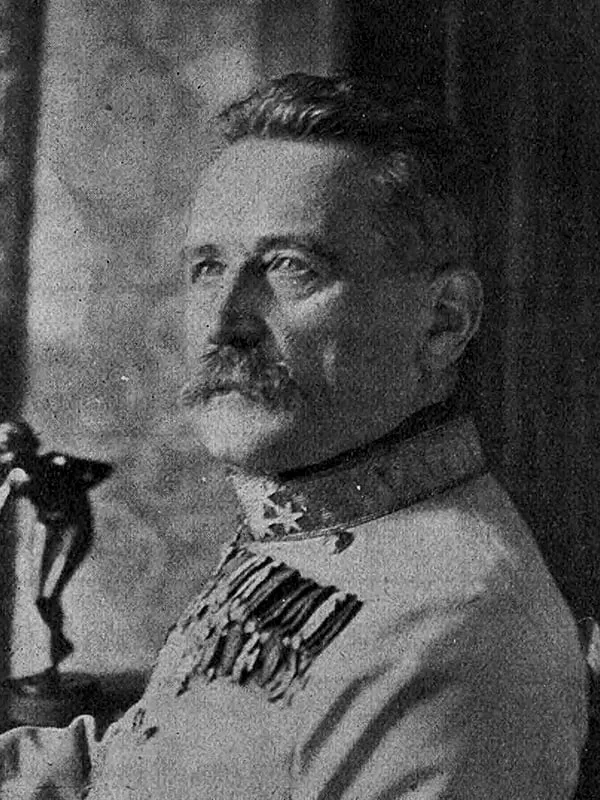
- Born:
- 1 December 1853, Trieste (Austrian Empire)
- Died:
- 26 November 1935, Vienna
- Author:
- Natalia
- Photo:
- Henner, domena publiczna, Wikimedia Commons

Karl Kuk was an Austrian military engineer and fortification specialist to whom the war gave two roles of importance to the Poles. In 1914, as commandant of the Kraków fortress, he prepared the city for a siege and had tens of thousands of its inhabitants removed. From May 1916 to April 1917 he was the Austro-Hungarian governor-general in Lublin and, together with the German governor-general in Warsaw, ruled the lands of the Kingdom of Poland occupied by the Central Powers. It was he who on 5 November 1916 proclaimed in Lublin the manifesto of the two emperors on the creation of the Kingdom of Poland, and then signed together with Hans Hartwig von Beseler the recruiting appeal and the ordinance on the Provisional Council of State. The Poles received him coolly and remembered him mainly for the requisitioning of food. His Austrian biographer considered him a just and capable governor.
Before the war
He was born on 1 December 1853 in Trieste, the son of a naval official. He described himself as a typical Austrian: his father was a Slovene, his mother a Czech German, as a child he spoke Italian at home, and he regarded himself as a man of German culture. From 1872 to 1876 he studied at the Technical Military Academy in Vienna and began his service in the engineers as a sapper lieutenant. In 1878 he took part in the occupation of Bosnia. He designed fortifications in Trento, taught fortification at the War School, headed the military office of railways, posts and telegraphs, and later was commandant of the fortresses of Petrovaradin and Komárno. He wrote works on the defence of fortresses and, under the pseudonym Karl Willen, also a treatise on Goethe’s “Faust”. He also published a book on the architecture of the Vienna Hofburg.
On 6 April 1912, as a Feldmarschalleutnant, he became commandant of the Kraków fortress, one of the most important fortresses of the monarchy, covering the road from the Kingdom of Poland to Silesia and Vienna. According to the Neue Deutsche Biographie he played a large part in preparing it for war.
The Kraków fortress, 1914–1916
When after the defeats in the Battle of Galicia the Austro-Hungarian armies fell back behind the San and the Dunajec in September 1914, Kraków became a front-line city. The fortress command ordered visitors to leave the city, and residents who wished to stay to lay in food for three months. According to the historian Bartosz Ogórek, several tens of thousands of people left in mid-September. At the beginning of November, as the Russians approached, a compulsory evacuation was announced. Soldiers searched homes, and anyone without supplies had to leave. The fortress command threatened the disobedient with court martial and even the death penalty by summary procedure, and after 13 November round-ups of the homeless and the poor were carried out. About a third of the population left the city. In the forefield villages were burned so that the enemy would find no shelter in them.
In the Battle of Kraków in the second half of November, Russian cavalry and leading infantry reached the forts, and field artillery shelled them from the hills near Kocmyrzów. No siege followed, and in December the Austrians drove the Russians back in the Battle of Limanowa. In March 1915 the fortress command announced another evacuation, which no longer affected so many people. The people of Kraków responded with a satirical song in which the commandant was said to have declared civilians “superfluous in the fortress”. In 1915 he was promoted to Feldzeugmeister, that is, general of artillery. According to Jan Lewandowski, the Kraków fortress played an important part in preparing the Central Powers’ May offensive at Gorlice.
Governor-general in Lublin
On 1 May 1916 Kuk was appointed governor-general of the Austro-Hungarian Military Government-General with its seat in Lublin. He succeeded General Erich von Diller, who was valued by the Poles and whom the emperor appointed governor of Galicia. Kuk was received with reluctance. Despite six years in Kraków he did not speak Polish. One of the Polish officials of the occupation wrote that he had been chosen precisely because he would not be able to communicate with the local population and would obediently carry out the orders of the Army High Command, especially regarding requisitions. The Galician politician Jan Hupka described how the Lublin gentry and intelligentsia, invited to hear him speak, pretended not to understand German. A Pole, General Tadeusz Rozwadowski, was also a contender for the post.
In June 1916, at a conference in Teschen, the Army High Command decided to increase the share of civilians and Polish officials in the occupation administration. Rivalry between Vienna and Berlin over the Polish question soon led to the Act of 5 November. On Sunday 5 November 1916, at noon, at the same time as Beseler was reading the manifesto at the Royal Castle in Warsaw, Kuk proclaimed it in the governor-general’s palace in Lublin on behalf of Emperor Franz Joseph I. He declared that the allied monarchs solemnly guaranteed the restoration of the Kingdom of Poland, and ended with a cheer for Poland raised in Polish. A Polish flag was hoisted in front of the palace. As early as 9 November the two governors-general issued a joint appeal calling on the inhabitants of the Kingdom to enlist as volunteers, before any Polish government had been formed. It provoked indignation, and few volunteers came forward.
On 6 December the ordinance on the Provisional Council of State, a Polish advisory body, signed by Beseler and Kuk, was published, and on 14 January 1917 the two handed its members their letters of appointment at the Royal Castle in Warsaw. According to Lewandowski, Kuk’s name is also linked with the “Kuk–Beseler” oath formula, whose rejection by the legionnaires in July 1917 caused the oath crisis.
In the memory of the people of Lublin, however, it was above all the requisitions that remained. The monarchy was starving, and the Army High Command, against Kuk’s objections, set up a commission to extract food from the occupied territories. At the end of the winter of 1917 Czech and Bosnian companies sent to Lublin to requisition took from the inhabitants not only food but also clothes, shoes and money. Riots broke out in the city, the Poles sent complaints to Vienna, and the authorities, fearing Polish indignation, ordered the seized goods to be returned. According to Hupka, on that day, when the governor’s wife was giving a concert, everyone sent her back their tickets.
On 24 April 1917 Emperor Karl I recalled Kuk. According to his Austrian biographer, the aim was to satisfy the demands of Polish deputies in parliament, who wanted a Pole in the post. His successor was Stanisław Szeptycki.
After the war
Kuk remained at the disposal of the Army High Command until the end of the war and headed the military fund for widows and orphans. After the war he was retired. Until his death he was honorary president of the association of graduates of the military technical schools. He died in Vienna on 26 November 1935.
Assessment
Polish and Austrian memory of Kuk differ greatly. Polish diarists such as Jan Hupka or Princess Maria Lubomirska, who called him “a paltry military figure”, saw him as an alien official who knew neither the language nor the needs of the country, an executor of a predatory economic policy. The Neue Deutsche Biographie, by contrast, presents him as a general well acquainted with Polish affairs, widely regarded as a just and capable governor. The historian Jan Lewandowski notes that of the four Austro-Hungarian governors-general in Lublin Kuk held office the longest, though only for a year, and that his name appears most often in the literature, because he signed the most important documents of the Central Powers’ policy towards Poland in 1916–1917. He did not, however, make that policy. The Act of 5 November was decided in Berlin and Vienna, and in the Austrian zone real economic power was exercised by the Army High Command.
Sources
Spotted a mistake?Report an error
Commanded in battles
(01)Often appears with
People who appear in the same events.