Poland · The Polish cause
Stanisław Szeptycki
Commandant of the Polish Legions (1916–1917), Austro-Hungarian military governor-general in Lublin (1917–1918), from November 1918 chief of the General Staff of the Polish Army
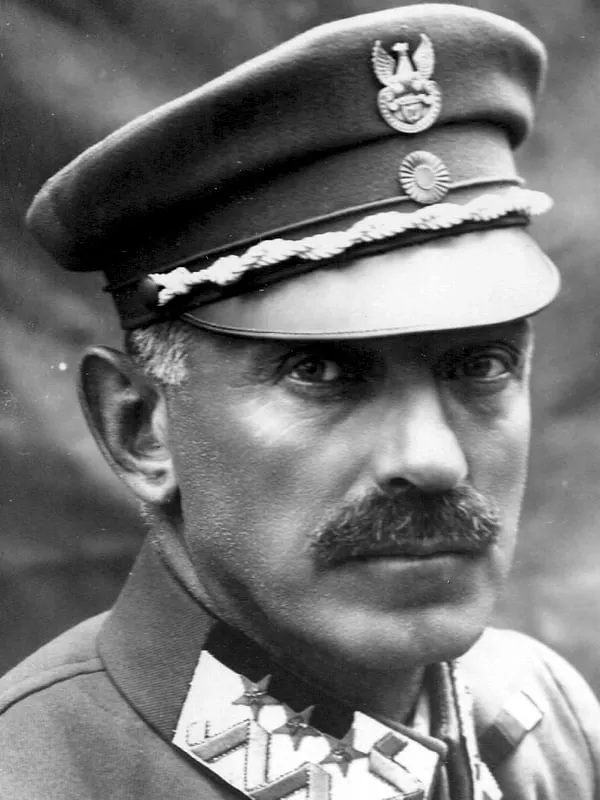
- Born:
- 3 November 1867, Przyłbice (Galicia, Austria-Hungary)
- Died:
- 9 October 1950, Korczyna
- Author:
- Natalia
- Photo:
- autor nieznany, domena publiczna, Wikimedia Commons

Count Stanisław Szeptycki was the only Pole who exercised occupation authority in the Kingdom of Poland during the Great War. A professional General Staff officer of the Austro-Hungarian army, a grandson of Aleksander Fredro and brother of the Greek Catholic metropolitan of Lviv, in 1916 he transferred at his own request to the Legions and became their commandant. From May 1917, as governor-general in Lublin, he pursued a policy meant to win the Poles over to Austria, while at the same time supporting the nascent Polish state institutions. When in February 1918 the Central Powers promised the Chełm Land to Ukraine, he resigned. In November 1918 he joined the Polish Army and, as chief of the General Staff, built it from the ground up together with Józef Piłsudski, with whom he later came into sharp conflict.
Before the war
He was born on 3 November 1867 at Przyłbice near Jaworów, into one of the most distinguished families of Eastern Galicia. He was the son of Count Jan Kanty Szeptycki and Zofia née Fredro. His elder brother Roman, in religion Andrey, became the Greek Catholic metropolitan of Lviv and the spiritual leader of the Ukrainians, and another brother, Kazimierz, in religion Klymentiy, also became a Greek Catholic monk. The Szeptyckis were thus a family in which Polish and Ukrainian Galicia met.
Stanisław chose the army. He graduated in artillery from the Technical Military Academy, from the higher riding school in Vienna and from the War School, the training ground of the Austrian General Staff. In 1904–1905, as a General Staff captain, he was military attaché at Russian headquarters in Manchuria and for nearly two years observed the Russo-Japanese War, from the Battle of the Yalu to Mukden. In 1911–1914 he was military attaché in Rome. In May 1914 he was promoted to colonel.
From the staff to the Legions
On the outbreak of war he was posted to the operations department of the Army High Command, and from 24 September 1914 he was chief of staff of the 2nd Corps on the Russian front. The Legions also fought within it, and there Szeptycki came into contact with them for the first time. In the autumn of 1915 he took command of the 30th Field Artillery Brigade. In June 1916 he transferred at his own request to the Polish Legions, and in July, during the Brusilov offensive, took over the Third Brigade from the seriously wounded Colonel Leon Berbecki. On 3 August at Rudka Miryńska on the Stokhid, commanding a group made up of the Second and Third Brigades, the Legion uhlans and two German battalions, he repulsed a strong Russian attack. The Austrians awarded him the Order of the Iron Crown for it.
In the autumn of 1916, after Piłsudski left the Legions, Szeptycki became commandant of the whole Legions. Sources date this moment differently: Jan Lewandowski gives October, other studies 14 November. On 1 December 1916, a few weeks after the Act of 5 November, the legionnaires under his command made a ceremonial entry into Warsaw. The Legions, renamed the Polish Auxiliary Corps, were to become the nucleus of the army of the new Kingdom of Poland. Szeptycki, who defended their Polish character against the plans of the Central Powers, lost his post in April 1917, when the corps was placed under the orders of the German governor-general Hans Hartwig von Beseler. He was then promoted to major-general.
Governor-general in Lublin
In April 1917 Emperor Karl I recalled the governor-general Karl Kuk from Lublin and, in accordance with the wishes of the Polish Club in Vienna, appointed Szeptycki in his place. In May he took office as the first and only Pole at the head of the Austro-Hungarian Military Government-General. According to the historian Jan Lewandowski, the emperor gave him powers that his predecessors had not had. After Kuk’s rule, associated with ruthless food requisitioning, Szeptycki changed the style of government. He removed officials, mostly Germans and Jews, from the occupation apparatus and replaced them with Poles from Galicia, and ordered district commandants to communicate with the population only in Polish. He made legionnaires his aides-de-camp and, contrary to regulations, addressed his subordinates in Polish. At his name-day banquet “Poland Is Not Yet Lost” was played, which Austrian officers reported to Vienna as betrayal of the monarchy’s interests.
He also banned the export of food from the occupied territory, against the demands of the Army High Command, and in June 1917 set up a National Economic Council with the participation of Polish landowners’ and urban organisations. Requisitioning nevertheless continued, since without it there would not have been enough food for the towns and the army. During the oath crisis he did not help the Germans hunt down legionnaires who had refused the oath and taken refuge in the Austrian zone. He took an active part in the negotiations over Polish authorities. On 12 September 1917 Emperor Karl authorised him by a handwritten letter to issue, together with Beseler, the patent on the Regency Council, and on 27 October Szeptycki sat beside Beseler in Warsaw cathedral when the Regency Council took office. In the disputes of the regents and of Jan Kucharzewski’s government with the Germans he took the Polish side. According to Lewandowski, at the turn of 1917 and 1918 the Austro-Polish solution, that is, union of the Kingdom with the Habsburg monarchy, reached its peak in Congress Poland.
All this was undone by the peace with Ukraine, concluded on 9 February 1918, in which the Central Powers granted the Ukrainian People’s Republic the Chełm Land and part of Podlachia. That very day Szeptycki asked by telegram to be relieved, and after a refusal repeated his request on 12 February. According to Lewandowski he was recalled on 20 February; according to other studies his resignation was accepted on 19 February. His successor was a Croat, General Anton Lipošćak. In June Szeptycki was sent to the Italian front as commander of the 85th Landwehr Infantry Brigade.
November 1918
On 1 November 1918 he joined the Polish Army. On 4 November the Regency Council appointed him a major-general and temporarily entrusted him with command of the Polish units in the former Austrian occupation zone and in the part of Galicia that was in Polish hands. After Piłsudski took power, on 15 or 16 November he succeeded General Tadeusz Rozwadowski as chief of the General Staff. At the beginning of 1919 he opposed the failed coup attempt of Colonel Marian Januszajtis. Piłsudski, thanking him in March 1919 for his work on the staff, wrote that it had laid “the foundations for building the Polish Army, created in conditions in which no army had ever been organised”.
After the war
From April 1919 he commanded the Lithuanian-Belarusian Front, whose troops took Minsk in August. In 1920 he commanded the 4th Army and then the North-Eastern Front, which in July was falling back before Tukhachevsky’s offensive. On 1 August, ill with dysentery and in conflict with Piłsudski, he left his post. In 1921 a special commission cleared him of the charges over the retreat. As army inspector in Kraków he supported the Third Silesian Uprising in 1921, and in 1923 he was minister of military affairs in Wincenty Witos’s government and established Polish Soldiers’ Day. During the May Coup he sided with the legal authorities, and in June 1926 he was retired. He settled at Korczyna near Krosno. In 1945, at the age of 78, he was for a few months president of the Polish Red Cross. He died at Korczyna on 9 October 1950.
Assessment
Historians see Szeptycki as an example of a Polish aristocrat and officer who for years served the Habsburgs loyally and at the decisive moment chose the Polish cause. The monographs of Piotr Mikietyński and Andrzej Wojtaszak judge him a capable staff officer and commander, and Jan Lewandowski asked outright whether in Lublin he was “in the service of the partitioning power or of the nation”. The answer is not simple. Szeptycki was an instrument of Austrian policy towards the Poles and continued to extract food from the Kingdom for the monarchy, but at the same time he Polonised the administration, protected legionnaires and supported the Regency Council. His resignation in February 1918 was one of the clearest signs that on the Polish question Austria-Hungary had lost the confidence even of its most loyal supporters.
The dispute with Piłsudski, who in his book “The Year 1920” attributed a nervous breakdown during the retreat to him, weighed on the general’s memory in the interwar period. Today his role in creating the General Staff and in the victorious fighting in Lithuania and Belarus in 1919 is remembered instead.
Sources
Spotted a mistake?Report an error
Often appears with
People who appear in the same events.