1916: The Eastern Front
Brusilov offensive
- Dates:
- 4 June – 20 September 1916
- Front:
- Eastern Front
- Location:
- Volhynia, Eastern Galicia and Bukovina, on a front almost 500 km long from Polesia and the Stokhod through Lutsk, Tarnopol and the Strypa to the Dniester, Czernowitz and the Carpathians (Russian Empire and Austria-Hungary, today Ukraine)On the battle map →
- Sides:
- Russian EmpireAleksei Brusilov, Alexey Kaledin, Vladimir Sakharov, Dmitry Shcherbachev, Platon LechitskyAustria-Hungary and Germany (from August also the Ottoman Empire)Franz Conrad von Hötzendorf, Alexander von Linsingen, Archduke Joseph Ferdinand, Eduard von Böhm-Ermolli, Felix von Bothmer, Karl von Pflanzer-Baltin
- Result:
- Russian victory. The Austro-Hungarian front was broken in Volhynia and Bukovina, and the Russians recovered Lutsk, Czernowitz and Bukovina. They did not reach their operational objectives, Kovel and Lviv.
- Author:
- Łukasz Skowroń
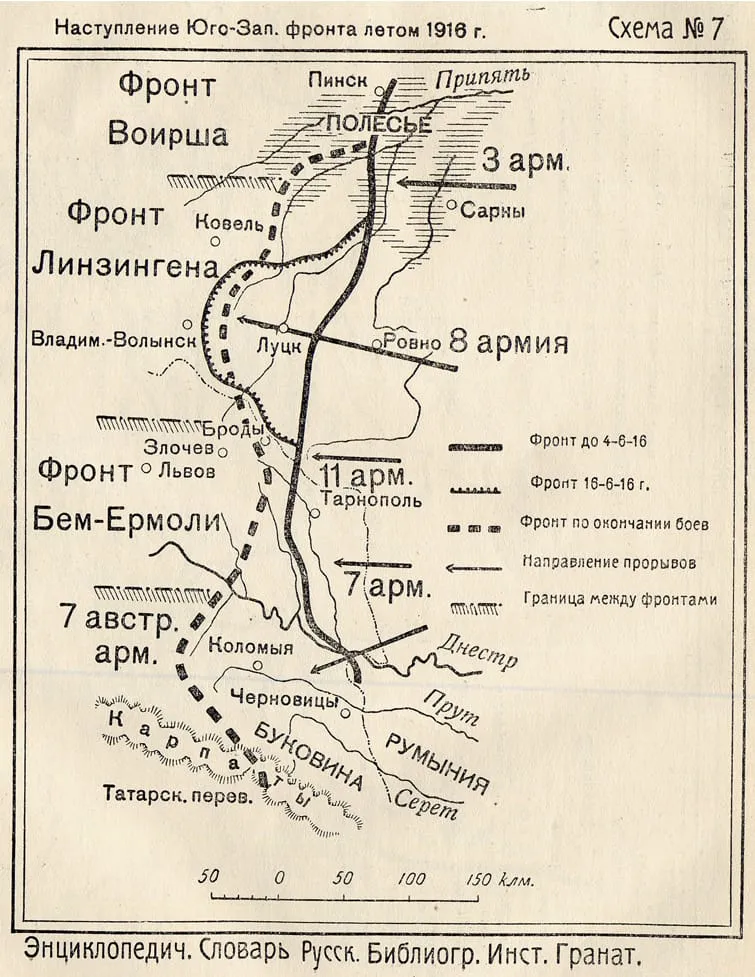
The Brusilov offensive was the greatest victory of the Russian army in the First World War and one of the greatest breakthroughs of the whole war. On 4 June 1916 the four armies of General Aleksei Brusilov’s South-Western Front struck simultaneously along the whole length of the front, from Volhynia to Bukovina. Within a few days they broke through the Austro-Hungarian positions at Lutsk and on the Dniester and took Lutsk, and within a few weeks Czernowitz and almost all of Bukovina. In June and July Austria-Hungary lost almost half a million soldiers, more than a quarter of a million of them taken prisoner or missing. The offensive, conceived as a subsidiary blow, saved the Italians, hastened the end of the German attacks at Verdun and induced Romania to enter the war. The Russians, however, failed to take the railway junction of Kovel, and in further, ever bloodier attacks in the summer and autumn they lost hundreds of thousands of men.
Name and dates
Russians at the time spoke of the “Lutsk breakthrough” (Lutsky proryv), after the town near which the army won its greatest success. The name “Brusilov breakthrough” (Brusilovsky proryv) became established later in Soviet historiography. German and Austrian literature speaks of the Brusilov offensive (Brussilow-Offensive), and describes the first days of fighting as the battles of Olyka and Lutsk, of Okna and of Jazłowiec.
Russia then used the Julian calendar, 13 days behind. According to Russian documents the offensive therefore began on 22 May, not 4 June. On this page all dates are given according to the Gregorian calendar.
The beginning is not in doubt; the end is harder. The British chronology of the war, on which our timeline is based, ends the “Brusilov offensive” at approximately 17 August 1916, when the attacks on Kovel collapsed. Russian and Soviet historiography usually takes 20 September (7 September by the Julian calendar), after a failed attack on Kovel from the south. The Austrian official history also describes Brusilov’s autumn attacks, the last of which died away in mid-October. On this page we take the dates 4 June – 20 September 1916, and treat the later fighting as its epilogue.
Background
At the conference at Chantilly in December 1915 the Allies decided that in 1916 they would attack together on all fronts. The Central Powers upset their plans. In February the Germans attacked at Verdun, and at the request of the French the Russians launched in March the offensive at Lake Naroch, which ended in a bloody defeat. In April, at a conference at Stavka in Mogilev, the Chief of Staff to the Supreme Commander, General Mikhail Alekseyev, presented the plan for a summer offensive. The main blow, towards Vilna, was to be delivered by the Western Front of General Alexei Evert, which had the most troops and heavy artillery. Brusilov, commander of the South-Western Front for only a few days, was the only front commander to insist that his troops could and should attack. According to his memoirs he assured them that he was not asking for reinforcements and would make do with what he had. He received permission, but his front was only to pin down the enemy and support Evert’s attack with a blow towards Lutsk and Kovel.
Events in Italy brought the date forward. On 15 May the Austrians attacked from the Tyrol at Asiago, and the Italian government and General Luigi Cadorna began to beg the Russians for quick help. Brusilov proposed 1 June, but the Western Front could not move before the middle of the month, so Alekseyev set the start of the attack for 4 June and Evert’s blow for 10–11 June. The Tsar approved this plan on 26 May. Austria-Hungary had earlier taken several divisions and a large part of its heavy artillery from the Eastern Front to the Tyrol. The Austrian command believed that south of Polesia the Russians could not break through fortified positions without large reinforcements, which they had not received.
Brusilov’s method
The experience of Naroch and Verdun showed that an attack concentrated on a single sector allowed the defender to bring up reserves there in time. Brusilov therefore decided that each of his four armies, and within them many corps as well, would prepare its own attack on a chosen sector 15–20 versts wide. The enemy, seeing preparations along the whole front, was not to know where the main blow would fall and could not shift his reserves. The main blow was the attack of General Alexey Kaledin’s Eighth Army towards Lutsk. The other armies, General Vladimir Sakharov’s Eleventh Army near Tarnopol, General Dmitry Shcherbachev’s Seventh Army on the lower Strypa and General Platon Lechitsky’s Ninth Army on the Dniester and the Prut, were to pin down the enemy, but each of them was preparing a genuine breakthrough. Alekseyev did not trust this method. Even on the night before the attack he urged Brusilov by telephone to postpone it and concentrate his forces in one place, invoking the Tsar’s wishes. Brusilov refused, and Alekseyev ended the conversation with the words: “God be with you. Act as you see fit.”
The preparations lasted more than a month and a half. At night the infantry dug its way ever closer to the enemy’s positions and built so-called places d’armes, networks of trenches and dugouts from which it was to launch the assault. These were to be no more than 200–400 paces from the enemy, and in places they came within a few dozen paces of the Austrian wire. Russian aircraft photographed the enemy positions, and the assault units rehearsed in the rear on faithful replicas of sections of the Austrian fortifications. The artillery was not to smother the positions with fire, but to destroy the wire and emplacements according to a precise plan and then accompany the infantry in the attack. “Success lies not in hurricane fire, but in good fire control according to precise tasks,” Brusilov wrote in his instructions. The Austrian official history admits that no Russian formation had ever before gone into an attack so well prepared.
Forces
According to Russian figures, at the start of the attack Brusilov’s four armies numbered about 534,000 infantry and 60,000 cavalry, with about 1,770 light and only 168 heavy guns. Opposite them stood, according to the same figures, about 448,000 infantry and 38,000 cavalry with about 1,300 light and 545 heavy guns. The Austrian official history states that Brusilov himself counted on a superiority of about a hundred thousand men. The Russians thus had no overall superiority of the kind usually required to break a fortified front. They achieved it only in the attack sectors, by bringing troops there from other parts of the front: at Lutsk 148 Russian battalions faced 53 Austro-Hungarian ones.
The front of the Central Powers south of Polesia was made up, from the north, of: the Army Group of General Alexander von Linsingen, with the Austro-Hungarian Fourth Army of Archduke Joseph Ferdinand at Lutsk and the First Army on the Ikva; General Eduard von Böhm-Ermolli’s Second Army near Tarnopol; General Felix von Bothmer’s German-Austrian South Army on the Strypa; and General Karl Pflanzer-Baltin’s Seventh Army on the Dniester and in Bukovina. The positions, built since the autumn of 1915, consisted of three belts of fortifications, with deep dugouts, concrete machine-gun emplacements and several rows of wire. The defenders considered them impregnable.
Course: the breakthrough (4–9 June)
At dawn on 4 June the Russian artillery opened fire along the whole front, from the Styr to Czernowitz. In Volhynia the bombardment went on, with breaks, for 29 hours. At 9 a.m. on 5 June the infantry of the Eighth Army went in against the Austro-Hungarian positions west of Olyka. Under cover of dust and smoke it broke into the trenches of the 2nd Infantry Division, where many defenders were taken prisoner straight out of their dugouts. By evening two Austro-Hungarian divisions had fallen back to the third line of defence, and some regiments had lost several thousand men each. On 6 June the Russian VIII Corps broke through the third line at Olyka, and the Austro-Hungarian corps, withdrawing one after another so as not to be outflanked, fell back towards the Styr. On 7 June the Russians took the Lutsk bridgehead, and in the evening a regiment of the 4th Rifle Division entered Lutsk. According to Russian figures, from 4 June the Eighth Army took more than 44,000 prisoners, at a cost of about 33,000 killed and wounded. By 9 June the front of the Fourth Army had been torn open over a length of about 85 kilometres and a depth of almost 50 kilometres.
At the same time, on the Dniester, Lechitsky’s Russian Ninth Army broke through the positions of the Austro-Hungarian Seventh Army east of Czernowitz as early as 4 June, and Okna changed hands several times. Over the following days Austrian reserves patched the gap, and on 6 June Shcherbachev’s Russian Seventh Army broke the front at Jazłowiec on the lower Strypa. Only on the sector of Sakharov’s Eleventh Army, near Tarnopol, did the attacks achieve little, although at Sapanów on the Ikva the Russians broke into the positions of the First Army and took almost 3,000 prisoners. By 9 June, according to Russian figures, the whole South-Western Front had taken more than 70,000 prisoners.
Course: Bukovina and Linsingen’s counter-attack (10–30 June)
On 10 June the Russian Ninth Army struck again at Okna and this time broke the front of the Austro-Hungarian Seventh Army. Pflanzer-Baltin’s troops fell back partly behind the Prut and partly westwards, towards Kolomyia, and his army split into two groups. The Russians took Zaleszczyki, and on 17 June they broke into the bridgehead of Czernowitz. On the night of 17/18 June they crossed the swollen Prut and the defenders abandoned the capital of Bukovina. The Russians took it for the third time in this war, after September 1914 and November 1914. General Mikhail Promtov’s group moved south, towards Suceava and the Carpathian passes. By the end of June the Russians held almost all of Bukovina, with Rădăuți and Kuty, and on 30 June they took Kolomyia. North of the Dniester the Russian Seventh Army took Buczacz on 10 June, but Bothmer’s German-Austrian South Army, to which the Austro-Hungarian XIII Corps, withdrawn from the lower Strypa, had been subordinated, beat off further attacks and held the front on the Strypa until the end of June.
Brusilov did not make full use of the gap in Volhynia. On 9 June Alekseyev told him to direct the Eighth Army from Lutsk towards Lviv, but the front commander, who regarded his blow as subsidiary to Evert’s attack and feared a German attack from the north, stubbornly aimed at Kovel, the railway junction linking him with the Western Front. Kaledin advanced cautiously. The Austrian official history considers that this hesitation saved the Austro-Hungarian front. The Germans and Austrians gained time to bring up reinforcements. General Erich von Falkenhayn sent German divisions to Volhynia, some of them from France, and Franz Conrad von Hötzendorf halted the offensive in the Tyrol and began to move troops from there to the east. On 16 June Linsingen’s troops counter-attacked the salient at Lutsk. By early July they had pushed the Russians back several kilometres in places, but did not recover Lutsk.
Evert’s Western Front, which was to deliver the main blow, postponed its attack several times. It moved only on 2–3 July at Baranovichi and came to a halt after a week of fighting, losing, according to English-language accounts, about 80,000 men. Already at the end of June Brusilov had received the Third Army from the Western Front, and after the defeat at Baranovichi Stavka recognised his front as the main direction of the offensive and handed him further corps, including the Guard.
Course: the fighting for Kovel (July–September)
On 4 July the Third and Eighth Armies attacked on the northern wing, on the Styr. At Kostiuchnówka the attack of the Russian XLVI Corps was held up for three days by brigades of the Polish Legions. The Battle of Kostiuchnówka cost the legionaries about 2,000 killed and wounded and became one of the most important battles in their tradition. Linsingen’s troops nevertheless had to fall back behind the Stokhod, a marshy river east of Kovel, where the front came to a halt for several months.
On 28 July Brusilov resumed the attack along the whole front. The Third Army and the new Special Army of General Vladimir Bezobrazov, formed from the Guard, the elite of the Tsar’s army, struck towards Kovel. The guardsmen went into the attack through the marshes of the Stokhod under the fire of German artillery and suffered enormous losses without breaking the front. The same day the Eleventh Army took Brody, and in the south the Ninth Army, after a battle fought between 7 and 10 August, took Stanisławów. At the end of July the Central Powers changed their command organisation: the northern part of the front, as far as the Brody area, was taken over by Paul von Hindenburg, and the southern part by Archduke Charles, heir to the throne of Austria-Hungary.
Further attacks on Kovel in August and September changed nothing. From 31 August to 3 September and from 16 to 23 September the Eighth Army and the Guard attacked south of Kovel, at Szelwów, Świniuchy and Korytnica. According to Russian accounts, in the September fighting they took only two villages, losing about 30,000 men. On the Złota Lipa and the Narajówka (PL) the Seventh Army fought German troops and the Ottoman XV Corps, sent by Enver Pasha to help his allies. In the Carpathians the Ninth Army took one peak and pass after another, but did not get through to Hungary. After Romania entered the war, declaring war on Austria-Hungary on 27 August, Stavka’s attention shifted to the south. Brusilov tried once more at the turn of September and October to storm the positions near Kovel and Włodzimierz Wołyński, but the Tsar forbade any continuation of these attacks.
Losses
Figures for the losses differ considerably and depend on the period they cover. According to the Austrian official history, the Austro-Hungarian forces on the Eastern Front lost 475,000 men in June and July 1916, including more than 22,000 killed, 115,000 wounded, 72,000 sick and almost 266,000 taken prisoner or missing. The German official history estimates Austro-Hungarian losses in the whole offensive at 616,000, including more than 327,000 prisoners, and German losses at 148,000. Russian and Soviet accounts state that the Central Powers lost about 1.5 million men in all, including from 400,000 to more than 500,000 prisoners, and that the Russians captured 581 guns and almost 1,800 machine guns.
Russian losses are even more disputed. According to Russian archival data, by mid-July the South-Western Front had lost almost 500,000 men killed, wounded and missing. The French general Noël de Castelnau, who was in Russia in February 1917, reported that Brusilov’s armies had lost 980,000 men. The Russian historian Sergei Nelipovich estimates the front’s losses from June to the end of October at about 1.4–1.65 million men, and the losses of the Central Powers over the same period at about 846,000. It is most often accepted that the Russians lost between half a million and a million men in the offensive.
Significance
The Brusilov offensive achieved more than had been expected of it. The Austrians had to break off their attack in Italy and move several divisions from the Tyrol to the east. The Germans sent more than a dozen divisions to the Eastern Front, some of them taken from France, which weakened their attacks at Verdun and their defence on the Somme. The Russian successes persuaded Romania, which had long been negotiating with the Entente, to enter the war.
For Austria-Hungary the defeat was a turning point. Its army was no longer capable of major independent operations, and in September the monarchy had to agree to a joint supreme command of the Central Powers under Emperor Wilhelm II, in practice under the German general staff. In the Austro-Hungarian regiments faith in their own commanders was shaken, and in some regiments the will to fight as well. The Austrian official history admits that the defeat at Lutsk cannot be regarded as inevitable.
For Russia, however, the victory proved incomplete. Brusilov took neither Kovel nor Lviv, and the failed attacks of Evert and Kuropatkin showed that the other commanders could not or would not repeat his method. The huge losses, especially among the Guard and experienced officers, exhausted the last reserves of the Tsar’s army and deepened the war-weariness which a few months later contributed to the outbreak of revolution. Brusilov’s method, that is, careful preparation, surprise and attacks on many sectors at once, nevertheless became a subject of study in many armies, and the Germans applied similar principles in their offensives of 1918.
Spotted a mistake?Report an error