Germany · The Central Powers
Felix von Bothmer
Commander of Corps Bothmer (1915), the South Army (1915–1918) and the 19th Army (1918), from 1918 colonel-general
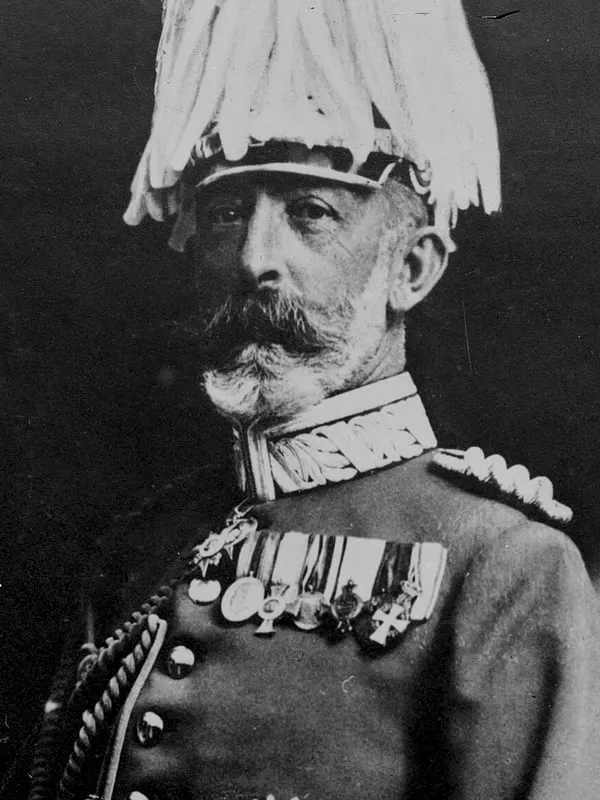
- Born:
- 10 December 1852, Munich (Kingdom of Bavaria)
- Died:
- 18 March 1937, Munich
- Author:
- Natalia
- Photo:
- Bain News Service, domena publiczna, Wikimedia Commons

Count Felix von Bothmer was a Bavarian general who before 1914 had commanded nothing bigger than a division, and who during the war became one of the most effective army commanders on the Eastern Front. In April 1915 his corps took the Carpathian ridge of Zwinin, and in May Stryj. From July 1915 to the beginning of 1918 he commanded the South Army, a mixed German, Austro-Hungarian and, in time, also Turkish army, which in Eastern Galicia withstood two great Russian offensives. In the summer of 1916, when the neighbouring Austro-Hungarian armies were breaking under Brusilov’s blows, Bothmer held the line of the Strypa, and in the summer of 1917 at Brzeżany he repulsed the attack with which the Kerensky offensive began.
Before the war
He was born on 10 December 1852 in Munich, into a Protestant family of counts. His father, Count Max von Bothmer, was a Bavarian lieutenant-general and quartermaster-general of the army. In February 1871, at the close of the Franco-Prussian War, he joined the Bavarian Infantry Life Regiment (Infanterie-Leib-Regiment) as a cadet, and in November he became a second lieutenant.
He spent most of his career on staffs. In 1875–1878 he went through the Bavarian War Academy, then served on the general staff of the Bavarian army, and in 1893–1895 on the Great General Staff in Berlin. In 1899 he became head of a department of the Bavarian general staff, and from 1901 he commanded the Infantry Life Regiment. In 1903 he was promoted to major-general, in 1905 to lieutenant-general, and took over the 2nd Division at Augsburg. From 1909 he was captain-general of the Leibgarde der Hartschiere, the honorary bodyguard of the King of Bavaria. In 1910 he retired with promotion to general of infantry.
1914–1915: the Carpathians and Stryj
The war found Bothmer unfit for field service. Sources speak of illness or of a broken leg. At the end of November or the beginning of December 1914 he took over the Bavarian 6th Reserve Infantry Division in Flanders, after the First Battle of Ypres had ended, and on 26 December the new II Bavarian Reserve Corps.
In the winter of 1914–1915 the Russians held the Carpathian passes and threatened Hungary. Bothmer’s staff was moved to the Carpathians, to the South Army of General Alexander von Linsingen, and in March 1915 his command was renamed Corps Bothmer. Throughout the Winter Battle in the Carpathians the South Army stormed the strongly fortified ridge of Zwinin in vain. It fell only on 9 April 1915, when Przemyśl was already in Russian hands. For Zwinin Bothmer received the Knight’s Cross of the Bavarian Military Order of Max Joseph.
After the breakthrough at Gorlice the Russians had to leave the Carpathians, and the South Army came down into the foothills. Bothmer’s corps, made up of the German 1st Infantry Division and part of the 3rd Guards Infantry Division, bore the main weight of the attack on Stryj. At Drohobycz and Stryj it long failed to break through, but on 31 May, after a short bombardment in which Austro-Hungarian 30.5 cm mortars also took part, it burst into the town and took more than 9,000 prisoners. For this Bothmer received the Commander’s Cross of the Order of Max Joseph.
The success was incomplete. A Russian counter-attack forced the corps, on the night of 9–10 June, to leave its bridgehead at Żurawno and fall back across the Dniester. Bothmer, who brought his troops back across the river unhindered, at once struck along the Dniester into the Russians’ flank and on 12 June took Żydaczów. At the end of June the South Army crossed the Dniester, and his corps, together with General Kosch’s corps, broke the Russian defence on the Gnila Lipa. At the beginning of July Bothmer received the Pour le Mérite.
1915–1916: the South Army on the Strypa
In July 1915, according to different sources on the 6th or the 8th, Linsingen took over the new Bug Army, and Bothmer took over the South Army. On 2 September the army crossed the Strypa, but at Tarnopol a Russian counter-attack put it in a critical position. Two regiments of the German Guard saved Bothmer from a widening of the breach, and he himself reported that many soldiers of the Austro-Hungarian 19th Division, mostly Czechs, had gone over to captivity. The front settled on the Strypa and stayed there until the following summer.
According to some accounts, in 1916 only one of the South Army’s five divisions was German. In June the Brusilov offensive broke the Austro-Hungarian front at Lutsk and south of the Dniester. On 11 June the Russian 7th Army of General Dmitry Shcherbachev, which had already taken Buczacz, attacked Bothmer’s right wing across the Strypa. The army, reinforced by the Austro-Hungarian XIII Corps withdrawn from the lower Strypa and by a German division from Macedonia, repulsed attack after attack, and the last major assault broke down on 21 June.
Bothmer held the line of the Strypa until August. Then the Russian advances on both his flanks, and above all the loss of Stanislau, threatened his rear. On the night of 10–11 August he was ordered to withdraw his corps behind the Zlota Lipa by 14 August, and he carried out the retreat in good order. On 22 August the Ottoman XV Corps, more than 30,000 men sent to his army, took up positions on the new line. The Russian offensive was losing strength, and Bothmer held the front into the autumn. On 5 November King Ludwig III of Bavaria presented him in Galicia with the Grand Cross of the Order of Max Joseph.
1917: Brzeżany and the Zbruch
In the summer of 1917 the South Army stood on the Zlota Lipa, in the centre of the front of General Eduard von Böhm-Ermolli’s army group, with German, Austro-Hungarian and the Turkish 20th Division. On 1 July the Kerensky offensive struck it. To its north the Russians and the Czechoslovak brigade routed two Austro-Hungarian divisions at Zborów, but at Brzeżany the South Army repulsed the attack of the Russian 7th Army. Russian losses on its sector were estimated at about 40,000 men.
On 19 July German divisions brought from the west broke through the front at Złoczów, and Bothmer’s army went over to the pursuit. Its divisions marched east through Czortków, fording the Seret where the bridges had been burnt, and on 29 July Bothmer ordered a bridgehead to be taken at Zaleszczyki on the Dniester. At the end of July the front came to a halt on the Zbruch, the border river between Galicia and Russia. According to German biographers, Wilhelm II then presented him at the front, near Buczacz, with the Oak Leaves to the Pour le Mérite.
1918: Lorraine
After the armistice of Brest-Litovsk the Germans were moving divisions to the west, and the South Army was dissolved at the turn of January and February 1918. On 4 February Bothmer took over the new 19th Army on a quiet sector of the front in Lorraine, which he commanded until the end of the war. On 9 April 1918 he was promoted to colonel-general. On 8 November, in the days of the revolution in Bavaria, he was recalled to the Bavarian war ministry. According to some sources he was to prepare the defence of southern Germany in case Entente troops advanced through collapsing Austria-Hungary, but three days later the armistice was signed. In December 1918 he oversaw the demobilisation of the Bavarian army and left the service.
After the war
Bothmer then lived in Munich as one of the most respected Bavarian soldiers. He was deputy grand master of the Order of Max Joseph, and in 1927 the Ludwig Maximilian University of Munich made him an honorary citizen of the university. For his 75th birthday a bronze plaque bearing his name was unveiled in the Feldherrnhalle (PL). He died in Munich on 18 March 1937. Adolf Hitler ordered a state funeral against the family’s wishes, attended by the former Crown Prince of Bavaria, Rupprecht. Bothmer was buried with his wife in Munich’s Northern Cemetery.
Assessment
Bothmer is little known today, but among the German commanders on the Eastern Front his record is one of the better ones. His entry in the “Neue Deutsche Biographie” credits his sound decisions for the fact that his army withstood a stronger enemy, and calls his decorations a recognition of his leadership. English-language accounts stress above all the summer of 1916: an army in which Austro-Hungarians predominated held its front while the neighbouring armies were falling apart, and when it was threatened with envelopment it withdrew in good order.
His army was an example of successful co-operation between allies. Its commander and staff and some of its divisions were German, but Austrians, Hungarians, Czechs and Turks also fought in it. It did not always go smoothly, as the reports from Tarnopol of soldiers of the 19th Division surrendering en masse show. Even so, the South Army was one of the few armies of the Central Powers against which the Russian offensives in Eastern Galicia broke for three years, and this was largely the merit of its commander.
Sources
Spotted a mistake?Report an error
Commanded in battles
(06)- 24 May – 11 June 1915Battle of the StryjEastern Front
- 27 June – 1 July 1915Battle of the Gniła LipaEastern Front
- 7–16 September 1915Battle of TarnopolEastern Front
- 4 June – 20 September 1916Brusilov offensiveEastern Front
- 1–16 July 1917Kerensky OffensiveEastern Front
- 19–28 July 1917Counter-offensive in Eastern GaliciaEastern Front