Russia · The Entente
Dmitry Shcherbachev
Commander of the Russian 11th and 7th Armies (1915–1917), de facto commander of the Romanian Front (1917–1918), general of infantry
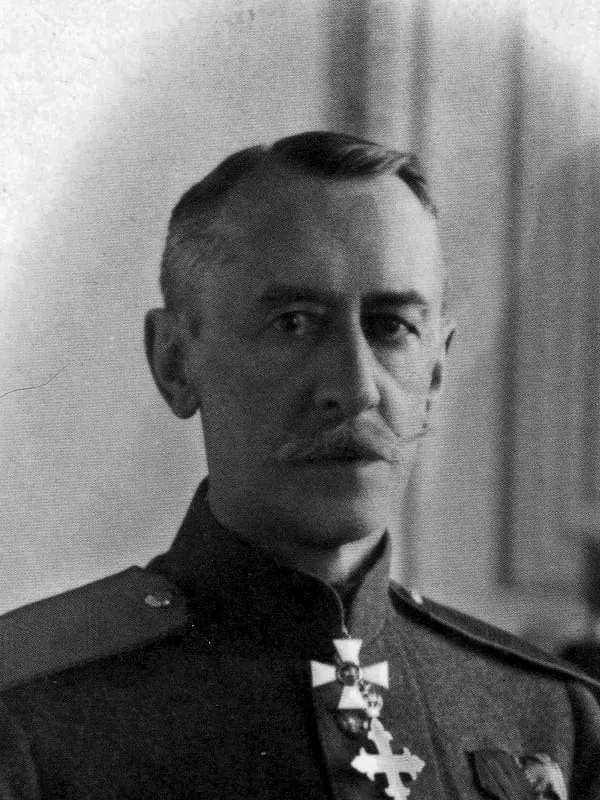
- Born:
- 18 February 1857
- Died:
- 18 January 1932, Nice
- Author:
- Natalia
- Photo:
- autor nieznany, domena publiczna, Wikimedia Commons

General of Infantry Dmitry Shcherbachev went through the whole war on the southern wing of the Eastern Front. In 1914 he commanded a corps at Lviv and Przemyśl, in 1915–1917 the 11th and then the 7th Army in Eastern Galicia, and from the spring of 1917, as deputy to the King of Romania, he in practice directed the entire Romanian Front. He was regarded as an educated, cautious and methodical commander who seldom suffered defeat but also seldom exploited victory. His hardest decisions, however, came at the end of 1917: he refused to recognise Lenin’s government, concluded the armistice of Focșani with the Central Powers and helped the Romanians disarm the disintegrating Russian troops.
Before the war
He was born on 18 February 1857 (6 February in the Julian calendar) into a noble family, the son of a major general. He graduated from the military gymnasium in Oryol and the Mikhailovsky Artillery School, served in the Guards horse artillery and in 1884 graduated with distinction from the Nicholas General Staff Academy. For the following years he worked on the staffs of the Guards and of the St Petersburg Military District. In 1903 he became a major general and commander of the Pavlovsky Life Guards Regiment.
In January 1905, on Bloody Sunday, he commanded a detachment of the Guards that dispersed a workers’ demonstration in central St Petersburg with gunfire. He then directed the suppression of mutinies in Kronstadt and in a Guards sapper battalion. For his loyalty he was appointed to the Emperor’s suite. In 1907–1912 he was commandant of the General Staff Academy. He carried out reforms there based on the experience of the lost war with Japan and brought in young, able lecturers, among them Nikolai Golovin, later the historian of the Russian army in this war. At the end of 1912 he took over IX Corps in the Kiev Military District, with which he went to war.
1914: Lviv and Przemyśl
IX Corps belonged to General Nikolai Ruzsky’s 3rd Army, which in August 1914 routed the Austrians on the Złota Lipa and Gniła Lipa and took Lviv. Russian biographies credit Shcherbachev with considerable initiative in the fighting for the city. He received the Order of St George, 4th class, precisely for the fighting at Lviv and in the Battle of Rawa Ruska, where his corps doggedly repulsed Austro-Hungarian attacks.
In mid-September, when Radko Dimitriev took over the 3rd Army, Shcherbachev was given command of a group of about six and a half divisions that laid siege to Przemyśl. At the beginning of October Dimitriev, wishing to take the fortress before a relief force arrived, threw the group into an assault on the forts. The main attack, against the forts near Siedliska, collapsed with heavy losses, because the Russians had no heavy siege artillery. A few days later the Austro-Hungarian relief force approached, the siege was broken off and the group was dissolved. In November and December IX Corps fought with the 3rd Army near Kraków and at Limanowa. At the end of the year Shcherbachev was promoted to general of infantry.
1915: the 11th Army
In April 1915, after the surrender of Przemyśl, he replaced the ailing General Andrei Selivanov at the head of the 11th Army. The army, which had besieged the fortress during the winter, moved into the Carpathians and took up positions in the foothills between Drohobycz and Dolina, facing the German-Austrian South Army of General Alexander von Linsingen. After the breakthrough at Gorlice it had to fall back together with the whole front. In the Battle of the Stryj Linsingen took Stryj on 31 May and crossed the Dniester at Żurawno. Shcherbachev answered with a counter-attack. Reinforced by the fresh VI Corps, on 8 and 9 June he struck near Żydaczów and Mikołajów, routed several Hungarian brigades, came within some fifteen kilometres of Stryj and forced the Germans back across the Dniester. It was one of the few Russian successes of those weeks, though it did not change the course of the campaign, which was decided further north at Przemyśl and Lviv.
In the summer the 11th Army retreated through Eastern Galicia, fighting in turn on the Gniła Lipa and the Złota Lipa, until it stood on the Sereth. In September, when the Central Powers tried to push further east, Shcherbachev struck from bridgeheads near Tarnopol and Trembowla. In the Battle of Tarnopol his corps broke through the positions of several Austro-Hungarian divisions and for a time put the South Army in a critical position. The Central Powers’ offensive in Eastern Galicia came to a halt, and the Austrians had to send there a corps intended for the expedition against Serbia. According to the Russian award list, his army took almost 53,000 prisoners between the second half of August and October. Shcherbachev received the Order of St George, 3rd class, for this, and in November the title of adjutant general to the Tsar.
The 7th Army and the Brusilov offensive
In the autumn of 1915 he took over the 7th Army, standing on the Strypa and the Dniester. From 27 December 1915 to 19 January 1916 he led it, together with General Platon Lechitsky’s 9th Army, in an offensive that was meant to bring a spectacular success and encourage Romania to enter the war. The attacks on the strongly fortified Austro-Hungarian positions on the Strypa and near Czernowitz collapsed with heavy losses.
Half a year later, in the Brusilov offensive, the 7th Army was given a secondary task, but this time Shcherbachev prepared the attack very carefully. On 6 June 1916 he broke through the front near Jazłowiec on the lower Strypa and took Buczacz. When, however, on 11 June he struck beyond the Strypa at General Felix von Bothmer’s South Army, the German and Austro-Hungarian troops threw him back, and the last major attack collapsed on 21 June. The Austrian official history admits that had Shcherbachev and Lechitsky attacked at that moment with full force, the front in eastern Galicia might have fallen apart. The caution of the Russian commanders gave the Central Powers time to bring up reinforcements. In the summer and autumn the 7th Army fought heavy battles on the Złota Lipa and the Narajówka against the Germans and the Ottoman XV Corps, but there was no further great breakthrough.
The Romanian Front
After the February Revolution, in April 1917, Shcherbachev became deputy to King Ferdinand I, the nominal commander of the Romanian Front. Four Russian and two Romanian armies were subordinate to him, and in practice he was commander of the entire front. The Romanian side was directed by the chief of the general staff, General Constantin Prezan, with whom Shcherbachev worked well.
In July 1917, as part of the Russian summer offensive, General Alexandru Averescu’s rebuilt Romanian army won the Battle of Mărăști. The attack had to be halted, however, because the Provisional Government, shaken by the defeat in Galicia, ordered the Russian armies to stand fast. In August Field Marshal August von Mackensen attacked at Mărășești and in the Oituz valley. At a critical moment Shcherbachev placed the Romanian 1st Army under the commander of the Russian 4th Army, General Alexander Ragoza, who ordered the Romanians to fall back. When the commander of the Romanian army, General Eremia Grigorescu, refused, Shcherbachev and Prezan agreed with him and gave him command of the whole sector. The Romanians and the Russians held the front, which was to last until the end of the war.
Armistice and disarmament
After the October Revolution Shcherbachev refused to recognise Bolshevik rule, and the front committee backed him in this. Far from Petrograd, at the side of the Romanian king, he had more freedom than the commanders of the other fronts. When, however, Lenin’s government called for an armistice, the Russian armies in Moldavia began to fall apart. On 3 December 1917 Shcherbachev told the King and the government that he no longer controlled the troops and, unwilling to carry out the orders of an authority he did not recognise, himself proposed a ceasefire to the enemy. On 9 December his delegates and the Romanian delegates signed the armistice of Focșani. In the negotiations they tried to limit the transfer of German troops to the west.
At the same time Shcherbachev came to an understanding with the Ukrainian Central Rada, which entrusted him with command of the so-called Ukrainian Front, comprising the troops of the Romanian and South-Western Fronts. In December, with his consent, Ukrainian units loyal to him and Romanian troops occupied headquarters and disarmed units controlled by the Bolsheviks. A Bolshevik envoy sent to arrest him failed to do so. Russian soldiers, deprived of weapons and supplies, walked home in the bitter winter. Shcherbachev also agreed to the entry of Romanian troops into Bessarabia, where the Moldavian Democratic Republic had recently been proclaimed, on the pretext of protecting the front’s supply lines. In response Lenin’s government broke off relations with Romania, and Shcherbachev was declared an enemy of the people and outlawed. At the same time, with his knowledge, a volunteer detachment was being formed in Iași, which in the spring of 1918 marched to the Don to fight the Bolsheviks. In April 1918, as Romania was concluding a separate peace, Shcherbachev gave up his command and settled on an estate that King Ferdinand had placed at his disposal.
After the war
After Germany’s surrender Shcherbachev went to Bucharest, where he discussed aid for the Whites with the French general Henri Berthelot. At the turn of 1918 and 1919 General Anton Denikin appointed him military representative of the White armies to the Allied governments, and Admiral Alexander Kolchak confirmed the appointment. In Paris he organised supplies for the Whites and tried to form units from Russian prisoners of war. In May 1920 he left the post because he disagreed with General Pyotr Wrangel over cooperation with Poland during the Polish–Soviet War. He believed it was more advantageous for the Whites not to help the Poles, because their defeat would force France to commit itself more heavily against the Bolsheviks.
He spent the rest of his life in Nice, living on a pension granted by the Romanian government. He was among the monarchists who supported the claim of Grand Duke Kirill Vladimirovich to the throne. He died on 18 January 1932 and was buried with military honours in the Russian cemetery in Nice. Marshal Prezan, his former Romanian comrade-in-arms, came to the funeral.
Assessment
Shcherbachev was among the best-educated Russian generals of this war, and his reforms at the General Staff Academy trained many of the officers who held command in 1914–1918. In the field he was cautious and methodical. The counter-attacks at Żurawno in 1915 and at Tarnopol in the autumn of that year showed that he could exploit a moment of enemy weakness. Critics, including the Austrian authors of the official history, pointed out, however, that in the summer of 1916 his caution allowed the Central Powers to save the front on the Strypa.
The Romanians valued him as a loyal ally of 1917, as the pension from the Romanian government and Prezan’s presence at his funeral testified. To the Bolsheviks he was an enemy of the people who had concluded an armistice on his own authority, disarmed revolutionary soldiers and agreed to Romania’s occupation of Bessarabia. Historians today see him rather as a commander who, in the chaos of late 1917, tried to save what remained of the front and to keep his commitments to Romania and the Entente, even though his decisions hastened the disintegration of the army he commanded.
Sources
Spotted a mistake?Report an error
Commanded in battles
(05)Mentioned in battles
(03)Often appears with
People who appear in the same events.